
Puck, 1879-01-22 · page 11 of 16
Puck — January 22, 1879 — page 11: what you’re looking at
What you’re looking at
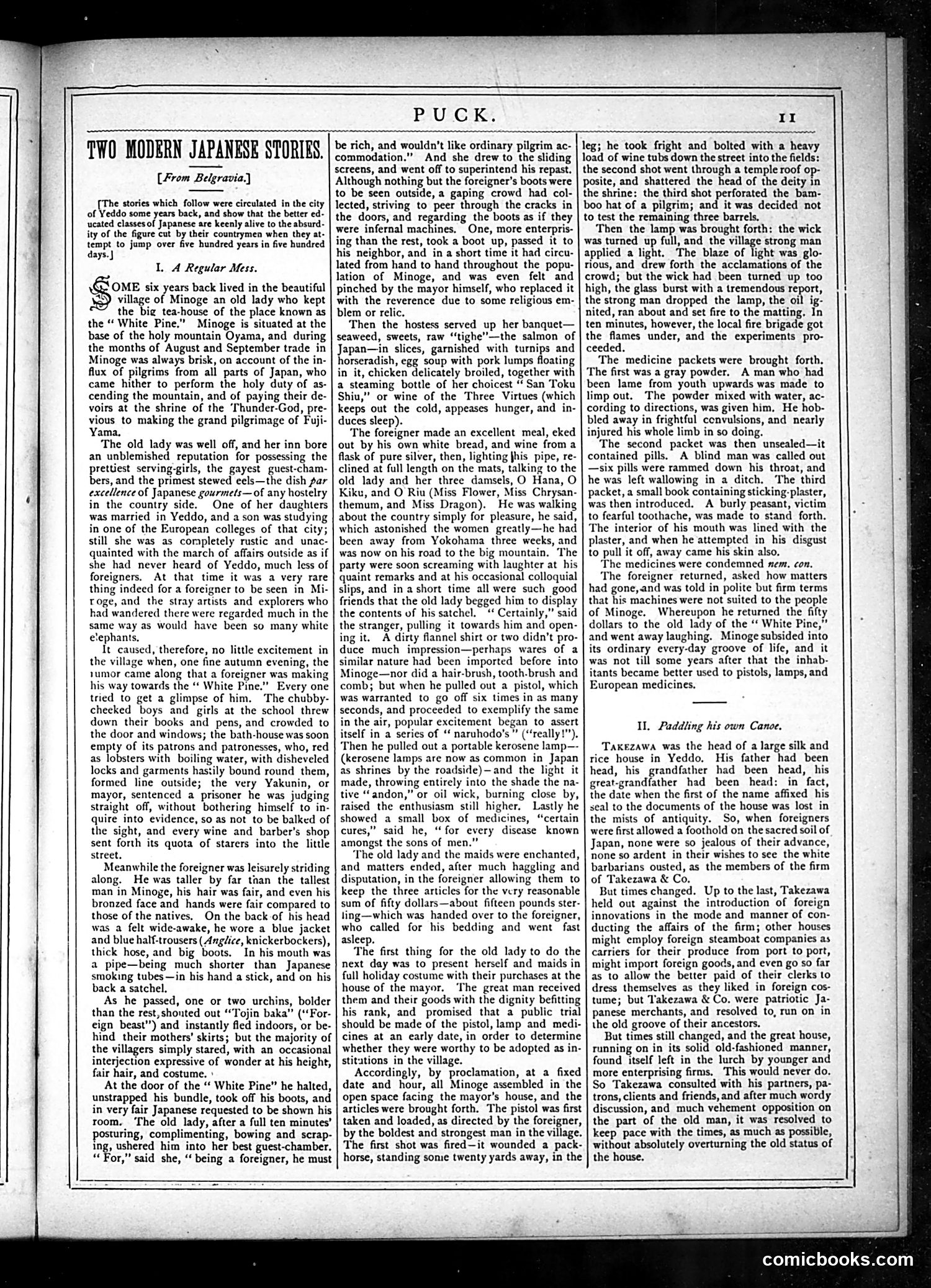
This page from *Puck* contains **two short fictional stories** rather than political cartoons. The heading "TWO MODERN JAPANESE STORIES" indicates the content focuses on narrative humor about Japan. The first story, "I. A Regular Mess," appears to satirize Western attitudes toward Japan during a period of increased foreign contact. It describes a foreigner's chaotic interactions in a Japanese village, highlighting cultural misunderstandings—particularly around Western goods (pistols, kerosene lamps, medicines) being introduced to traditional communities. The second story, "II. Paddling his own Canoe," continues this theme with a protagonist named Takezawa navigating foreign business innovations. These stories likely reflect late 19th-century American curiosity and condescension toward Japan, using humor to explore the friction between traditional Japanese society and Western modernization.
📄 Transcribed text from this page (OCR, searchable)
Machine-transcribed from the original scan — historical spelling and the odd misread are preserved.
PUCK. It TWO MODERN JAPANESE STORIES. [From Belgravia. (Th, sores which follow were circlated i the city of Yeddo some years back, and show that the better ed- ucated classes of Japanese are keenly alive to the absurd- ity of the figure cut by their countrymen when they at- tempt to jump over five hundred years in five hundred days.) L.A Regular Mess. OME six years back lived in the beautiful =) village of Minoge an old lady who kept the big tea-house of the place known as the “ White Pine.” Minoge is situated at the base of the holy mountain Oyama, and during the months of August and September trade in Minoge was always brisk, on account of the in- flux of pilgrims from all parts of Japan, who came hither to perform the holy duty of as- cending the mountain, and of paying their de- voirs at the shrine of the ‘Thunder-God, pre- vious to making the grand pilgrimage of Fuji- Yama. The old lady was well off, and her inn bore an unblemished reputation for possessing the prettiest serving-girls, the gayest guest-cham- bers, and the primest stewed eels—the dish par excellence of Japanese gourmets—of any hostelry in the country side. One of her daughters was married in Yeddo, and a son was studying in one of the European colleges of that city; still she was as completely rustic and unac- quainted with the march of affairs outside as if she had never heard of Yeddo, much less of foreigners. At that time it was a very rare thing indeed for a foreigner to be seen in Mi- roge, and the stray artists and explorers who had wandered there were regarded much in the same way as would have been so many white e’ephants, It caused, therefore, no little excitement in the village when, one fine autumn evening, the rumor came along that a foreigner was making his way towards the “ White Pine.” Every one tried to get a glimpse of him. The chubby- cheeked boys and girls at the school threw down their books and pens, and crowded to the door and windows; the bath-house was soon empty of its patrons and patronesses, who, red as lobsters with boiling water, with disheveled locks and garments hastily bound round them, formed line outside; the very Yakunin, or mayor, sentenced a prisoner he was judging straight off, without bothering himself to in- quire into evidence, so as not to be balked of the sight, and every wine and barber's shop sent forth its quota of starers into the little street. Meanwhile the foreigner was leisurely striding along. He was taller by far than the tallest man in Minoge, his hair was fair, and even his bronzed face and hands were fair compared to those of the natives. On the back of his head was a felt wide-awake, he wore a blue jacket and blue half-trousers ( Angéice, knickerbockers), thick hose, and big boots. In his mouth was a pipe—being much shorter than Japanese smoking tubes —in his hand a stick, and on his back a satchel, As he passed, one or two urchins, bolder than the rest, shouted out “Tojin baka” (‘For- eign beast”) and instantly fled indoors, or be- hind their mothers’ skirts; but the majority of the villagers simply stared, with an occasional interjection expressive of wonder at his height, fair hair, and costume. ' At the door of the “ White Pine” he halted, unstrapped his bundle, took off his boots, and in very fair Japanese requested to be shown his room. ‘The old lady, after a full ten minutes’ posturing, complimenting, bowing and scrap- ing, ushered him into her best guest-chamber. or,” said she, “‘ being a foreigner, he must be rich, and wouldn't like ordinary pilgrim ac- commodation.” And she drew to the sliding screens, and went off to superintend his repast. Although nothing but the foreigner’s boots were to be seen outside, a gaping crowd had col- lected, striving to peer through the cracks in the doors, and regarding the boots as if they were infernal machines. One, more enterpris- ing than the rest, took a boot up, passed it to his neighbor, and in a short time it had circu- lated from hand to hand throughout the popu- lation of Minoge, and was even felt and pinched by the mayor himself, who replaced it with the reverence due to some religious em- blem or relic, Then the hostess served up her banquet— seaweed, sweets, raw “‘tighe’—the salmon of Japan—in slices, garnished with turnips and horseradish, egg soup with pork lumps floating in it, chicken delicately broiled, together with a steaming bottle of her choicest “ San Toku Shiu,” or wine of the Three Virtues (which keeps out the cold, appeases hunger, and in- duces sleep). ‘The foreigner made an excellent meal, eked out by his own white bread, and wine from a flask of pure silver, then, lighting Jhis pipe, re- clined at full length on the mats, talking to the old lady and her three damsels,O Hana, O Kiku, and O Riu (Miss Flower, Miss Chrysan- themum, and Miss Dragon). He was walking about the country simply for pleasure, he said, which astonished the women greatly—he had been away from Yokohama three weeks, and was now on his road to the big mountain. The party were soon screaming with laughter at his quaint remarks and at his occasional colloquial slips, and ina short time all were such good friends that the old lady begged him to display the contents of his satchel. ‘‘ Certainly,” said the stranger, pulling it towards him and open- ing it. A dirty flannel shirt or two didn’t pro- duce much impression—perhaps wares of a similar nature had been imported before into Minoge—nor did a hair-brush, tooth-brush and comb; but when he pulled out a pistol, which was warranted to go off six times in as many seconds, and proceeded to exemplify the same in the air, popular excitement began to assert itself in a series of “ naruhodo's” (‘really!"). Then he pulled out a portable kerosene lamp— (kerosene lamps are now as common in Japan as shrines by the roadside)—and the light it made, throwing entirely into the shade the na- tive “andon,” or oil wick, burning close by, raised the enthusiasm still higher. Lastly he showed a small box of medicines, “certain cures,” said he, “for every disease known amongst the sons of men.” ‘The old lady and the maids were enchanted, and matters ended, after much haggling and disputation, in the foreigner allowing them to keep the three articles for the very reasonable sum of fifty dollars—about fifteen pounds ster- ling—which was handed over to the foreigner, who called for his bedding and went fast asleep. The first thing for the old lady to do the next day was to present herself and maids in full holiday costume with their purchases at the house of the mayor. ‘The great man received them and their goods with the dignity befitting his rank, and promised that a public trial should be made of the pistol, lamp and medi- cines at an early date, in order to determine whether they were worthy to be adopted as in- stitutions in the village. Accordingly, by proclamation, at a fixed date and hour, all Minoge assembled in the open space facing the mayor’s house, and the articles were brought forth. The pistol was first taken and loaded, as directed by the foreigner, by the boldest and strongest man in the village. The first shot was fired—it wounded a pack- horse, standing some twenty yards away, in the leg; he took fright and bolted with a heavy load of wine tubs down the street into the fields: the second shot went through a temple roof o; posite, and shattered the head of the deity in the shrine: the third shot perforated the bam- boo hat of a pilgrim; and it was decided not to test the remaining three barrels. Then the lamp was brought forth: the wick was turned up full, and the village strong man applied a light. The blaze of light was glo- rious, and drew forth the acclamations of the crowd; but the wick had been turned up too high, the glass burst with a tremendous report, the strong man dropped the lamp, the oil ig- nited, ran about and set fire to the matting, In ten minutes, however, the local fire brigade got the flames under, and the experiments pro- ceeded. The medicine packets were brought forth. ‘The first was a gray powder. A man who had been lame from youth upwards was made to limp out. The powder mixed with water, ac- cording to directions, was given him, He hob- bled away in frightful convulsions, and nearly injured his whole limb in so doing. The second packet was then unsealed—it contained pills. A blind man was called out —six pills were rammed down his throat, and he was left wallowing in a ditch, The third packet, a small book containing sticking-plaster, was then introduced. A burly peasant, victim to fearful toothache, was made to stand forth. The interior of his mouth was lined with the plaster, and when he attempted in his disgust to pull it off, away came his skin also. The medicines were condemned nem. con. ‘The foreigner returned, asked how matters had gone, and was told in polite but firm terms that his machines were not suited to the people of Minoge. Whereupon he returned the fifty dollars to the old lady of the ‘‘ White Pine,” and went away laughing. Minoge subsided into its ordinary every-day groove of life, and it was not till some years after that the inhab- itants became better used to pistols, lamps, and European medicines. Il. Paddling his own Canoe, Taxezawa was the head of a large silk and tice house in Yeddo. His father had been head, his grandfather had been head, his great-grandfather had been head: in fact, the date when the first of the name affixed his seal to the documents of the house was lost in the mists of antiquity. So, when foreigners were first allowed a foothold on the sacred soil of Japan, none were so jealous of their advance, none so ardent in their wishes to see the white barbarians ousted, as the members of the firm of Takezawa & Co, But times changed. Up to the last, Takezawa held out against the introduction of foreign innovations in the mode and manner of con- ducting the affairs of the firm; other houses might employ foreign steamboat companies as carriers for their produce from port to port, might import foreign goods, and even go so far as to allow the better paid of their clerks to dress themselves as they liked in foreign cos- tume; but Takezawa & Co. were patriotic Ja- panese merchants, and resolved to, run on in the old groove of their ancestors. But times still changed, and the great house, running on in its solid old-fashioned manner, found itself left in the lurch by younger and more enterprising firms, This would never do. So Takezawa consulted with his partners, pa- trons, clients and friends, and after much wordy discussion, and much vehement opposition on the part of the old man, it was resolved to keep pace with the times, as much as possible, without absolutely overturning the old status of the house, comicbooks.com