
Puck, 1879-01-22 · page 12 of 16
Puck — January 22, 1879 — page 12: what you’re looking at
What you’re looking at
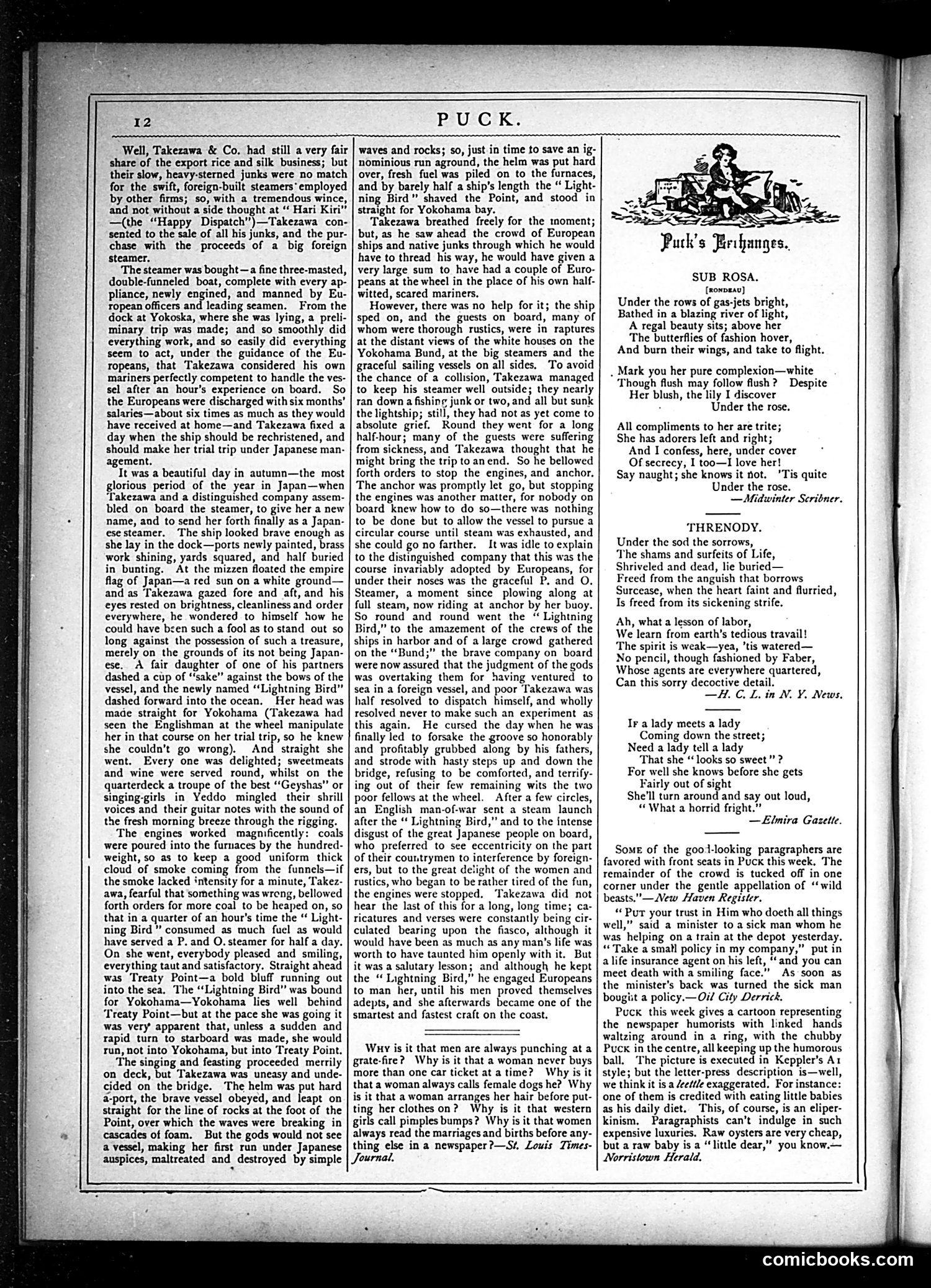
This page contains **three separate satirical poems** rather than political cartoons. "**Puck's Brijmages**" mocks a fashionable woman's complexion and vanity. "**Threnody**" appears to be a sardonic poem about labor and death. "**Is a Lady Meets a Lady**" satirizes women's social interactions and fashion obsessions. The bottom section contains miscellaneous humorous observations about human behavior—questioning why men punch each other, why women call dogs "she," and why newspapers publish trivial domestic gossip. The small illustration at top shows Puck, the magazine's mascot character. These pieces target late 19th-century social conventions, particularly women's fashion-consciousness, vanity, and the triviality of society pages—typical Puck satire of the era.
📄 Transcribed text from this page (OCR, searchable)
Machine-transcribed from the original scan — historical spelling and the odd misread are preserved.
PUCK. Well, Takezawa & Co. had still a very fair share of the export rice and silk business; but their slow, heavy-sterned junks were no match for the swift, foreign-built steamers‘ employed by other firms; so, with a tremendous wince, and not without a side thought at “ Hari Kiri” —(the “Happy Dispatch”)—Takezawa con- sented to the sale of all his junks, and the pur- chase with the proceeds of a big foreign steamer. ‘The steamer was bought—a fine three-masted, double-funneled boat, complete with every ap- pliance, newly engined, and manned by Eu- ropean officers an leading seamen. From the dock at Yokoska, where she was lying, a preli- minary trip was made; and so smoothly did everything work, and so easily did everything seem to act, under the guidance of the Eu- ropeans, that Takezawa considered his own mariners perfectly competent to handle the ves- sel after an hour's experience on board. So the Europeans were discharged with six months’ salaries—about six times as much as they would have received at home—and Takezawa fixed a day when the ship should be rechristened, and should make her trial trip under Japanese man- agement. It was a beautiful day in autumn—the most glorious period of the year in Japan—when ‘Takezawa and a distinguished company assem- bled on board the steamer, to give her a new name, and to send her forth finally as a Japan- esesteamer. The ship looked brave enough as she lay in the dock—ports newly painted, brass work shining, yards squared, and half buried in bunting. At the mizzen floated the empire flag of Japan—a red sun on a white ground— and as Takezawa gazed fore and aft, and his eyes rested on brightness, cleanliness and order everywhere, he wondered to himself how he could have been such a fool as to stand out so long against the possession of such a treasure, merely on the grounds of its not being Japan- ese. A fair daughter of one of his partners dashed a cup of “sake” against the bows of the vessel, and the newly named “Lightning Bird” dashed forward into the ocean. Her head was made straight for Yokohama (Takezawa had seen the Englishman at the wheel manipulate her in that course on her trial trip, so he knew she couldn't go wrong). And straight she went. Every one was delighted; sweetmeats and wine were served round, whilst on the quarterdeck a troupe of the best “‘Geyshas”’ or singing-girls in Yeddo mingled their shrill voices and their guitar notes with the sound of the fresh morning breeze through the rigging. The engines worked magnificently: coals were poured into the furnaces by the hundred- weight, so as to keep a good uniform thick cloud of smoke coming from the funnels—if the smoke lacked intensity for a minute, Takez- awa, fearful that something was wrong, bellowed forth orders for more coal to be heaped on, so that in a quarter of an hour's time the “ Light- ning Bird" consumed as much fuel as would have served a P. and O. steamer for half a day. On she went, everybody pleased and smiling, everything taut and satisfactory. Straight ahead was Treaty Point—a bold bluff running out into the sea. The ‘Lightning Bird” was bound for Yokohama—Yokohama lies well behind ‘Treaty Point—but at the pace she was going it was very apparent that, unless a sudden and rapid turn to starboard was made, she would run, not into Yokohama, but into Treaty Point. ‘The singing and feasting proceeded merrily on deck, but Takezawa was uneasy and unde- cided on the bridge. ‘The helm was put hard a-port, the brave vessel obeyed, and leapt on straight for the line of rocks at the foot of the Point, over which the waves were breaking in cascades of foam. But the gods would not see a vessel, making her first run under Japanese auspices, maltreated and destroyed by simple waves and rocks; so, just in time to save an ig- nominious run aground, the helm was put hard over, fresh fuel was piled on to the furnaces, and by barely half a ship’s length the “ Light- ning Bird” shaved the Point, and stood in straight for Yokohama bay. Takezawa breathed freely for the tnoment; but, as he saw ahead the crowd of European ships and native junks through which he would have to thread his way, he would have given a very large sum to have had a couple of Euro- peans at the wheel in the place of his own half- witted, scared mariners. However, there was no help for it; the ship sped on, and the guests on board, many of whom were thorough rustics, were in raptures at the distant views of the white houses on the Yokohama Bund, at the big steamers and the graceful sailing vessels on all sides. To avoid the chance of a collision, Takezawa managed to keep his steamer well outside; they nearly ran down a fishing junk or two, and all but sunk the lightship; still, they had not as yet come to absolute grief. Round they went for a long half-hour; many of the guests were suffering from sickness, and Takezawa thought that he might bring the trip to anend. So he bellowed forth orders to stop the engines, and anchor, The anchor was promptly let go, but stopping the engines was another matter, for nobody on board knew how to do so—there was nothing to be done but to allow the vessel to pursue a circular course until steam was exhausted, and she could go no farther. It was idle to explain to the distinguished company that this was the course invariably adopted by Europeans, for under their noses was the graceful P. and O. Steamer, a moment since plowing along at full steam, now riding at anchor by her buoy. So round and round went the “ Lightning Bird,” to the amazement of the crews of the ships in harbor and of a large crowd gathered on the “Bund;” the brave company on board were now assured that the judgment of the gods was overtaking them for having ventured to sea in a foreign vessel, and poor Takezawa was half resolved to dispatch himself, and wholly resolved never to make such an experiment as this again. He cursed the day when he was finally led to forsake the groove so honorably and profitably grubbed along by his fathers, and strode with hasty steps up and down the bridge, refusing to be comforted, and terrify- ing out of their few remaining wits the two poor fellows at the wheel. After a few circles, an English man-of-war sent a steam launch after the “ Lightning Bird,” and to the intense disgust of the great Japanese people on board, who preferred to see eccentricity on the part of their countrymen to interference by foreign- ers, but to the great delight of the women and tustics, who began to be rather tired of the fun, the engines were stopped. ‘Takezawa did not hear the last of this for a long, long time; ca- ricatures and verses were constantly being cir- culated bearing upon the fiasco, although it would have been as much as any man's life was worth to have taunted him openly with it. But it was a salutary lesson; and although he kept the “ Lightning Bird,” he engaged Europeans to man her, until his men proved themselves adepts, and she afterwards became one of the smartest and fastest craft on the coast. Wuy is it that men are always punching at a grate-fire? Why is it that a woman never buys more than one car ticket at a time? Why is it that a woman always calls female dogs he? Why is it that a woman arranges her hair before put- ting her clothes on? Why is it that western girls call Pimples bumps? Why is it that women always read the marriages and births before any- thing else in a newspaper ?—St. Louis Times- Journal, SUB ROSA. [rowpeav) Under the rows of gas-jets bright, Bathed in a blazing river of light, A regal beauty sits; above her The butterflies of fashion hover, And burn their wings, and take to flight. . Mark you her pure complexion—white Though flush may follow flush? Despite Her blush, the lily I discover : Under the rose. All compliments to her are trite; She has adorers left and right; And I confess, here, under cover Of secrecy, I too—I love her! Say naught; she knows it not. ‘Tis quite Under the rose. —Midwinter Scribner. THRENODY. Under the sod the sorrows, ‘The shams and surfeits of Life, Shriveled and dead, lie buried— Freed from the anguish that borrows Surcease, when the heart faint and flurried, Is freed from its sickening strife. Ah, what a lesson of labor, We learn from earth's tedious travail! The spirit is weak—yea, ’tis watered— No pencil, though fashioned by Faber, Whose agents are everywhere quartered, Can this sorry decoctive detail. —H.C.L. in N.Y. News. Ir a lady meets a lady Coming down the street; Need a lady tell a lady That she ‘looks so sweet” ? For well she knows before she gets Fairly out of sight She'll turn around and say out loud, “What a horrid fright.” —Elmira Gazelle. Some of the good-looking paragraphers are favored with front seats in Puck this week, The remainder of the crowd is tucked off in one corner under the gentle appellation of “wild beasts." —New Haven Register. “Pur your trust in Him who doeth all things well,” said a minister to a sick man whom he was helping on a train at the depot yesterday. “Take a small policy in my company,” put in a life insurance agent on his left, ‘and you can meet death with a smiling face.” As soon as the minister's back was turned the sick man bougiit a policy.— Oi? City Derrick. Puck this week gives a cartoon representing the newspaper humorists with linked hands waltzing around in a ring, with the chubby Puck in the centre, all keeping up the humorous ball. ‘The picture is executed in Keppler’s At style; but the letter-press description is—well, we think it is a e/t/e exaggerated. For instance: one of them is credited with eating little babies as his daily diet. This, of course, is an eliper- kinism, Paragraphists can’t indulge in such expensive luxuries. Raw oysters are very cheap, but a raw baby is a “little dear,” you know.— Norristown Herald, comicbooks.com