
A complete issue · 16 pages · 1879
Puck — January 15, 1879
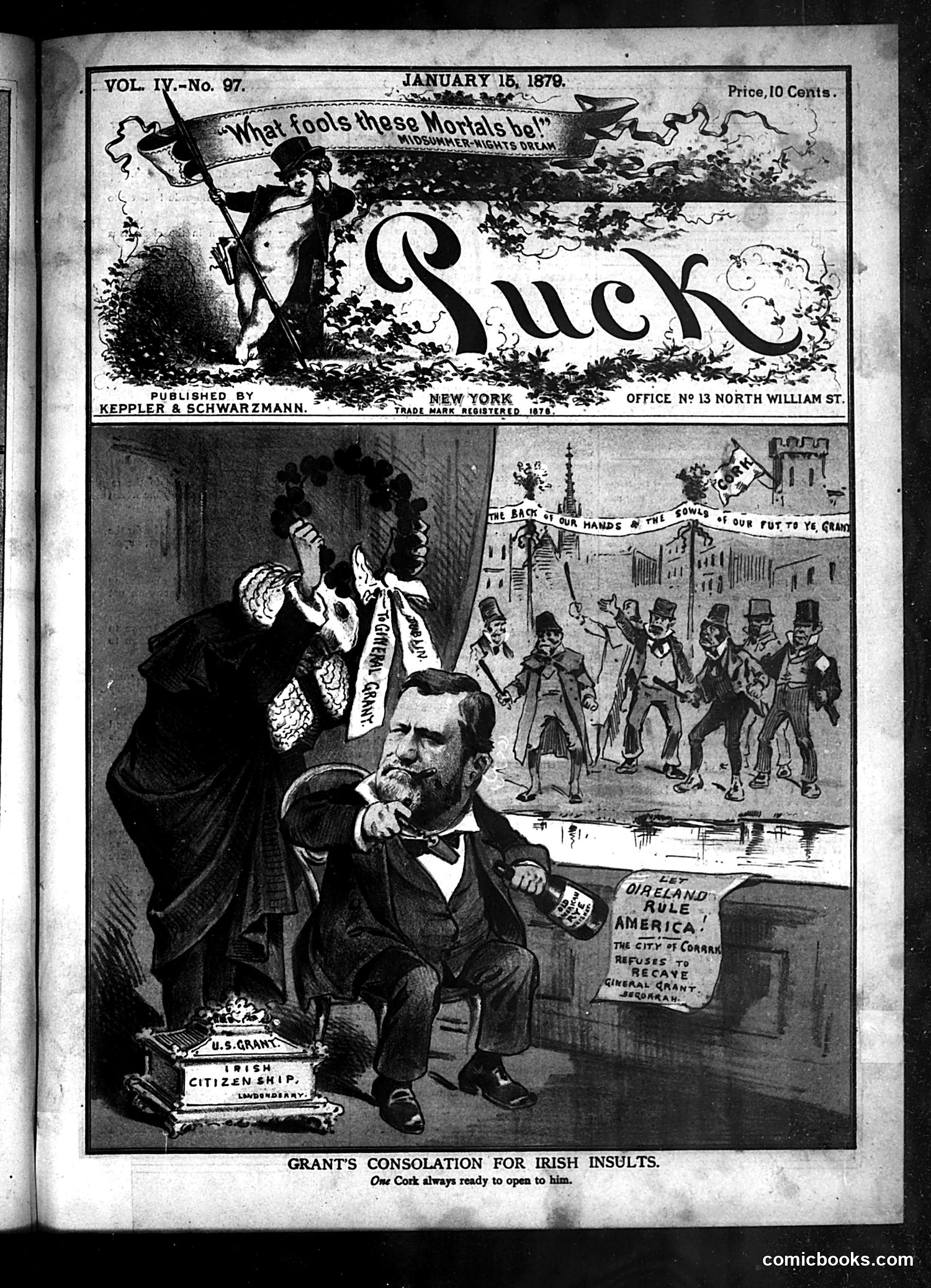
This January 1879 Puck cartoon satirizes President Ulysses S. Grant receiving comfort over perceived Irish disrespect. The main image shows Grant seated, holding a bottle labeled "Irish Citizenship Liberdenary" [sic], while a female figure (likely Columbia or Liberty) stands behind offering consolation. The background scene depicts what appears to be a public gathering or protest with men in top hats, suggesting Irish-American political activity. A banner reads "Let Ireland Rule America" and references Grant's refusal to receive General Ignatieff [unclear context]. The caption's pun—"One Cork always ready to open to him"—plays on Cork (the Irish county) and the cork on a whiskey bottle, suggesting drink as Grant's solace for diplomatic tensions with Irish-Americans during his presidency.
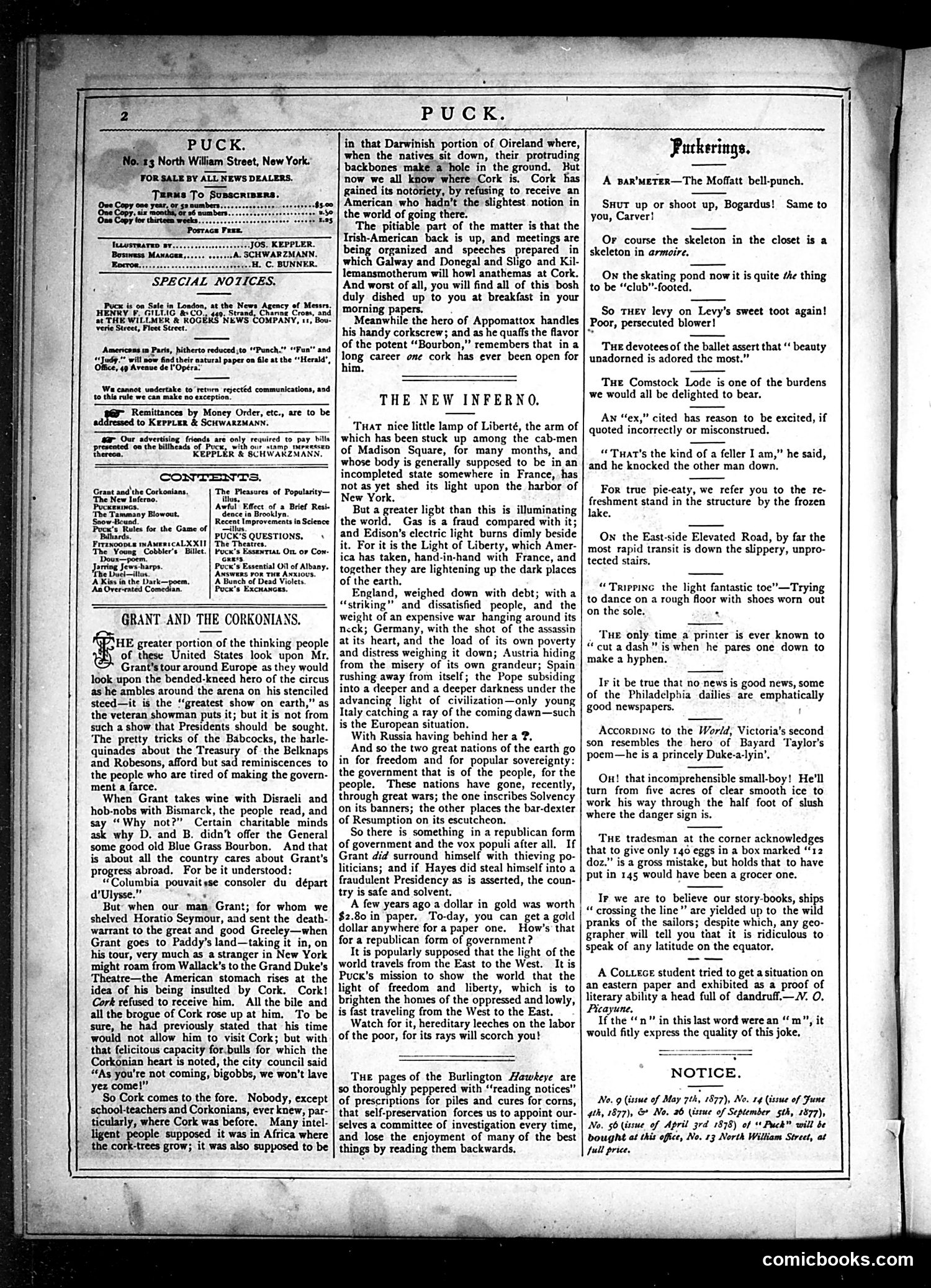
This page is primarily **text-based editorial content** rather than political cartoons. The main article, "Grant and the Corkonians," discusses General Ulysses S. Grant's recent travels. It references "Cork" (likely Cork, Ireland) and criticizes Grant for refusing to receive an American visitor there, satirizing his behavior as ungracious. The piece mocks Grant's celebrity status while arguing he shouldn't have snubbed an American abroad. It also contains commentary on various political and social issues of the era, including references to European politics and American financial matters. The page includes several smaller satirical items and notices typical of Puck's format, but without clear accompanying illustrations visible in this image, the full satirical impact is diminished.
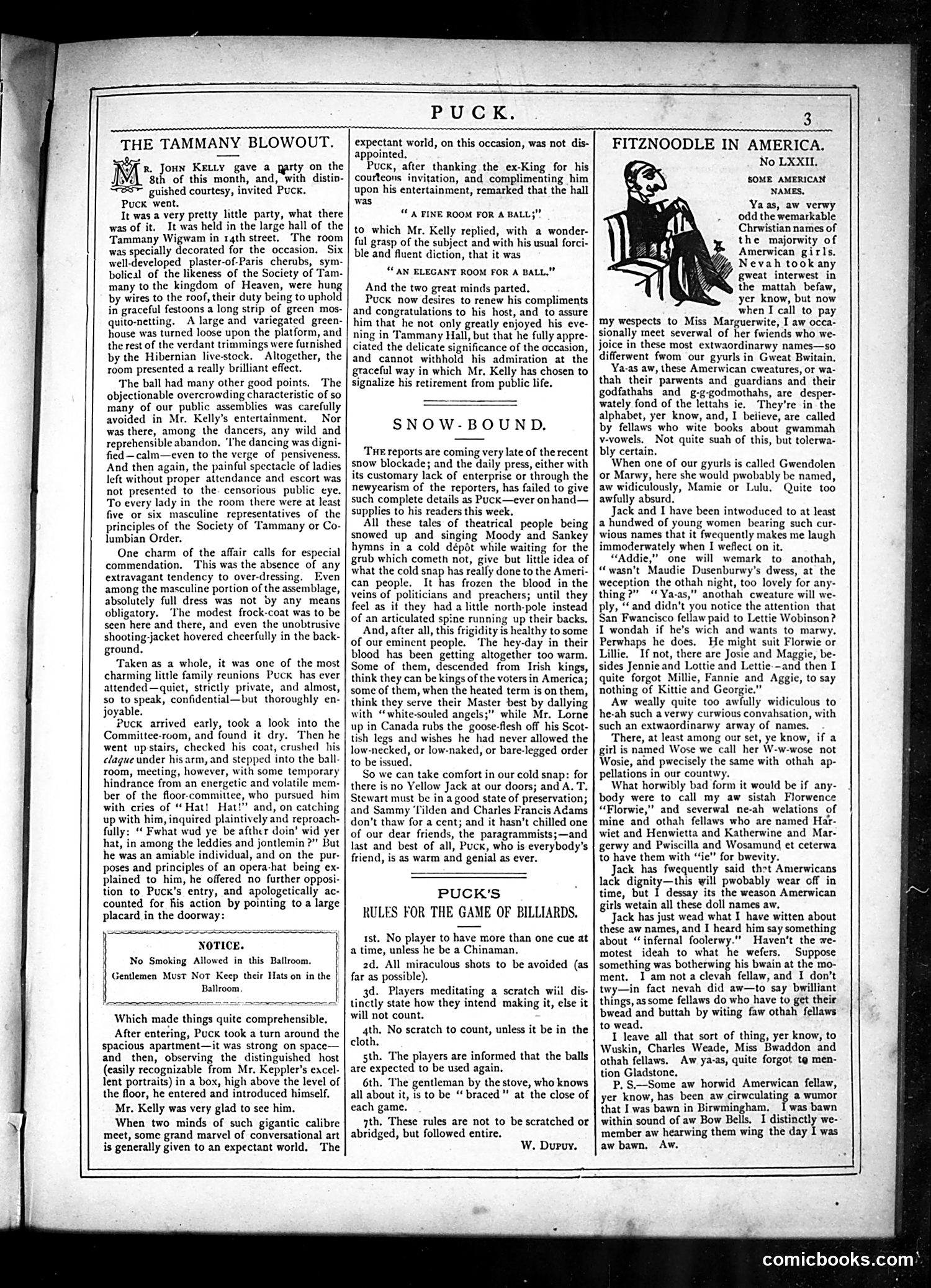
This page contains three distinct sections: 1. **"The Tammany Blowout"** - A satirical account of a lavish party hosted by Tammany Hall (New York's Democratic political machine). The satire mocks the extravagant decorations and the irony of politicians claiming to represent the common man while enjoying such opulence. 2. **"Fitznoodle in America"** - A humorous piece mocking American naming conventions and cultural practices. The unnamed narrator ridicules peculiar American names (particularly those given to women) as unnecessarily complicated and distinctly un-Christian, reflecting period attitudes toward American eccentricity versus European convention. 3. **"Puck's Rules for the Game of Billiards"** - A straightforward set of billiards game rules, likely a regular feature. The page primarily satirizes political excess and American cultural quirks.
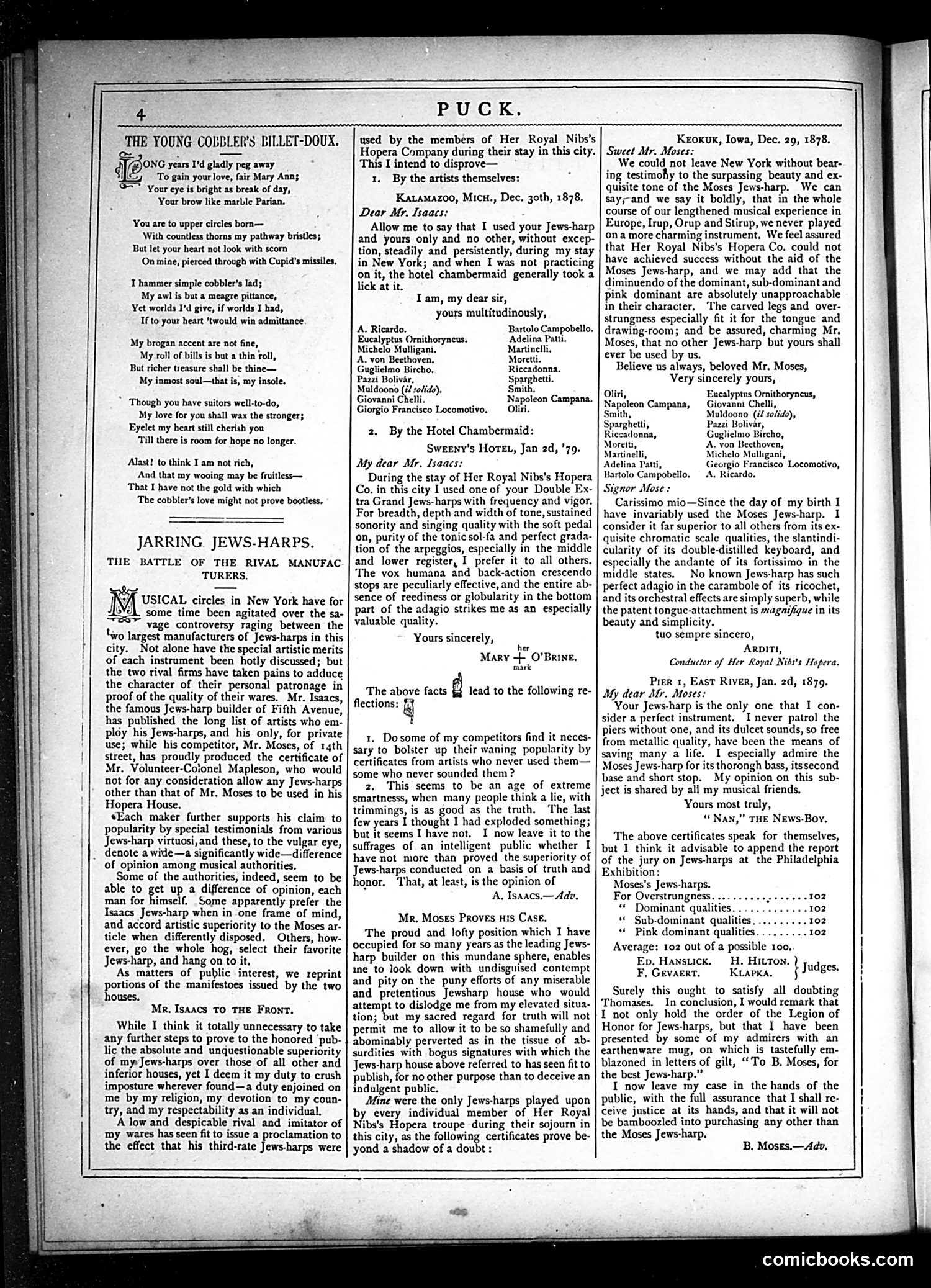
This page consists primarily of **letters and testimonials about Jews-harps** (the musical instrument), not political satire. The main article, "Jarring Jews-Harps: The Battle of the Rival Manufacturers," documents a commercial dispute among Jews-harp makers in New York City. The text reveals competitive claims about instrument quality between manufacturers, with various musicians and conductors writing endorsements. One letter from "Ms. Isaac to the Front" suggests the controversy involved accusations of inferior competing products and questions about authenticity. This appears to be **product advertising disguised as editorial content**—a common Puck strategy combining commerce with humor. The "battle" is commercial rivalry rather than political satire, though the satirical framing mocks the earnestness of manufacturers' competing claims about a humble folk instrument.
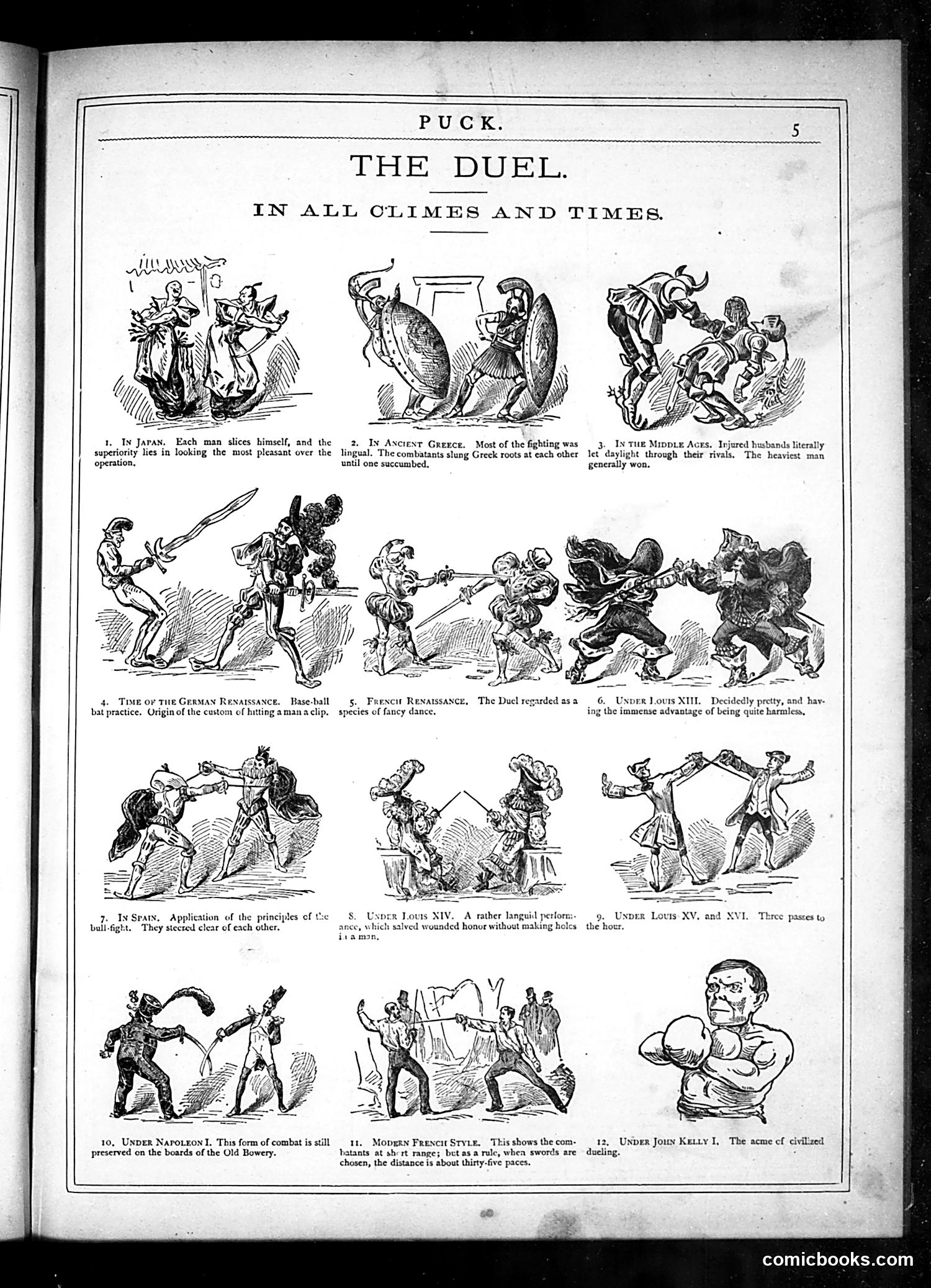
This satirical page from *Puck* compares dueling practices across historical periods and cultures. Each panel illustrates a different era's approach to settling disputes through combat: The sequence moves from Japan's ritualistic self-slicing to Ancient Greece's wrestling, Medieval combat, German Renaissance baseball-bat practice, French Renaissance fancy dancing, and various European royal-era duels under Louis XIII-XVI. The satire's point appears to be **mocking the absurdity and persistence of dueling across civilizations**—suggesting that whether ritualistic, athletic, or theatrical, all cultures have found similarly ridiculous ways to resolve honor disputes. Panel 12 shows "civilised dueling" under John Kelly I (unclear reference), implying even modern "civilized" society hasn't truly abandoned this barbaric practice, merely refined its performance. The overall message critiques human irrationality about honor and violence.
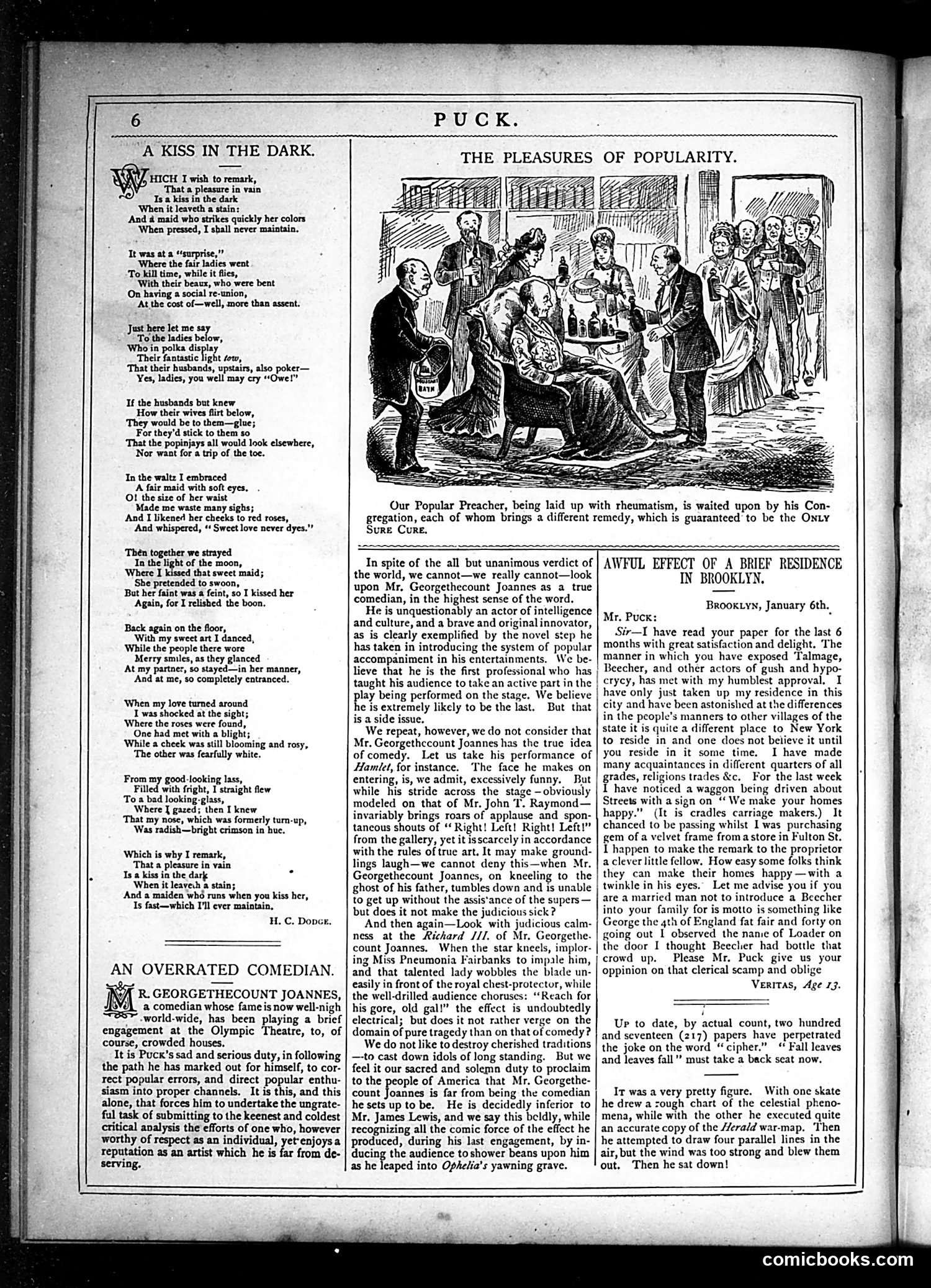
The page contains three distinct sections: **"A Kiss in the Dark"** (left): A romantic poem by H.C. Dodge about a stolen kiss, likely representing typical sentimental Victorian verse that Puck would parody. **"The Pleasures of Popularity"** (center): A cartoon showing a preacher mobbed by congregants, each bringing different "cures" for his rheumatism. The satire targets popular entertainment's superficial solutions and public gullibility. **"An Overrated Comedian"** (bottom): Critiques actor George the Count Joannes, who performed at the Olympia Theatre. The text argues his popularity is undeserved, criticizing his comedic style and suggesting audiences are easily impressed. This represents Puck's role critiquing entertainment and public taste during this era. The overall page mixes satire of sentimentality, religious hypocrisy, and theatrical mediocrity—typical Puck content.
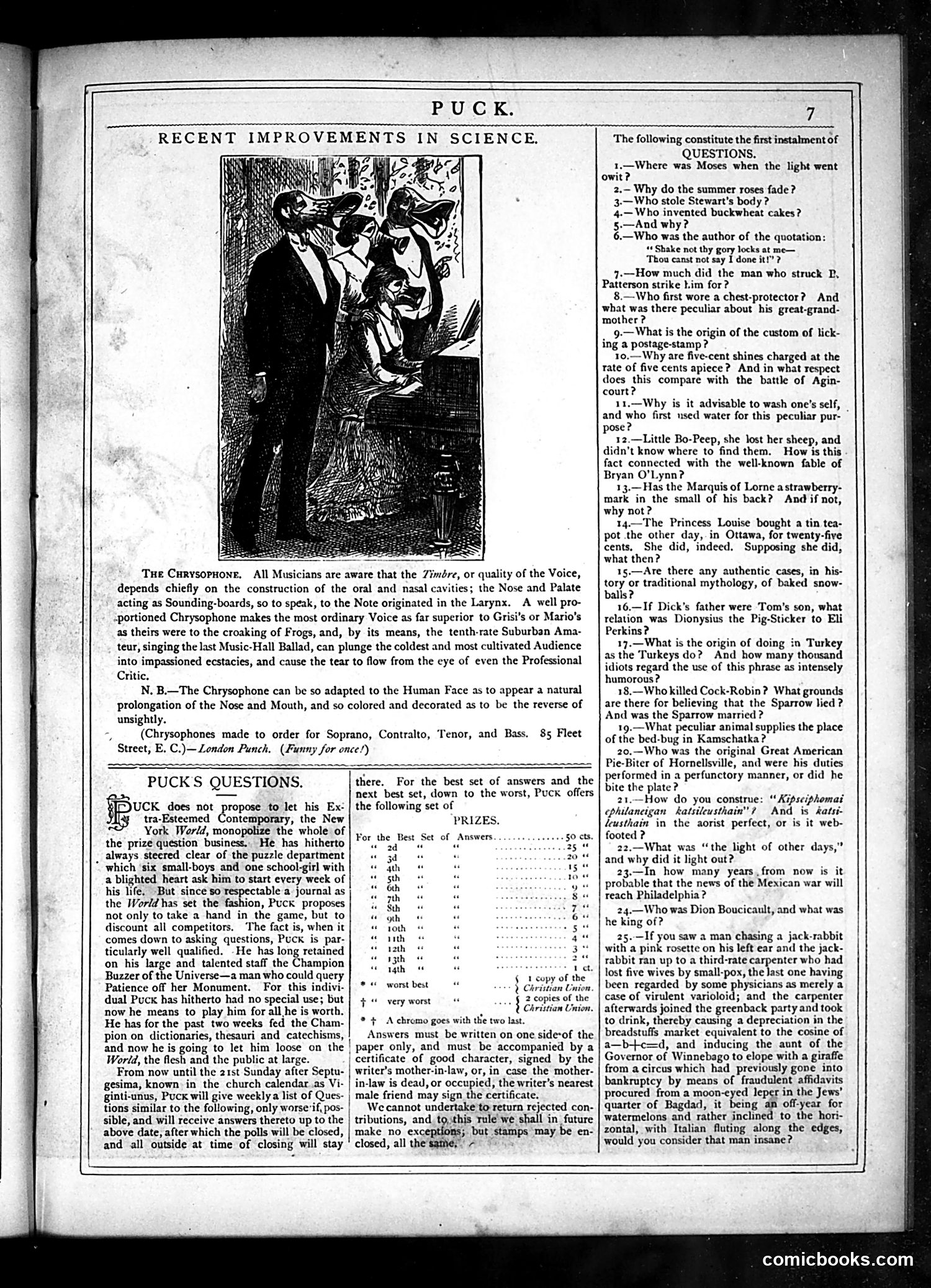
This satirical cartoon mocks a pseudo-scientific invention called the "Chrysophone." The illustration shows a well-dressed man demonstrating the device to an audience of women, who appear delighted or amazed. The accompanying text explains the Chrysophone as a supposed improvement on human vocal apparatus, claiming it enhances the voice quality by adapting to "the Human Face to appear a natural prolongation of the Nose and Mouth." The satire targets both scientific charlatanism and the gullibility of audiences (particularly women) toward dubious "improvements." It's characteristic of Puck's skepticism toward pseudoscience and hucksterism. The formal technical language used ironically underscores the device's fundamental absurdity—it appears to be an elaborate hoax marketed as legitimate innovation.
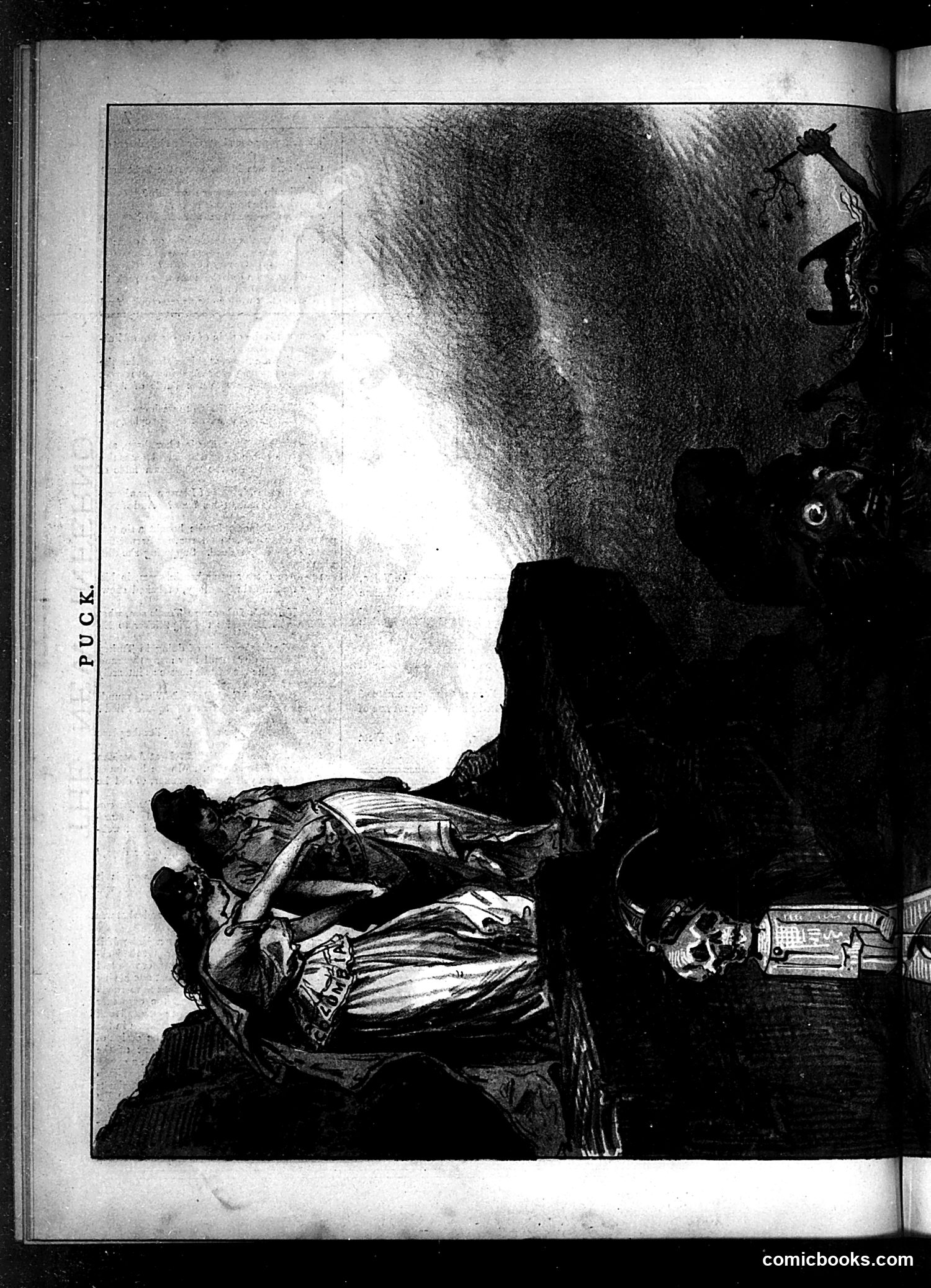
This page from *Puck* magazine shows a dark political cartoon titled "PUCK" (visible on the left margin). The image depicts a stark, dramatic scene: a figure in military dress stands over what appears to be a dead or dying person lying on the ground. The composition suggests a commentary on military violence or a wartime atrocity. However, without additional context—such as the publication date, caption text, or identifying markers—I cannot definitively identify the specific historical event, military figure, or political situation being satirized. The style and printing quality suggest late 19th or early 20th century, but the exact subject remains unclear from the image alone. The satirical intent appears critical of military power or violence, but specific details require more information.
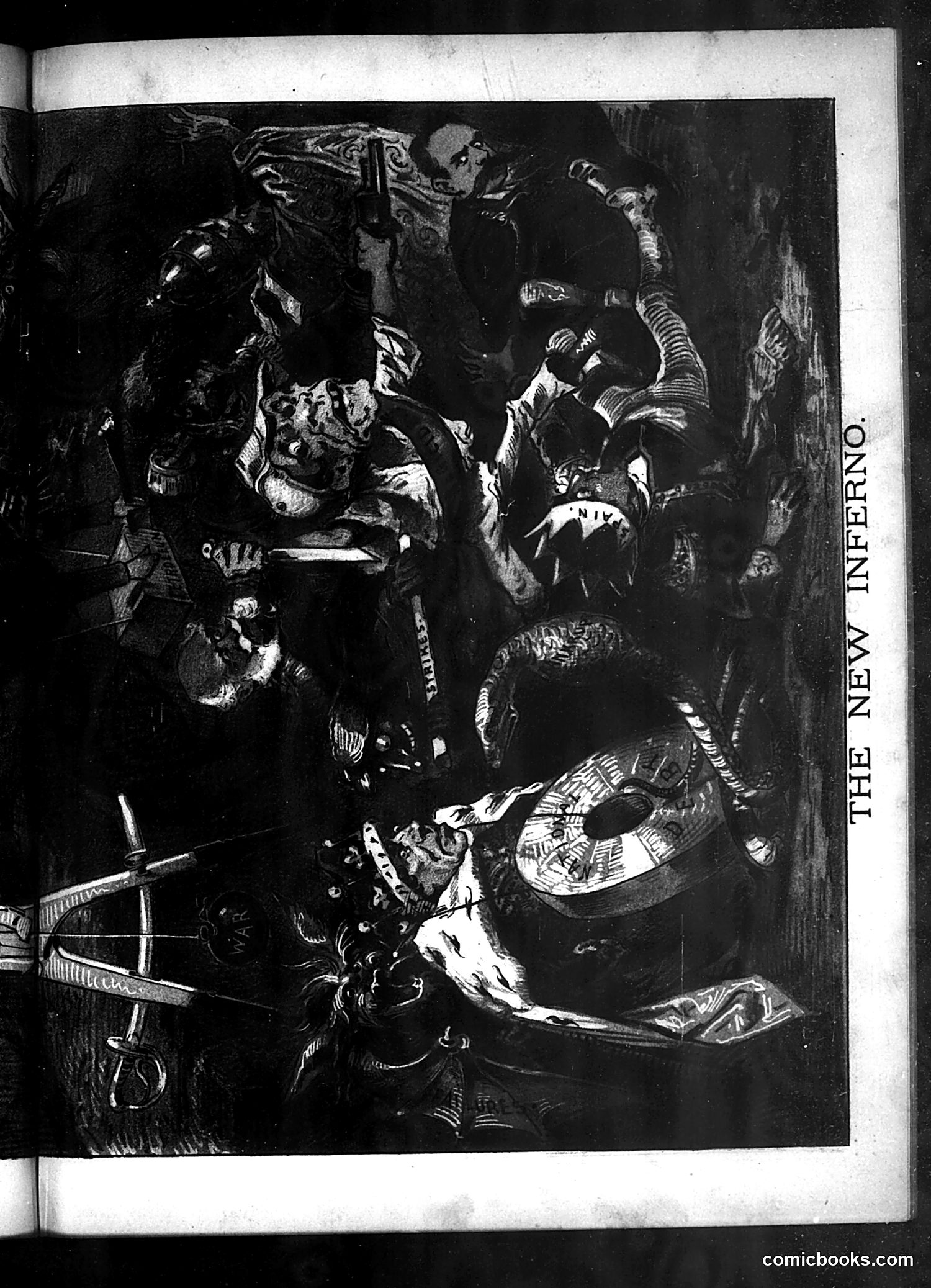
This appears to be a dramatic illustration titled "The New Inferno" depicting a hellish scene with multiple figures in torment. The style and composition suggest it's a political allegory, likely referencing Dante's *Inferno*, adapted to critique contemporary figures or events. The crowded, chaotic composition with demons, the damned, and architectural elements suggests this satirizes prominent politicians or public figures of the period being consigned to Hell for their misdeeds. Without clearer identification of specific individuals or visible text indicating the exact historical moment, the precise targets remain unclear, though the grandly theatrical style is characteristic of Puck's moral-political commentary through classical literary references. The engraving technique and dramatic rendering emphasize the severity of the depicted moral failings.
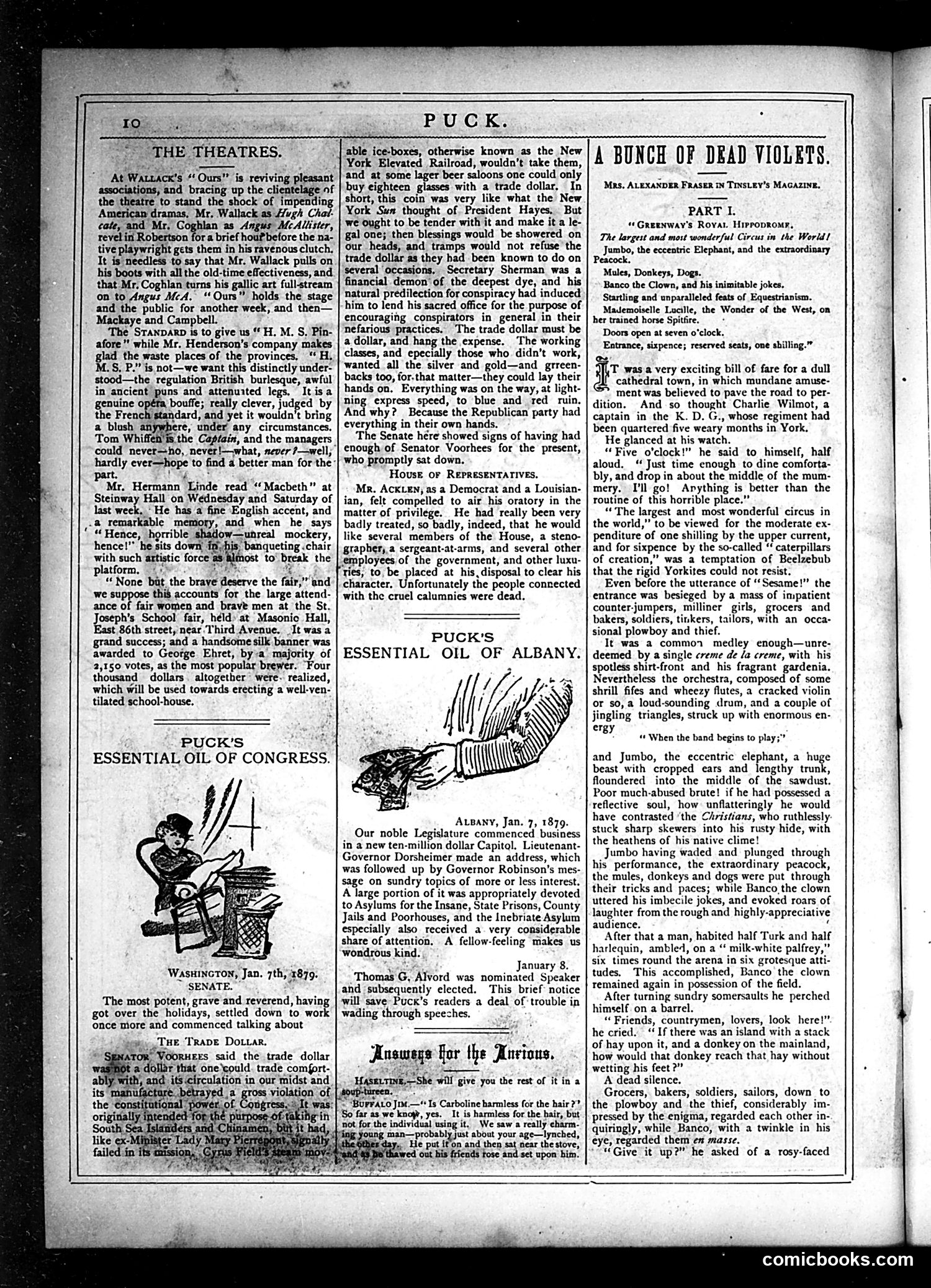
This page contains two satirical cartoons titled "Puck's Essential Oil of Congress" and "Puck's Essential Oil of Albany," both dated January 1879. The cartoons appear to mock legislative bodies through crude visual metaphors. The Congress cartoon depicts politicians as incompetent and corrupt, while the Albany cartoon similarly criticizes state legislators. The "essential oil" framing suggests distilling politics down to its most concentrated—and presumably most ridiculous—form. The accompanying text discusses political issues of the era, including congressional debates about currency (particularly the "trade dollar") and allegations of bribery. The satire targets both Republican and Democratic politicians for corruption and wasteful spending during the post-Reconstruction period. These cartoons exemplify Puck's role as a sharp critic of American institutional politics.
This page is primarily **text, not political cartoons**. It appears to be Part III of a serialized story titled "Greenway's Royal Hippodrome" about a character named Charlie Wilmot and a woman named Lucille. The narrative describes their romantic entanglement: Charlie attends circus performances where Lucille performs, they develop feelings for each other, and the story details their emotional and physical interactions. The text emphasizes Lucille's beauty and Charlie's infatuation, culminating in romantic encounters. **No political satire or social commentary is evident** on this page. Rather, it's a sentimental romance narrative—the type of serialized fiction Puck magazine included alongside its satirical cartoons to attract broader readership. The content reflects late-19th/early-20th-century romantic conventions and attitudes toward courtship.
This page contains primarily serialized fiction rather than political satire. The main content is "Part V" of a romantic story involving characters named Lucille, Charlie Wilmot, and Spitfire—a narrative about love, separation, and longing set in what appears to be the late 19th century. At the bottom, there's a small section titled "Puck's Beginnings" featuring a poem called "The Carpenter's Wooing" and a brief humorous anecdote about a Mobille man making a witty remark about spice. The page lacks the typical political cartoons or satirical commentary Puck was known for. It's primarily literary content with minimal visual elements beyond decorative headers, representing the magazine's serialized fiction offerings alongside its political humor.
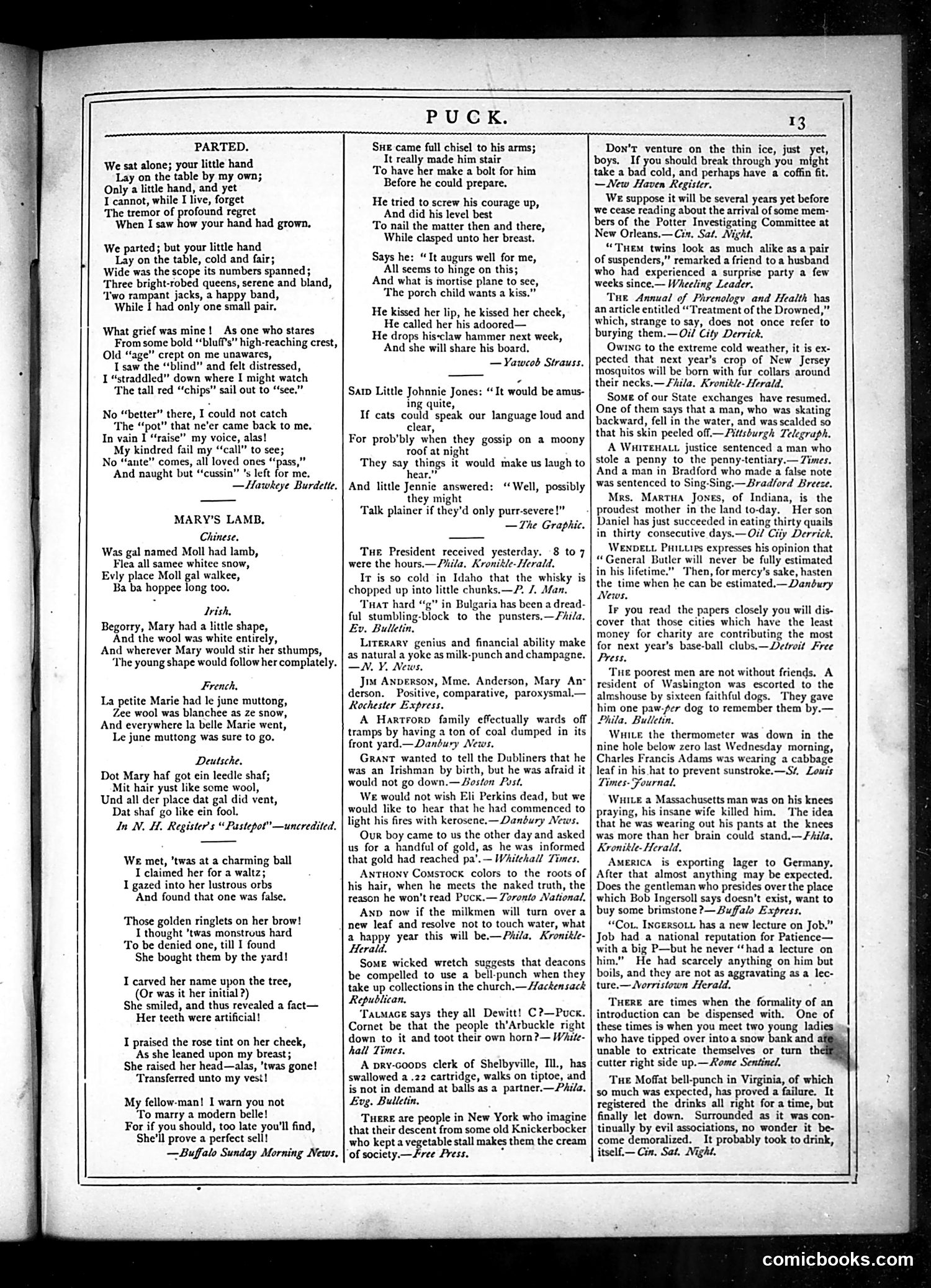
This page contains primarily **poetry and prose text** rather than political cartoons. The pieces include "Parted," "Mary's Lamb" (with multilingual variations), and various humorous anecdotes. The right column contains **brief satirical notes** on contemporary topics: a party of "spongers," treatment of drowned persons, cold weather in New Jersey, baseball club finances, and various social observations about notable figures like President [unnamed], Justice Whitehead, and Mrs. Martha Jones. The satire is **gentle and miscellaneous**—targeting everyday social follies, weather inconveniences, and minor scandals rather than major political figures. Without visible political cartoons on this particular page, the content represents Puck's **lighter, humor-focused editorial material** typical of the magazine's literary sections.
This page is primarily **advertisements and notices** rather than political cartoons. The visible content includes: - **Masquerade Ball advertisements** for the Aaron Society and German Liederkranz (cultural organizations) - **Photography and business services** (photographer, dentist, typewriter company) - **Patent and trademark services** from Paul Goepel - **Cigarette and extract advertisements** (Marquis cigarettes, Puck's Extract) - **Miscellaneous short humorous items** in the left column (brief jokes about geography, dentistry, and journalism) The page layout is typical of 19th-century magazines: dense advertising surrounding small satirical content. The brief humor pieces mock professions and human foibles rather than specific political figures. **No major political cartoons or identifiable caricatures appear on this page.**
This page is primarily **advertising**, not editorial or satirical content. It contains numerous commercial advertisements for late 19th-century products and services including: - Champagne and wine (Piper-Heidsieck, Cham Eveneoge & Cie) - Umbrellas (Isaac Smith's) - Furniture (Mathesius & Frey, Pachtmann & Moelich) - Tailoring services (Nicoll, the Tailor) - Tableware and china (H.D. Bassford) - A lottery (Louisiana State Lottery Co.) - Boats and miscellaneous services The page includes one illustrated element: **Kurtz's Portraits** advertising, which shows silhouettes of figures but lacks clear political or satirical commentary. This appears to be a standard Puck magazine back page devoted to revenue-generating advertisements rather than the magazine's signature political satire.
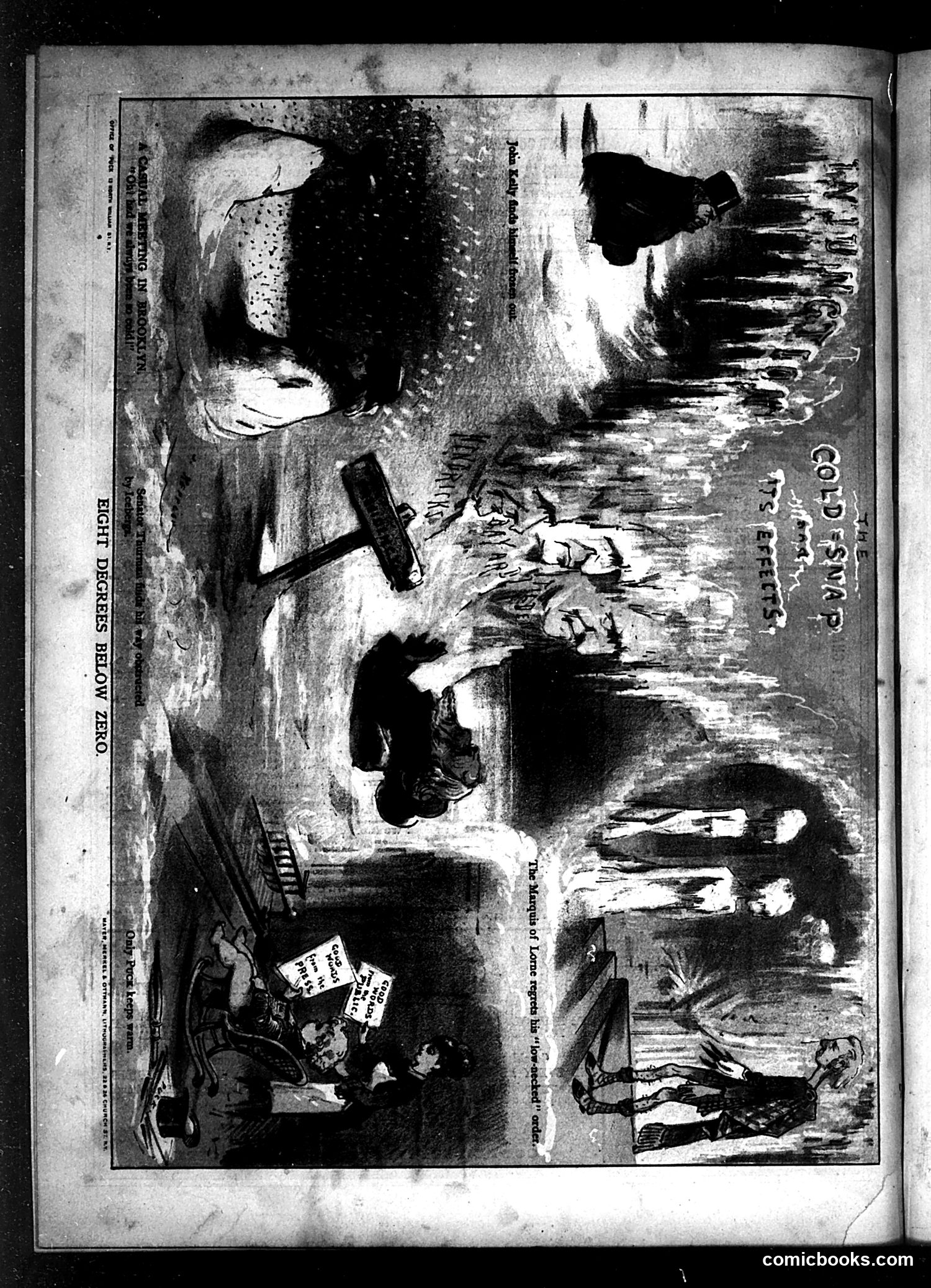
This appears to be a page from Puck magazine featuring satirical content about politics or social issues. The image is rotated 90 degrees, making specific details difficult to interpret with certainty. The visible text references "BERT DEARGES BELOW ZERO" and "GOD SAVE THE KING," suggesting British or Empire-related political commentary. The cartoons appear to depict multiple scenes or panels showing figures in various situations, likely commenting on contemporary political events or social conditions. However, due to the image quality, rotation, and OCR limitations, I cannot confidently identify the specific figures caricatured, the exact historical context, or the precise satirical point being made. A properly oriented, higher-resolution image would be needed for accurate interpretation of the cartoon's political message and intended targets.