
Puck, 1879-01-15 · page 6 of 16
Puck — January 15, 1879 — page 6: what you’re looking at
What you’re looking at
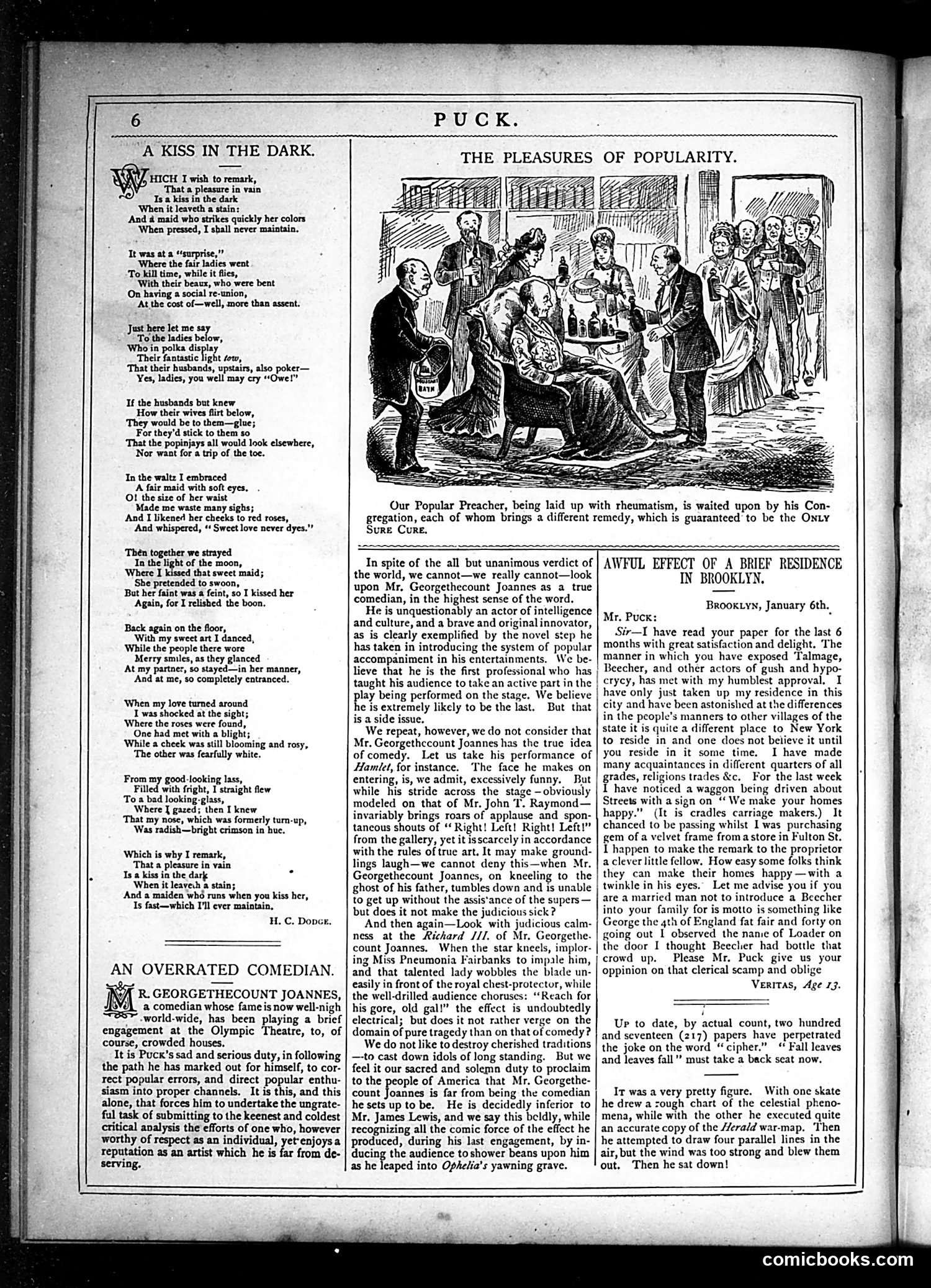
The page contains three distinct sections: **"A Kiss in the Dark"** (left): A romantic poem by H.C. Dodge about a stolen kiss, likely representing typical sentimental Victorian verse that Puck would parody. **"The Pleasures of Popularity"** (center): A cartoon showing a preacher mobbed by congregants, each bringing different "cures" for his rheumatism. The satire targets popular entertainment's superficial solutions and public gullibility. **"An Overrated Comedian"** (bottom): Critiques actor George the Count Joannes, who performed at the Olympia Theatre. The text argues his popularity is undeserved, criticizing his comedic style and suggesting audiences are easily impressed. This represents Puck's role critiquing entertainment and public taste during this era. The overall page mixes satire of sentimentality, religious hypocrisy, and theatrical mediocrity—typical Puck content.
📄 Transcribed text from this page (OCR, searchable)
Machine-transcribed from the original scan — historical spelling and the odd misread are preserved.
‘A KISS IN THE DARK. HICH I wish to remark, ‘That a pleasure in vain Is a kiss in the dark ‘When it leaveth a stain: ‘And a maid who strikes quickly her colors ‘When pressed, I shall never maintain, Tt was at a “‘surprise,’” Where the fair ladies went To kill time, while it fies, With their beaux, who were bent On having a social re-union, At the cost of—well, more than assent. Just here let me Gi To the ladies below, ‘Who in polka display Their fantastic light sow, That their husbands, upstairs, also poker— Yes, ladies, you well may cry “Owe!” If the husbands but knew How their wives flirt below, ‘They would be to them—glue; For they'd stick to them so ‘That the popinjays all would look elsewhere, ‘Nor want for a trip of the toe. In the waltz I embraced A fair maid with soft eyes, OL the size of her waist Made me waste many sighs; And I likened her cheeks to red roses, ‘And whispered, “ Sweet love never dyes." ‘Then together we strayed In the light of the Ron Where I kissed that sweet maid; She pretended to swoon, But her faint was a feint, so I kissed her ‘Again, for I relished the boon. Back again on the floor, With my sweet art I danced, While the people there wore Merry smiles, as they glanced At my partner, So stayed—in her manner, ‘And at me, so completely entranced. ‘When my love turned around I was shocked at the sight; ‘Where the roses were found, One had met with a blight; While a cheek was still blooming and rosy, The other was fearfully white. From my good-looking lass, Filled with fright, I straight flew To a bad looking-giass, Where I gazed; then I knew That my nose, which was formerly tun-up, Was radish—bright crimson in hue. Which is why I remark, That a pleasure in vain Is a kiss in the dark : When it leavech a stain; ‘And a maiden whé runs when you kiss her, Is fast—which I'll ever maintain, H. C. Dopce. AN OVERRATED COMEDIAN. MM GEORGETHECOUNT JOANNES, a comedian whose fame is now well-nigh => world-wide, has been playing a brief engagement at the Olympic Theatre, to, of course, crowded houses. It is Puck's sad and serious duty, in following the path he has marked out for himself, to cor- rect popular errors, and direct popular enthu- siasm into proper channels. It is this, and this alone, that forces him to undertake the ungrate- fal task of submitting to the keenest and coldest ctitical analysis the efforts of one who, however worthy of respect as an individual, yet-enjoysa reputation as an artist which he is dir from de- serving, Uj GZ, Our Popular Preacher, being laid up with rheumatism, is waited upon by his Con- gregation, each of whom brings a different remedy, which is guaranteed’ to be the ONLY Sure Cure. In spite of the all but unanimous verdict of the world, we cannot—we really cannot—look upon Mr, Georgethecount Joannes as a true comedian, in the highest sense of the word. He is unquestionably an actor of intelligence and culture, and a brave and original innovator, as is clearly exemplified by the novel step he has taken in introducing the system of popular accompaniment in his entertainments. We be- lieve that he is the first profes: play being performed on the stage. We believe he is extremely likely to be the last. But that is a side issue. We repeat, however, we do not consider that Mr. Georgethccount Joannes has the true idea of comedy. Let us take his performance of Hamlet, for instance. The face he makes on entering, is, we admit, excessively funny. But while his stride across the stage - obviously modeled on that of Mr. John ‘I. Raymond— invariably brings roars of applause and spon- tancous shouts of ‘Right! Left! Right! Left!” from the gallery, yet it isscarcely in accordance with the rules of true art, It may make ground- lings laugh—we cannot deny this—when Mr. Georgethecount Joannes, on kneeling to the ghost of his father, tumbles down and is unable to get up without the assis‘ance of the supers — but does it not make the judicious sick? And then again—Look with judicious calm- ness at the Aichard ///, of Mr. Georgethe- count Joannes. When the star kneels, implor- ing Miss Pneumonia Fairbanks to impale him, and that talented lady wobbles the blade un- easily in front of the royal chest-protector, while the well-drilled audience choruses: ‘Reach for his gore, old gal!” the effect is undoubtedly electrical; but does it not rather verge on the domain of pure tragedy than on that of comedy? We do not like to destroy cherished traditions —-to cast down idols of long standing. But we feel it our sacred and solemn duty to proclaim to the people of America that Mr. Georgethe- count Joannes is far from being the comedian he sets up to be. He is decidedly inferior to Mr. James Lewis, and we say this beldly, while recognizing all the comic force of the effect he produced, during his last engagement, by in- ducing the audience to shower beans upon him as he leaped into Ophelia’s yawning grave. nal who has ; taught his audience to take an active part in the | AWFUL EFFECT OF A BRIEF RESIDENCE IN BROOKLYN. BRooKLyn, January 6th. Mr. Puck: . Sir—I have read your paper for the last 6 months with great satisfaction and delight. The manner in which you have exposed ‘Talmage, Beecher, and other actors of gush and hypo- crycy, has met with my humblest approval, I have only just taken up my residence in this city and have been astonished at the differences in the pcople’s manners to other villages of the state it is quite a different place to New York to reside in and one does not believe it until you reside in it some time. I have made many acquaintances in different quarters of all grades, religions trades &c. For the last week I have noticed a waggon being driven about Streets with a sign on “We make your homes happy.” (It is cradles carriage makers.) It chanced to be passing whilst I was purchasing gem of a velvet frame froma store in Fulton St. 1 happen to make the remark to the proprietor aclever little fellow. How easy some folks think they can make their homes happy—with a twinkle in his eyes. Let me advise you if you are a married man not to introduce a Beecher into your family for is motto is something like George the 4th of England fat fair and forty on going out I observed the nanic of Loader on the door I thought Beecher had bottle that crowd up. Please Mr. Puck give us your oppinion on that clerical scamp and oblige VerITAS, Age 73. Up to date, by actual count, two hundred and seventeen (217) papers have perpetrated the joke on the word “cipher.” ‘“ Fall leaves and leaves fall’ must take a back seat now. Ir was a very pretty figure. With one skate he drew a rough chart of the celestial pheno- mena, while with the other he executed quite an accurate copy of the //era/d war-map. ‘Then he attempted to draw four parallel lines in the air, but the wind was too strong and blew them out. Then he sat down! comicbooks.com