
Puck, 1879-01-15 · page 11 of 16
Puck — January 15, 1879 — page 11: what you’re looking at
What you’re looking at
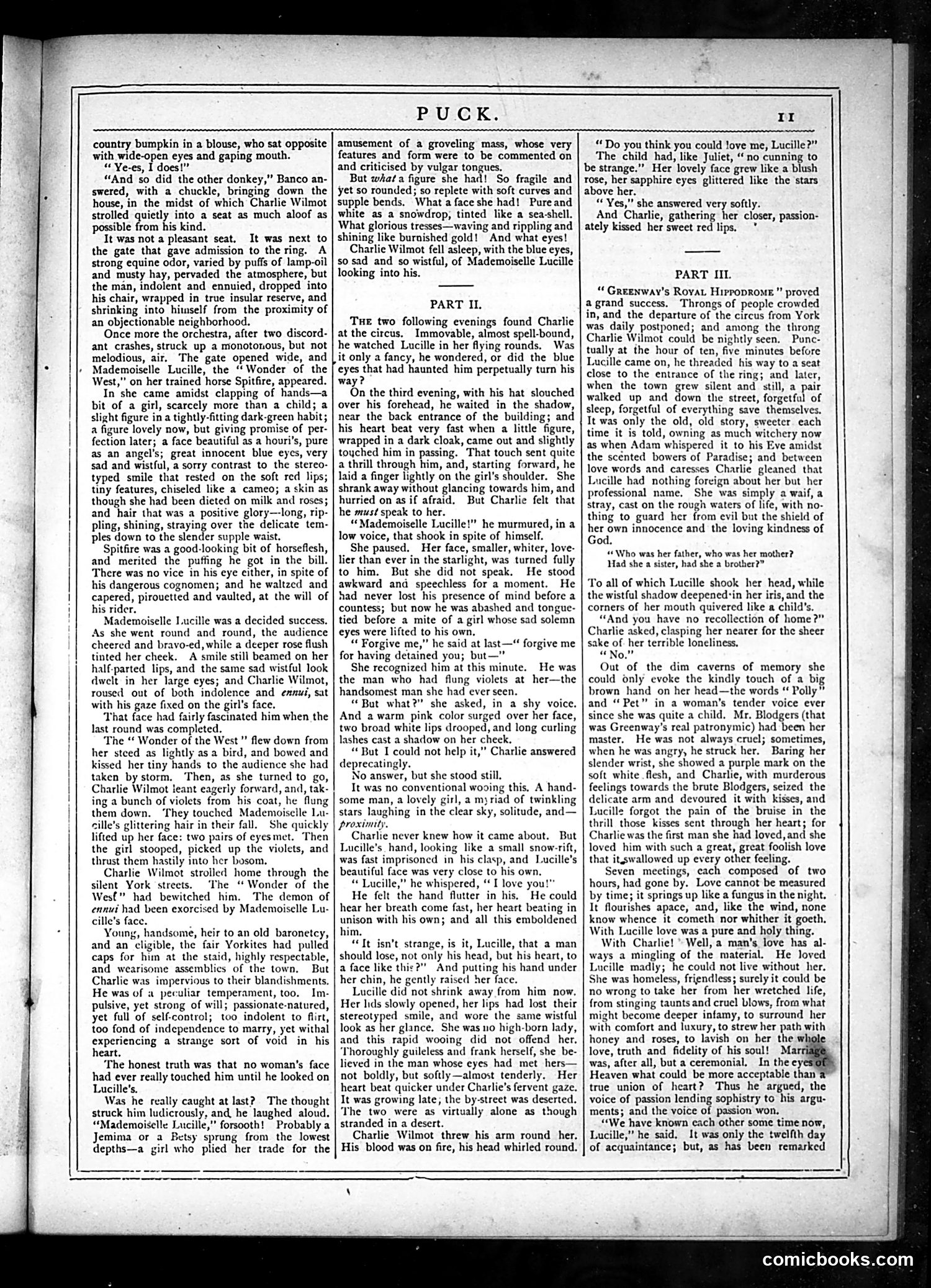
This page is primarily **text, not political cartoons**. It appears to be Part III of a serialized story titled "Greenway's Royal Hippodrome" about a character named Charlie Wilmot and a woman named Lucille. The narrative describes their romantic entanglement: Charlie attends circus performances where Lucille performs, they develop feelings for each other, and the story details their emotional and physical interactions. The text emphasizes Lucille's beauty and Charlie's infatuation, culminating in romantic encounters. **No political satire or social commentary is evident** on this page. Rather, it's a sentimental romance narrative—the type of serialized fiction Puck magazine included alongside its satirical cartoons to attract broader readership. The content reflects late-19th/early-20th-century romantic conventions and attitudes toward courtship.
📄 Transcribed text from this page (OCR, searchable)
Machine-transcribed from the original scan — historical spelling and the odd misread are preserved.
PUCK. Ir country bumpkin in a blouse, who sat opposite with wide-open eyes and gaping mouth. “ Ye-es, I does!” “And so did the other donkey,” Banco an- swered, with a chuckle, bringing down the house, in the midst of which Charlie Wilmot strolled quietly into a seat as much aloof as possible from his kind. It was not a pleasant seat. It was next to the gate that gave admission to the ring. A strong equine odor, varied by puffs of lamp-oil and musty hay, pervaded the atmosphere, but the man, indolent and ennuied, dropped into his chair, wrapped in true insular reserve, and shrinking into himself from the proximity of an objectionable neighborhood. Once more the orchestra, after two discord- ant crashes, struck up a monotonous, but not melodious, air. The gate opened wide, and Mademoiselle Lucille, the ‘‘ Wonder of the West," on her trained horse Spitfire, appeared. In'she came amidst clapping of hands—a bit of a girl, scarcely more than a child; a slight figure in a tightly-fitting dark-green habit; a figure lovely now, but giving promise of per- fection later; a face beautiful as a houri’s, pure as an angel's; great innocent blue eyes, very sad and wistful, a sorry contrast to the stereo- typed smile that rested on the soft red lips; tiny features, chiseled like a cameo; a skin as though she had been dicted on milk and roses; and hair that was a positive glory—long, rip- pling, shining, straying over the delicate tem- ples down to the slender supple waist. Spitfire was a good-looking bit of horsefiesh, and merited the puffing he got in the bill. There was no vice in his eye either, in spite of his dangerous cognomen; and he waltzed and capered, pirouetted and vaulted, at the will of his rider. Mademoiselle Lucille was a decided success. ‘As she went round and round, the audience cheered and bravo-ed, while a deeper rose flush tinted her cheek. A smile still beamed on her half-parted lips, and the same sad wistful look dwelt in her large eyes; and Charlie Wilmot, roused out of both indolence and ennui, sat with his gaze fixed on the girl's face. ‘That face had fairly fascinated him when the last round was completed. ‘The ‘“ Wonder of the West” flew down from her steed as lightly as a bird, and bowed and kissed her tiny hands to the audience she had taken by storm. Then, as she turned to go, Charlie Wilmot leant eagerly forward, and, tak- ing a bunch of violets from his coat, he flung them down. ‘They touched Mademoiselle Lu- cille’s glittering hair in their fall. She quickly lifted up her face: two pairs of eyes met. Then the girl stooped, picked up the violets, and thrust them hastily into her bosom. Charlie Wilmot strolled home through the silent York streets. ‘The ‘ Wonder of the Wesf” had bewitched him. The demon of ennui had been exorcised by Mademoiselle Lu- cille’s face. Young, handsome, heir to an old baronetcy, and an cligible, the fair Yorkites had pulled caps for him at the staid, highly respectable, and wearisome assemblies of the town, But Charlie was impervious to their blandishments. He was of a peculiar temperament, too. Im- pulsive, yet strong of will; passionate-natured, yet full of self-control; too indolent to flirt, too fond of independence to marry, yet withal experiencing a strange sort of void in his heart. ‘The honest truth was that no woman's face had ever really touched him until he looked on Lucille’s. Was he really caught at last? The thought struck him ludicrously, and he laughed aloud. “Mademoiselle Lucille," forsooth! Probably a Jemima or a Betsy sprung from the lowest depths—a girl who plied her trade for the amusement of a groveling mass, whose very features and form were to be commented on and criticised by vulgar tongues, But what a figure she had! So fragile and yet so rounded; so replete with soft curves and supple bends. What a face she had! Pure and white as a snowdrop, tinted like a sea-shell. What glorious tresses—-waving and rippling and shining like burnished gold! And what eyes! Charlie Wilmot fell asleep, with the blue eyes, so sad and so wistful, of Mademoiselle Lucille looking into his. PART IL Te two following evenings found Charlie at the circus. Immovable, almost spell-bound, he watched Lucille in her flying rounds. Was it only a fancy, he wondered, or did the blue [eyes that had haunted him perpetually turn his way? On the third evening, with his hat slouched over his forehead, he waited in the shadow, near the back entrance of the building; and his heart beat very fast when a little figure, wrapped in a dark cloak, came out and slightly toyched him in passing. That touch sent quite a thrill through him, and, starting forward, he laid a finger lightly on the girl’s shoulder. She shrank away without glancing towards him, and hurried on as if afraid. But Charlie felt that he must speak to her. “Mademoiselle Lucille!” he murmured, in a low voice, that shook in spite of himself. She paused. Her face, smaller, whiter, love- lier than ever in the starlight, was turned fully to him. But she did not speak. He stood awkward and speechless for a moment. He had never lost his presence of mind before a countess; but now he was abashed and tongue- tied before a mite of a girl whose sad solemn eyes were lifted to his own. “ Forgive me,” he said at las for having detained you; but—' She recognized him at this minute. He was the man who had flung violets at her—the handsomest man she had ever seen. “But what?” she asked, in a shy voice. And a warm pink color surged over her face, two broad white lips drooped, and long curling lashes cast a shadow on her cheek. “But I could not help it,” Charlie answered deprecatingly. No answer, but she stood still. It was no conventional wooing this. A hand- some man, a lovely gisl, a myriad of twinkling stars laughing in the clear sky, solitude, and— proximity. Charlie never knew how it came about. But Lucille’s hand, looking like a small snow-rift, was fast imprisoned in his clasp, and Lucille’s beautiful face was very close to his own. “ Lucille,” he whispered, “I love you!" He felt the hand flutter in his, He could hear her breath come fast, her heart beating in unison with his own; and all this emboldened him. “It isn’t strange, is it, Lucille, that a man should lose, not only his head, but his heart, to a face like this?” And putting his hand under her chin, he gently raised her face. Lucille did not shrink away from him now. Her lids slowly opened, her lips had lost their stereotyped smile, and wore the same wistful look as her glance. She was no high-born lady, and this rapid wooing did not offend her. ‘Thoroughly guileless and frank herself, she be- lieved in the man whose eyes had met hers— not boldly, but softly—almost tenderly. Her heart beat quicker under Charlie's fervent gaze. It was growing late; the by-street was deserted. The two were as virtually alone as though stranded in a desert. Charlie Wilmot threw his arm round her, His blood was on fire, his head whirled round. —* forgive me “Do you think you could love me, Lucille?” The child had, like Juliet, “no cunning to be strange.” Her lovely face grew like a blush rose, her sapphire eyes glittered like the stars above her. “ Yes," she answered very softly. And Charlie, gathering her closer, passion- ately kissed her sweet red lips. ° PART IIL. “ Greenway's Rovat Hirroprome ” proved a grand success, Throngs of people crowded in, and the departure of the circus from York was daily postponed; and among the throng Charlie Wilmot could be nightly seen. Punc- tually at the hour of ten, five minutes before Lucille came on, he threaded his way to a seat close to the entrance of the ring; and later, when the town grew silent and still, a pair walked up and down the street, forgetful of sleep, forgetful of everything save themselves. It was only the old, old story, sweeter each time it is told, owning as much witchery now as when Adam whispered it to his Eve amidst the scénted bowers of Paradise; and between love words and caresses Charlie gleaned that Lucille had nothing foreign about her but her professional name, She was simply a waif, a stray, cast on the rough waters of life, with no- thing to guard her from evil but the shield of her own innocence and the loving kindness of God. “Who was her father, who was her mother? Mad she a sister, had she a brother?” To all of which Lucille shook her head, while the wistful shadow deepened:in her iris, and the corners of her mouth quivered like a child’s. “And you have no recollection of home?” Charlie asked, clasping her nearer for the sheer sake of her terrible loneliness, “No,” Out of the dim caverns of memory she could only evoke the kindly touch of a big brown hand on her head—the words “ Polly” and “Pet” in a woman's tender voice ever since she was quite a child, Mr. Blodgers (that was Greenway’s real patronymic) had been her master, He was not always cruel; sometimes, when he was angry, he struck her. Baring her slender wrist, she showed a purple mark on the soft white. flesh, and Charlie, with murderous feelings towards the brute Blodgers, seized the delicate arm and devoured it with kisses, and Lucille forgot the pain of the bruise in the thrill those kisses sent through her heart; for Charlie was the first man she had loved, and she loved him with such a great, great foolish love that itswallowed up every other feeling. Seven meetings, cach composed of two hours, had gone by. Love cannot be measured by time; it springs up like a fungus in the night. It flourishes apace, and, like the wind, none know whence it cometh nor whither it goeth. With Lucille love was a pure and holy thing. With Charlie! Well, a man's love has al- ways a mingling of the material. He loved Lucille madly; he could not live without her, She was homeless, friendless; surely it could be no wrong to take her from her wretched life, from stinging taunts and cruel blows, from what might become deeper infamy, to surround her with comfort and luxury, to strew her path with honey and roses, to lavish on her the whole love, truth and fidelity of his soul! Mai was, after all, but a ceremonial, In the ey Heaven what could be more acceptable than true union of heart? Thus he argued, the voice of passion lending sophistry to his argu- ments; and the voice of passion won. “‘We have known cach other some time now, Lucille,” he said, It was only the twelfth day of acquaintance; but, as has been remarked comicbooks.com