
Puck, 1879-01-15 · page 12 of 16
Puck — January 15, 1879 — page 12: what you’re looking at
What you’re looking at
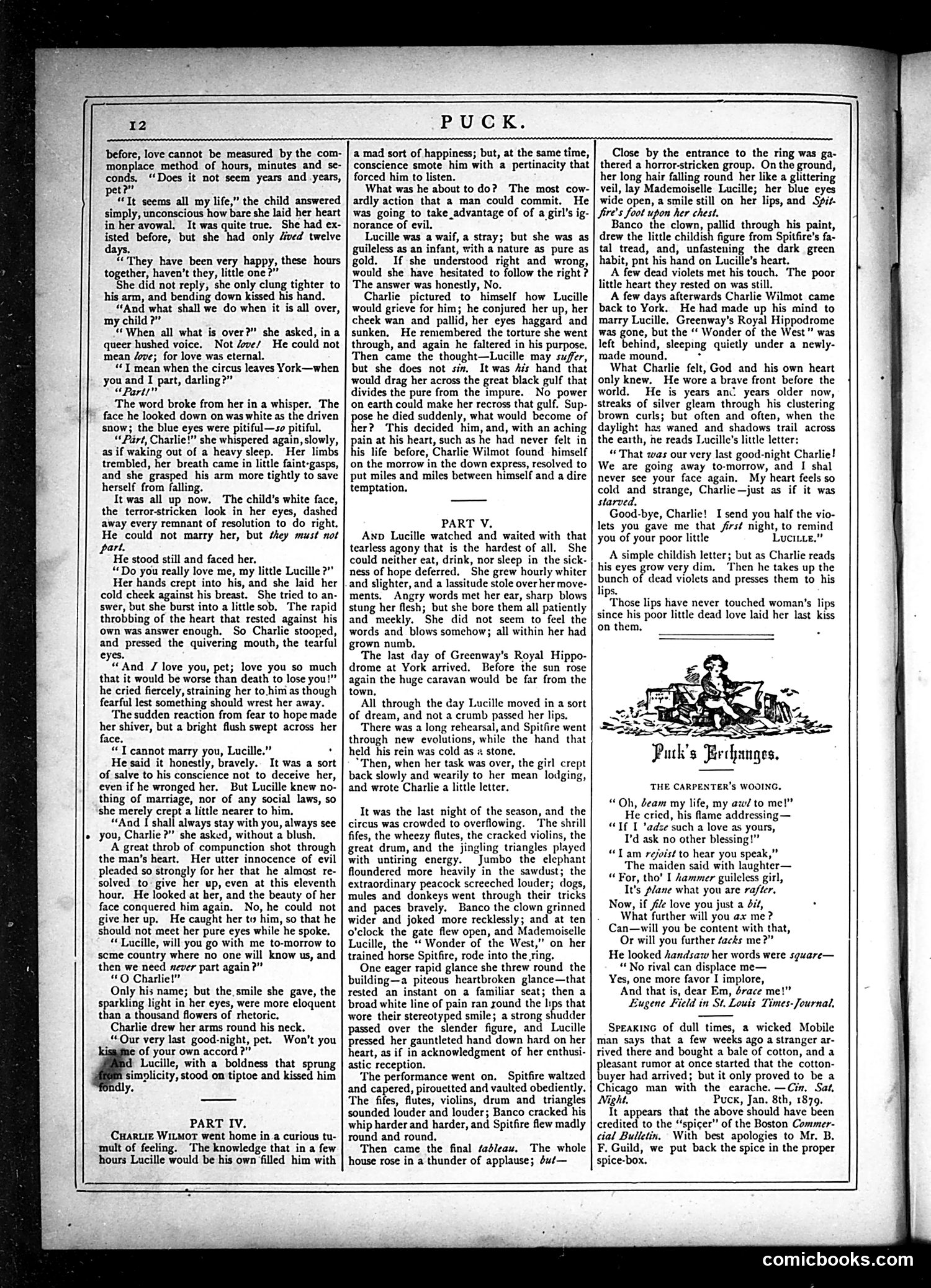
This page contains primarily serialized fiction rather than political satire. The main content is "Part V" of a romantic story involving characters named Lucille, Charlie Wilmot, and Spitfire—a narrative about love, separation, and longing set in what appears to be the late 19th century. At the bottom, there's a small section titled "Puck's Beginnings" featuring a poem called "The Carpenter's Wooing" and a brief humorous anecdote about a Mobille man making a witty remark about spice. The page lacks the typical political cartoons or satirical commentary Puck was known for. It's primarily literary content with minimal visual elements beyond decorative headers, representing the magazine's serialized fiction offerings alongside its political humor.
📄 Transcribed text from this page (OCR, searchable)
Machine-transcribed from the original scan — historical spelling and the odd misread are preserved.
before, love cannot be measured by the com- monplace method of hours, minutes and se- conds. “Does it not seem years and years, pet?” “Tt seems all my life,” the child answered simply, unconscious how bare she laid her heart in her avowal. It was quite true. She had ex- isted before, but she had only dived twelve ys. “They have been very happy, these hours together, haven't they, little one?” She did not reply, she only clung tighter to his arm, and bending down kissed his hand. “And what shall we do when it is all over, my child?” «When all what is over?” she asked, in a queer hushed voice. Not /ove/ He could not mean ove; for love was eternal. “T mean when the circus leaves York—when you and I part, darling?” “Part!” The word broke from her in a whisper. The face he looked down on was white as the driven snow; the blue eyes were pitiful—so pitiful. “Part, Charlie! she whispered again, slowly, as if waking out of a heavy sleep. Her limbs trembled, her breath came in little faint-gasps, and she grasped his arm more tightly to save herself from falling. It was all up now. The child’s white face, the terror-stricken look in her eyes, dashed away every remnant of resolution to do right. He could not marry her, but they must not part. He stood still and faced her. “Do you really love me, my little Lucille?” Her hands crept into his, and she laid her cold cheek against his breast. She tried to an- swer, but she burst into a littlesob. The rapid throbbing of the heart that rested against his own was answer enough. So Charlie stooped, and pressed the quivering mouth, the tearful eyes. “And J love you, pet; love you so much that it would be worse than death to lose you!” he cried fiercely, straining her to.him as though fearful lest something should wrest her away. The sudden reaction from fear to hope made her shiver, but a bright flush swept across her face. “T cannot marry you, Lucille.” a He said it honestly, bravely. It was a sort of salve to his conscience not to deceive her, even if he wronged her. But Lucille knew no- thing of marriage, nor of any social laws, so ‘she merely crept a little nearer to him, “And I shall always stay with you, always see you, Charlie ?”” she asked, without a blush, A great throb of compunction shot through the man’s heart. Her utter innocence of evil pleaded so strongly for her that he almost re- solved to give her up, even at this eleventh hour. He looked at her, and the beauty of her face conquered him again. No, he could not give her up. He caught her ta him, so that he should not meet her pure eyes while he spoke. “ Lucille, will you go with me to-morrow to seme country where no one will know us, and then we need never part again?” “O Charlie!” Only his name; but the. smile she gave, the sparkling light in her eyes, were more eloquent than a thousand flowers of rhetoric. Charlie drew her arms round his neck. “Our very last good-night, pet. Won't you isaigne of your own accord ?”” id Lucille, with a boldness that sprung simplicity, stood on tiptoe and kissed him idly. PART IV. Cuartiz WiLMor went home in a curious tu- mult of feeling. The knowledge that in a few hours Lucille would be his own filled him with PUCK. a mad sort of happiness; but, at the same time, conscience smote him with a pertinacity that forced him to listen. What was he about todo? The most cow- ardly action that a man could commit. He was going to take_advantage of of a girl's ig- norance of evil. Lucille was a waif, a stray; but she was as guileless as an infant, with a nature as pure as gold. If she understood right and wrong, would she have hesitated to follow the right ? The answer was honestly, No. Charlie pictured to himself how Lucille would grieve for him; he conjured her up, her cheek wan and pallid, her eyes haggard and sunken, He remembered the torture she went through, and again he faltered in his purpose. Then came the thought—Lucille may suffer, but she does not sin, It was Ais hand that would drag her across the great black gulf that divides the pure from the impure. No power on earth could make her recross that gulf. Sup- ose he died suddenly, what would become of er? This decided him, and, with an aching ain at his heart, such as he had never felt in is life before, Charlie Wilmot found himself on the morrow in the down express, resolved to put miles and miles between himself and a dire temptation, PART V. Anp Lucille watched and waited with that tearless agony that is the hardest of all. She could neither eat, drink, nor sleep in the sick- ness of hope deferred. She grew hourly whiter and slighter, and a lassitude stole over her move- ments. Angry words met her ear, sharp blows stung her flesh; but she bore them all patiently and meekly. She did not seem to feel the words and blows somehow; all within her had grown numb. The last day of Greenway's Royal Hippo- drome at York arrived. Before the sun rose again the huge caravan would be far from the town, All through the day Lucille moved in a sort of dream, and not a crumb passed her lips. There was a long rehearsal, and Spitfire went through new evolutions, while the hand that held his rein was cold as 2 stone. “Then, when her task was over, the girl crept back slowly and wearily to her mean lodging, and wrote Charlie a little letter. It was the last night of the season, and the circus was crowded to overflowing. ‘The shrill fifes, the wheezy flutes, the cracked violins, the great drum, and the jingling triangles played with untiring energy. Jumbo the elephant floundered more heavily in the sawdust; the extraordinary peacock screeched louder; dogs, mules and donkeys went through their tricks and paces bravely. Banco the clown grinned wider and joked more recklessly; and at ten o'clock the gate flew open, and Mademoiselle Lucille, the ‘* Wonder of the West,” on her trained horse Spitfire, rode into the ring. ‘One eager rapid glance she threw round the building—a piteous heartbroken glance—that rested an instant on a familiar seat; then a broad white line of pain ran sound the lips that wore their stereotyped smile; a strong shudder passed over the slender figure, and Lucille pressed her gauntleted hand down hard on her heart, as if in acknowledgment of her enthusi- astic reception. ‘The performance went on. Spitfire waltzed and capered, pirouetted and vaulted obediently. The fifes, flutes, violins, drum and triangles sounded louder and louder; Banco cracked his whip harder and harder, and Spitfire flew madly round and round. Then came the final fadleau. The whole house rose in a thunder of applause; du/— Close by the entrance to the ring was ga- thered a horror-stricken group. On the ground, her long hair falling round her like a glittering veil, lay Mademoiselle Lucille; her blue eyes wide open, a smile still on her lips, and Spit- fire's foot upon her chest. Banco the clown, pallid through his paint, drew the little childish figure from Spitfire’s fa- tal tread, and, unfastening the dark green habit, pnt his hand on Lucille’s heart. A few dead violets met his touch. The poor little heart they rested on was still. A few days afterwards Charlie Wilmot came back to York. He had made up his mind to marry Lucille. Greenway's Royal Hippodrome was gone, but the “‘ Wonder of the West” was left behind, sleeping quietly under a newly- made mound. . What Charlie felt, God and his own heart only knew. He wore a brave front before the world. He is years anc years older now, streaks of silver gleam through his clustering brown curls; but often and often, when the daylight has waned and shadows trail across the earth, ne reads Lucille’s little letter: “That was our very last good-night Charlie! We are going away to-morrow, and I shal never see your face again, My heart feels so cold and strange, Charlie—just as if it was starved. Good-bye, Charlie! I send you half the vio- lets you gave me that frst night, to remind you of your poor little Lucite.” A simple childish letter; but as Charlie reads his eyes grow very dim, ‘Then he takes up the bunch of dead violets and presses them to his lips. ‘Those lips have never touched woman's lips since his poor little dead love laid her last kiss Puck's Brchanges, THE CARPENTER’S WOOING, “Oh, beam my life, my aw/ to me!” He cried, his flame addressing — “Tf I 'adze such a love as yours, I'd ask no other blessing!” “Tam rejoist to hear you speak,” The maiden said with laughter— “For, tho’ I hammer guileless girl, It’s plane what you are rafter. Now, if file love you just a dit, . _ What further will you ax me? Can—will you be content with that, Or will you further sacks me?” He looked Aandsaw her words were square— “No rival can displace me— Yes, one more favor I implore, And that is, dear Em, érace me!” Eugene Field in St, Louis Times-Journal, SpeakinG of dull times, a wicked Mobile man says that a few weeks ago a stranger ar- rived there and bought a bale of cotton, and a leasant rumor at once started that the cotton- uyer had arrived; but it only proved to be a Chicago man with the earache. —Cin, Sat, Night. Puck, Jan. 8th, 1879. It appears that the above should have been credited to the “spicer”’ of the Boston Commer- cial Bulletin, With best apologies to Mr. B. F, Guild, we put back the spice in the proper spice-box. comicbooks.com