
A complete issue · 16 pages · 1879
Puck — January 8, 1879
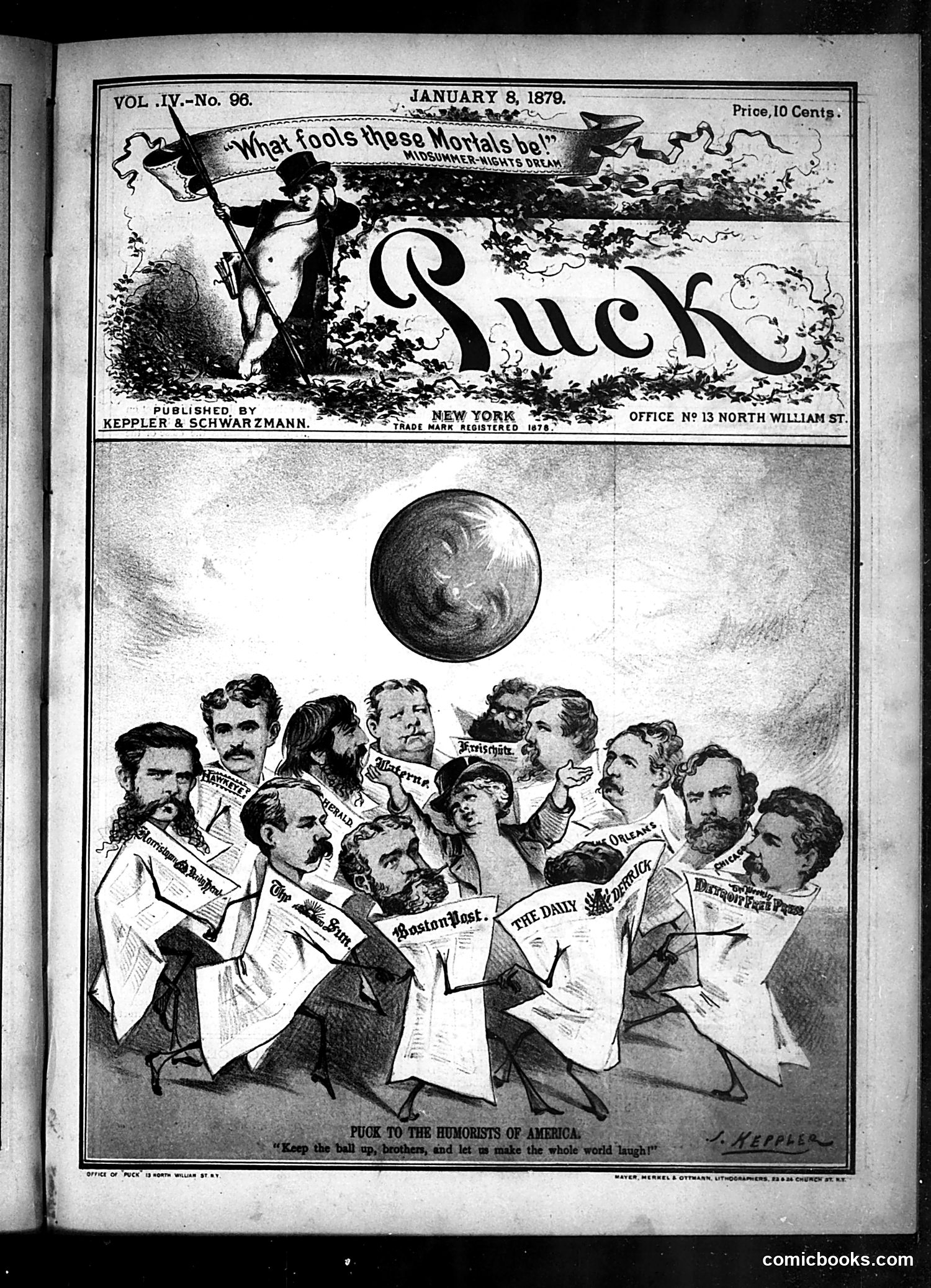
This satirical cartoon depicts newspaper editors as jesters juggling a globe, captioned "Puck to the humorists of America" with the motto "Keep the ball up, brothers, and let us make the whole world laugh." The caricatured figures wear sashes identifying major American newspapers including the Boston Post, The Daily and others (some text is unclear). The cartoon celebrates the satirical press's role as social commentators and entertainers. The top banner—"What fools these mortals be!"—quotes Shakespeare, suggesting newspapers position themselves as wise observers mocking human folly. This reflects Puck's identity as a humor magazine competing with other satirical publications to influence public opinion through mockery and caricature rather than serious journalism.
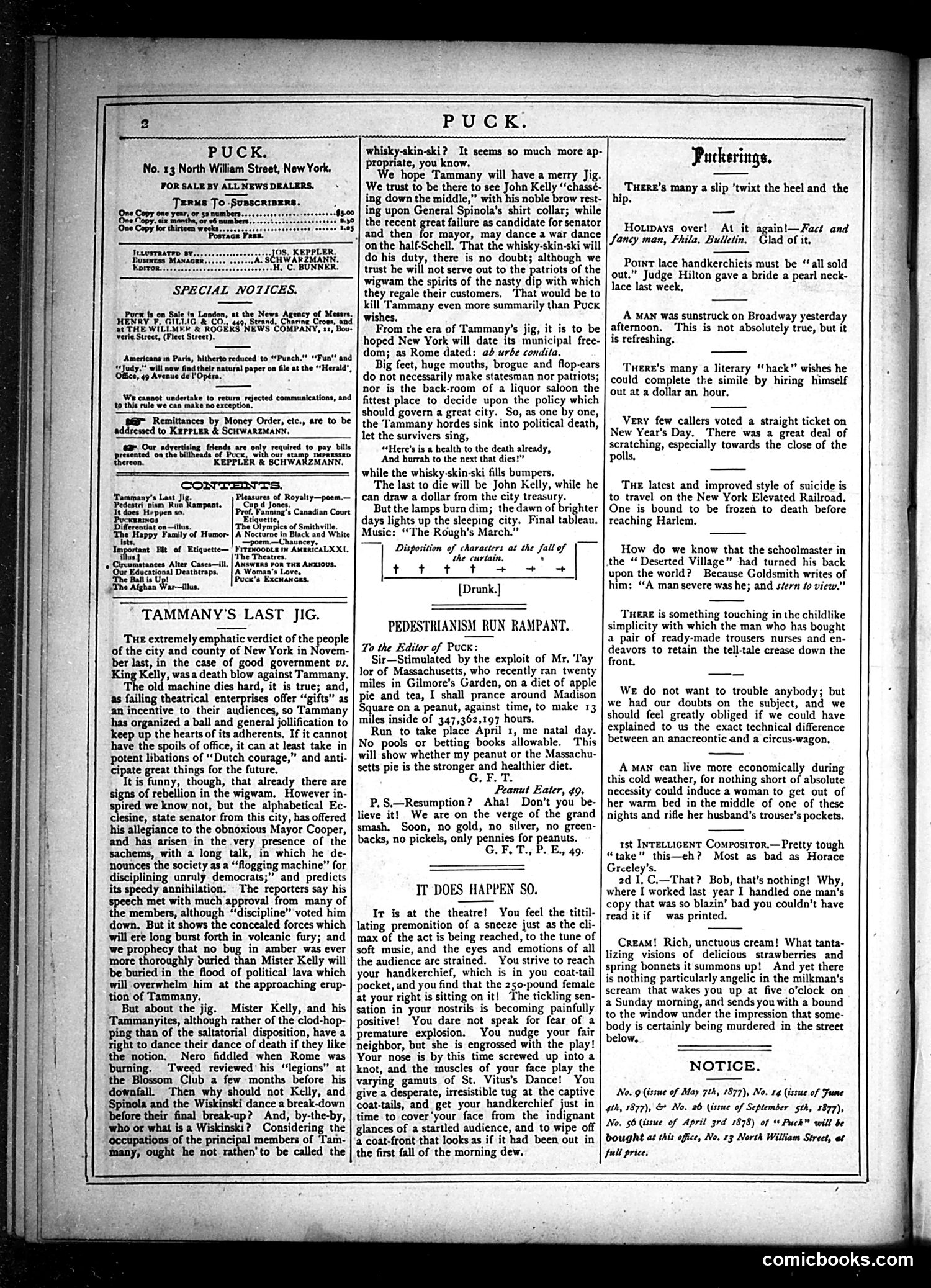
This page from Puck magazine contains primarily **text content rather than political cartoons**—mainly editorial commentary, notices, and humorous columns under headings like "Puckerings" and "It Does Happen So." The main substantive piece is **"Tammany's Last Jig,"** a satirical commentary on New York City politics attacking **Tammany Hall** (the Democratic political machine). The article references **John Kelly** and **"Dutch courage,"** criticizing Tammany's political influence and predicting the organization's downfall. Other items mock everyday absurdities: suicide methods, a schoolmaster's cynicism, pedestrian behavior, and theater etiquette. **Without seeing the actual cartoon illustrations** (if present), I cannot identify specific caricatured figures or visual satire. The page appears to be predominantly political and social commentary in written form rather than visual cartoon form.
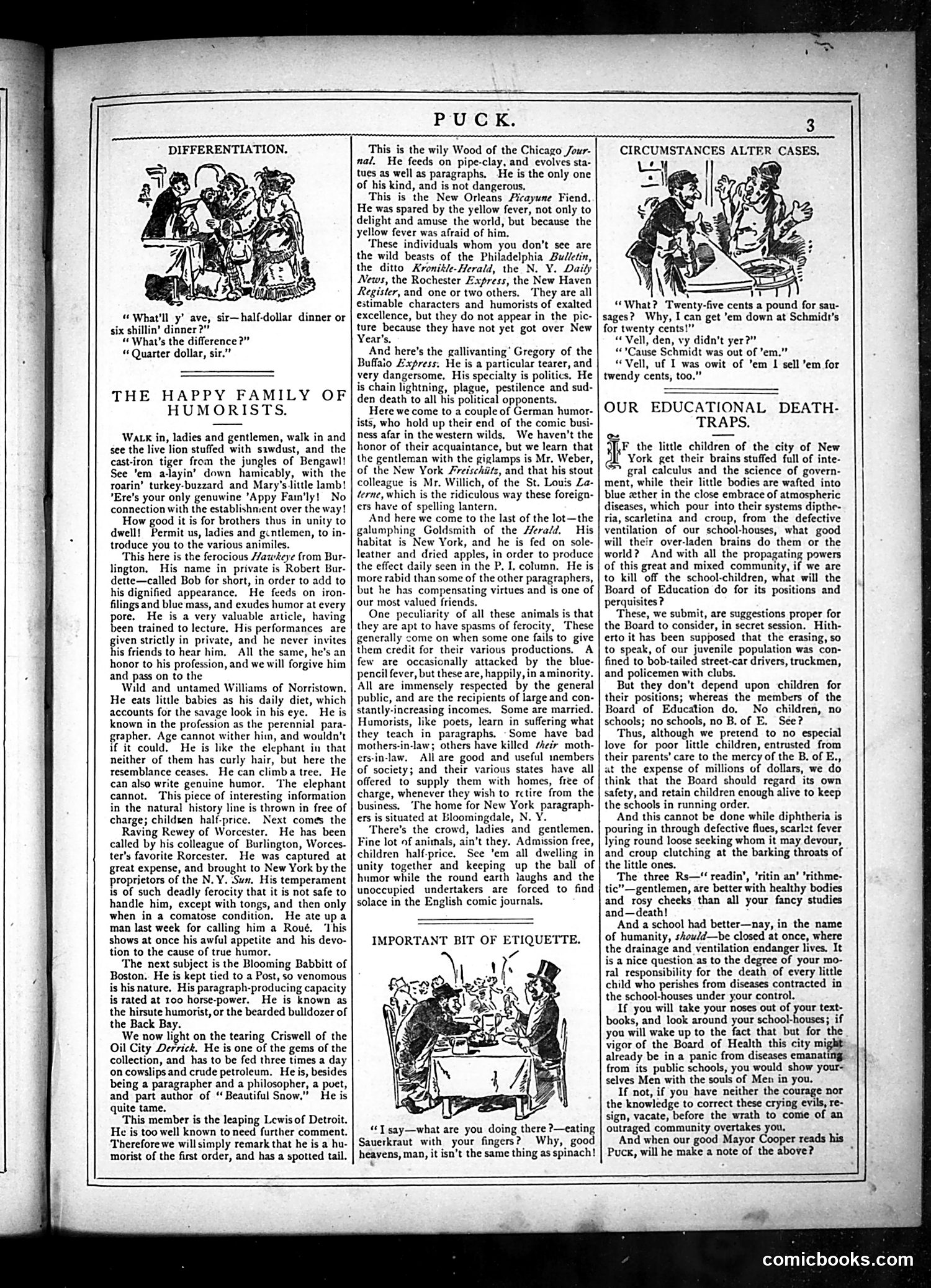
This page celebrates prominent American newspaper humorists and satirists of the era. The left column profiles writers like Bill Nye, Eugene Field, and others who contributed humor to major publications—identifying them by their distinctive styles and subject matter. The cartoon depicts these humorists as a "happy family," emphasizing their camaraderie despite working for competing papers. The satire notes they're generally "inoffensive" yet influential figures in American journalism, though some (like Gregory of the *Indianapolis News*) are described as "dangerous" due to their political commentary. The piece humorously suggests these writers—who might otherwise be rivals—share mutual professional respect and constitute a recognizable "type" in American letters.
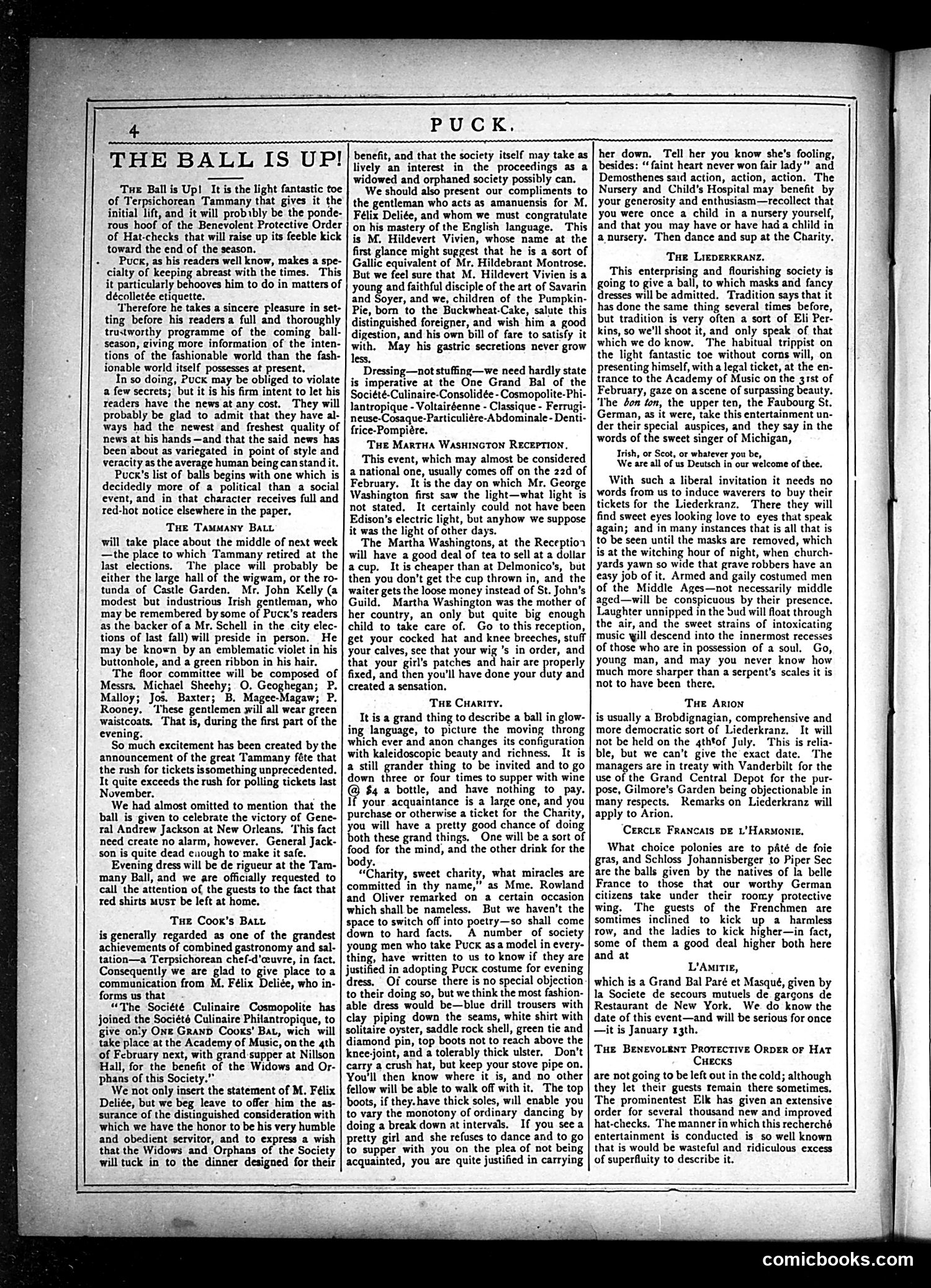
This page consists primarily of **satirical text columns** rather than political cartoons. The main pieces discuss: 1. **"The Ball is Up!"** - Commentary on a Tammany Hall social event, with mockery of the organization's charitable pretensions and verbose naming conventions (referencing the "Société Culinaire-Consolidée" and similar grandiose titles). 2. **"The Martha Washington Reception"** - Satirizing a fundraiser where society women are encouraged to attend while wearing period costume, with biting commentary about social pretension. 3. **References to various social clubs and charitable balls**, poking fun at New York's upper-class society and their performative charity. The satire targets **Tammany Hall's political machine** and **wealthy New Yorkers' self-congratulatory charity work**—suggesting their balls and fundraisers are more about social status than genuine philanthropy. The tone is consistently mocking toward elite hypocrisy.
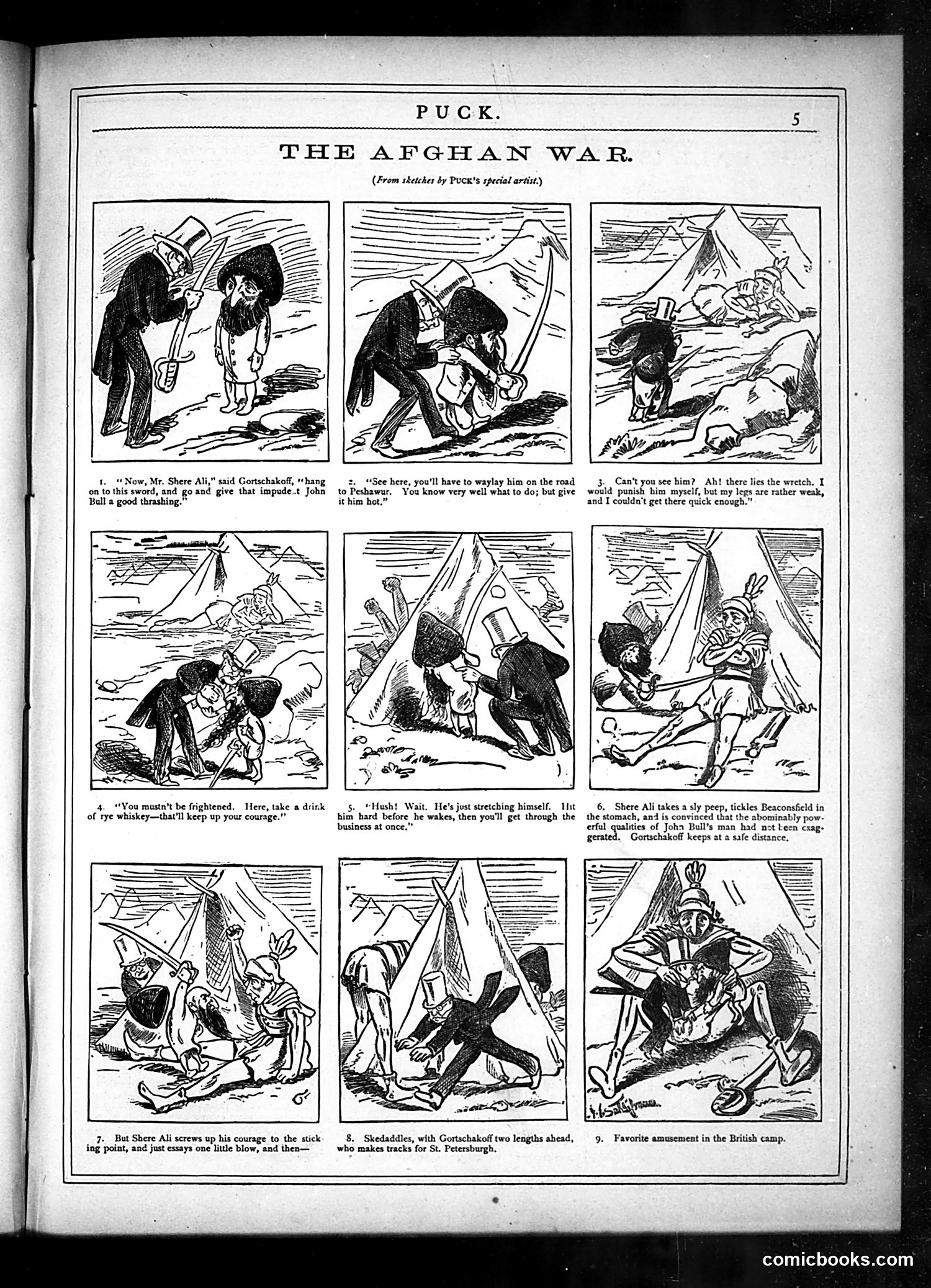
This nine-panel comic satirizes British military leadership during the Afghan War (appears to be 1880s conflict). The caricatured figures represent British commanders, likely including Sir Shere Ali (mentioned in panel 1) and General Gortschakoff, depicted as incompetent military leaders. The satire mocks their strategy through comedic scenarios: soldiers drinking whiskey for courage, commanders stretching themselves before battle as if exercising, and increasingly absurd military tactics. Panel 9 shows "favorite amusement in the British camp"—suggesting the leadership is playing games rather than conducting serious warfare. The overall message criticizes British military bungling and poor strategic decisions in Afghanistan, portraying commanders as foolish rather than competent war leaders.
This page contains two satirical pieces about royal protocol and Canadian society. **"Pleasures of Royalty"** is a poem mocking the constraints of royal life—queens and kings lacking genuine freedom despite their status, forced into formality and duty rather than enjoying authentic pleasure. **"Prof. Fanning's Canadian Court Etiquette"** discusses a Professor Fanning who has written about proper court behavior. The satire focuses on Canadian attempts to emulate English royal customs. It includes humorous anecdotes about court rules (gloves at dinners, proper guest positioning, soup-eating etiquette) and pokes fun at Canadians' earnest but sometimes awkward adoption of British aristocratic conventions. The overall tone mocks both the artificiality of royal life and Canadian social pretension in copying English upper-class manners.
This page contains **no cartoon or satirical illustration**—it is entirely text documenting the minutes and constitution of the Olympic Debating Society of Smithville, New York, established December 31, 1877. The content records meeting proceedings, elected officers (including President Cicero C. Pratt and Secretary Philetus M. Hoskins), and constitutional rules governing debates on topics like "The Printing Press" and "The Steam Engine." This appears to be a **society records page** rather than satirical content. Puck magazine occasionally published such institutional documents alongside humor. The page has historical value as documentation of 19th-century American civic organizations and their formal procedures, but contains no political satire or caricature for modern readers to interpret.
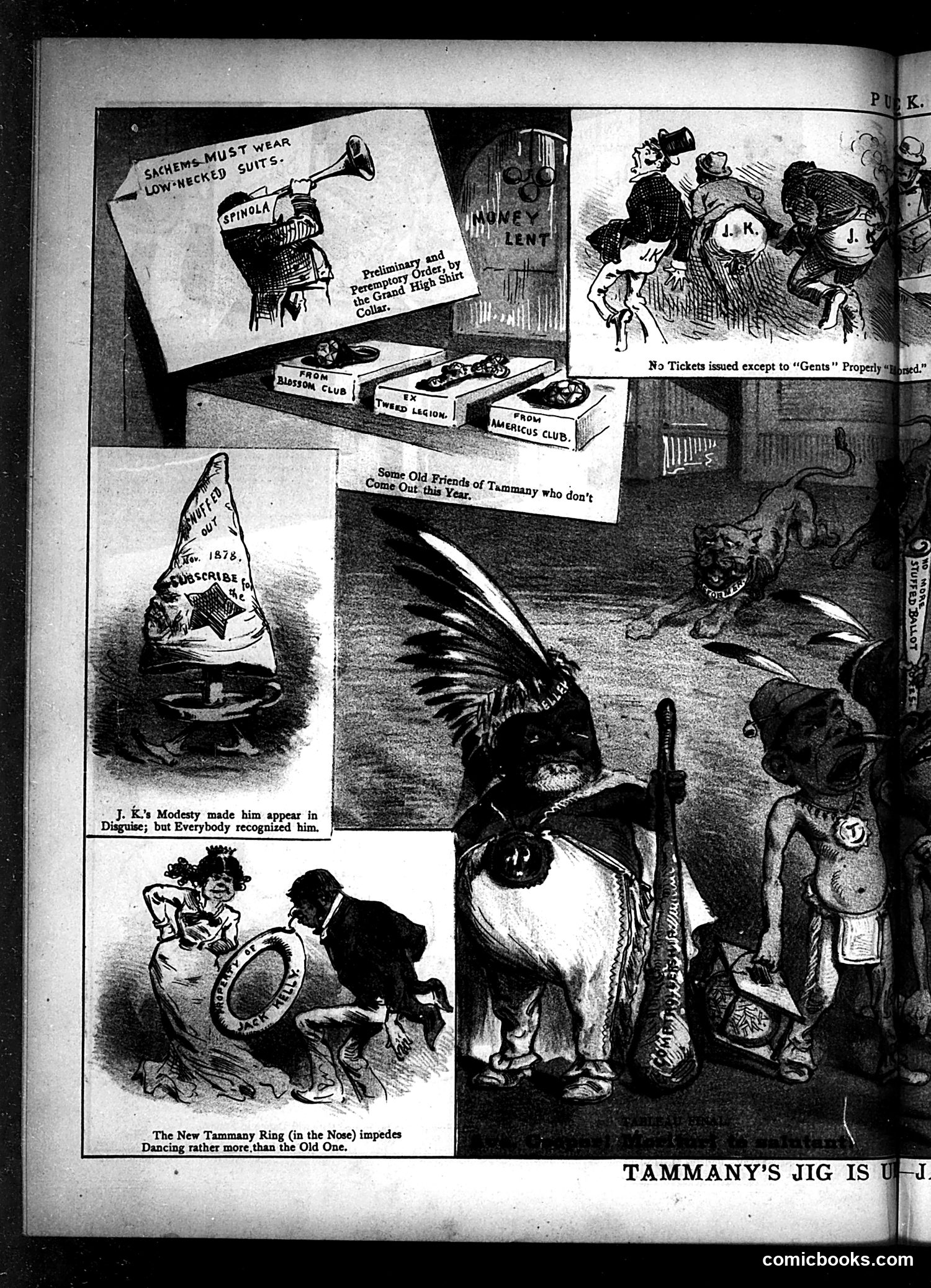
This Puck page satirizes **Tammany Hall**, the Democratic political machine controlling New York City politics. The cartoons mock Tammany's corruption and control over the city. Key elements include: - **Top left**: A megaphone advertising "Sachems must wear low-necked suits" with a "Spinola" reference—likely criticizing leaders' appearance or pretense. - **Middle left**: "J.K.'s Modesty made him appear in Disguise; but Everybody recognized him"—suggesting a politician's failed attempt to hide his identity. - **Bottom**: "The New Tammany Ring (in the Nose)" depicts the machine's leadership literally controlled like animals, with figures manipulated by a nose ring. The overall message: Tammany Hall bosses control the city's politics through manipulation and corruption, despite superficial attempts at respectability.
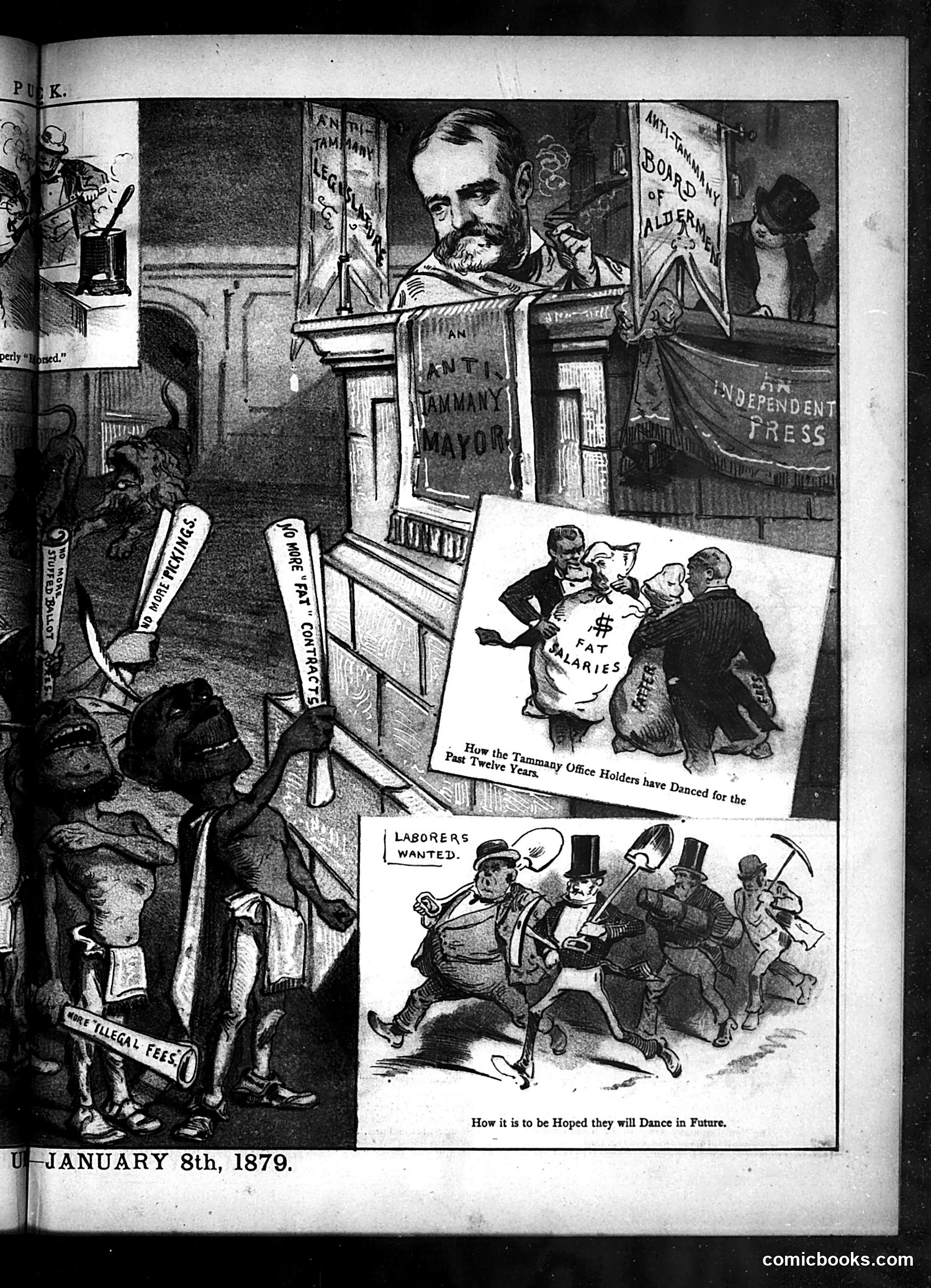
This page satirizes New York City's Tammany Hall political machine and its corrupt leadership. The large central figure appears to be a Tammany boss presiding over his corrupt operation, with banners reading "Anti-Tammany" and "Board of Aldermen" visible. The left panel shows figures labeled with terms like "Illegal Fees" and "Bribery"—representing corruption endemic to Tammany operations. The upper middle cartoon depicts office holders "dancing for fat salaries" over twelve years, mocking how Tammany associates enriched themselves. The bottom panel, titled "Laborers Wanted," shows workers seeking employment, satirizing how Tammany's corruption and patronage system disadvantaged ordinary laborers while enriching political insiders. The overall message critiques Tammany's systematic exploitation and graft.
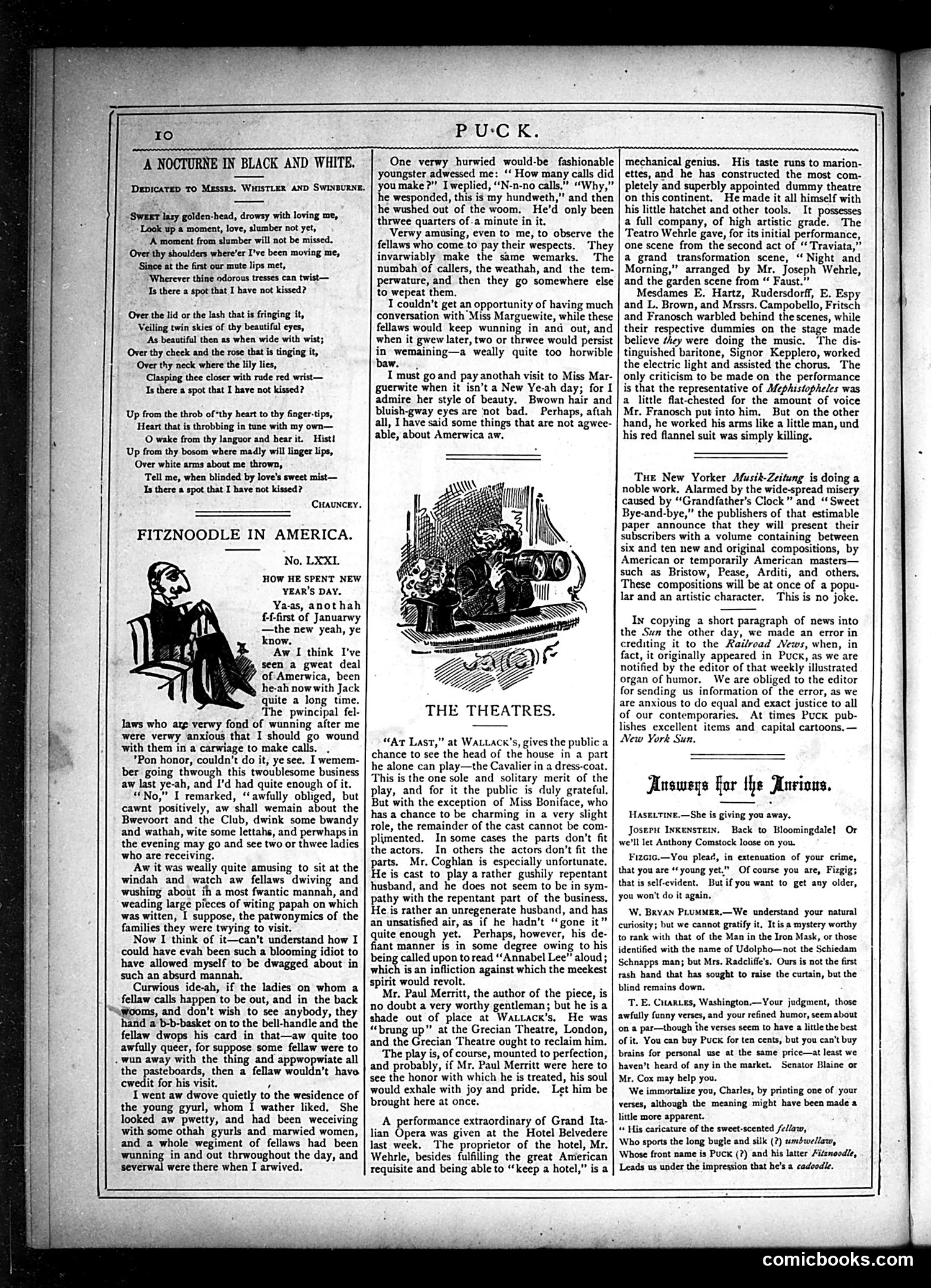
This page contains literary and theatrical commentary rather than political cartoons. The main content includes: **"A Nocturne in Black and White"** - A poem by Whistler and Swinburne (likely a satire on these artists' styles). **"Fitznoodle in America"** - A humorous piece about a character's first New Year's Day in America, poking fun at American social customs and etiquette around holiday visiting. **"The Theatres"** section critiques current stage productions, including a detailed review of "At Last" at Wallace's Theatre, criticizing various actors' performances and noting Miss Boniface as the only charming performer. **"Answers for the Antiques"** - A witty Q&A column addressing reader inquiries about literary and cultural figures. The illustration shows a rotund gentleman in Victorian dress, likely representing the "Fitznoodle" character. The content satirizes American social conventions and theatrical mediocrity rather than specific political figures.
This page from *Puck* magazine contains a literary story titled "A Woman's Love: A Slavonian Study" by Adrien De Vauvedes, not a political cartoon. The text is a romantic narrative about a Slavonian patrician named Teodoro who falls in love with a young fisherman's daughter on the island of St. Andrea near Ragusa (modern-day Croatia). The story appears designed to illustrate *Puck*'s editorial point in the header: that love among "simple-minded sincere people" differs from love among civilized nations, being more genuine and less corrupted by social pretense. This is a sentimental rather than satirical piece, likely presented as a contrast to *Puck*'s typically humorous content.
This page contains **Puck's Beginnings**, a satirical section describing social stereotypes. Rather than a political cartoon, it's a series of character sketches mocking recognizable types in late 19th-century society. The visible entries mock people like the "Pretty boy" (vain, fashionable), the "Sad spectacle" (a formerly wealthy man now poor), and the "Unimportant object" (likely someone socially insignificant). Each type receives witty, biting commentary on their pretensions, mannerisms, or social failures. The illustration shows what appears to be a social gathering or party scene, reinforcing the satirical focus on social behavior and class dynamics. This format—mocking recognizable social types—was typical Puck humor: ridiculing the follies and vanities of contemporary society through character observation.
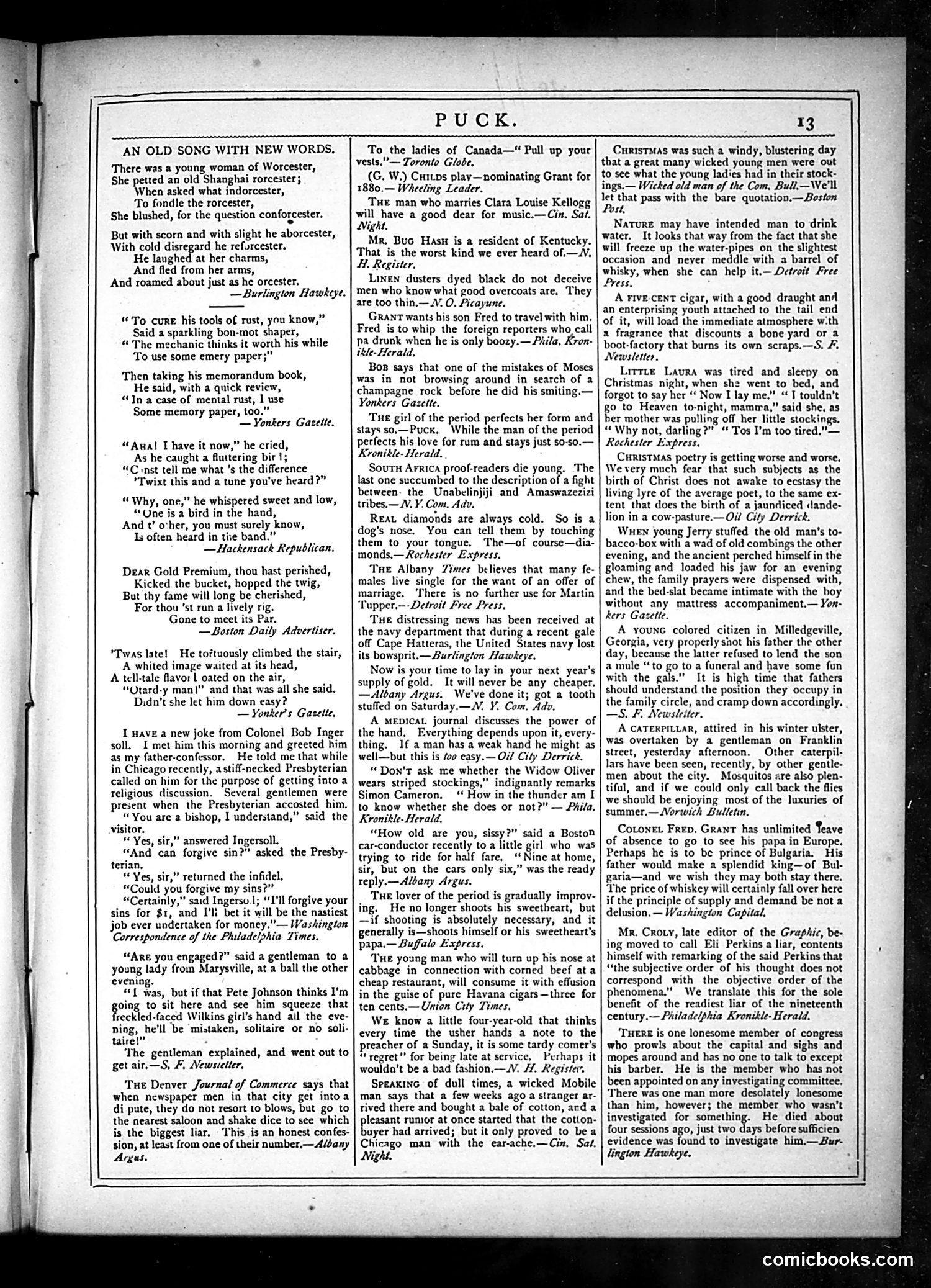
This page contains miscellaneous short jokes and satirical comments rather than a unified political cartoon. The content includes: **Social commentary** on various topics: a critique of Canadian women ("Pull up your vests"), jokes about Kentucky residents, observations about drinking habits, and commentary on Christmas behavior. **Political/social references** include mentions of Moses, South African tribes, marriage customs, and newspaper industry practices. **Satirical targets** appear to include: journalistic standards ("proof-readers die young"), gender relations, drinking culture, and contemporary social pretensions. The jokes are brief, witty observations typical of Puck's humor—targeting hypocrisy and social foibles rather than specific political figures. Without clearer visual caricatures or identifiable references, precise historical context is difficult to establish from text alone.
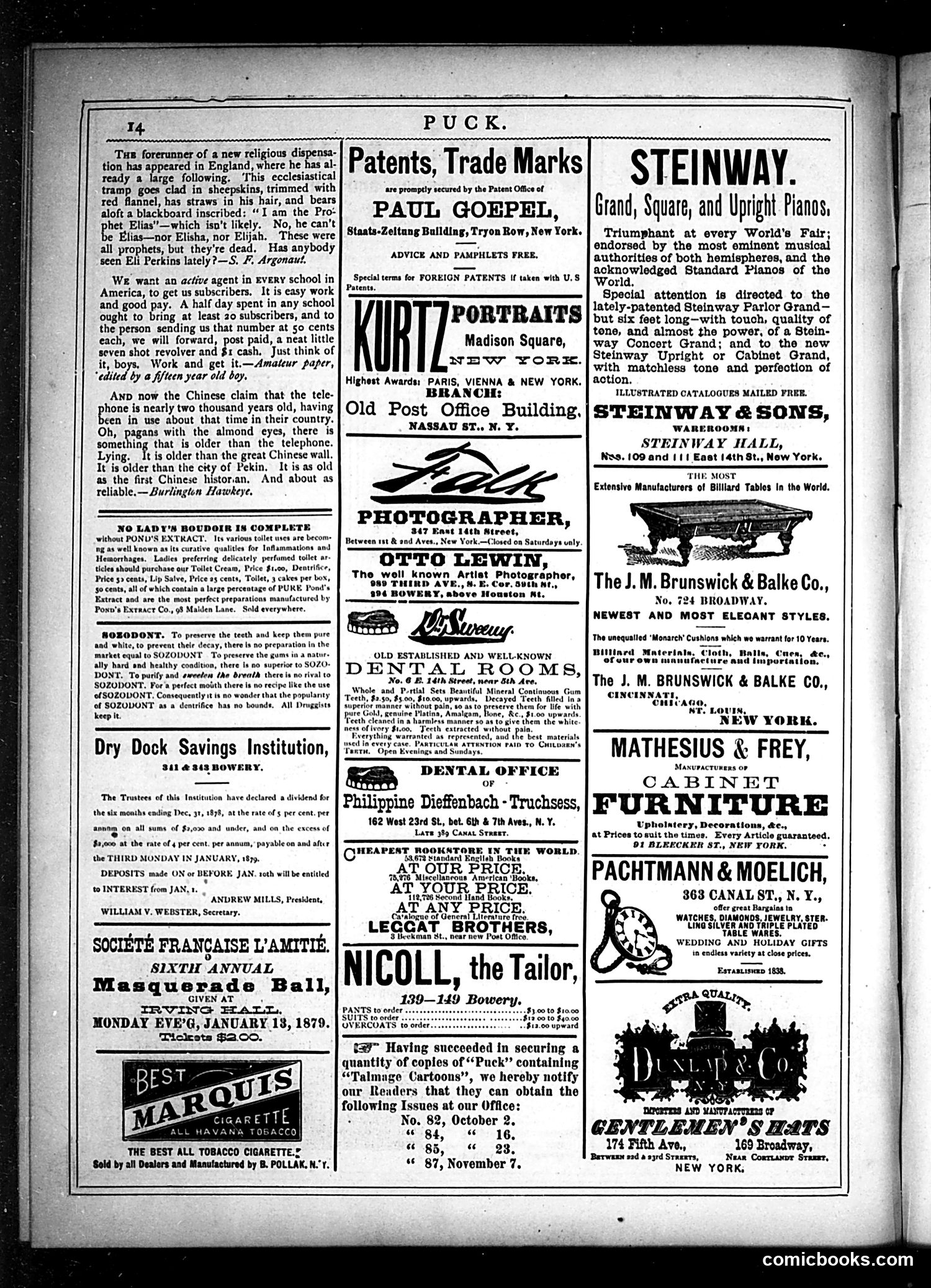
This page is **primarily advertising**, not a satirical cartoon feature. It contains commercial advertisements for various services and products typical of 1879 New York, including: - Piano manufacturers (Steinway) - Patent services - Portrait studios - Dental offices - Furniture companies - A tailor shop - Bookstores - Tobacco products There is **no discernible political cartoon or satire** on this page. The only potentially humorous editorial content appears to be brief text snippets at the top discussing a "new religious dispensation" in Scotland and observations about Chinese history, but these are fragmentary and lack accompanying illustrations to convey satirical intent. This represents a typical advertising-heavy page from *Puck's* interior, rather than a showcase for the magazine's famous satirical cartoons.
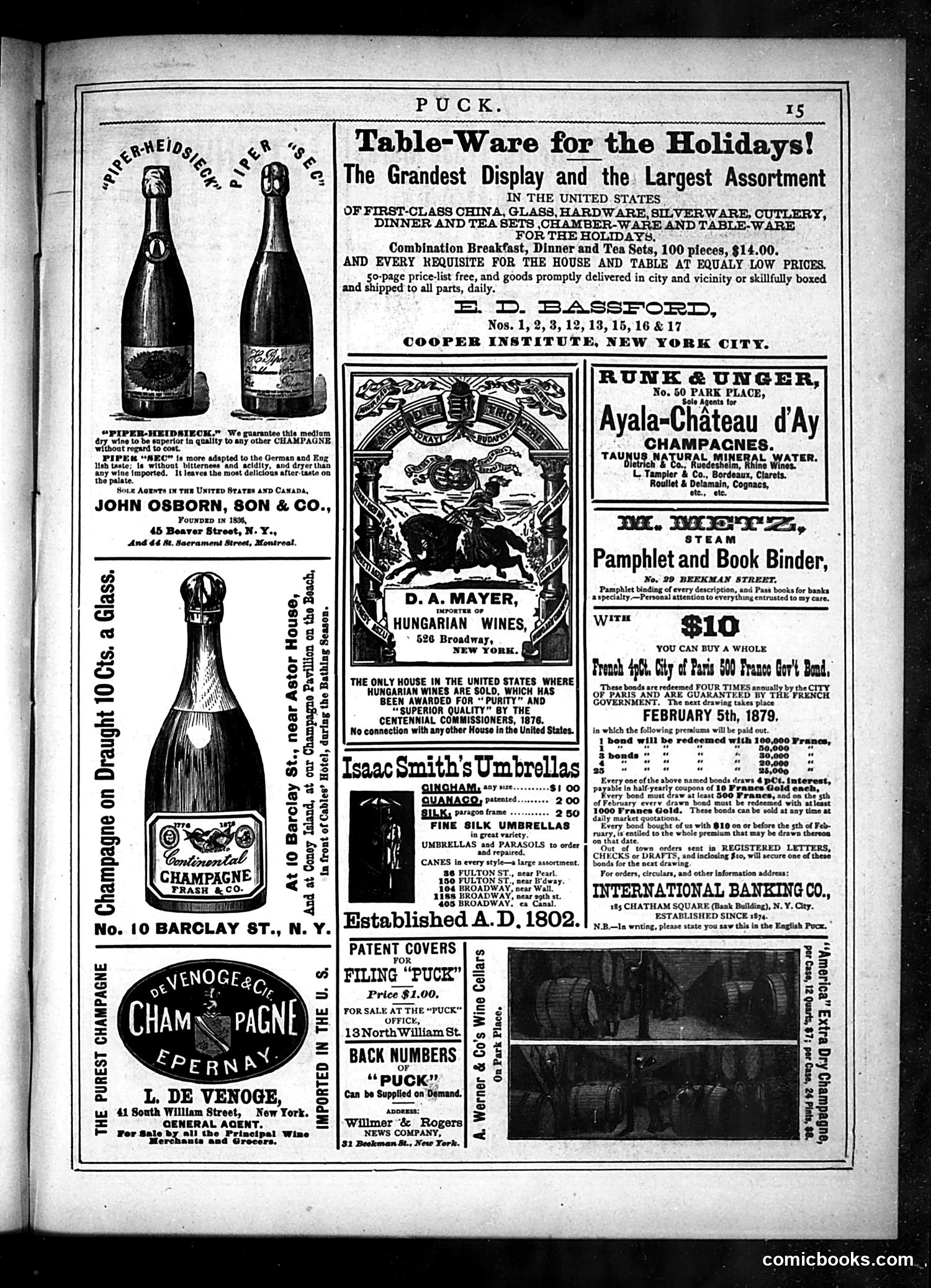
This is primarily an **advertising page** from Puck magazine, not a political cartoon or satire spread. The page consists entirely of commercial advertisements for various products and services, including: - Champagne and wine (Piper-Heidsieck, D.A. Mayer Hungarian Wines, Devenoge & Cie) - Table-ware and dinnerware for holiday shopping - Umbrellas and parasols - A French government bond investment opportunity - Pamphlet binding services - Patent covers for the magazine itself The advertisements reflect late 19th-century consumer goods and services. While the page appears in Puck, it serves a commercial rather than satirical purpose—generating revenue through paid advertisements rather than delivering political or social commentary.
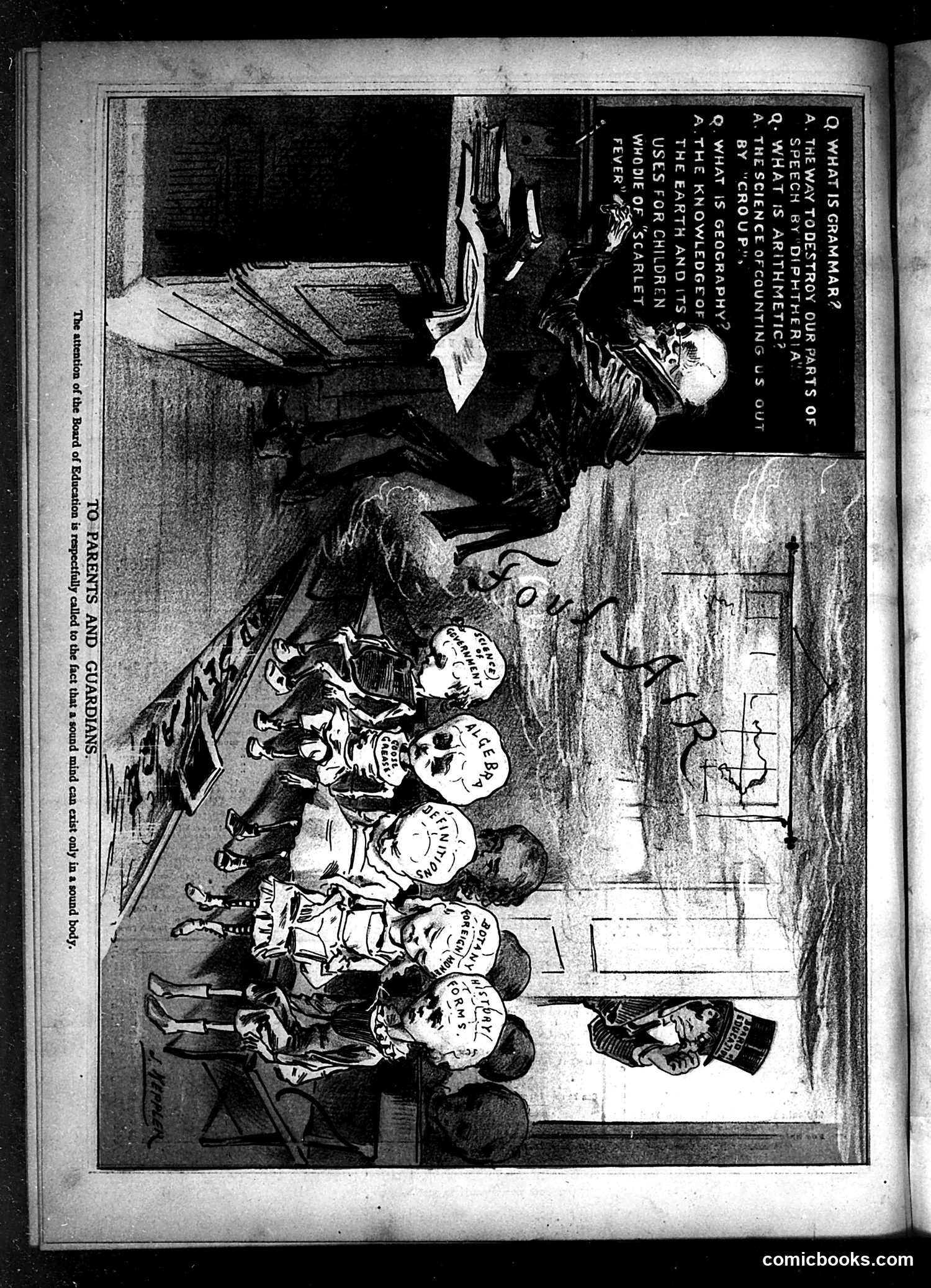
This appears to be a Puck magazine political cartoon titled "To Parents and Guardians," depicting a schoolroom scene. The image shows what appears to be a teacher or authority figure instructing a group of young students wearing caps labeled with various names or designations (text is difficult to read clearly in the reproduction). The satirical point seems to critique education or indoctrination of youth, likely referencing late 19th or early 20th-century concerns about what children were being taught. The hierarchical positioning—with the authority figure elevated above the students—emphasizes the power dynamic. Without clearer legibility of the labels on the students' caps or the specific historical context, I cannot definitively identify the particular political issue or figures being satirized. The cartoon likely addresses contemporary educational debates or concerns about youth socialization from that era.