
Puck, 1879-01-08 · page 6 of 16
Puck — January 8, 1879 — page 6: what you’re looking at
What you’re looking at
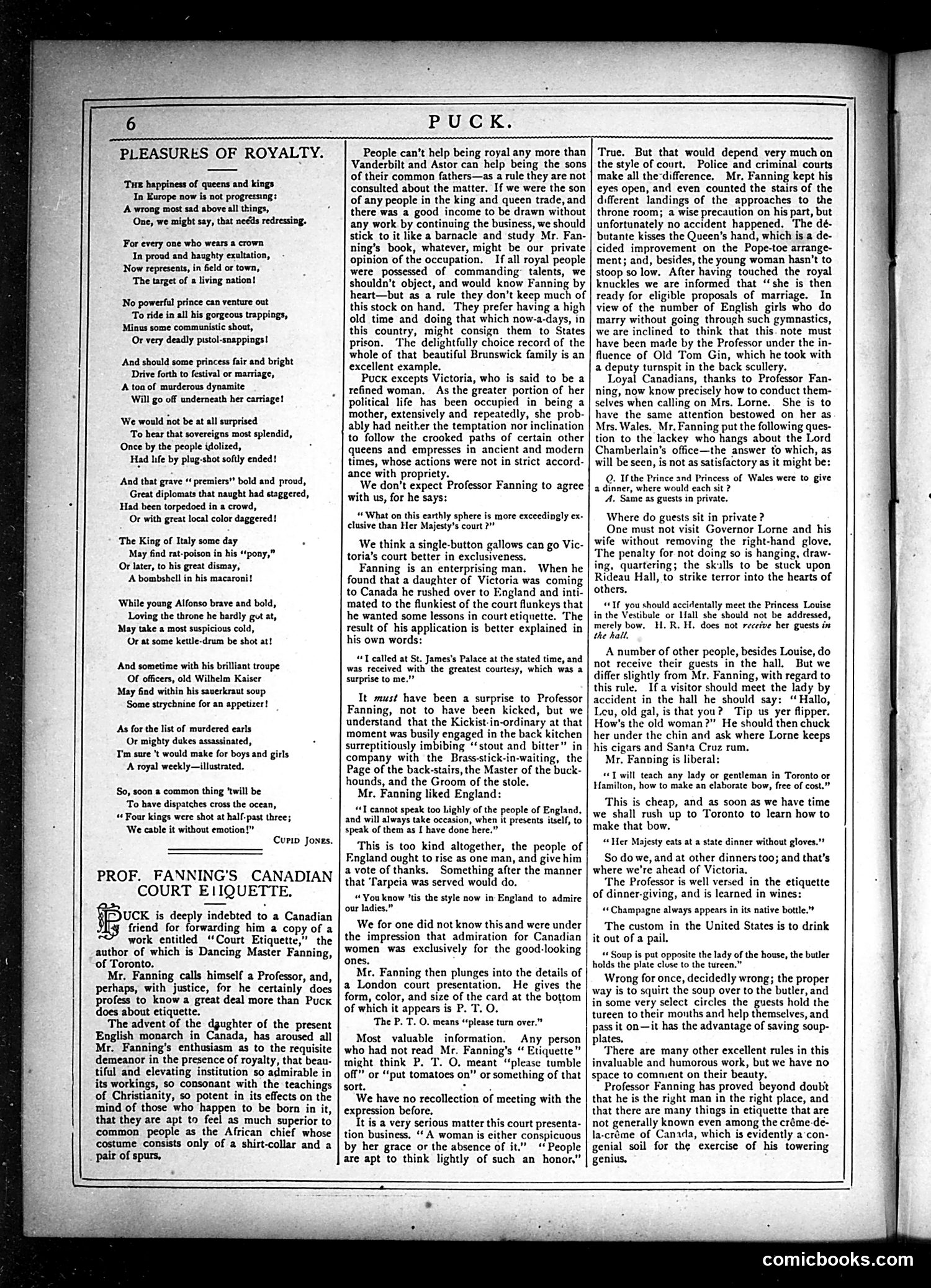
This page contains two satirical pieces about royal protocol and Canadian society. **"Pleasures of Royalty"** is a poem mocking the constraints of royal life—queens and kings lacking genuine freedom despite their status, forced into formality and duty rather than enjoying authentic pleasure. **"Prof. Fanning's Canadian Court Etiquette"** discusses a Professor Fanning who has written about proper court behavior. The satire focuses on Canadian attempts to emulate English royal customs. It includes humorous anecdotes about court rules (gloves at dinners, proper guest positioning, soup-eating etiquette) and pokes fun at Canadians' earnest but sometimes awkward adoption of British aristocratic conventions. The overall tone mocks both the artificiality of royal life and Canadian social pretension in copying English upper-class manners.
📄 Transcribed text from this page (OCR, searchable)
Machine-transcribed from the original scan — historical spelling and the odd misread are preserved.
PLEASURES OF ROYALTY. ‘Tue happiness of queens and kings In Europe now is not progressing: ‘A wrong most sad above all things, One, we might say, that neéds redressing, For every one who wears a crown In proud and haughty exultation, Now represents, in feld or town, The target of a living nation! ‘No powerful prince can venture out To ride in all his gorgeous trappings, Minus some communistic shout, Or very deadly pistol-snappings! ‘And should some princess fair and bright Drive forth to festival or marriage, Aton of murderous dynamite Will go off underneath her carriage! ‘We would not be at all surprised To hear that sovereigns most splendid, Once by the people idolized, Had life by plug-shot softly ended! And that grave “ premiers" bold and proud, Great diplomats that naught had staggered, Had been torpedoed in a crowd, Or with great local color daggered! The King of Italy some day May find rat-poison in his “pony,” Or later, to his great dismay, ‘A bombshell in his macaroni! While young Alfonso brave and bold, Loving the throne he hardly gut at, May take a most suspicious cold, Or at some kettle-drum be shot at! And sometime with his brilliant troupe Of officers, old Wilhelm Kaiser ‘May find within his sauerkraut soup Some strychnine for an appetizer! ‘As for the list of murdered earls Or mighty dukes assassinated, T'm sure 't would make for boys and girls ‘A royal weekly—illustrated. So, soon a common thing ‘twill be To have dispatches cross the ocean, «Four kings were shot at half-past three; We cable it without emotion!” Cori Joxes. PROF. FANNING'S CANADIAN COURT E!IQUETTE. prs is deeply indebted to a Canadian friend for forwarding him a copy of a work entitled ‘Court Etiquette,” the author of which is Dancing Master Fanning, of Toronto. Mr. Fanning calls himself a Professor, and, perhaps, with justice, for he certainly does profess to know a great deal more than Puck does about etiquette. The advent of the dgughter of the present English monarch in Canada, has aroused all Mr. Fanning’s enthusiasm as to the requisite demeanor in the presence of royalty, that beau- tiful and elevating institution so admirable in its workings, so consonant with the teachings of Christianity, so potent in its effects on the mind of those who happen to be born in it, that they are apt to feel as much superior to common people as the African chief whose costume consists only of a shirt-collar and a pair of spurs, PUCK. People can’t help being royal any more than Vanderbilt and Astor can help being the sons of their common fathers—as a rule they are not consulted about the matter. If we were the son of any people in the king and queen trade, and there was a good income to be drawn without any work by continuing the business, we should stick to it like a barnacle and study Mr. Fan- ning’s book, whatever, might be our private opinion of the occupation. If all royal people were possessed of commanding: talents, we shouldn't object, and would know Fanning by heart—but as a rule they don’t keep much of this stock on hand. They prefer having a high old time and doing that which now-a-days, in this country, might consign them to States prison. The delightfully choice record of the whole of that beautiful Brunswick family is an excellent example. Puck excepts Victoria, who is said to be a refined woman. As the greater portion of her political life has been occupied in being a mother, extensively and repeatedly, she prob- ably had neither the temptation nor inclination to follow the crooked paths of certain other queens and empresses in ancient and modern times, whose actions were not in strict accord- ance with propriety. We don't expect Professor Fanning to agree with us, for he says: “What on this earthly sphere is more exceedingly ex- clusive than Her Majesty's court 2”” We think a single-button gallows can go Vic- toria’s court better in exclusiveness. Fanning is an enterprising man. When he found that a daughter of Victoria was coming to Canada he rushed over to England and inti- mated to the flunkiest of the court flunkeys that he wanted some lessons in court etiquette. The result of his application is better explained in his own words: “T called at St. James's Palace at the stated time, and was received with the greatest courtesy, which was a surprise to me." It must have been a surprise to Professor Fanning, not to have been kicked, but we understand that the Kickist-in-ordinary at that moment was busily engaged in the back kitchen surreptitiously imbibing ‘stout and bitter” in company with the Brass-stick-in-waiting, the Page of the back-stairs, the Master of the buck- hounds, and the Groom of the stole, Mr. Fanning liked England: “I cannot speak too Lighly of the people of England, and will always take occasion, when it presents itself, to speak of them as I have done here.” This is too kind altogether, the people of England ought to rise as one man, and give him a vote of thanks. Something after the manner that ‘Tarpeia was served would do. “You know ‘tis the style now in England to admire our ladies.” We for one did not know this and were under the impression that admiration for Canadian women was exclusively for the good-looking ones, Mr. Fanning then plunges into the details of a London court presentation. He gives the form, color, and size of the card at the bottom of which it appears is P. T. O. The P. T. O. means “please turn over.” Most valuable information. Any person who had not read Mr. Fanning’s “ Etiquette” might think P. T. O. meant “please tumble off” or “put tomatoes on” or something of that sort. lees We have no recollection of meeting with the expression before. It is a very serious matter this court presenta- tion business, ‘A woman is either conspicuous by her grace or the absence of it.” ‘People are apt to think lightly of such an honor,” True. But that would depend very much on the style of court, Police and criminal courts make all the-difference. Mr. Fanning kept his eyes open, and even counted the stairs of the different landings of the approaches to the throne room; a wise precaution on his part, but unfortunately no accident happened. The dé- butante kisses the Queen’s hand, which is a de- cided improvement on the Pope-toe arrange- ment; and, besides, the young woman hasn't to stoop so low. After having touched the royal knuckles we are informed that ‘she is then ready for eligible proposals of marriage. In view of the number of English girls who do marry without going through such gymnastics, we are inclined to think that this. note must have been made by the Professor under the in- fluence of Old Tom Gin, which he took with a deputy turnspit in the back scullery, Loyal Canadians, thanks to Professor Fan- ning, now know precisely how to conduct them- selves when calling on Mrs. Lorne. She is to have the same attention bestowed on her as Mrs. Wales, Mr. Fanning put the following ques- tion to the lackey who hangs about the Lord Chamberlain's office—the answer to which, as will be seen, is not as satisfactory as it might be: Q. Ifthe Prince and Princess of Wales were to give a dinner, where would each sit ? ‘A. Same as guests in private. Where do guests sit in private ? One must not visit Governor Lorne and his wife without removing the right-hand glove. The penalty for not doing so is hanging, draw- ing, quartering; the skulls to be stuck upon Rideau Hall, to strike terror into the hearts of others, “If you should accidentally meet the Princess Louise in the Vestibule or Iall she should not be addressed, merely bow. H.R. H. does not receive her guests in the hall. A number of other people, besides Louise, do not receive their guests in the hall. But we differ slightly from Mr. Fanning, with regard to this rule. If a visitor should meet the lady by accident in the hall he should say: “Hallo, Leu, old gal, is that you? Tip us yer flipper. How's the old woman ?” He should then chuck her under the chin and ask where Lorne keeps his cigars and Santa Cruz rum. Mr. Fanning is liberal: “Twill teach any lady or gentleman in Toronto or Hamilton, how to make an elaborate bow, free of cost.” This is cheap, and as soon as we have time we shall rush up to Toronto to learn how to make that bow. “Her Majesty eats at a state dinner without gloves.” So do we, and at other dinners too; and that’s where we're ahead of Victoria. The Professor is well versed in the etiquette of dinner-giving, and is learned in wines: «Champagne always appears in its native bottle.”” The custom in the United States is to drink it out of a pail. «+ Soup is put opposite the lady of the house, the butler holds the plate close to the tureen.” Wrong for once, decidedly wrong; the proper way is to squirt the soup over to the butler, and in some very select circles the guests hold the tureen to their months and help themselves, and pass it on—it has the advantage of saving soup- plates, There are many other excellent rules in this invaluable and humorous work, but we have no space to comment on their beauty. Professor Fanning has proved beyond doubt that he is the right man in the right place, and that there are many things in etiquette that are not generally known even among the créme-dé- la-créme of Canada, which is evidently a'con- genial soil for the exercise of his towering genius, comicbooks.com