
Puck, 1879-01-08 · page 10 of 16
Puck — January 8, 1879 — page 10: what you’re looking at
What you’re looking at
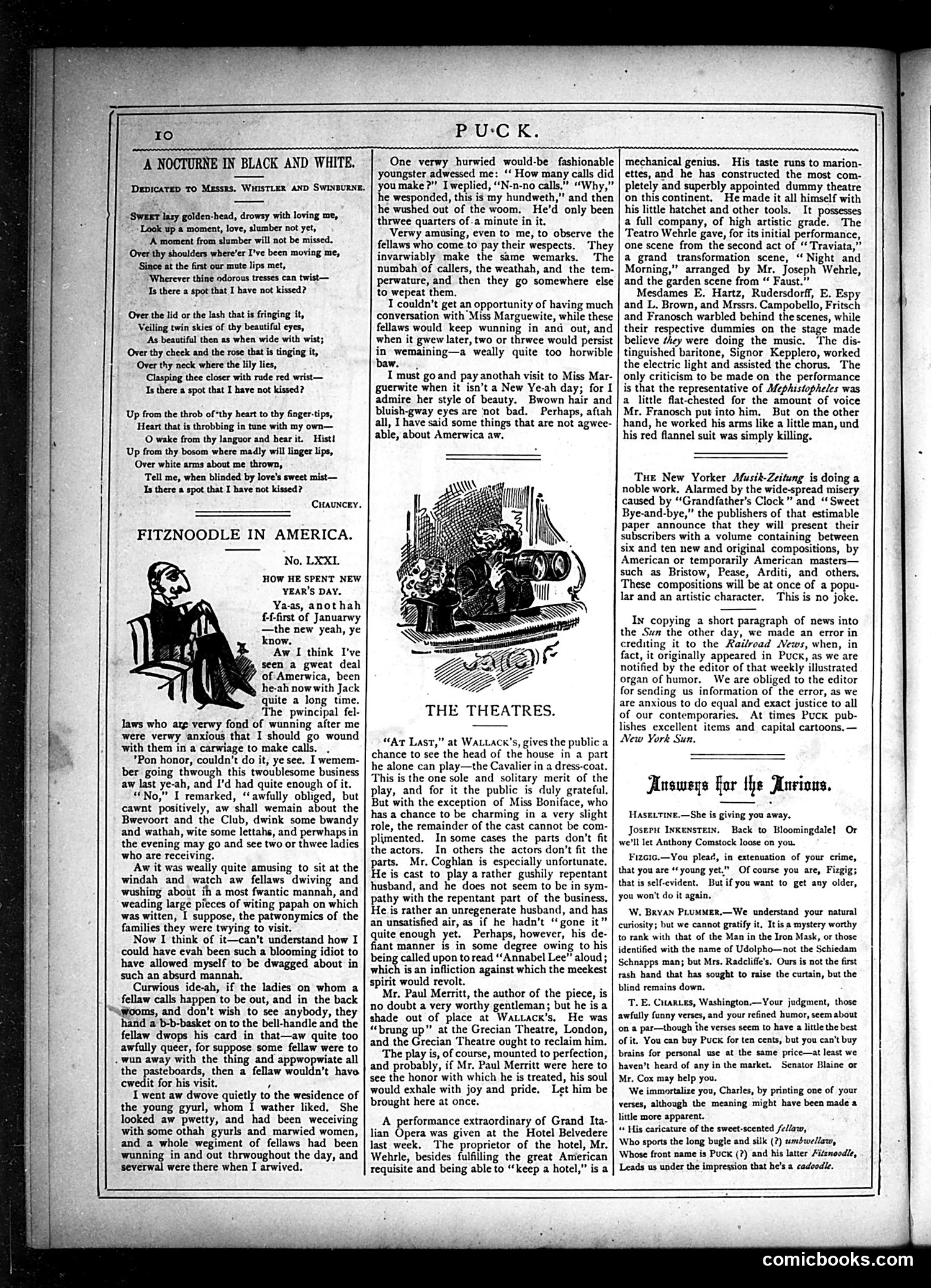
This page contains literary and theatrical commentary rather than political cartoons. The main content includes: **"A Nocturne in Black and White"** - A poem by Whistler and Swinburne (likely a satire on these artists' styles). **"Fitznoodle in America"** - A humorous piece about a character's first New Year's Day in America, poking fun at American social customs and etiquette around holiday visiting. **"The Theatres"** section critiques current stage productions, including a detailed review of "At Last" at Wallace's Theatre, criticizing various actors' performances and noting Miss Boniface as the only charming performer. **"Answers for the Antiques"** - A witty Q&A column addressing reader inquiries about literary and cultural figures. The illustration shows a rotund gentleman in Victorian dress, likely representing the "Fitznoodle" character. The content satirizes American social conventions and theatrical mediocrity rather than specific political figures.
📄 Transcribed text from this page (OCR, searchable)
Machine-transcribed from the original scan — historical spelling and the odd misread are preserved.
ieee A NOCTURNE IN BLACK AND WHITE. DEDICATED TO Messrs. WHISTLER AND SWINBURNE. “Sweet lazy golden-head, drowsy with loving me, “Look up a moment, love, slumber not yet, ‘A moment from slumber will not be missed. Over thy shoulders where’er I’ve been moving me, ‘Since at the first our mute lips met, “Wherever thine odorous tresses can twist— Is there a spot that I have not kissed? Over the lid or the lash that is fringing it, Veiling twin skies of thy beautiful eyes, ‘As beautifal then as when wide with wist; ‘Over thy cheek and the rose that is tinging it, ‘Over thy neck where the lily lies, Clasping thee closer with rude red wrist— Is there a spot that I have not kissed? Up from the throb of thy heart to thy finger-tips, Heart that is throbbing in tune with my own— O wake from thy languor and hear it. Hist! Up from thy bosom where madly will linger lips, Over white arms about me thrown, Tell me, when blinded by love's sweet mist— Is there a spot that I have not kissed? (CHAUNCEY. FITZNOODLE IN AMERICA. No, LXXL HOW HE SPENT NEW YEAR'S DAY, Ya-as, anothah f-f-first of Januarwy —the new yeah, ye know. Aw I think I've seen a gweat deal of Amerwica, been he-ah nowwith Jack quite a long time. The pwincipal fel- laws who arg verwy fond of wunning after me were verwy anxious that I should go wound with them in a carwiage to make calls. . "Pon honor, couldn’t do it, ye see. I wemem- ber going thwough this twoublesome business aw last ye-ah, and I'd had quite enough of it. *€No,” I remarked, ‘awfully obliged, but cawnt positively, aw shall wemain about the Bwevoort and the Club, dwink some bwandy and wathah, wite some lettahs, and perwhapsin the evening may go and see two or thwee ladies who are receiving. ‘Aw it was weally quite amusing to sit at the windah and watch aw fellaws dwiving and wushing about ih a most fwantic mannah, and weading large pieces of witing papah on which was witten, I suppose, the patwonymics of the families they were twying to visit. Now I think of it—can’t understand how I could have evah been such a blooming idiot to have allowed myself to be dwagged about in such an absurd mannah. Curwious ide-ah, if the ladies on whom a fellaw calls happen to be out, and in the back “wooms, and don’t wish to see anybody, they hand a b-b-basket on to the bell-handle and the fellaw dwops his card in that—aw quite too awfully queer, for suppose some fellaw were to . wun away with the thing and appwopwiate all the pasteboards, then a fellaw wouldn't havo cwedit for his visit. ' I went aw dwove quietly to the wesidence of the young gyurl, whom I wather liked. She looked aw pwetty, and had been weceiving with some othah gyurls and marwied women, and a whole wegiment of fellaws had been wunning in and out thrwoughout the day, and were there when I arwived. severwi PUCK. One verwy hurwied would-be fashionable youngster adwessed me: “ How many calls did you make ?”” I weplied, ‘‘N-n-no calls.” “Why,” he wesponded, this is my hundweth,” and then he wushed out of the woom. He'd only been thrwee quarters of a minute in it. Verwy amusing, even to me, to observe the fellaws who come to pay their wespects. ‘They invarwiably make the same wemarks. The numbah of callers, the weathah, and the tem- perwature, and then they go somewhere else to wepeat them. I couldn’t get an opportunity of having much conversation with Miss Marguewite, while these fellaws would keep wunning in and out, and when it gwew later, two or thrwee would persist in wemaining—a weally quite too horwible baw. I must go and pay anothah visit to Miss Mar- guerwite when it isn’t a New Ye-ah day; for I admire her style of beauty. Bwown hair and bluish-gway eyes are not bad. Perhaps, aftah all, Ihave said some things that are not agwee- able, about Amerwica aw, “Ar Last,” at WALLACK's, gives the public a chance to see the head of the house in a part he alone can play—the Cavalier in a dress-coat. This is the one sole and solitary merit of the play, and for it the public is duly grateful. But with the exception of Miss Boniface, who has a chance to be charming in a very slight role, the remainder of the cast cannot be com- plimented. In some cases the parts don’t fit the actors. In others the actors don't fit the parts. Mr. Coghlan is especially unfortunate. He is cast to play arather gushily repentant husband, and he does not seem to be in sym- pathy with the repentant part of the business. He is rather an unregenerate husband, and has an unsatisfied air, as if he hadn’t ‘gone it” quite enough yet. Perhaps, however, his de- fiant manner is in some degree owing to his being called upon toread ‘Annabel Lee” aloud; which is an infliction against which the meekest spirit would revolt. Mr. Paul Merritt, the author of the piece, is no doubt a very worthy gentleman; but he is a shade out of place at Wattack’s, He was “brung up” at the Grecian Theatre, London, and the Grecian Theatre ought to reclaim him. The play is, of course, mounted to perfection, and probably, if Mr. Paul Merritt were here to see the honor with which he is treated, his soul would exhale with joy and pride. Let him be brought here at once. A performance extraordinary of Grand Ita- lian Opera was given at the Hotel Belvedere last week. The proprietor of the hotel, Mr. Wehrle, besides fulfilling the great American requisite and being able to ‘‘keep a hotel,” is a mechanical genius. His taste runs to marion- ettes, and he has constructed the most com- pletely and superbly appointed dummy theatre on this continent. He made it all himself with his little hatchet and other tools. It possesses a full company, of high artistic grade. The ‘Teatro Wehrle gave, for its initial performance, one scene from the second act of “Traviata,” a grand transformation scene, “ Night and Morning,” arranged by Mr. Joseph Wehrle, and the garden scene from “ Faust.” Mesdames E. Hartz, Rudersdorff, E. Espy and L, Brown, and Mrssrs. Campobello, Fritsch and Franosch warbled behind the scenes, while their respective dummies on the stage made believe they were doing the music. The dis- tinguished baritone, Signor Kepplero, worked the electric light and assisted the chorus, The only criticism to be made on the performance is that the representative of Mephistopheles was a little flat-chested for the amount of voice Mr. Franosch put into him. But on the other hand, he worked his arms like a little man, und his red flannel suit was simply killing. Tue New Yorker Musik-Zeitung is doing a noble work, Alarmed by the wide-spread misery caused by “Grandfather's Clock” and “ Sweet Bye-and-bye,” the publishers of that estimable paper announce that they will present their subscribers with a volume containing between six and ten new and original compositions, by American or temporarily American masters— such as Bristow, Pease, Arditi, and others, These compositions will be at once of a popu- lar and an artistic character. This is no joke. In copying a short paragraph of news into the Sun the other day, we made an error in crediting it to the Railroad News, when, in fact, it originally appeared in Puck, as we are notified by the editor of that weekly illustrated organ of humor. We are obliged to the editor for sending us information of the error, as we are anxious to do equal and exact justice to all of our contemporaries. At times Puck pub- lishes excellent items and capital cartoons. — New York Sun. Answeys for the Anriaus. Hasettive.—She is giving you away. Joseru INKENSTEIN, Back to Bloomingdale! Or we'll let Anthony Comstock loose on you. Fizo1c.—You plead, in extenuation of your crime, that you are young yet.” Of course you are, Fizgig; that is self-evident. But if you want to get any older, you won't do it again, W. Bryan PiumMeR.—We understand your natural curiosity; but we cannot gratify it, Itis a mystery worthy to rank with that of the Man in the Iron Mask, or those identified with the name of Udolpho—not the Schiedam Schnapps man; but Mrs. Radcliffe's. Ours is not the first rash hand that has sought to raise the curtain, but the blind remains down. T.E. CHARLES, Washington.—Your judgment, those awfully funny verses, and your refined humor, seem about on a par—though the verses seem to have a little the best of it. You can buy Puck for ten cents, but you can’t buy brains for personal use at the same price—at least we haven’t heard of any in the market. Senator Blaine or Mr. Cox may help you, ‘We immortalize you, Charles, by printing one of your verses, although the meaning might have been made a little more apparent. «« His caricature of the sweet-scented /ellaw, Who sports the long bugle and silk (?) umSwellaw, Whose front name is Puck (?) and his latter Fitsnoodle, Leads us under the impression that he’s a cadodle. | comicbooks.com