
Puck, 1879-01-08 · page 7 of 16
Puck — January 8, 1879 — page 7: what you’re looking at
What you’re looking at
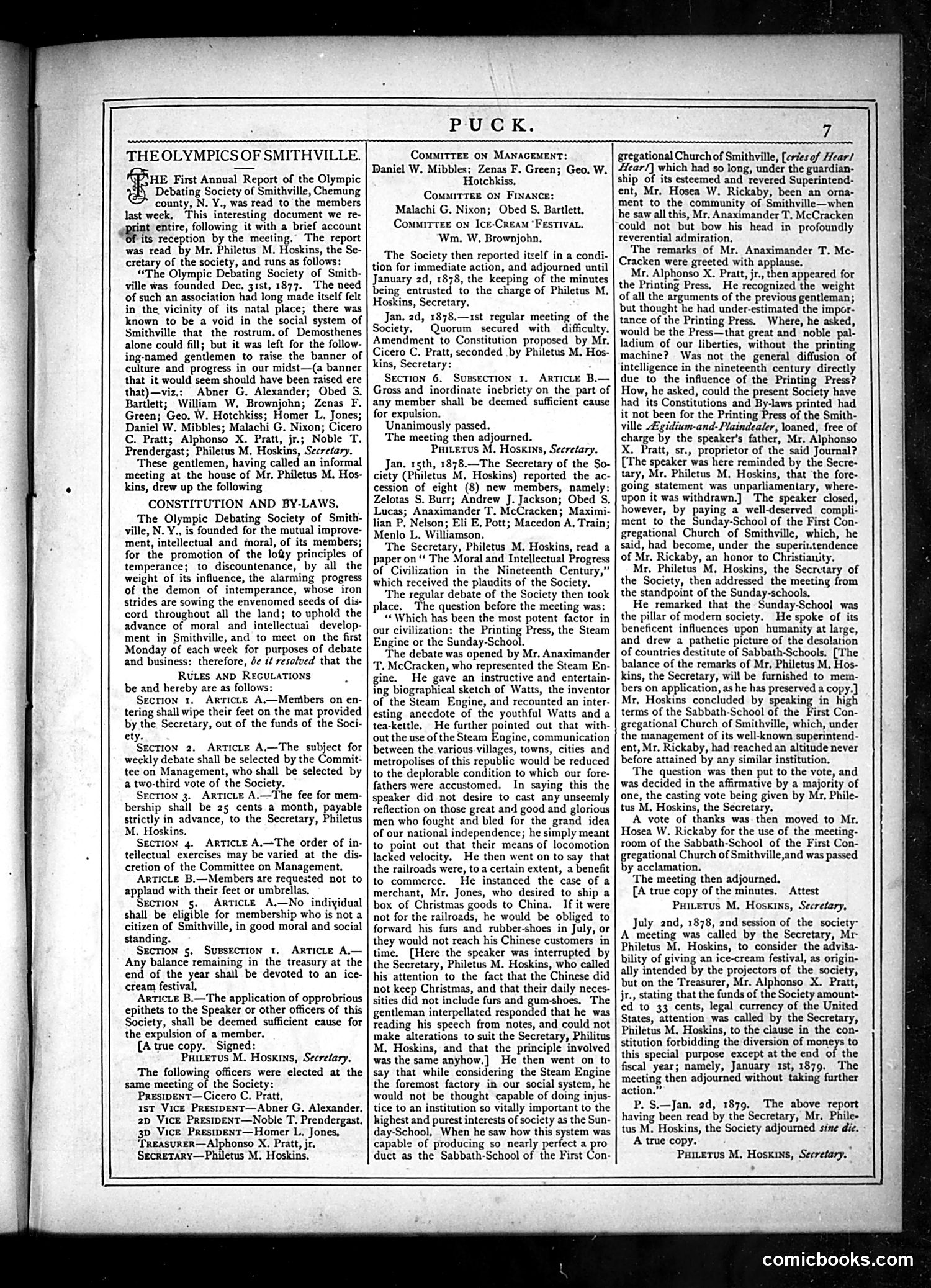
This page contains **no cartoon or satirical illustration**—it is entirely text documenting the minutes and constitution of the Olympic Debating Society of Smithville, New York, established December 31, 1877. The content records meeting proceedings, elected officers (including President Cicero C. Pratt and Secretary Philetus M. Hoskins), and constitutional rules governing debates on topics like "The Printing Press" and "The Steam Engine." This appears to be a **society records page** rather than satirical content. Puck magazine occasionally published such institutional documents alongside humor. The page has historical value as documentation of 19th-century American civic organizations and their formal procedures, but contains no political satire or caricature for modern readers to interpret.
📄 Transcribed text from this page (OCR, searchable)
Machine-transcribed from the original scan — historical spelling and the odd misread are preserved.
PUCK. 7 THEOLYMPICS OF SMITHVILLE. HE First Annual Report of the Olympic Debating Society of Smithville, Chemung county, N. Y., was read to the members last week. This interesting document we re- .print entire, following it with a brief account its reception by the meeting.” The report was read by Mr, Philetus M. Hoskins, the Se- cretary of the society, and runs as follows: “The Olympic Debating Society of Smith- ville was founded Dec. 31st, 1877. The need of such an association had long made itself felt in the vicinity of its natal place; there was known to be a void in the social system of Smithville that the rostrum, of Demosthenes alone could fill; but it was left for the follow- ing-named gentlemen to raise the banner of culture and progress in our midst—(a banner that it would seem should have been raised ere that)—viz.: Abner G. Alexander; Obed 3S. Bartlett; William W. Brownjohn; Zenas F. Green; Geo, W. Hotchkiss; Homer L. Jones; Daniel W. Mibbles; Malachi G. Nixon; Cicero C. Pratt; Alphonso X. Pratt, jr; Noble T. Prendergast; Philetus M. Hoskins, Secretary, ‘These gentlemen, having called an informal meeting at the house of Mr. Philetus M. Hos- kins, drew up the following CONSTITUTION AND BY-LAWS, The Olympic Debating Society of Smith- ville, N. Y., is founded for the mutual improve- ment, intellectual and moral, of its members; for the promotion of the logy principles of temperance; to discountenance, by all the weight of its influence, the alarming progress of the demon of intemperance, whose iron strides are sowing the envenomed seeds of dis- cord throughout all the land; to uphold the advance of moral and intellectuai develop- ment in Smithville, and to meet on the first Monday of each week for purposes of debate and business: therefore, de s¢ resolved that the Rugs AND REGULATIONS be and hereby are as follow: Secrion 1. ARtICLE A.—Mentbers on en- tering shall wipe their feet on the mat provided by the Secretary, out of the funds of the Soci- ety. Section 2. Articte A.—The subject for weekly debate shall be selected by the Commit- tee on Management, who shall be selected by a two-third vote of the Society. Section 3. ARTICLE A.—The fee for mem- bership shall be 25 cents a month, payable strictly in advance, to the Secretary, Philetus M. Hoskins, Section 4. ARTICLE A.—The order of in- tellectual exercises may be varied at the dis- cretion of the Committee on Management. ArticLe B.—Members are requested not to applaud with their feet or umbrellas, Section 5. AxticLe A.—No indiyidual shall be eligible for membership who is not a citizen of Smithville, in good moral and social standing. SecTION 5. SuBsEcTiIon 1. ARTICLE A,— Any balance remaining in the treasury at the end of the year shail be devoted to an ice- cream festival. ‘Arricte B.—The application of opprobrious epithets to the Speaker or other officers of this Society, shall be deemed sufficient cause for the expulsion of a member. [A true copy. Signed: Puitetus M. Hoskins, Secrefary, The following officers were elected at the same meeting of the Society: Presipent—Cicero C. Pratt, 1st Vice Presipent—Abner G. Alexander. 2p Vice Presipent—Noble T. Prendergast. 3p Vice Presipent—Homer L. Jones, ‘TREASURER—A|phonso X. Pratt, jr. SecreTaRY—Philetus M. Hoskins. ComMiTT£e ON MANAGEMENT: Daniel W. Mibbles; Zenas F. Green; Geo, W. Hotchkiss, ComTTEE ON FINANCE: Malachi G. Nixon; Obed S. Bartlett. Committee on Ice-Cream ‘Festivan, Wm. W. Brownjohn, The Society then reported itcelf in a condi- tion for immediate action, and adjourned until January 2d, 1878, the keeping of the minutes being entrusted to the charge of Philetus M. Hoskins, Secretary, Jan. 2d, 1878,—1st regular meeting of the Society. | Quorum secured with difficulty. Amendment to Constitution proposed by Mr. Cicero C. Pratt, seconded by Philetus M, Hos- kins, Secretary: Section 6. Supsecrion 1. ARTICLE B.— Gross and inordinate inebriety on the part of any member shall be deemed sufficient cause for expulsion. Unanimously passed. The meeting then adjourned. Puitetus M. Hoskins, Secretary. Jan, 15th, 1878.—The Secretary of the So- ciety (Philetus M. Hoskins) reported the ac- cession of eight (8) new members, namely: Zelotas S. Burr; Andrew J. Jackson; Obed S. Lucas; Anaximander T. McCracken; Maximi- lian P, Nelson; Eli E, Pott; Macedon A. Train; Menlo L. Williamson, The Secretary, Philetus M. Hoskins, read a paper on The Moral and Intellectual Progress of Civilization in the Nineteenth Century,” which received the plaudits of the Society. The regular debate of the Society then took place. The question before the meeting was: “‘Which has been the most potent factor in our civilization: the Printing Press, the Steam Engine or the Sunday-School. The debate was opened by Mr. Anaximander ‘T. McCracken, who represented the Steam En- gine. He gave an instructive and entertain- ing biographical sketch of Watts, the inventor of the Steam Engine, and recounted an inter- esting anecdote of the youthful Watts and a tea-kettle. He further pointed out that with- out the use of the Steam Engine, communication between the various villages, towns, cities and metropolises of this republic would be reduced to the deplorable condition to which our fore- fathers were accustomed. In saying this the speaker did not desire to cast any unseemly reflection on those great and good and glorious men who fought and bled for the grand idea of our national independence; he simply meant to point out that their means of locomotion lacked velocity. He then went on to say that the railroads were, toa certain extent, a benefit to commerce. He instanced the case of a merchant, Mr. Jones, who desired to ship a box of Christmas goods to China. If it were not for the railroads, he would be obliged to forward his furs and rubber-shoes in July, or they would not reach his Chinese customers in time. [Here the speaker was interrupted by the Secretary, Philetus M. Hoskins, who called his attention to the fact that the Chinese did not keep Christmas, and that their daily neces- sities did not include furs and gum-shoes, The gentleman interpellated responded that he was reading his speech from notes, and could not make alterations to suit the Secretary, Philitus M. Hoskins, and that the principle involved was the same anyhow.] He then went on to say that while considering the Steam Engine the foremost factory in our social system, he would not be thought capable of doing injus- tice to an institution so vitally important to the highest and purest interests of society as the Sun- day-School, When he saw how this system was capable of producing so nearly perfect a pro duct as the Sabbath-School of the First Con- gregational Church of Smithville, [cries of Hear! Hear! which had so long, under the guardian- ship of its esteemed and revered Superintend- ent, Mr. Hosea W. Rickaby, been an orna- ment to the community of Smithville—when he saw all this, Mr, Anaximander T. McCracken could not but bow his head in profoundly reverential admiration. The remarks of Mr. Anaximander T. Mc- Cracken were greeted with applause. Mr. Alphonso X. Pratt, jr., then appeared for the Printing Press, He recognized the weight of all the arguments of the previous gentleman; but thought he had under-estimated the impor- tance of the Printing Press, Where, he asked, would be the Press—that great and noble pal- ladium of our liberties, without the printing machine? Was not the general diffusion of intelligence in the nineteenth century directly due to the influence of the Printing Press? How, he asked, could the present Society have had its Constitutions and By-laws printed had it not been for the Printing Press of the Smith- ville 22gidium-and-Plaindealer, loaned, free of charge by the speaker's father, Mr. Alphonso X. Pratt, sr., proprietor of the said Journal? [The speaker was here reminded by the Secre- tary, Mr. Philetus M. Hoskins, that ‘the fore- going statement was unparliamentary, where- upon it was withdrawn.] The speaker closed, however, by paying a well-deserved compli- ment to the Sunday-School of the First Con- gregational Church of Smithville, which, he said, had become, under the superir.tendence of Mr, Rickaby, an honor to Christianity. Mr. Philetus M. Hoskins, the Secretary of the Society, then addressed the meeting from the standpoint of the Sunday-schools, He remarked that the Sunday-School was the pillar of modern society. He spoke of its beneficent influences upon humanity at large, and drew a pathetic picture of the desolation of countries destitute of Sabbath-Schools. [The balance of the remarks of Mr, Philetus M. Hos- kins, the Secretary, will be furnished to mem- bers on application, as he has preserved a copy.] Mr. Hoskins concluded by speaking in high terms of the Sabbath-School of the First Con- gregational Church of Smithville, which, under the management of its well-known superintend- ent, Mr. Rickaby, had reached an altitude never before attained by any similar institution. The question was then put to the vote, and was decided in the affirmative by a majority of one, the casting vote being given by Mr. Phile- tus M. Hoskins, the Secretary, A vote of thanks was then moved to Mr. Hosea W. Rickaby for the use of the meeting- room of the Sabbath-School of the First Con- gregational Church of Smithville,and was passed by acclamation, The meeting then adjourned, [A true copy of the minutes. Attest Puivetus M. Hoskins, Secretary, July and, 1878, 2nd session of the society A meeting was called by the Secretary, Mr Philetus M. Hoskins, to consider the advi8a- hility of giving an ice-cream festival, as origin- ally intended by the projectors of the society, but on the Treasurer, Mr. Alphonso X. Pratt, jr., stating that the funds of the Society amount- ed to 33 cents, legal currency of the United States, ‘attention was called by the Secretary, Philetus M. Hoskins, to the clause in the con- stitution forbidding the diversion of moneys to this special purpose except at the end of the fiscal year; namely, January 1st, 1879. The meeting then adjourned without taking further action.” P, S.—Jan. 2d, 1879. The above report having been read by the Secretary, Mr. Phile- tus M. Hoskins, the Society adjourned sine die. A true copy. : Puitetus M. Hoskins, Secretary, comicbooks.com