
Puck, 1879-01-08 · page 12 of 16
Puck — January 8, 1879 — page 12: what you’re looking at
What you’re looking at
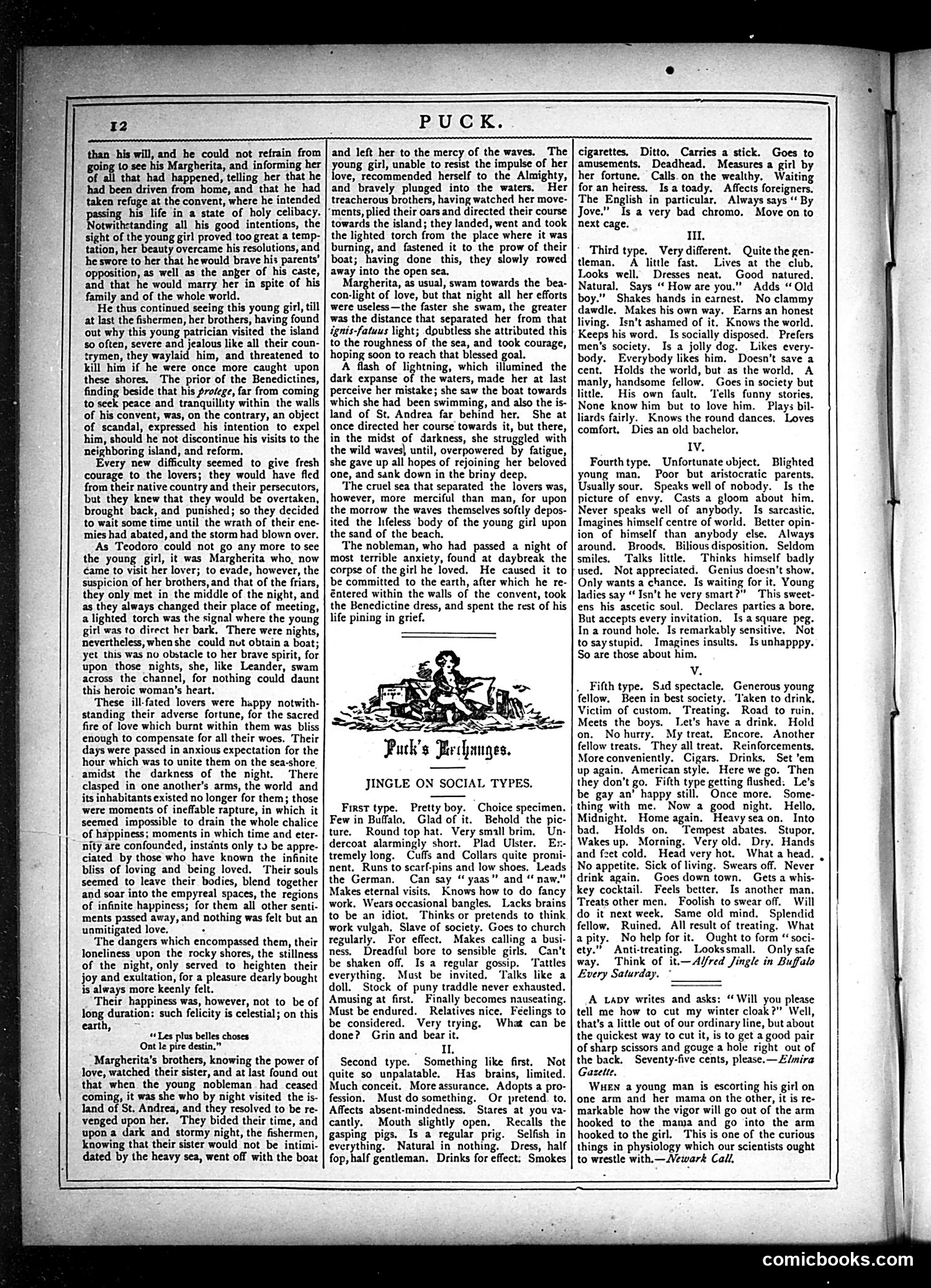
This page contains **Puck's Beginnings**, a satirical section describing social stereotypes. Rather than a political cartoon, it's a series of character sketches mocking recognizable types in late 19th-century society. The visible entries mock people like the "Pretty boy" (vain, fashionable), the "Sad spectacle" (a formerly wealthy man now poor), and the "Unimportant object" (likely someone socially insignificant). Each type receives witty, biting commentary on their pretensions, mannerisms, or social failures. The illustration shows what appears to be a social gathering or party scene, reinforcing the satirical focus on social behavior and class dynamics. This format—mocking recognizable social types—was typical Puck humor: ridiculing the follies and vanities of contemporary society through character observation.
📄 Transcribed text from this page (OCR, searchable)
Machine-transcribed from the original scan — historical spelling and the odd misread are preserved.
than his will, and he could not reteain from to see his Margherita, and informing her ot that had hanced’ telling her that he had been driven from home, and that he had taken refuge at the convent, where he intended ing his life in a state of holy celibacy. Notwithstanding all his good intentions, the sight of the young girl proved too great a temp- tation, her beauty overcame his resolutions, and he swore to her that he would brave his parents’ opposition, as well as the anger of his caste, and that he would marry her in spite of his family and of the whole world. : He thus continued seeing this young girl, till at last the fishermen, her brothers, having found out why this young patrician visited the island so often, severe and jealous like all their coun- trymen, they waylaid him, and threatened to kill him if he were once more caught upon these shores, The prior of the Benedictines, finding beside that his protege, far from coming to seek peace and tranquillity within the walls of his convent, was, on the contrary, an object of scandal, expressed his intention to expel him, should he not discontinue his visits to the neighboring island, and reform. Every new difficulty seemed to give fresh courage to the lovers; they would have fled from their native country and their persecutors, but they knew that they would be overtaken, brought back, and punished; so they decided to wait some time until the wrath of their ene- mies had abated, and the storm had blown over. As Teodoro could not go any more to see the young girl, it was Margherita who, now ¢ame to visit her lover; to evade, however, the suspicion of her brothers, and that of the friars, they only met in the middle of the night, and as they always changed their place of meeting, a lighted torch was the signal where the young girl was to direct her bark, There were nights, nevertheless, when she could nut obtain a boat; yet this was no obstacle to her brave spirit, for upon those nights, she, like Leander, swam across the channel, for nothing could daunt this heroic woman's heart. These ill-fated lovers were happy notwith- standing their adverse fortune, for the sacred fire of love which burnt within them was bliss enough to compensate for all their woes. Their days were passed in anxious expectation for the hour which was to unite them on the sea-shore amidst the darkness of the night. There clasped in one another’s arms, the world and its inhabitants existed no longer for them; those were moments of ineffable rapture, in which it seemed impossible to drain the whole chalice of happiness; moments in which time and eter- nity are confounded, instants only to be appre- ciated by those who have known the infinite bliss of loving and being loved. ‘Their souls seemed to leave their bodies, blend together and soar into the empyreal spaces, the regions of infinite happiness; for them all other senti- ments passed away, and nothing was felt but an unmitigated love. + The dangers which encompassed them, their loneliness upon the rocky shores, the stillness of the night, only served to heighten their joy and exultation, for a pleasure dearly bought is always more keenly felt. Their happiness was, however, not to be of long duration: such felicity is celestial; on this earth, «Les plus belles choses Ont le pire destin,” Margherita’s brothers, knowing the power of love, watched their sister, and at last found out that when the young nobleman had ceased coming, it was she who by night visited the is- land of St. Andrea, and they resolved to be re- venged upon her, They bided their time, and upon a dark and stormy night, the fishermen, knowing that their sister would not be intimi- dated by the heavy sea, went off with the boat PUCK. and left her to the mercy of the waves. The young girl, unable to resist the impulse of her love, recommended herself to the Almighty, and bravely plunged into the waters, Her treacherous brothers, having watched her move- ‘ments, plied their oars and directed their course towards the island; they landed, went and took the lighted torch from the place where it was burning, and fastened it to the prow of their boat; having done this, they slowly rowed away into the open sea, Margherita, as usual, swam towards the bea- con-light of love, but that night all her efforts were useless—the faster she swam, the greater was the distance that separated her from that ignis-fatuus light; doubtless she attributed this to the roughness of the sea, and took courage, hoping soon to reach that blessed goal. A flash of lightning, which illumined the dark expanse of the waters, made her at last perceive her mistake; she saw the boat towards which she had been swimming, and also the is- land of St. Andrea far behind her. She at once directed her course towards it, but there, in the midst of darkness, she struggled with the wild waves| until, overpowered by fatigue, she gave up all hopes of rejoining her beloved one, and sank down in the briny deep. The cruel sea that separated the lovers was, however, more merciful than man, for upon the morrow the waves themselves softly depos- ited the lifeless body of the young girl upon the sand of the beach, The nobleman, who had passed a night of most terrible anxiety, found at daybreak the corpse of the girl he loved. He caused it to be committed to the earth, after which he re- ntered within the walls of the convent, took the Benedictine dress, and spent the rest of his life pining in grief. Puck's Frchauges. JINGLE ON SOCIAL TYPES. First type. Pretty boy. Choice specimen. Few in Buffalo, Glad of it. Behold the pic- ture. Round top hat. Very small brim. Un- dercoat alarmingly short. Plad Ulster. Ex tremely long. Cuffs and Collars quite promi- nent. Runs to scarf-pins and low shoes. Leads the German. Can say “ yaas” and “ naw.” Makes eternal visits, Knows how to do fancy work, Wears occasional bangles. Lacks brains to be an idiot. Thinks or pretends to think work vulgah, Slave of society. Goes to church regularly. For effect. Makes calling a busi- ness, Dreadful bore to sensible girls. Can't be shaken off. Is a regular gossip. ‘Tattles everything. Must be invited. ‘Talks like a doll. Stock of puny traddle never exhausted, Amusing at first. Finally becomes nauseating. Must be endured. Relatives nice, Feelings to be considered. Very trying. What can be done? Grin and bear it. IL Second type. Something like first, Not quite so unpalatable, Has brains, limited. Much conceit. More assurance. Adopts a pro- fession, Must do something. Or pretend. to. Affects absent-mindedness, Stares at you va- cantly, Mouth slightly open. Recalls the gasping pigs. Is a regular prig. Selfish in everything. Natural in nothing. Dress, half fop, half gentleman. Drinks for effect: Smokes cigarettes, Ditto, Carries a stick. Goes to amusements. Deadhead. Measures a girl by her fortune. Calls.on the wealthy. Waiting for an heiress, Isatoady. Affects foreigners. The English in particular. Always says “¢ By Jove.” Is a very bad chromo. Move on to next cage. IL Third type. Very different. Quite the gen- tleman. A little fast. Lives at the club. Looks well. Dresses neat. Good natured. Natural. Says “How are you.” Adds “Old boy.” Shakes hands in earnest. No clammy dawdle. Makes his own way. Earns an honest living. Isn't ashamed of it. Knows the world. Keeps his word. Is socially disposed. Prefers men’s society. Is a jolly dog. Likes every- body. Everybody likes him. Doesn’t save a cent. Holds the world, but as the world, A manly, handsome fellow. Goes in society but little. His own fault. ‘Tells funny stories, None know him but to love him. Plays bil- liards fairly. Knows the round dances, Loves comfort, Dies an old bachelor, Iv. Fourth type. Unfortunate object. Blighted young man. Poor but aristocratic parents. Usually sour. Speaks well of nobody. Is the picture of envy. Casts a gloom about him. Never speaks well of anybody. Is sarcastic. Imagines himself centre of world. Better opin- ion of himself than anybody else. Always around. Broods, Bilious disposition. Seldom smiles. Talks little. Thinks himself badly used, Not appreciated. Genius doesn't show, Only wants a chance. Is waiting for it. Young ladies say “Isn't he very smart?” This sweet- ens his ascetic soul. Declares parties a bore. But accepts every invitation, Is a square peg. In a round hole. Is remarkably sensitive. Not to saystupid. Imagines insults, Is unhapppy. So are those about him. Vv. Fifth type. Sud spectacle. Generous young fellow, Been in best society. ‘l'aken to drink, Victim of custom, Treating. Road to ruin, Meets the boys. Let's have a drink. Hold on. Nohurry. My treat. Encore. Another fellow treats. They all treat. Reinforcements, More conveniently. Cigars. Drinks. Set ’em up again. American style. Here we go. Then they don't go. Fifth type getting flushed: Le’s be gay an’ happy still. Once more. Some- thing with me. Now a good night. Hello. Midnight. Home again. Heavy seaon. Into bad. Holds on, ‘Tempest abates. Stupor. Wakes up. Morning. Very old. Dry. Hands and feet cold. Head very hot. No appetite. Sick of living. Swears off. Never drink again. Goes down town. Gets a whis- key cocktail. Feels better. Is another man, Treats other men. Foolish to swear off. Will do it next week, Same old mind. Splendid fellow. Ruined, All result of treating. What a pity. No help for it. Ought to form “ soci- ety.” Anti-treating. Lookssmall. Only safe way. Think of it—Al/red Jingle in Buffalo Every Saturday. * A Lapy writes and asks: “Will you please tell me how to cut my winter cloak?” Well, that’s a little out of our ordinary line, but about the quickest way to cut it, is to get a good pair of sharp scissors and gouge a hole right out of the back. Seventy-five cents, please.—Z/nira Gazette. WueEn a young man is escorting his girl on one arm and her mama on the other, it is re- markable how the vigor will go out of the arm hooked to the mama and go into the arm hooked to the girl. This is one of the curious things in physiology which our scientists ought to wrestle with.—ewark Call, comicbooks.com What a head.