
Puck, 1879-01-08 · page 3 of 16
Puck — January 8, 1879 — page 3: what you’re looking at
What you’re looking at
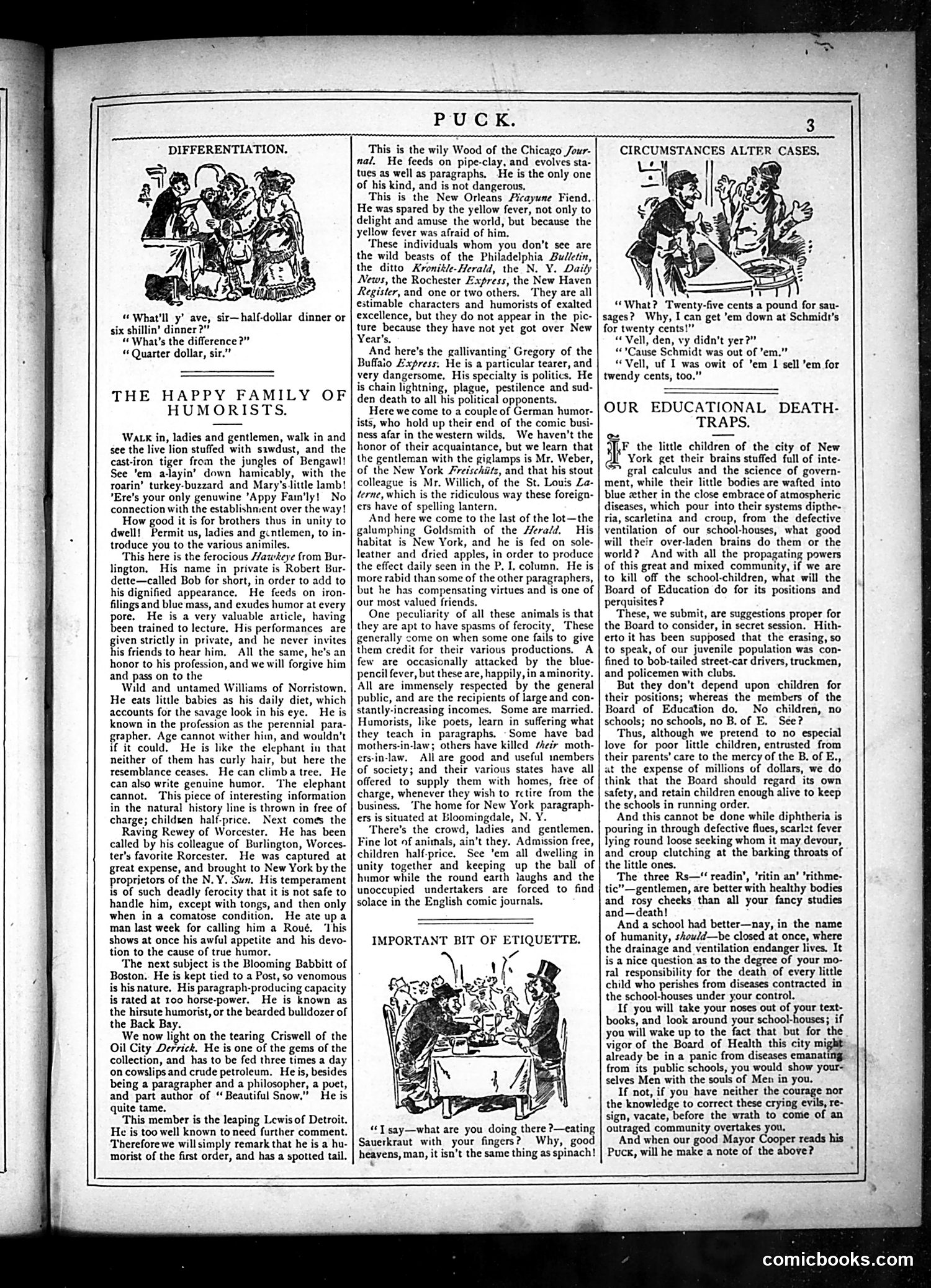
This page celebrates prominent American newspaper humorists and satirists of the era. The left column profiles writers like Bill Nye, Eugene Field, and others who contributed humor to major publications—identifying them by their distinctive styles and subject matter. The cartoon depicts these humorists as a "happy family," emphasizing their camaraderie despite working for competing papers. The satire notes they're generally "inoffensive" yet influential figures in American journalism, though some (like Gregory of the *Indianapolis News*) are described as "dangerous" due to their political commentary. The piece humorously suggests these writers—who might otherwise be rivals—share mutual professional respect and constitute a recognizable "type" in American letters.
📄 Transcribed text from this page (OCR, searchable)
Machine-transcribed from the original scan — historical spelling and the odd misread are preserved.
PUCK. 3 DIFFERENTIATION. “ What'll y’ ave, sir—half-dollar dinner or six shillin’ dinner?” “ What's the difference?” “Quarter dollar, sir.” THE HAPPY FAMILY OF HUMORISTS. Wax in, ladies and gentlemen, walk in and see the live lion stuffed with sawdust, and the cast-iron tiger from the jungles of Bengawl! See 'em a-layin’ down hamicably, with the roarin’ turkey-buzzard and Mary's.little lamb! "Ere’s your only genuwine ’Appy Fatn'ly! No connection with the establishnient over the way! How good it is for brothers thus in unity to dwell! Permit us, ladies and gentlemen, to in- troduce you to the various animiles. This here is the ferocious Hawkeye from Bur- lington, His name in private is Robert Bur- dette—called Bob for short, in order to add to his dignified appearance. He feeds on iron- filings and blue mass, and exudes humor at every pore. He is a very valuable article, having been trained to lecture. His performances are given strictly in private, and he never invites his friends to hear him, All the same, he’s an honor to his profession, and we will forgive him and pass on to the Wild and untamed Williams of Norristown, He eats little babies as his daily diet, which accounts for the savage look in his eye. He is known in the profession as the perennial para- grapher. Age cannot wither him, and wouldn't if it could. He is like the elephant in that neither of them has curly hair, but here the resemblance ceases. He can climba tree. He can also write genuine humor. ‘The elephant cannot. This piece of interesting information in the natural history line is thrown in free of charge; childsen half-price. Next comes the Raving Rewey of Worcester. He has been called by his colleague of Burlington, Worces- ter’s favorite Rorcester. He was captured at great expense, and brought to New York by the proprietors of the N.Y. Sux. His temperament is of such deadly ferocity that it is not safe to handle him, except with tongs, and then only when in a comatose condition. He ate upa man last week for calling him a Roué, ‘This shows at once his awful appetite and his devo- tion to the cause of true humor. The next subject is the Blooming Babbitt of Boston. He is kept tied to a Post, so venomous is his nature. His paragraph-producing capacity is rated at 100 horse-power. He is known as the hirsute humorist, or the bearded bulldozer of the Back Bay. We now light on the tearing Criswell of the Oil City Derrick. He is one of the gems of the collection, and has to be fed three times a day on cowslips and crude petroleum. He is, besides being a paragrapher and a philosopher, a poet, and part author of ‘Beautiful Snow.” He is quite tame. This member is the leaping Lewis of Detroit. He is too well known to need further comment. Therefore we will simply remark that he is a hu- morist of the first order, and has a spotted tail. This is the wily Wood of the Chicago Jour- nal, He feeds on pipe-clay, and evolves sta- tues as well as paragraphs. He is the only one of his kind, and is not dangerous, This is the New Orleans Picayune Fiend. He was spared by the yellow fever, not only to delight and amuse the world, but because the yellow fever was afraid of him. ‘These individuals whom you don't see are the wild beasts of the Philadelphia Bul/etin, the ditto Xronitle-Herald, the N. Y. Daily News, the Rochester Express, the New Haven Register, and one or two others. They are all estimable characters and humorists of exalted excellence, but they do not appear in the pic- ture because they have not yet got over New Year's, And here's the gallivanting’ Gregory of the Buffaio Express. He is a particular tearer, and very dangersome. His specialty is politics. He is chain lightning, plague, pestilence and sud- den death to all his political opponents. Here we come to a couple of German humor- ists, who hold up their end of the comic busi- ness afar in the western wilds, We haven't the honor of their acquaintance, but we learn that the gentleman with the giglamps is Mr. Weber, of the New York Freischiitz, and that his stout colleague is Mr. Willich, of the St. Louis Za- terne, which is the ridiculous way these foreign- ers have of spelling lantern. And here we come to the last of the lot—the galumphing Goldsmith of the Herald. His habitat is New York, and he is fed on sole- leatner and dried apples, in order to produce the effect daily seen in the P. I, column. He is more rabid than some of the other paragraphers, but he has compensating virtues and is one of our most valued friends, One peculiarity of all these animals is that they are apt to have spasms of ferocity, These generally come on when some one fails to give them credit for their various productions, A few ate occasionally attacked by the blue- pencil fever, but these are, happily, in aminority. All are immensely respected by the general public, and are the recipients of large and con- stantly-increasing incomes. Some are married. Humorists, like poets, learn in suffering what they teach in paragraphs. -Some have bad mothers-in-law; others have killed “heir moth- ers-in-law. All are good and useful inembers of society; and their various states have all offered to’ supply them with homes, free of charge, whenever they wish to rctire from the business, ‘The home for New York paragraph- ers is situated at Bloomingdale, N. Y. There’s the crowd, ladies and gentlemen. Fine lot of animals, ain't they. Admission free, children half-price. See 'em all dwelling in unity together and keeping up the ball of humor while the round earth laughs and the unoccupied undertakers are forced to find solace in the English comic journals, IMPORTANT BIT OF ETIQUETTE. “J say—what are you doing there ?—eating Sauerkraut with your fingers? Why, good heavens, man, it isn’t the same thing as spinach! CIRCUMSTANCES ALTER CASES, “‘What? Twenty-five cents a pound for sau- sages? Why, I can get ‘em down at Schmidr’s for twenty cents!" “Vell, den, vy didn't yer?” “Cause Schmidt was out of ’em.” “Vell, uf I was owit of ’em I sell ’em for twendy cents, too.” OUR EDUCATIONAL DEATH- TRAPS. a the little children of the city of New York get their brains stuffed full of inte- gral calculus and the science of govern- ment, while their little bodies are wafted into blue ether in the close embrace of atmospheric diseases, which pour into their systems dipthe- ria, scarletina and croup, from the defective ventilation of our school-houses, what good will their over-laden brains do them or the world? And with all the propagating powers of this great and mixed community, if we are to kill off the school-children, what will the Board of Education do for its positions and perquisites? These, we submit, are suggestions proper for the Board to consider, in secret session. Hith- erto it has been supposed that the erasing, so to speak, of our juvenile population was con- fined to bob-tailed street-car drivers, truackmen, and policemen with clubs. But they don't depend upon children for their positions; whereas the members of the Board of Education do. No children, no schools; no schools, no B. of E. Sée? Thus, although we pretend to no especial love for poor little children, entrusted from their parents’ care to the mercy of the B, of E., at the expense of millions of dollars, we do think that the Board should regard its own safety, and retain children enough alive to keep the schools in running order. And this cannot be done while diphtheria is pouring in through defective flues, scarlst fever lying round loose seeking whom it may devour, and croup clutching at the barking throats of the little ones. The three Rs—* readin’, 'ritin an’ 'rithme- tic’ gentlemen, are better with healthy bodies and rosy cheeks than all your fancy studies and—death! And a school had better—nay, in the name of humanity, shou/d—be closed at once, where the drainage and ventilation endanger lives. It is a nice question as to the degree of your mo- ral responsibility for the death of every little child who perishes from diseases contracted in the school-houses under your control. If you will take your noses out of your text- books, and look around your school-houses; if you will wake up to the fact that but for the vigor of the Board of Health this city might already be in a panic from diseases emanating: from its public schools, you would show your= selves Men with the souls of Men in you. If not, if you have neither the courage nor the knowledge to correct these crying evils, re- sign, vacate, before the wrath to comie of an outraged community overtakes you, ‘ And when our good Mayor Cooper reads his Puck, will he make a note of the above? CA comicbooks.com