
Puck, 1879-01-08 · page 11 of 16
Puck — January 8, 1879 — page 11: what you’re looking at
What you’re looking at
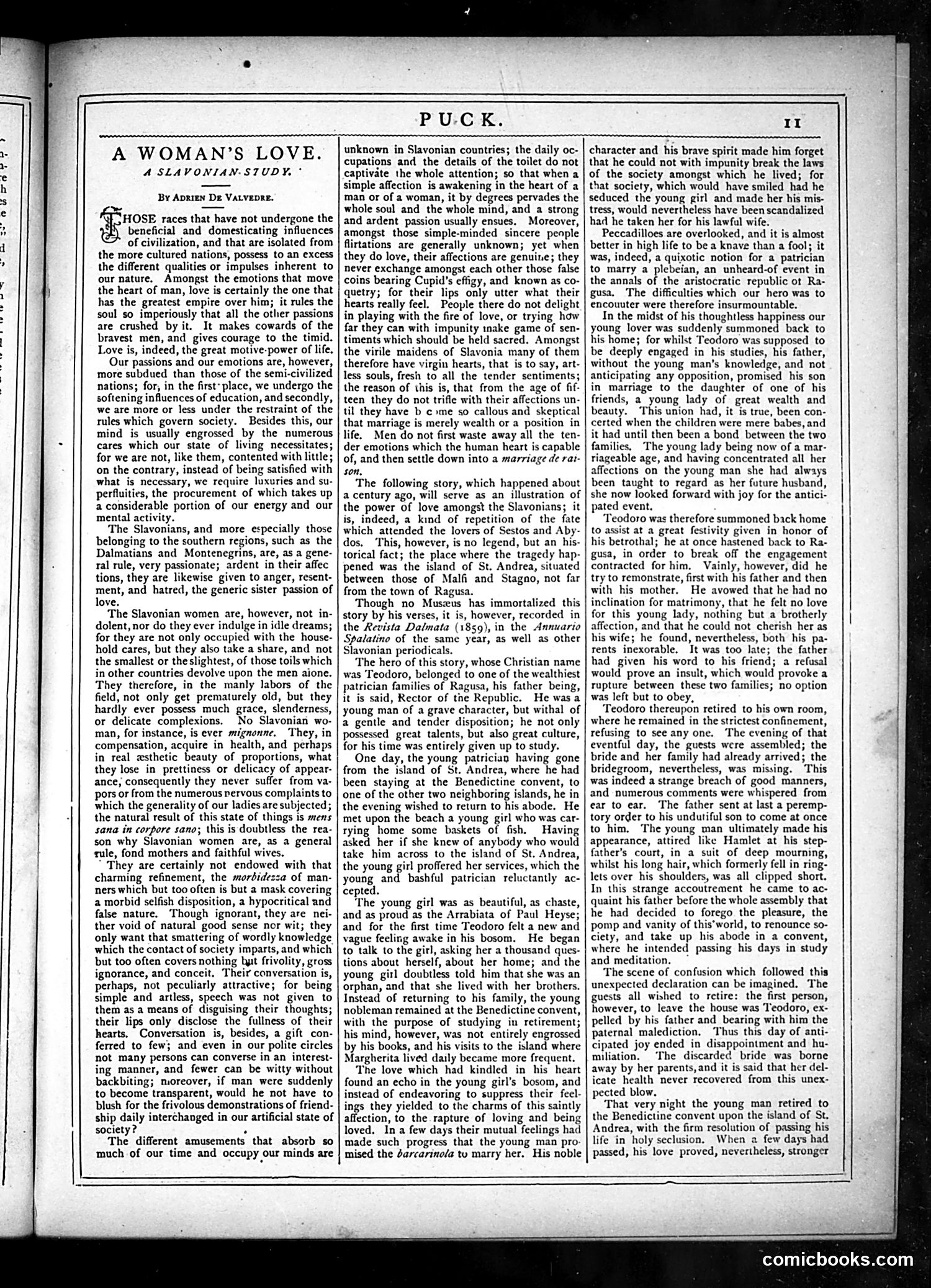
This page from *Puck* magazine contains a literary story titled "A Woman's Love: A Slavonian Study" by Adrien De Vauvedes, not a political cartoon. The text is a romantic narrative about a Slavonian patrician named Teodoro who falls in love with a young fisherman's daughter on the island of St. Andrea near Ragusa (modern-day Croatia). The story appears designed to illustrate *Puck*'s editorial point in the header: that love among "simple-minded sincere people" differs from love among civilized nations, being more genuine and less corrupted by social pretense. This is a sentimental rather than satirical piece, likely presented as a contrast to *Puck*'s typically humorous content.
📄 Transcribed text from this page (OCR, searchable)
Machine-transcribed from the original scan — historical spelling and the odd misread are preserved.
PU-CK. Ir A WOMAN’S LOVE. A SLAVONIAN.STUDY. * By Aprien De VALVEDRE. ~~ a HOSE races that have not undergone the beneficial and domesticating influences of civilization, and that are isolated from the more cultured nations, possess to an excess the different qualities or impulses inherent to our nature. Amongst the emotions that move the heart of man, love is certainly the one that has the greatest empire over him; it rules the soul so imperiously that all the other passions are crushed by it. It makes cowards of the bravest men, and gives courage to the timid. Love is, indeed, the great motive-power of life. Our passions and our emotions are, however, more subdued than those of the semi-civilized nations; for, in the first-place, we undergo the softening influences of education, and secondly, we are more or less under the restraint of the rules which govern society. Besides this, our mind is usually engrossed by the numerous cares which our state of living necessitates; for we are not, like them, contented with little; on the contrary, instead of being satisfied with what is necessary, we require luxuries and su- perfluities, the procurement of which takes up aconsiderable portion of our energy and our mental activity. ‘The Slavonians, and more especially those belonging to the southern regions, such as the Dalmatians and Montenegrins, are, as a gene- ral rule, very passionate; ardent in their affec tions, they are likewise given to anger, resent- ment, and hatred, the generic sister passion of love. The Slavonian women are, however, not in- dolent, nor do they ever indulge in idle dreams; for they are not only occupied with the house- hold cares, but they also take a share, and not the smallest or the slightest, of those toils which in other countries devolve upon the men aione. They therefore, in the manly labors of the field, not only get prematurely old, but they hardly ever possess much grace, slenderness, or delicate complexions. No Slavonian wo- man, for instance, is ever mignonne. They, in compensation, acquire in health, and perhaps in real wsthetic beauty of proportions, what they lose in prettiness or delicacy of appear- ance, consequently they never suffer from va- pors or from the numerous nervous complaints to which the generality of our ladies are subjected; the natural result of this state of things is mens sana in corpore sano; this is doubtless the rea- son why Slavonian women are, as a general tule, fond mothers and faithful wives. " They are certainly not endowed with that charming refinement, the morbidezza of man- ners which but too often is but a mask covering a morbid selfish disposition, a hypocritical and false nature. Though ignorant, they are nei- ther void of natural good sense nor wit; they only want that smattering of wordly knowledge which the contact of society imparts, and which but too often covers nothing hat frivolity, gross ignorance, and conceit. Their conversation is, perhaps, not peculiarly attractive; for being simple and artless, speech was not given to them as a means of disguising their thoughts; their lips only disclose the fullness of their hearts. Conversation is, besides, a gift con- ferred to few; and even in our polite circles not many persons can converse in an interest- ing manner, and fewer can be witty without backbiting;’ moreover, if man were suddenly to become transparent, would he not have to blush for the frivolous demonstrations of friend- ship daily interchanged in our artificial state of society ? . The different amusements that absorb so much of our time and occupy our minds are unknown in Slavonian countries; the daily oc- cupations and the details of the toilet do not captivate the whole attention; so that when a simple affection is awakening in the heart of a man or of a woman, it by degrees pervades the whole soul and the whole mind, and a strong and ardent passion usually ensues. Moreover, amongst those simple-minded sincere people flirtations are generally unknown; yet when they do love, their affections are genuine; they never exchange amongst each other those false coins bearing Cupid's effigy, and known as co- quetry; for their lips only utter what their hearts really feel. People there do not delight in playing with the fire of love, or trying haw far they can with impunity inake game of sen- timents which should be held sacred. Amongst the virile maidens of Slavonia many of them therefore have virgin hearts, that is to say, art- less souls, fresh to all the tender sentiments; the reason of this is, that from the age of fif- teen they do not trifle with their affections un- til they have b c sme so callous and skeptical that marriage is merely wealth or a position in life. Men do not first waste away all the ten- der emotions which the human heart is capable of, and then settle down into a marriage de rat- son, The following story, which happened about a century ago, will serve as an illustration of the power of love amongst the Slavonians; it is, indeed, a kind of repetition of the fate which attended the lovers of Sestos and Aby- dos, ‘his, however, is no legend, but an his- torical fact; the place where the tragedy hap- pened was the island of St. Andrea, situated between those of Malfi and Stagno, not far from the town of Ragusa. Though no Muszeus has immortalized this story by his verses, it is, however, recorded in the Revista Dalmata (1859), in the Annuario Spalatino of the same year, as well as other Slavonian periodicals. The hero of this story, whose Christian name was Teodoro, belonged to one of the wealthiest patrician families of Ragusa, his father being, it is said, Rector of the Republic. He was a young man of a grave character, but withal of a gentle and tender disposition; he not only possessed great talents, but also great culture, for his time was entirely given up to study. One day, the young patrician having gone from the island of St. Andrea, where he had been staying at the Benedictine convent, to one of the other two neighboring islands, he in the evening wished to return to his abode. He met upon the beach a young girl who was car- rying home some baskets of fish, Having asked her if she knew of anybody who would take him across to the island of St. Andrea, the young girl proffered her services, which the young and bashful patrician reluctantly ac- cepted. ‘The young girl was as beautiful, as chaste, and as proud as the Arrabiata of Paul Heyse; and for the first time Teodoro felt a new and vague feeling awake in his bosom. He began to talk to the girl, asking her a thousand ques- tions about herself, about her home; and the young gitl doubtless told him that she was an orphan, and that she lived with her brothers. Instead of returning to his family, the young nobleman remained at the Benedictine convent, with the purpose of studying in retirement; his mind, however, was not entirely engrossed by his books, and his visits to the island where Margherita lived daily became more frequent. ‘The love which had kindled in his heart found an echo in the young girl's bosom, and instead of endeavoring to suppress their feel- ings they yielded to the charms of this saintly affection, to the rapture of loving and being loved. In a few days their mutual feelings had made such progress that the young man pro: mised the darcarinola tu marry her. His noble character and his brave spirit made him forget that he could not with impunity break the laws of the society amongst which he lived; for that society, which would have smiled had he seduced the young girl and made her his mis- tress, would nevertheless have been scandalized had he taken her for his lawful wife. Peccadilloes are overlooked, and it is almost better in high life to be a knave than a fool; it was, indeed, a quixotic notion for a patrician to marry a plebeian, an unheard-of event in the annals of the aristocratic republic ot Ra- gusa, The difficulties which our hero was to encouuter were therefore insurmountable. In the midst of his thoughtless happiness our young lover was suddenly summoned back to his home; for whilst Teodoro was supposed to be deeply engaged in his studies, his father, without the young man’s knowledge, and not anticipating any opposition, promised his son in marriage to the daughter of one of his friends, a young lady of great wealth and beauty. This union had, it is true, been con- certed when the children were mere babes, and it had until then been a bond between the two families, The young lady being now of a mar- riageable age, and having concentrated all her affections on the young man she had always been taught to regard as her future husband, she now looked forward with joy for the antici- pated event, ‘Teodoro was therefore summoned back home to assist at a great festivity given in honor of his betrothal; he at once hastened back to Ra- gusa, in order to break off the engagement contracted for him, Vainly, however, did he try to remonstrate, first with his father and then with his mother. He avowed that he had no inclination for matrimony, that he felt no love for this young lady, nothing but a brotherly affection, and that he could not cherish her as his wife; he found, nevertheless, both his pa- rents inexorable, It was too late; the father had given his word to his friend; a refusal would prove an insult, which would provoke a rupture between these two families; no option was left but to obey, Teodoro thereupon retired to his own room, where he remained in the strictest confinement, refusing to see any one. The evening of that eventful day, the guests were assembled; the bride and her family had already arrived; the bridegroom, nevertheless, was missing. This was indeed a strange breach of good manners, and numerous comments were whispered from ear to ear. The father sent at last a peremp- tory order to his undutiful son to come at once to him. The young man ultimately made his appearance, attired like Hamlet at his step- father’s court, in a suit of deep mourning, whilst his long hair, which formerly fell in ring- lets over his shoulders, was all clipped short. In this strange accoutrement he came to ac- quaint his father before the whole assembly that he had decided to forego the pleasure, the pomp and vanity of this’world, to renounce so- ciety, and take up his abode in a convent, where he intended passing his days in study and meditation. ~ The scene of confusion which followed this unexpected declaration can be imagined. The guests all wished to retire: the first person, however, to leave the house was Teodoro, ex- pelled by his father and bearing with him the paternal malediction, Thus this day of anti- cipated joy ended in disappointment and hu- miliation. ‘The discarded bride was borne away by her parents, and it is said that her del- icate health never recovered from this unex- pected blow. That very night the young man retired to the Benedictine convent upon the island of St. Andrea, with the firm resolution of passing his life in holy seclusion, When a few days had passed, his love proved, nevertheless, stronger comicbooks.com