
A complete issue · 16 pages · 1878
Puck — December 4, 1878
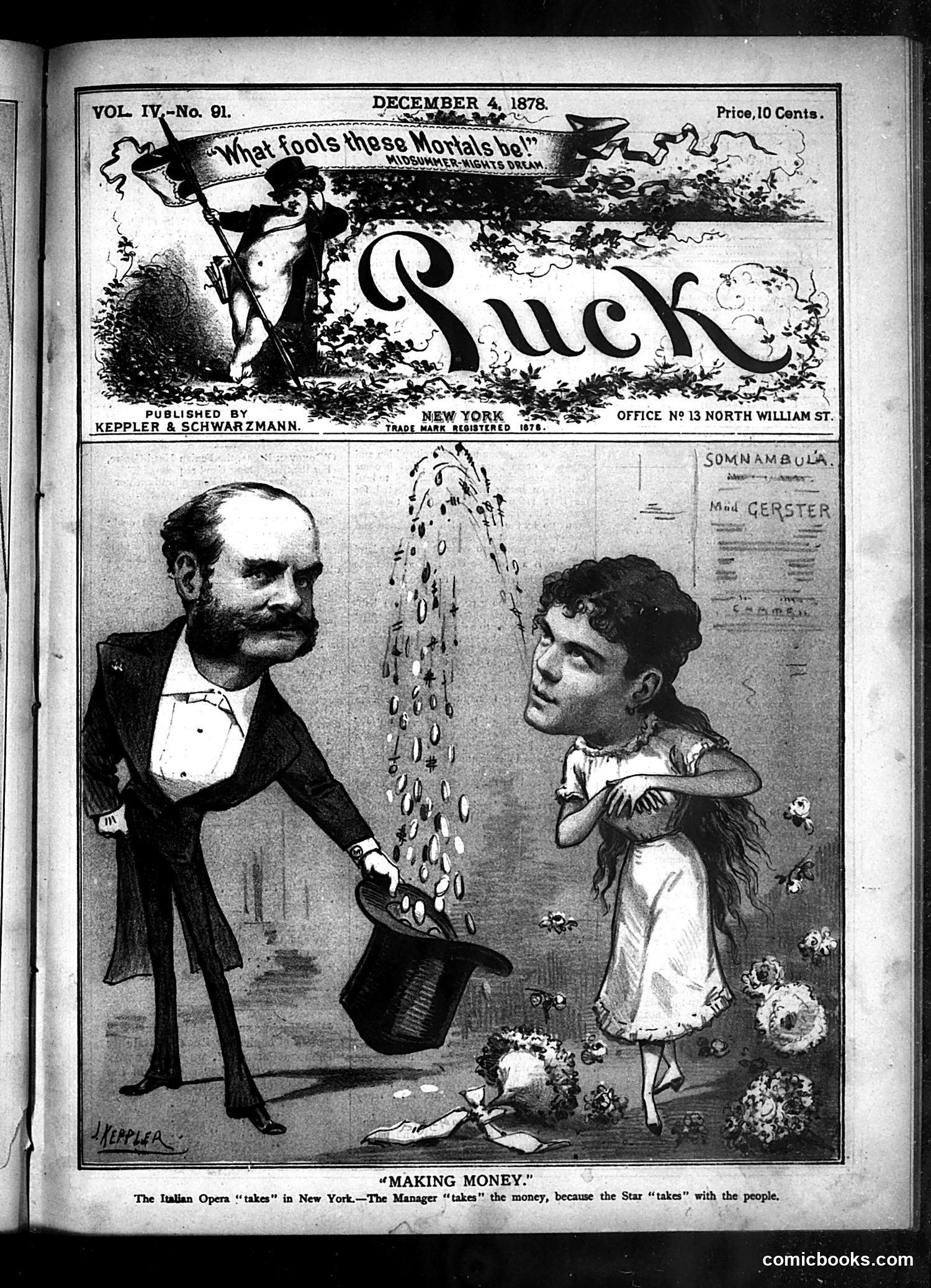
This satirical cartoon comments on Italian opera management in New York. The caption explains: "The Italian Opera 'takes' in New York—The Manager 'takes' the money, because the Star 'takes' with the people." The cartoon depicts a well-dressed opera manager (left, with characteristic exaggerated features) pouring money from a hat onto a young female opera singer (right). The satire targets the financial dynamics of opera: while the star performer attracts audiences and generates revenue through their popularity ("takes" with the people), the manager profits by controlling the money flow. This reflects 19th-century tensions between artistic talent and management exploitation in entertainment industries.
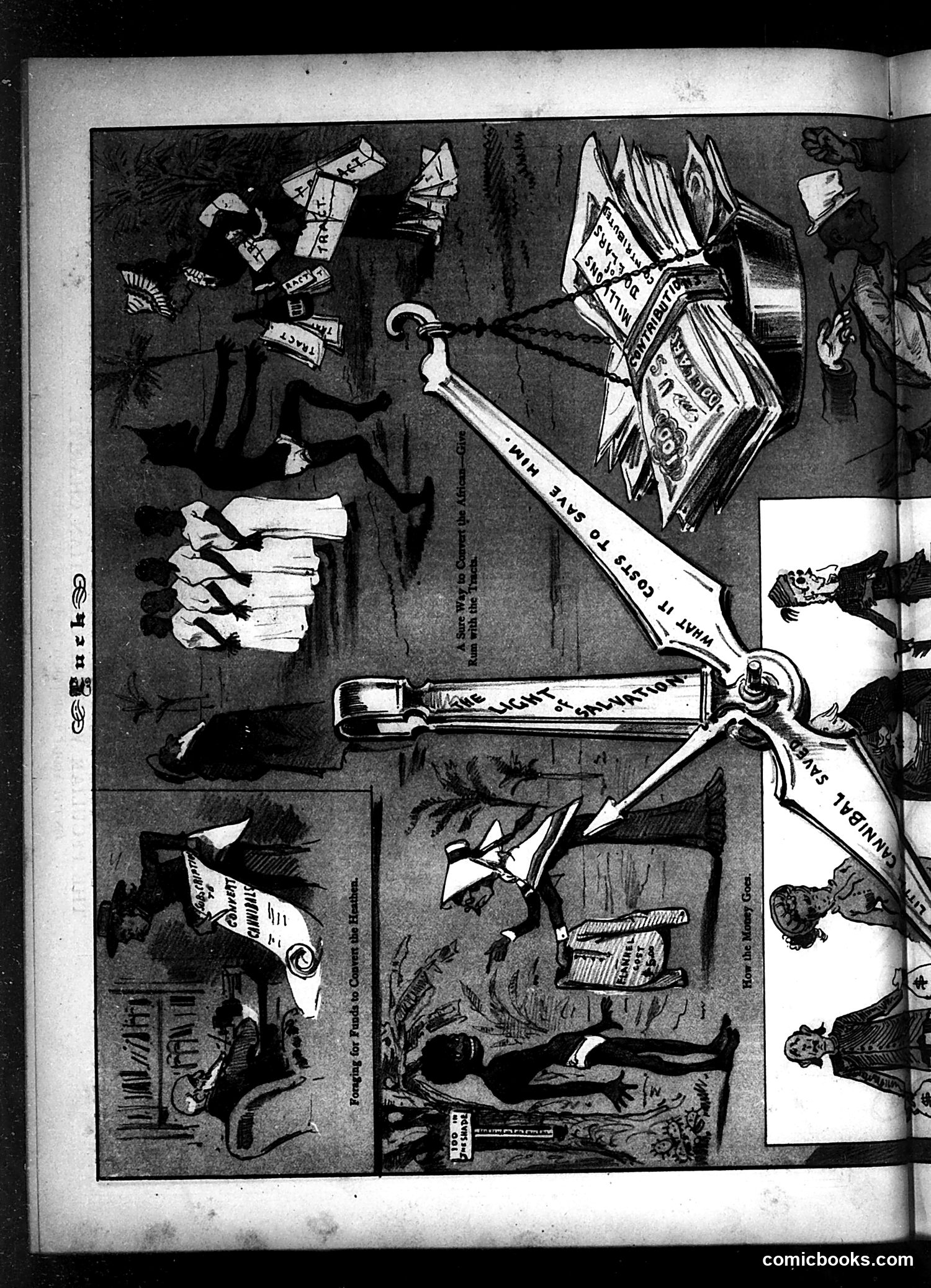
This page contains three distinct sections: a masthead, editorial content, and satirical commentary rather than illustrated cartoons. **"The Horror of the Day"** critiques wealthy philanthropists who fund distant causes—like converting Africans or building marble churches—while ignoring poor people starving in their own cities. The satire targets hypocrisy: donors give to prestigious projects but neglect local suffering. References to "Captain Schwensen" and the "Hindoo widow" suggest specific contemporary charitable scandals, though their exact identities are unclear from this excerpt. **"Puckerings"** section offers brief satirical quips mocking various subjects, including the Fenian Center and Heywood Comic Opera Co. The overall tone attacks wealthy donors' moral priorities and self-serving charitable giving patterns prevalent in the Gilded Age.
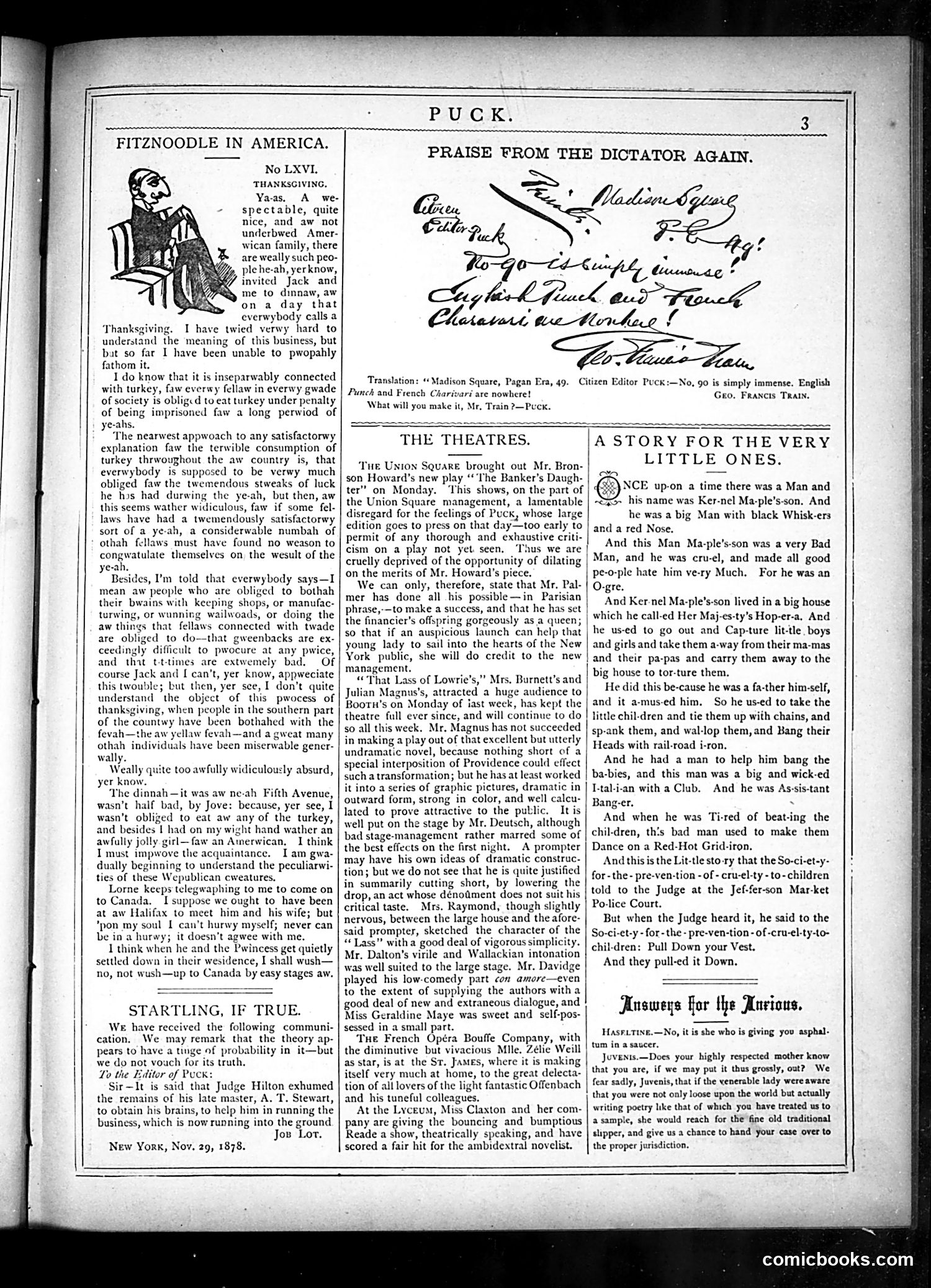
This satirical cartoon depicts an Irish immigrant ("Fitznoodle") struggling to understand American Thanksgiving traditions. The piece mocks working-class Irish assimilation into American society, suggesting their bewilderment at unfamiliar customs and social hierarchies. The cartoon ridicules both Irish immigrants' outsider status and American pretensions about democratic equality. The protagonist's inability to grasp why Thanksgiving involves eating turkey—and his broader confusion about American social rituals—serves as the humor. The text emphasizes the "terrible consumption" of turkeys and connects this to broader class and cultural tensions between established Americans and newer Irish arrivals. This reflects 1870s-era anti-Irish prejudice common in American satire, where ethnic stereotyping was considered entertainment.
This page contains primarily text-based humor and anecdotes rather than political cartoons. The content includes: **"A Legend of Cokki Ben-Butlah"** — a satirical poem about a saint, likely referencing Islamic or Middle Eastern religious figures through exaggerated dialect. **"Gallic Gumdrops"** — brief humorous sketches featuring romantic misadventures and social comedy, including references to Shakespeare and marriage. Various other short comedic pieces about everyday situations (hotel encounters, carriage rides, philosophical observations). The humor relies on wordplay, dialect humor, and social satire typical of 1880s-90s Puck magazine. Without seeing actual illustrations, the satirical targets appear to be Victorian social conventions, romantic entanglements, and cultural pretensions rather than specific political figures. The tone suggests general social satire aimed at middle-class American readers.
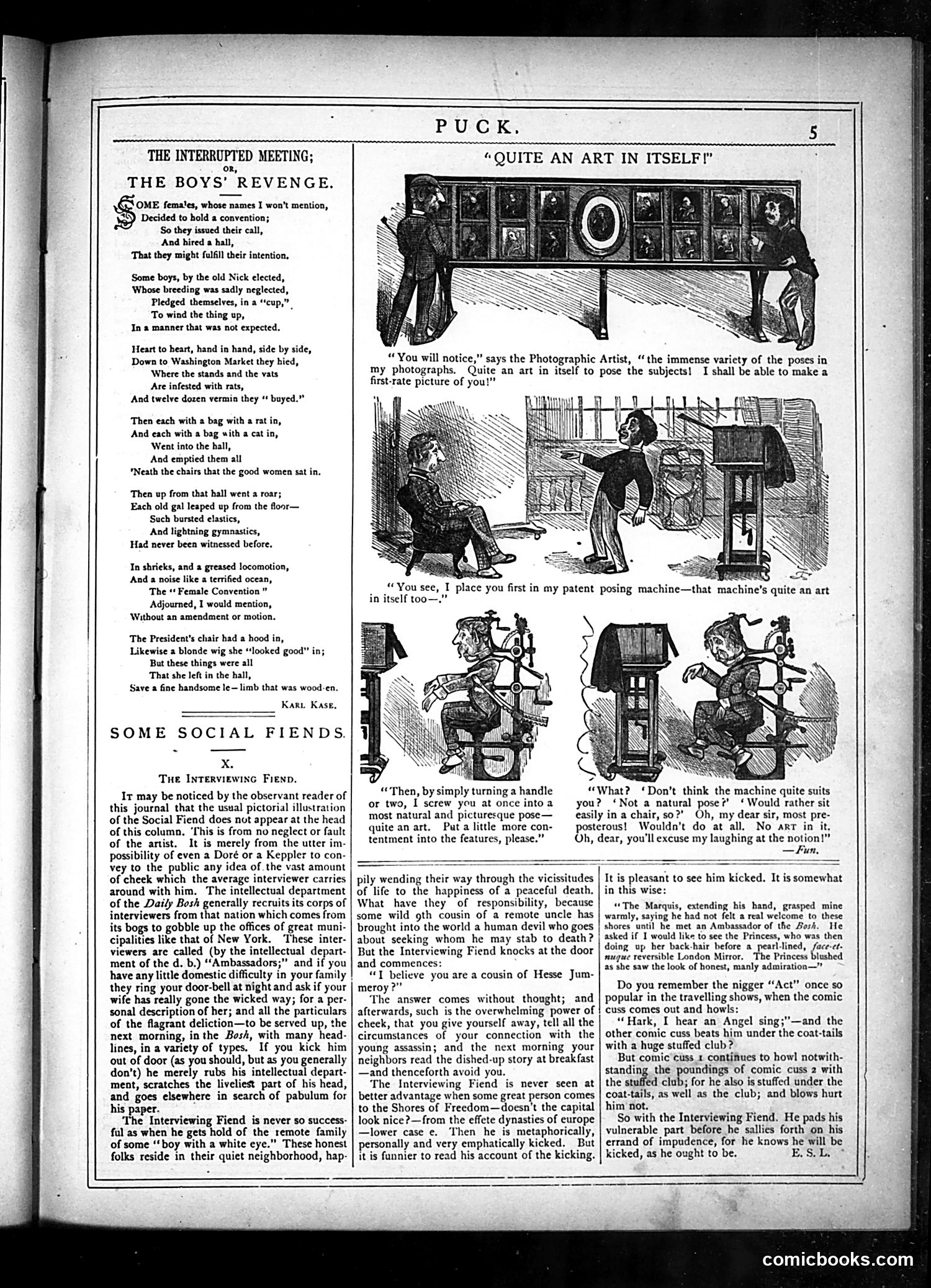
This cartoon mocks **photography portrait studios** of the era. A "Photographic Artist" demonstrates his "patent posing machine"—a mechanical contraption that forcibly arranges subjects' bodies into "natural and picturesque" poses. The joke satirizes how studios claimed artistic skill while actually using rigid, uncomfortable devices to position paying customers. The lower panels show the machine contorting people into increasingly absurd positions, with dialogue emphasizing the pretense: the artist insists this mechanical torture produces "quite an art." The satire targets Victorian-era photography's false claims of naturalness and artistic sophistication—when commercial studios relied on devices and constraints to produce standardized, unnatural-looking portraits.
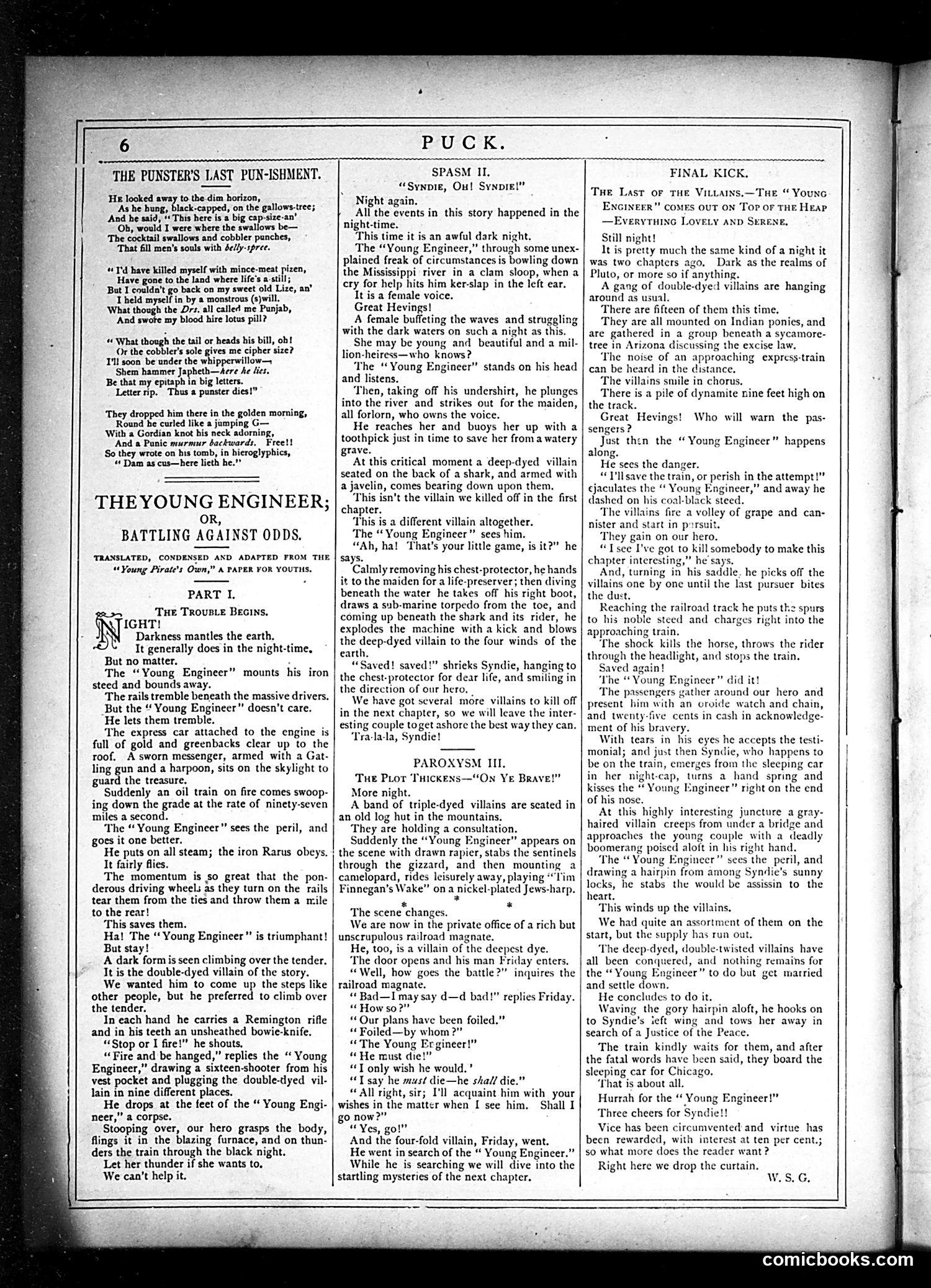
This page contains three serialized story sections rather than political cartoons: "The Punster's Last Pun-ishment," "Spasm II" ("Syndie, Oh! Syndie!"), and "The Young Engineer; or, Battling Against Odds." These appear to be adventure/melodrama narratives with illustrated sections, typical of Puck's mixed content format. "The Young Engineer" involves a hero rescuing a maiden from villains near a river and railroad, featuring dramatic action and narrow escapes. The stories represent entertainment content rather than political satire. Without visible caricatures of recognizable public figures or contemporary political references in the visible portions, this page functions as light fiction content for Puck's readership rather than social commentary.
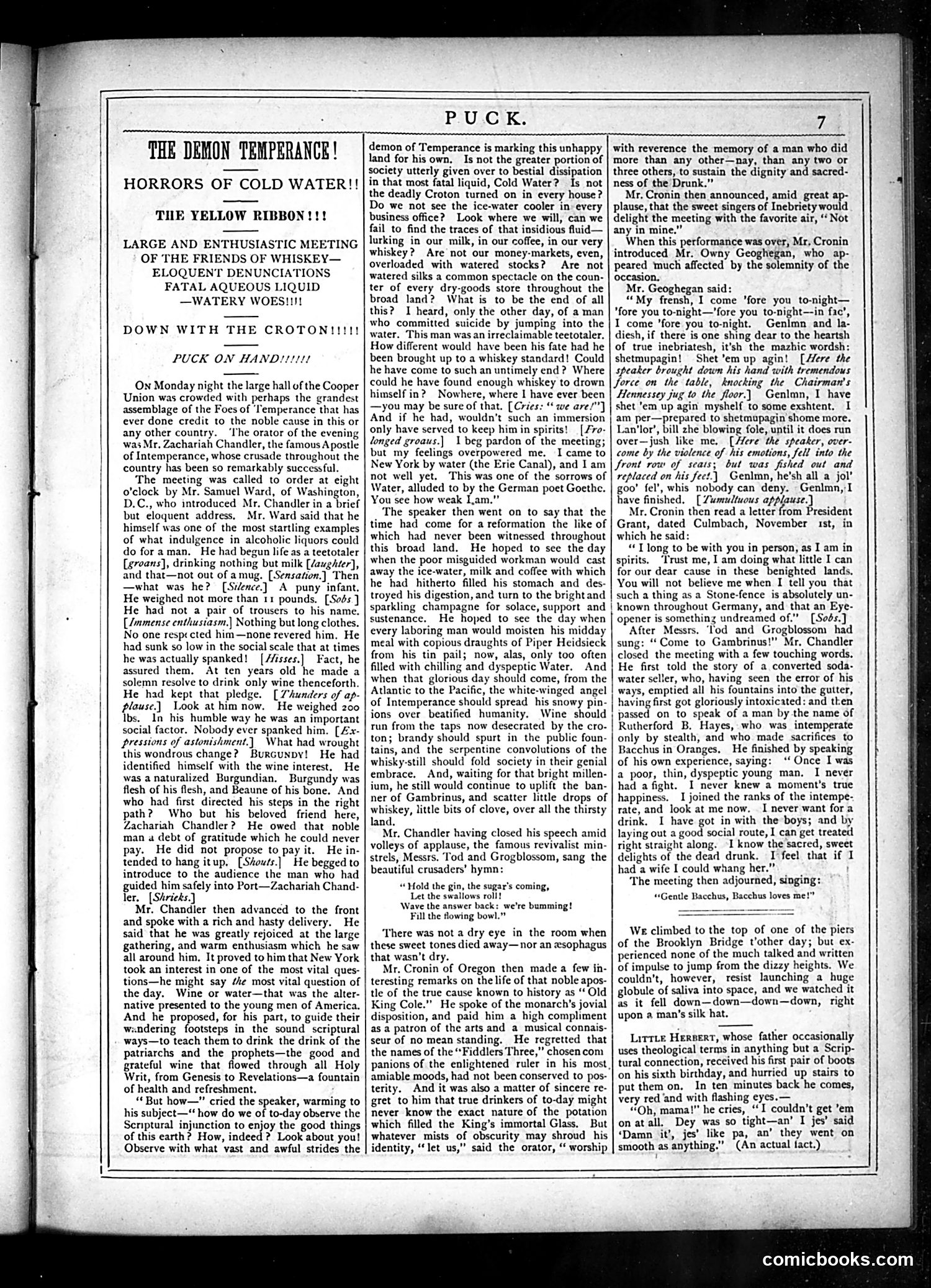
This page satirizes the temperance movement through mock-heroic headlines and a detailed narrative account of a pro-temperance meeting. The satire employs ironic titles like "The Demon Temperance" and "Horrors of Cold Water" to mock temperance advocates who opposed alcohol consumption. The text describes a Cooper Union meeting where temperance speakers (including Mr. Owny Geoghegan and Mr. Cronin) deliver passionate speeches against whiskey, ice water, and other beverages, promoting abstinence. The satire ridicules their rhetoric as hyperbolic and self-righteous. A closing anecdote about "Little Herbert" mocking temperance advocates adds comedic deflation. The piece targets the earnest moral crusading of temperance reformers as absurd excess, reflecting Puck's anti-prohibition stance during America's temperance debates of the late 19th century.
I can see this is a Puck magazine page with satirical cartoons, but the OCR text provided is blank, making it difficult to identify specific political figures or references with certainty. From the images alone, I can observe: - Multiple cartoon panels depicting figures in what appears to be political/social satire - References to documents, money, and official proceedings - Caricatured characters in various poses suggesting chaos or disorder - Banners or scrolls with text (largely illegible in this reproduction) Without legible text or OCR content to guide interpretation, I cannot reliably identify which politicians, events, or social issues this satirizes. The style and composition suggest early-to-mid 20th century American political commentary, but specific identification requires clearer textual evidence. To properly explain this cartoon's meaning to modern readers, I would need either clearer image resolution or the actual article text.
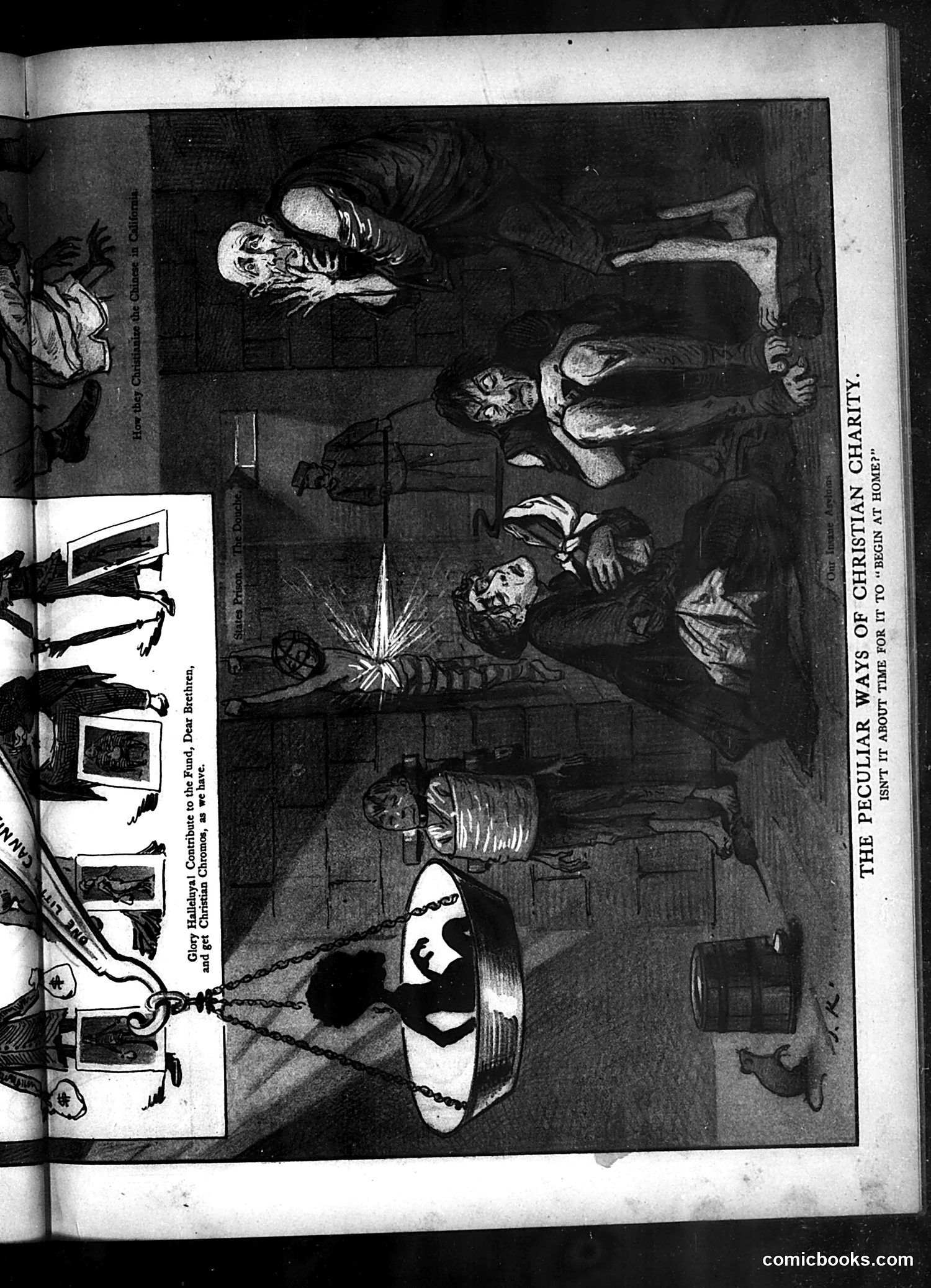
This satirical cartoon depicts the hypocrisy of Christian charity during the Gilded Age. The title suggests the work critiques how charitable giving was practiced inconsistently or selectively by the wealthy and religious institutions. The image shows multiple figures in what appears to be a domestic or institutional setting. Based on typical Puck satire of this era, it likely mocks the contrast between professed Christian values and actual treatment of the poor or marginalized. The composition suggests a scene of charity gone wrong—possibly showing wealthy donors, charity workers, or recipients in morally questionable circumstances. Without clearer identification of specific individuals or captions visible in the image, the exact targets remain unclear, though the overall message critiques the gap between Christian rhetoric and charitable practice.
This page from *Puck* magazine appears to be a serialized short story titled "Bianca" by W.E. Norris, set in Venice. The narrative is presented in traditional magazine fiction format—dense columns of text with an illustrated header. The story concerns a romantic complication: the narrator must inform his sister Bianca of an embarrassing entanglement involving a young woman. He describes maneuvering through Venice, arranging meetings, and managing social consequences. The tone is melodramatic, typical of late 19th-century serialized fiction. **No political satire is evident on this page.** This is literary content rather than political commentary or cartooning. The "Puck" masthead indicates magazine branding, but the actual content serves as entertainment fiction for readers rather than satirical commentary on contemporary events or figures.
This appears to be a text-heavy page from Puck magazine consisting primarily of a serialized narrative story titled "PUCK" rather than political cartoons. The story describes travel experiences in Italy, mentioning locations like the Dolomite region and Venice, interactions with local guides and nobility (including references to a "Conte di Rosenau"), and encounters with mosquitoes and various social situations. While Puck was known for satirical political content, this particular page contains no visible political cartoons or caricatures. Instead, it's a humorous travel narrative—the kind of satirical literary content the magazine also published alongside its more famous visual satire. Without identifying specific dated historical events in the text, the page appears to be satirizing 19th-century tourism and cultural observations.
This page is primarily text-based humor content rather than political cartoons. It features "Puck's Briginques" — a collection of brief satirical jokes and witty observations about contemporary life. The jokes target various subjects: incompetent cooks, church singers, romantic mishaps, and social pretensions. Several reference specific newspapers (New York World, New Haven Register, Burlington Hawk-Eye), suggesting these were responses to or commentary on news items. Notable targets include a "Congressman Smith" accused of bigamy and various absurd situations (a horse that ate a widow, a man climbing stairs backwards). The humor relies on wordplay, puns, and mockery of human foolishness rather than partisan politics. Without visible illustrations on this particular page, the satire operates through text alone — typical of Puck's lighter comedic filler content alongside its more prominent political cartoons.
This page is predominantly **advertisements** for Arnold, Constable & Co., a major department store, promoting holiday shopping with offerings in dress patterns, furnishings, gentlemen's goods, children's clothing, and other merchandise. The left column contains brief satirical **news items and jokes** typical of Puck's format, touching on various social observations: labor issues, banking practices, French writing instruction, dry goods clerks, and Pennsylvania's politics. There's also a **Best Marquis Cigarette advertisement** at the bottom. **No clear political cartoon dominates this page.** Instead, it's a mix of commercial advertising and short humor pieces reflecting late 19th-century American concerns about work, commerce, and society—formatted as a typical Puck magazine page blending editorial content with paid advertisements.
This page is **primarily advertising**, not satirical content. It's a typical late 19th-century Puck magazine advertisements page featuring various commercial products and services: - **Yeast and piano manufacturers** (Fleischmann's Compressed Yeast, Steinway pianos) - **Patent medicines** (Apollinaris Mineral Water, Vichy Water) - **Dental services** (Dr. Sweeny's Dental Rooms) - **Furniture and binding services** - **Patent and trademark registration** services The one illustrated figure appears in the Hunyadi János mineral water advertisement—showing what seems to be a Hungarian nobleman or historical figure, capitalizing on European exoticism to market the product to American consumers. The page demonstrates how 19th-century magazines funded themselves through advertising while maintaining their satirical editorial content elsewhere in the issue.
This appears to be primarily a **page of advertisements** from Puck magazine rather than a satirical cartoon page. The content includes ads for various commercial products and services typical of the late 1870s: fine furs (F. Booss & Bro.), wines and champagne (De Venoge, D.A. Mayer's Hungarian wines), photography services, umbrellas, a student lamp, coffee pots, safes, and notably the **Louisiana State Lottery**. The lottery advertisement is the most prominent editorial content, promoting an "unprecedented attraction" with half-a-million dollars distributed. This reflects the historical reality that state lotteries were major gambling enterprises in this era. The page demonstrates how 19th-century magazines funded operations through extensive advertising rather than subscription alone.
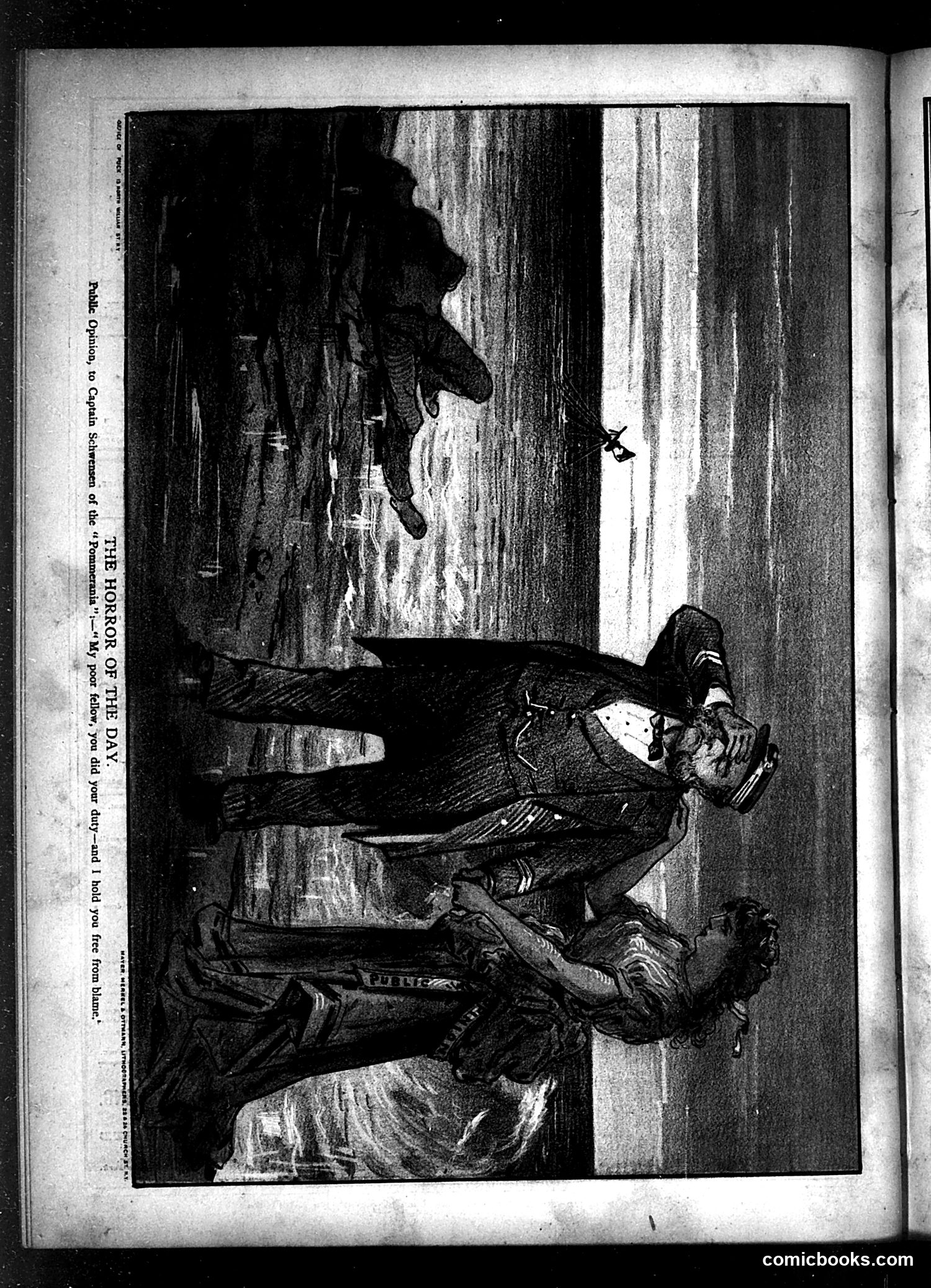
This page from *Puck* magazine appears to show a political cartoon depicting a confrontation scene. The image is rotated 90 degrees, showing figures in period dress (appearing to be late 19th century based on the clothing and illustration style). The OCR text is largely illegible in the provided excerpt, making it difficult to identify the specific political figures or events being satirized. The cartoon seems to depict some kind of dramatic encounter or conflict, but without clearer text or caption visibility, I cannot reliably identify which political figures are caricatured, what specific event is being referenced, or what the satirical point was intended to be. To properly explain this cartoon's meaning, a clearer image of the caption or title would be necessary.