
Puck, 1878-12-04 · page 7 of 16
Puck — December 4, 1878 — page 7: what you’re looking at
What you’re looking at
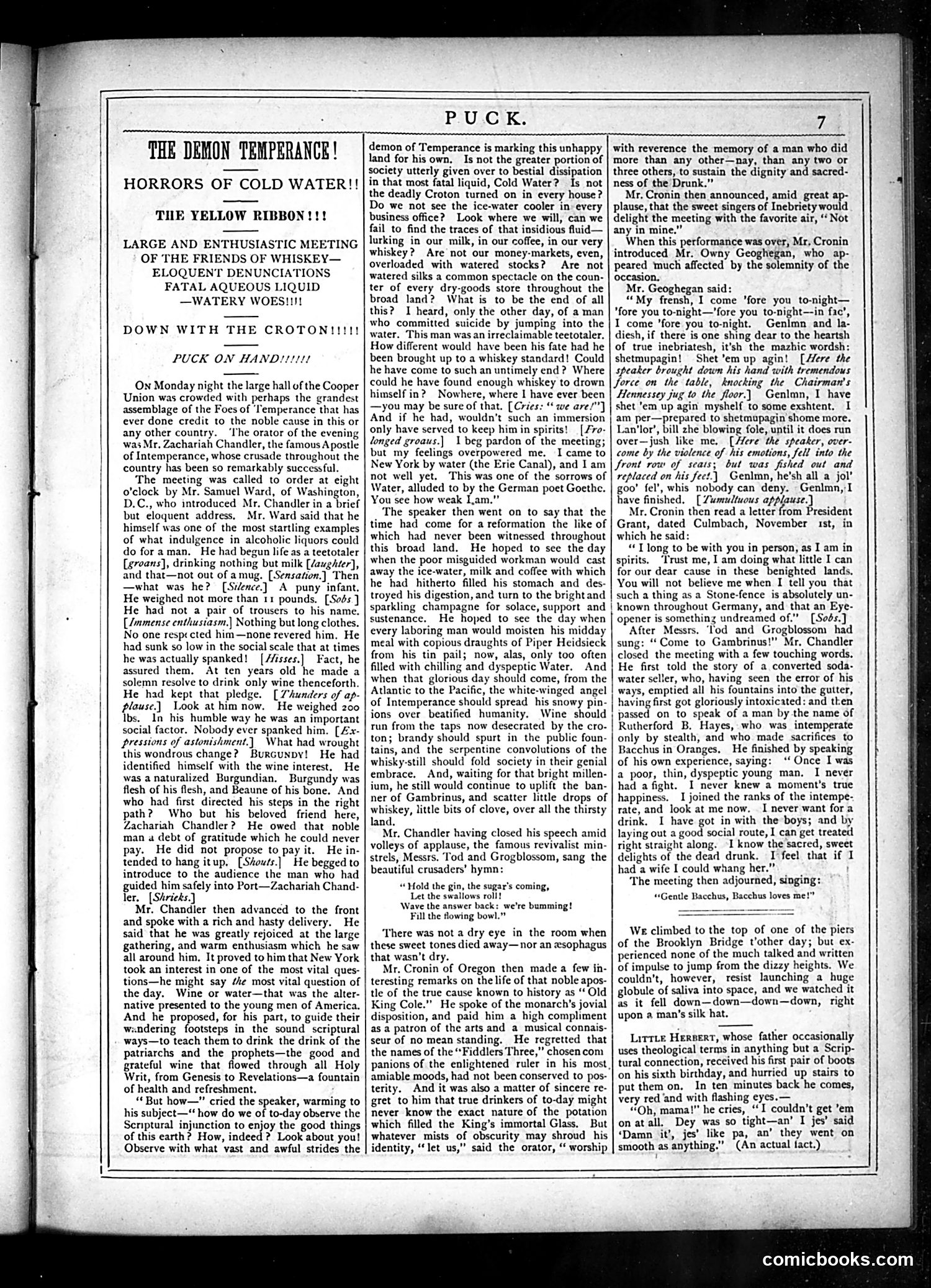
This page satirizes the temperance movement through mock-heroic headlines and a detailed narrative account of a pro-temperance meeting. The satire employs ironic titles like "The Demon Temperance" and "Horrors of Cold Water" to mock temperance advocates who opposed alcohol consumption. The text describes a Cooper Union meeting where temperance speakers (including Mr. Owny Geoghegan and Mr. Cronin) deliver passionate speeches against whiskey, ice water, and other beverages, promoting abstinence. The satire ridicules their rhetoric as hyperbolic and self-righteous. A closing anecdote about "Little Herbert" mocking temperance advocates adds comedic deflation. The piece targets the earnest moral crusading of temperance reformers as absurd excess, reflecting Puck's anti-prohibition stance during America's temperance debates of the late 19th century.
📄 Transcribed text from this page (OCR, searchable)
Machine-transcribed from the original scan — historical spelling and the odd misread are preserved.
PUCK. 7 THE DEMON TEMPERANCE! HORRORS OF COLD WATER!! THE YELLOW RIBBON!!! LARGE AND ENTHUSIASTIC MEETING OF THE FRIENDS OF WHISKEY— ELOQUENT DENUNCIATIONS FATAL AQUEOUS LIQUID —WATERY WOES!!! DOWN WITH THE CROTON!!!1! On Monday night the large hall uf the Cooper Union was crowded with perhaps the grandest assemblage of the Foes of ‘Temperance that has ever done credit to the noble cause in this or any other country. ‘I'he orator of the evening was Mr, Zachariah Chandler, the famous Apostle of Intemperance, whose crusade throughout the country has been so remarkably successful. The meeting was called to order at eight o'clock by Mr. Samuel Ward, of Washington, D.C., who introduced Mr. Chandler in a brief but eloquent address, Mr. Ward said that he himself was one of the most startling examples of what indulgence in alcoholic liquors could do fora man. He had begun life as a teetotaler [groans], drinking nothing but milk [/aughter], and that—not out of amug. [Sensation.] Then —what was he? [Silence] A puny infant. He weighed not more than 11 pounds. [Sods] He had not a pair of trousers to his name. [/mmense enthusiasm.] Nothing but long clothes. No one respected him—none revered him. He had sunk so low in the social scale that at times he was actually spanked! [//isses.] Fact, he assured them. At ten years old he made a solemn resolve to drink only wine thenceforth. He had kept that pledge. [Thunders of ap- plause.) Look at him now. He weighed 200 Ibs. In his humble way he was an important social factor. Nobody ever spanked him. [£x- pressions of astonishment.) What had wrought this wondrous change? Burcunpy! He had identified himself with the wine interest. He was a naturalized Burgundian. Burgundy was flesh of his flesh, and Beaune of his bone. And who had first directed his steps in the right path? Who but his beloved friend here, Zachariah Chandler? He owed that noble man a debt of gratitude which he could never pay. He did not propose to pay it. He in- tended to hang itup. [Shouts] He begged to introduce to the audience the man who had guided him safely into Port—Zachariah Chand- ler, [Shricks.] Mr. Chandler then advanced to the front and spoke with a rich and hasty delivery. He said that he was greatly rejoiced at the large gathering, and warm enthusiasm which he saw all around him. It proved to him that New York took an interest in one of the most vital ques- tions—he might say he most vital question of the day, Wine or water—that was the alter- native presented to the young men of America. And he proposed, for his part, to guide their wandering footsteps in the sound scriptural ways—to teach them to drink the drink of the patriarchs and the prophets—the good and grateful wine that flowed through all Holy Writ, from Genesis to Revelations—a fountain of health and refreshment. “But how—” cried the speaker, warming to his subject—“‘ how do we of to-day observe the Scriptural injunction to enjoy the good things of this earth? How, indeed ? Look about you! Observe with what vast and awful strides the demon of Temperance is marking this unhappy land for his own, Is not the greater portion of society utterly given over to bestial dissipation in that most fatal liquid, Cold Water? Is not the deadly Croton turned on in every house? Do we not see the ice-water cooler in every business office? Look where we will, can we fail to find the traces of that insidious fluid— lurking in our milk, in our coffee, in our very whiskey? Are’not our money-markets, even, overloaded with watered stocks? Are not watered silks a common spectacle on the coun- ter of every dry-goods store throughout the broad land? What is to be the end of all this? I heard, only the other day, of a man who committed suicide by jumping into the water. This man was an irreclaimable teetotaler. How different would have been his fate had he been brought up to a whiskey standard! Could he have come to such an untimely end? Where could he have found enough whiskey to drown himself in? Nowhere, where I have ever been —you may be sure of that. [Cries: we are/"] And if he had, wouldn't such an immersion only have served to keep him in spirits! [Zro- longed groaus.| 1 beg pardon of the meeting; but my feelings overpowered me. I came to New York by water (the Erie Canal), and I am not well yet. ‘This was one of the sorrows of Water, alluded to by the German poet Goethe. You see how weak I,am."" The speaker then went on to say that the time had come for a reformation the like of which had never been witnessed throughout this broad land. He hoped to see the day when the poor misguided workman would cast away the ice-water, milk and coffee with which he had hitherto filled his stomach and des- troyed his digestion, and turn to the brightand sparkling champagne for solace, support and sustenance. He hoped to see the day when every laboring man would moisten his midday meal with copious draughts of Piper Heidsieck from his tin pail; now, alas, only too often filled with chilling and dyspeptic Water. And when that glorious day should come, from the Atlantic to the Pacific, the white-winged angel of Intemperance should spread his snowy pin- ions over beatified humanity. Wine should tun from the taps now desecrated by the cro- ton; brandy should spurt in the public foun- tains, and the serpentine convolutions of the whisky-still should fold society in their genial embrace. And, waiting for that bright millen- ium, he still would continue to uplift the ban- ner of Gambrinus, and scatter little drops of whiskey, little bits of clove, over all the thirsty land. Mr. Chandler having closed his speech amid volleys of applause, the famous revivalist min- strels, Messrs. Tod and Grogblossom, sang the beautiful crusaders’ hymn: “Hold the gin, the sugar's coming, Let the swallows roll! Wave the answer back: we're bumming! Fill the flowing bowl.” ‘There was not a dry eye in the room when these sweet tones died away—nor an wsophagus that wasn’t dry, Mr. Cronin of Oregon then made a few in- teresting remarks on the life of that noble apos- tle of the true cause known to history as ‘Old King Cole.” He spoke of the monarch's jovial disposition, and paid him a high compliment as a patron of the arts and a_ musical connais- seur of no mean standing. He regretted that the names of the “Fiddlers Three,” chosen com panions of the enlightened ruler in his most, amiable moods, had not been conserved to pos- terity. And it was also a matter of sincere re- gret to him that true drinkers of to-day might never know the exact nature of the potation which filled the King’s immortal Glass. But whatever mists of obscurity may shroud his identity, “let us,” said the orator, “ worship with reverence the memory of a man who did more than any other—nay, than any two or three others, to sustain the dignity and sacred- ness of the Drunk.” Mr. Cronin then announced, amid great ap- plause, that the sweet singers of Inebriety would delight the meeting with the favorite air, “ Not any in mine.” When this performance was over, Mr, Cronin introduced Mr. Owny Geoghegan, who ap- peared much affected by the solemnity of the occasion, Mr. Geoghegan said: “My frensh, I come 'fore you to-night— “fore you to-night—'fore you to-night—in fac’, I come ‘fore you to-night. Genlmn and la- diesh, if there is one shing dear to the heartsh of true inebriatesh, it'sh the mazhic wordsh: shetmupagin! Shet ’em up agin! [Here the speaker brought down his hand with tremendous Sorce on the table, knocking the Chairman's Hennessey jug to the floor.) Genlmn, 1 have shet 'em up agin myshelf to some exshtent. I am per—prepared to shetmapagin shome more. Lan'lor’, bill zhe blowing fole, until it does run over—jush like me, [Here the speaker, over- come by the violence of his emotions, fell into the Sront row of seats; but was fished out and replaced on his feet.| Genlmn, he’sh all a jol’ goo’ fel’, whis nobody can deny. Genlmn,'I have finished. [Zumultuous applause.) Mr. Cronin then read a letter from President Grant, dated Culmbach, November st, in which he said: “T long to be with you in person, as I am in spirits. ‘Trust me, I am doing what little I can for our dear cause in these benighted lands, You will not believe me when I tell you that such a thing as a Stone-fence is absolutely un- known throughout Germany, and that an Eye- opener is something undreamed of.” [Sobs.] After Messrs. ‘Tod and Grogblossom had sung: ‘Come to Gambrinus!” Mr. Chandler closed the meeting with a few touching words. He first told the story of a converted soda- water seller, who, having seen the error of his ways, emptied all his fountains into the gutter, having first got gloriously intoxicated: and then passed on to speak of a man by the name of Rutherford B, Hayes, who was intemperate only by stealth, and who made sacrifices to Bacchus in Oranges. He finished by speaking of his own experience, saying: ‘ Once I was a poor, thin, dyspeptic young man. I never had a fight. I never knew a moment's true happiness. I joined the ranks of the intempe- rate, and look at me now. I never want for a drink. I have got in with the boys; and by laying out a good social route, I can get treated. right straight along. I know the sacred, sweet delights of the dead drunk. I'feel that if I had a wife I could whang her.” ' The meeting then adjourned, singing: “Gentle Bacchus, Bacchus loves me!” We climbed to the top of one of the piers of the Brooklyn Bridge t’other day; but ex- perienced none of the much talked and written of impulse to jump from the dizzy heights. We couldn't, however, resist launching a huge globule of saliva into space, and we watched it as it fell down—down—down—down, right upon a man’s silk hat. Lirtte Hernert, whose father occasionally uses theological terms in anything but a Scrip- tural connection, received his first pair of boots on his sixth birthday, and hurried up stairs to put them on, In ten minutes back he comes, very red and with flashing eyes.— “Qh, mama!” he cries, ‘(I couldn’t get ’em onatall. Dey was so tight—an’ I jes’ said ‘Damn it’, jes’ like pa, an’ they went on smooth as anything.” (An actual fact.) ee comicbooks.com