
Puck, 1878-12-04 · page 10 of 16
Puck — December 4, 1878 — page 10: what you’re looking at
What you’re looking at
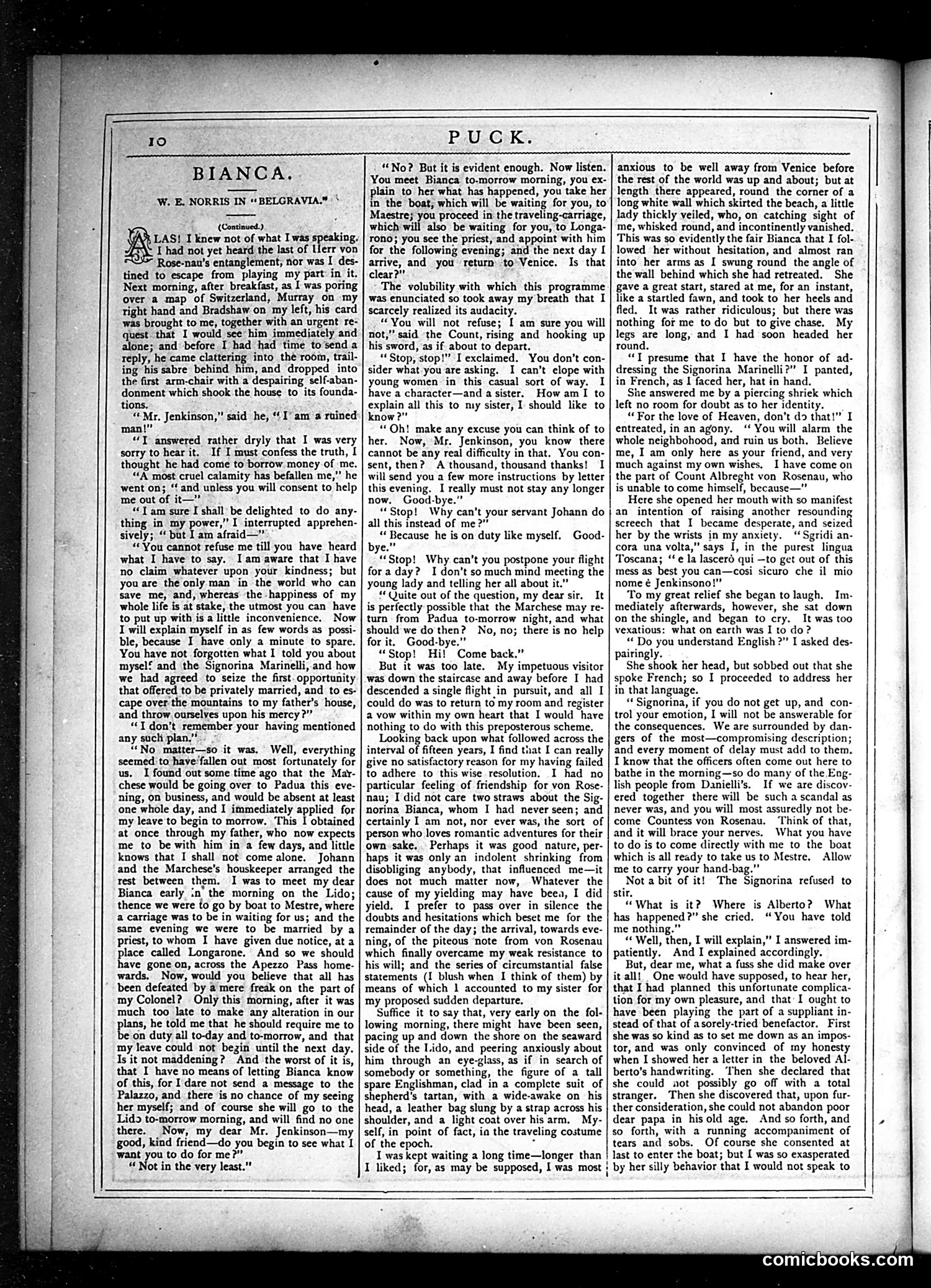
This page from *Puck* magazine appears to be a serialized short story titled "Bianca" by W.E. Norris, set in Venice. The narrative is presented in traditional magazine fiction format—dense columns of text with an illustrated header. The story concerns a romantic complication: the narrator must inform his sister Bianca of an embarrassing entanglement involving a young woman. He describes maneuvering through Venice, arranging meetings, and managing social consequences. The tone is melodramatic, typical of late 19th-century serialized fiction. **No political satire is evident on this page.** This is literary content rather than political commentary or cartooning. The "Puck" masthead indicates magazine branding, but the actual content serves as entertainment fiction for readers rather than satirical commentary on contemporary events or figures.
📄 Transcribed text from this page (OCR, searchable)
Machine-transcribed from the original scan — historical spelling and the odd misread are preserved.
PUCK. BIANCA, ‘W. E. NORRIS IN “BELGRAVIA.” | * © Continued.) ev LAS! I knew not of what I was speaking. Thad not yet heard) the last of err von Rose-nau’s entanglement, nor was I des- tined to escape from playing my part in it, Next morning, after breakfast, as I was poring over a map of Switzerland, Murray on my tight hand and Bradshaw on my left, his card was brought to me, together with an urgent re- quest that I would see’ him immediately and alone; and before I had had time to’send a reply, he came clattering into thé room, trail- ing his sabre behind him, and dropped into the first arm-chair with a despairing self-aban- donment which shook the house to its founda- tions. “Mr. Jenkinson,” said he, 1’ am ‘a ruined man!” “TY answered rather dryly that I was very sorry to hear it. If I must confess the truth, 1 thought he had come to borrow moncy of me. “A most cruel calamity has befallen me,” he went on; “and unless you will consent to help me out of it—”” “Tam sure I shall be delighted to do any- thing in my power,” I interrupted apprehen- sively; “ but I am afraid—” “You cannot refuse me till you have heard what I have to say. Iam aware that I have no claim whatever upon your kindness; but you are the only man in the world who can save me, and, whereas the -happiness of my whole life is at stake, the utmost you can have to put up with is a little inconvenience. Now I will explain myself in as few words as possi- ble, because I have only a minute to spare. You have not forgotten what I told you about myself and the Signorina Marinelli, and how we had agreed to seize the first. opportunity that offered to be privately married, and to es- cape over'the mountains to my father’s house, and throw. ourselves upon his mercy?” “I don't remember your having mentioned any suck plan,’ “No matter—so it was. Well, everything seemed to have‘fallen out most fortunately for us. I found out some time ago that the Mar- chese would be going over to Padua this eve- ning, on business, and would be absent at least one whole day, and I immediately applied for my leave'to begin to morrow. This I obtained at once through my father, who now expects me to be with him in a few days, and little knows that I shall not come alone. Johann and the Marchese’s houskeeper arranged the Test between them. I was to meet my dear Bianca early in’ the morning on the Lido; thence we were to go by boat to Mestre, where a carriage was to be in waiting for us; and the same evening we were to be married by a priest, to whom I have given due notice, at a place called Longarone. And so we should have gone on, across the Apezzo Pass home- wards. Now, would you believe that all has been defeated by @ mere freak on the part of my Colonel? Only this morning, after it was much too late to make any alteration in our plans, he told me that he should require me to e on duty all to-day and to-morrow, and that my leave could not begin until the next day. Is it not maddening? And the worst of it is, that I have no means of letting Bianca know of this, for I dare not send a message to the Palazzo, and there is no chance of my seeing her myself; and of course she will go to the Lid> to-morrow morning, and will find no one there. Now, my dear Mr. Jenkinson—my good, kind friend—do you begin to see what I Vaiatiae to do for me?” “Not in the very least.” “No? But it is evident enough. Now listen. You meet Bianca to-morrow morning, you ex- plain to her what has happened, you take her in the boat, which will be waiting for you, to Maestre; you proceed in the traveling-carriage, which will also be waiting for you, to Longa- rono; you see the priest, and appoint with him for the following evening; and the next day { arrive, and you return to Venice. Is that clear?” The volubility with which this programme was enunciated so took away my breath that I scarcely realized its audacity. “You will not refuse; 1 am sure you will not,” said ‘the Count, rising and hooking up his sword, as if about to depart. “Stop, stop!” I exclaimed. You don’t con- sider what you are asking. I can’t elope with young women in this casual sort of way, I have a character—and a sister. How amI to explain all this to my sister, I should like to know 2” “Oh! make any excuse you can think of to her. Now, Mr. Jenkinson, you know there cannot be any real difficulty in that. You con- sent, then? A thousand, thousand thanks! 1 will send you a few more instructions by letter this evening. I really must not stay any longer now. Good-bye.” “Stop! Why can’t your servant Johann do all this instead of me?” “Because he is on duty like myself. bye.” “Stop! Why.can't you postpone your flight fora day? I don’t so much mind meeting the young lady and telling her all about it.” Quite out of the question, my dear sir. It is perfectly possible that the Marchese may re- turn from Padua to-morrow night, and what should we do then? No, no; there is no help for it. Good-bye.” “Stop! Hi! Come back.” But it was too late. My impetuous visitor was down the staircase and away before I had descended a single flight in pursuit, and all I could do was to return to my room and register a vow within my own heart that I would have nothing to do with this preposterous scheme. Looking back upon what followed across the interval of fifteen years, I find that I can really give no satisfactory reason for my having failed to adhere to this wise resolution, I had no particular feeling of friendship for von Rose- nau; I did not care two straws about the Sig- norina Bianca, whom I had never seen; and certainly I am not, nor ever was, the sort of person who loves romantic adventures for their own sake, Perhaps it was good nature, per- haps it was only an indolent shrinking from disobliging anybody, that influenced me—it does not much matter now, Whatever the cause of my yielding may have beea, I did yield. I prefer to pass over in silence the doubts and hesitations which beset me for the remainder of the day; the arrival, towards eve- ning, of the piteous note from von Rosenau which finally overcame my weak resistance to his will; and the series of circumstantial false statements (I blush when I think of them) by means of which 1 accounted to my sister for my proposed sudden departure, Suffice it to say that, very early on the fol- lowing morning, there might have been seen, pacing up and down the shore on the seaward side of the Lido, and peering anxiously about him through an eye-glass, as if in search of somebody or something, the figure of a tall spare Englishman, clad in a complete suit of shepherd's tartan, with a wide-awake on his head, a leather bag slung by a strap across his shoulder, and a light coat over his arm. My- self, in point of fact, ia the traveling costume of the epoch. is I was kept waiting a long time—longer than Good- anxious to be well away from Venice before the rest of the world was up and about; but at length there appeared, round the corner of a long white wall which skirted the beach, a little lady thickly veiled, who, on catching sight of me, whisked round, and incontinently vanished. This was so evidently the fair Bianca that I fol- lowed her without hesitation, and almost ran into her arms as I swung round the angle of the wall behind which she had retreated. She gave a great start, stared at me, for an instant, like a startled fawn, and took to her heels and fled. It was rather ridiculous; but there was nothing for me to do but to give chase. My legs are long, and I had soon headed her round, “T presume that I have the honor of ad- dressing the Signorina Marinelli?” I panted, in French, as I faced her, hat in hand. She answered me by a piercing shriek which left no room for doubt as to her identity. “For the love of Heaven, don’t do that!” I entreated, in an agony. “‘ You will alarm the whole neighbohood, and ruin us both. Believe me, I am only here as your friend, and very much against my own wishes, I have come on the part of Count Albreght von Rosenau, who is unable to come himself, because—"” Here she opened her mouth with so manifest an intention of raising another resounding screech that I became desperate, and seized her by the wrists in my anxiety. ‘Sgridi an- cora una volta,” says I, in the purest lingua Toscana; ‘‘e la lascerd qui —to get out of this mess as best you can—cosi sicuro che il mio nome é Jenkinsono!” ‘To my great relief she began to laugh. Im- mediately afterwards, however, she sat down on the shingle, and began to cry. It was too vexatious: what on earth was I to do? “Do you understand English ?” I asked des- pairingly. She shook her head, but sobbed out that she spoke French; so I proceeded to address her in that language. “Signoria, if you do not get up, and con- trol your emotion, I will not be answerable for the consequences. We are surrounded by dan- gers of the most—compromising description; and every moment of delay must add to them. I know that the officers often come out here to bathe in the morning—so do many of the Eng- lish people from Danielli’s. If we are discov- ered together there will be such a scandal as never was, and you will most assuredly not be- come Countess von Rosenau. Think of that, and it will brace your nerves. What you have to do is to come directly with me to the boat which is all ready to take us to Mestre. Allow me to carry your hand-bag.” Not a bit of it! The Signorina refused to stir. “What is it? Where is Alberto? What has happened?” she cried. “You have told me nothing.” “ Well, then, I will explain,” I answered im- patiently. And I explained accordingly. But, dear me, what a fuss she did make over it all! One would have supposed, to hear her, that I had planned this unfortunate complica- tion for my own pleasure, and that’ I ought to have been playing the part of a suppliant in- stead of that of asorely-tried benefactor. First she was so kind as to set me down as an impos- tor, and was only convinced of my honesty when I showed her a letter in the beloved Al- berto’s handwriting. Then she declared that she could aot possibly go off with a total stranger. Then she discovered that, upon fur- ther consideration, she could not abandon poor dear papa in his old age. And so forth, and so forth, with a running accompaniment of tears and sobs. Of course she consented at last to enter the boat; but I was so exasperated I liked; for, as may be supposed, I was most H by her silly behavior that I would not speak to comicbooks.com