
Puck, 1878-12-04 · page 3 of 16
Puck — December 4, 1878 — page 3: what you’re looking at
What you’re looking at
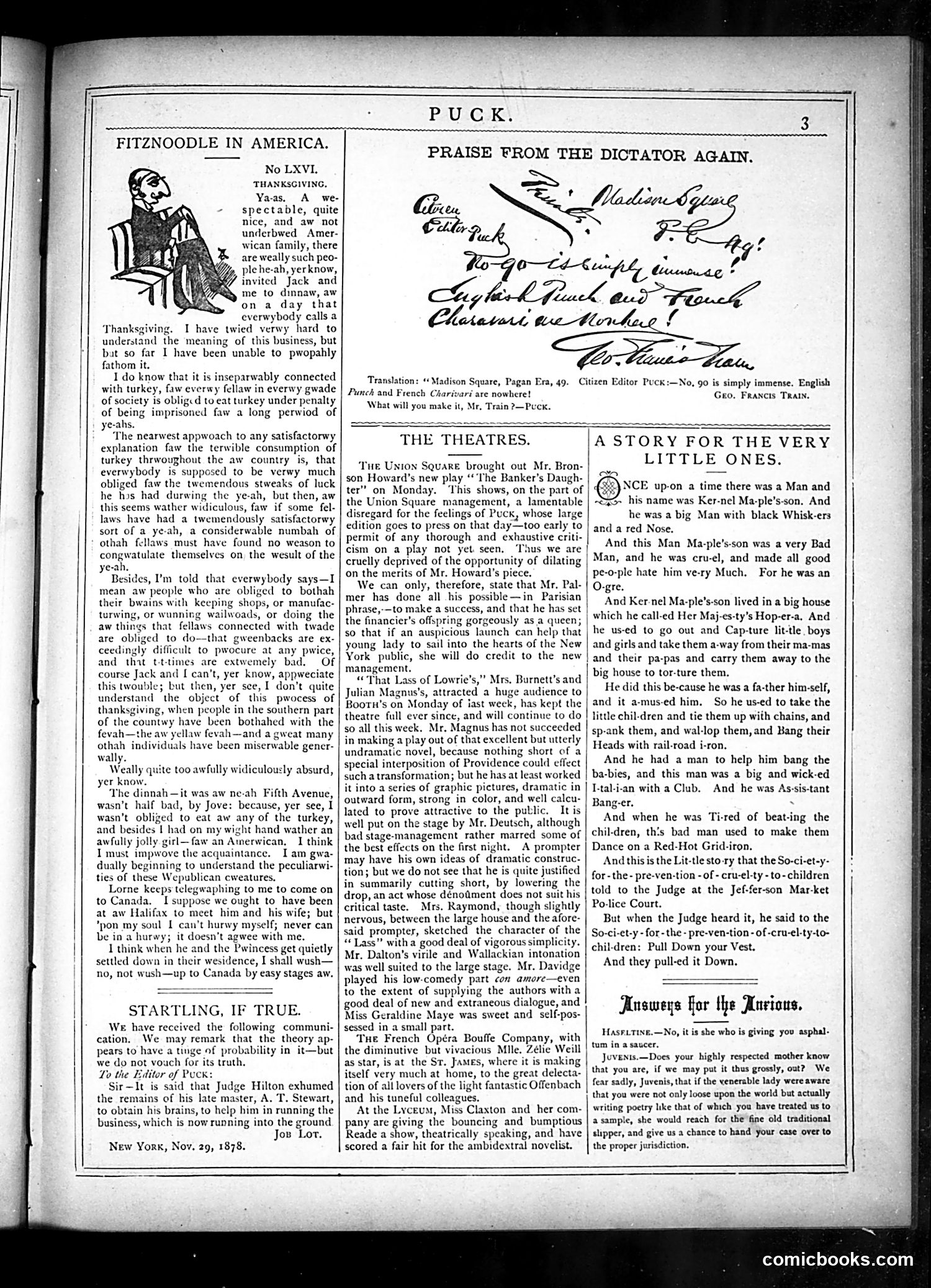
This satirical cartoon depicts an Irish immigrant ("Fitznoodle") struggling to understand American Thanksgiving traditions. The piece mocks working-class Irish assimilation into American society, suggesting their bewilderment at unfamiliar customs and social hierarchies. The cartoon ridicules both Irish immigrants' outsider status and American pretensions about democratic equality. The protagonist's inability to grasp why Thanksgiving involves eating turkey—and his broader confusion about American social rituals—serves as the humor. The text emphasizes the "terrible consumption" of turkeys and connects this to broader class and cultural tensions between established Americans and newer Irish arrivals. This reflects 1870s-era anti-Irish prejudice common in American satire, where ethnic stereotyping was considered entertainment.
📄 Transcribed text from this page (OCR, searchable)
Machine-transcribed from the original scan — historical spelling and the odd misread are preserved.
PUCK. FITZNOODLE IN AMERICA. No LXVI. THANKSGIVING, Ya-as. A we- spectable, quite nice, and aw not underbwed Amer- wican family, there are weally such peo- plehe-ah, yerknow, 7 invited Jack and me to dinnaw, aw on a day that everwybody calls a ‘Thanksgiving. I have twied verwy hard to understand the meaning of this business, but bat so far I have been unable to pwopahly fathom it, 1 do know that it is inseparwably connected with turkey, faw everwy fellaw in everwy gwade of society is obliged to eat turkey under penalty of being imprisoned faw a long perwiod of ye-ahs. he nearwest appwoach to any satisfactorwy explanation faw the terwible consumption of turkey thrwoughout the aw country is, that everwybody is supposed to be verwy ‘much obliged faw the twemendous stweaks of luck he his had durwing the ye-ah, but then, aw this seems wather widiculous, faw if some fel- laws have had a twemendously satisfactorwy sort of a ye-ah, a considerwable numbah of othah fellaws must have found no weason to congwatulate themselves on the wesult of the ye-ah, Besides, I’m told that everwybody says—I mean aw people who are obliged to bothah their bwains with keeping shops, or manufac- turwing, or wunning wailwoads, or doing the aw things that fellaws connected with twade are obliged to do-that gweenbacks are ex- ceedingly difficult to pwocure at any pwice, and that t-t-times are extwemely bad. Of course Jack and [ can’t, yer know, appweciate this twouble; but then, yer sce, I don’t quite understand the object of this pwocess of thanksgiving, when people in the southern part of the countwy have been bothahed with the fevah—the aw yellaw fevah—and a gweat many othah individuals have been miserwable gener- wally. Weally quite too awfully widiculously absurd, yer know. The dinnah—it was aw ne-ah Fifth Avenue, wasn’t half bad, by Jove: because, yer see, I wasn’t obliged to eat aw any of the turkey, and besides | had on my wight hand wather an awfully jolly girl—faw an Atmerwican, I think I must impwove the acquaintance. I am gwa- dually beginning to understand the peculiarwi- ties of these Wepublican cweatures. Lorne keeps telegwaphing to me to come on to Canada. I suppose we ought to have been at aw Halifax to meet him and his wife; but "pon my soul I can’t hurwy myself; never can be ina hurwy; it doesn’t agwee with me. 1 think when he and the Pwincess get quietly settled down in their wesidence, I shall wush— no, not w ush—up to Canada by easy stages aw. STARTLING, IF TRUE. WE have received the following communi- cation. We may remark that the theory ap- pears to have a tinge of probability in it—but we do not vouch for its truth, To the Editor of Puck: Sir—It is said that Judge Hilton exhumed the remains of his late master, A. T. Stewart, to obtain his brains, to help him in running the business, which is now runing into the ground Jos Lor. New York, Nov. 29, 1878. PRAISE ree THE DICTATOR AGAIN. Mladiia byte aS, Daiwa eae te Mork Translation: “ Madison Square, Pagan Era, 49. Citizen Editor Puc! Punch and French Charivari are nowhere! What will you make it, Mr, Train ?—Puck. f a . :—No, 90 is simply immense. English Geo. Francis Train, THE THEATRES. ‘Tue Union Square brought out Mr. Bron- son Howard’s new play “The Banker's Daugh- ter” on Monday. ‘This shows, on the part of the Union Square management, a lamentable disregard for the feelings of Puck, whose large edition goes to press on that day—too early to | permit of any thorough and exhaustive criti- cism on a play not yet. seen, ‘Thus we are cruelly deprived of the opportunity of dilating | on the merits of Mr. Howard’s piece. We can only, therefore, state that Mr. Pal- mer has done all his possible—in Parisian | phrase,-—to make a success, and that he has set | the financier’s offspring gorgeously as a queen; so that if an auspicious launch can help that young lady to sail into the hearts of the New York public, she will do credit to the new management. “ That Lass of Lowrie’s,” Mrs. Burnett’s and | fagnus’s, attracted a huge audience to has kept the theatre full ever since, and will continue to do so all this week. Mr, Magnus has not succeeded in making a play out of that excellent but utterly undramatic novel, because nothing short of a special interposition of Providence could effect such a transformation; but he has at least worked it into a series of graphic pictures, dramatic in outward form, strong in color, and well calcu- lated to prove attractive to the pull Tris well put on the stage by Mr. Deutsch, although bad stage-management rather marred some of the best effects on the first night. A prompter may have his own ideas of dramatic construc. tion; but we do not see that he is quite justified in summarily cutting short, by lowering the drop, an act whose dénodment does not suit his critical taste. Mrs. Raymond, though slightly nervous, between the large house and the afore- said prompter, sketched the character of the “Lass” witha good deal of vigorous simplicity. Mr. Dalton’s virile and Wallackian intonation was well suited to the large stage. Mr. Davi played his low-comedy part con amore—even to the extent of supplying the authors with a good deal of new and extraneous dialogue, and Miss Geraldine Maye was sweet and self-pos- sessed in a small part. ‘THe French Opéra Bouffe Company, with the diminutive but vivacious Mlle. Zélie Weill as star, is at the Sr. Jases, where it is making itself very much at home, to the great delecta- tion of all lovers of the light fantastic Offenbach and his tuneful colleagues, At the Lyceum, Miss Claxton and her com- pany are giving the bouncing and bumptious Reade a show, theatrically speaking, and have scored a fair hit for the ambidextral novelist. A STORY FOR THE VERY LITTLE ONES. NCE up-on a time there was a Man and his name was Ker-nel Ma-ple’s-son. And he was a big Man with black Whisk-ers and a red Nose. And this Man Ma-ple’s-son was a very Bad Man, and he was cru-el, and made all good pe-o-ple hate him ve-ry Much. For he was an O-gre. And Ker-nel Ma-ple’s-son lived in a big house which he call-ed Her Maj-es-ty’s Hop-er-a, And he us-ed to go out and Cap-ture lit-tle. boys and girls and take them a-way from their ma-mas and their pa-pas and carry them away to the big house to tor-ture them. He did this be-cause he was a fa-ther him-self, and it a-mus-ed him, So he us-ed to take the little chil-dren and tie them up with chains, and sp-ank them, and wal-lop them, and Bang their Heads with rail-road i-ron. And he had a man to help him bang the ba-bies, and this man was a big and wick-ed I-tal-i-an with a Club. And he was As-sis-tant Bang-er. And when he was Ti-red of beat-ing the chil-dren, th's bad man used to make them Dance on a Red-Hot Grid-iron. And this is the Lit-tle sto-ry that the So-ci-et-y- for-the- pre-ven-tion - of - cru-el-ty - to-children told to the Judge at the Jef-fer-son Mar-ket Po-lice Court. But when the Judge heard it, he said to the So-ci-et-y - for- the - pre-ven-tion - of-cru-el-ty-to- chil-dren: Pull Down your Vest. And they pull-ed it Down, Answeys For the Anrious. Hasritine.—No, it is she who is giving you asphal- tum in a saucer. JuvENis.—Does your highly respected mother know that you are, if we may put it thus grossly, out? We fear sadly, Juvenis, that if the venerable lady were aware that you were not only loose upon the world but actually writing poetry like that of which you have treated us to asample, she would reach for the fine old traditional slipper, and give us a chance to hand your case over to the proper jurisdiction. comicbooks.com