
A complete issue · 16 pages · 1878
Puck — October 23, 1878
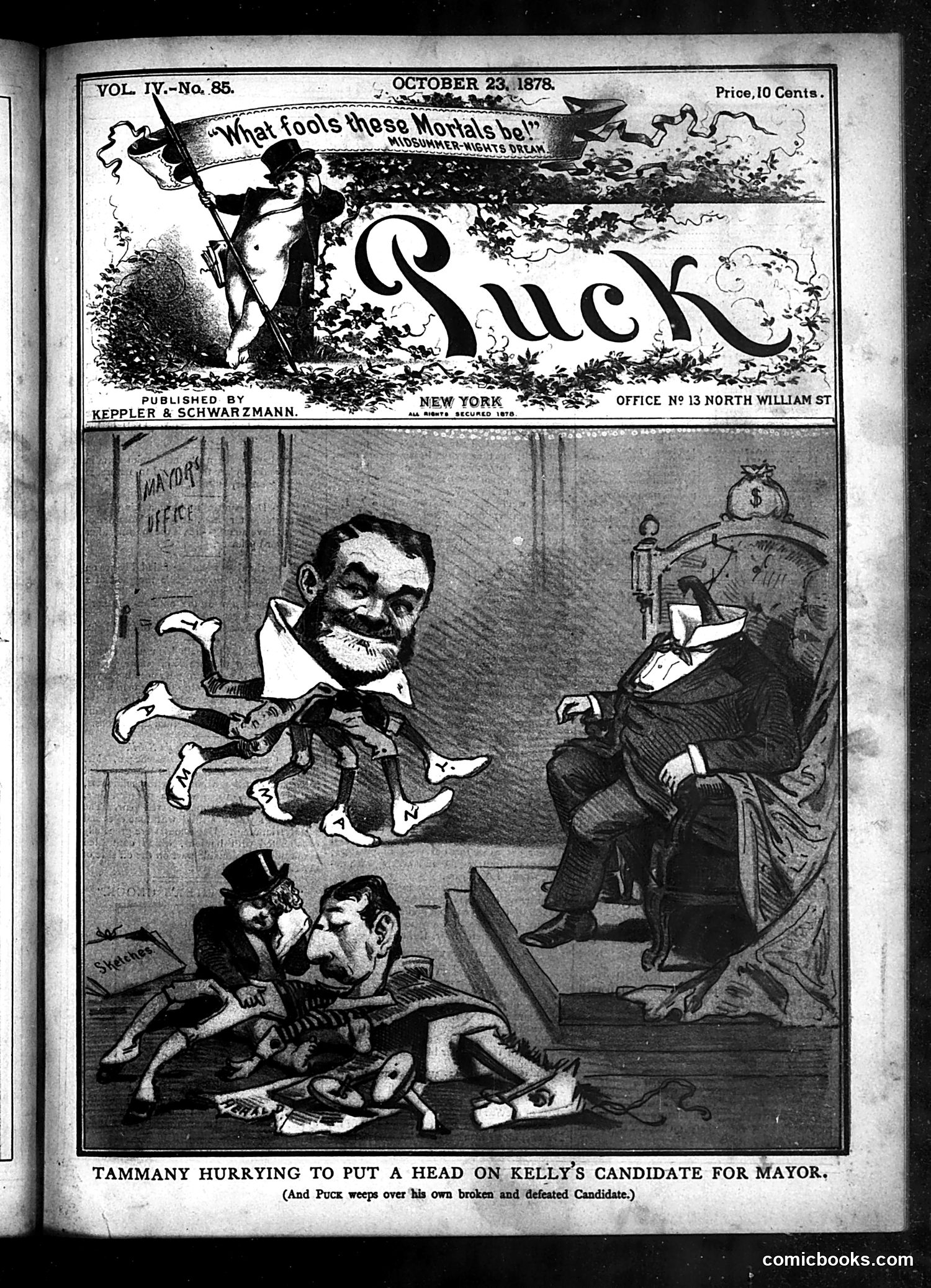
This political cartoon satirizes New York City's Tammany Hall political machine and its interference in the mayoral election. The caption reads: "Tammany Hurrying to Put a Head on Kelly's Candidate for Mayor. (And Puck weep over his own broken and defeated Candidate.)" The imagery depicts Tammany Hall (the large figure in the chair, upper right) attempting to manipulate or "construct" a mayoral candidate, while smaller figures below appear to be political operatives or supporters struggling with the process. The cartoon criticizes Tammany's control over local politics and its tendency to install preferred candidates rather than supporting genuinely qualified individuals. The satire attacks machine politics and corruption in New York's electoral system during this era.
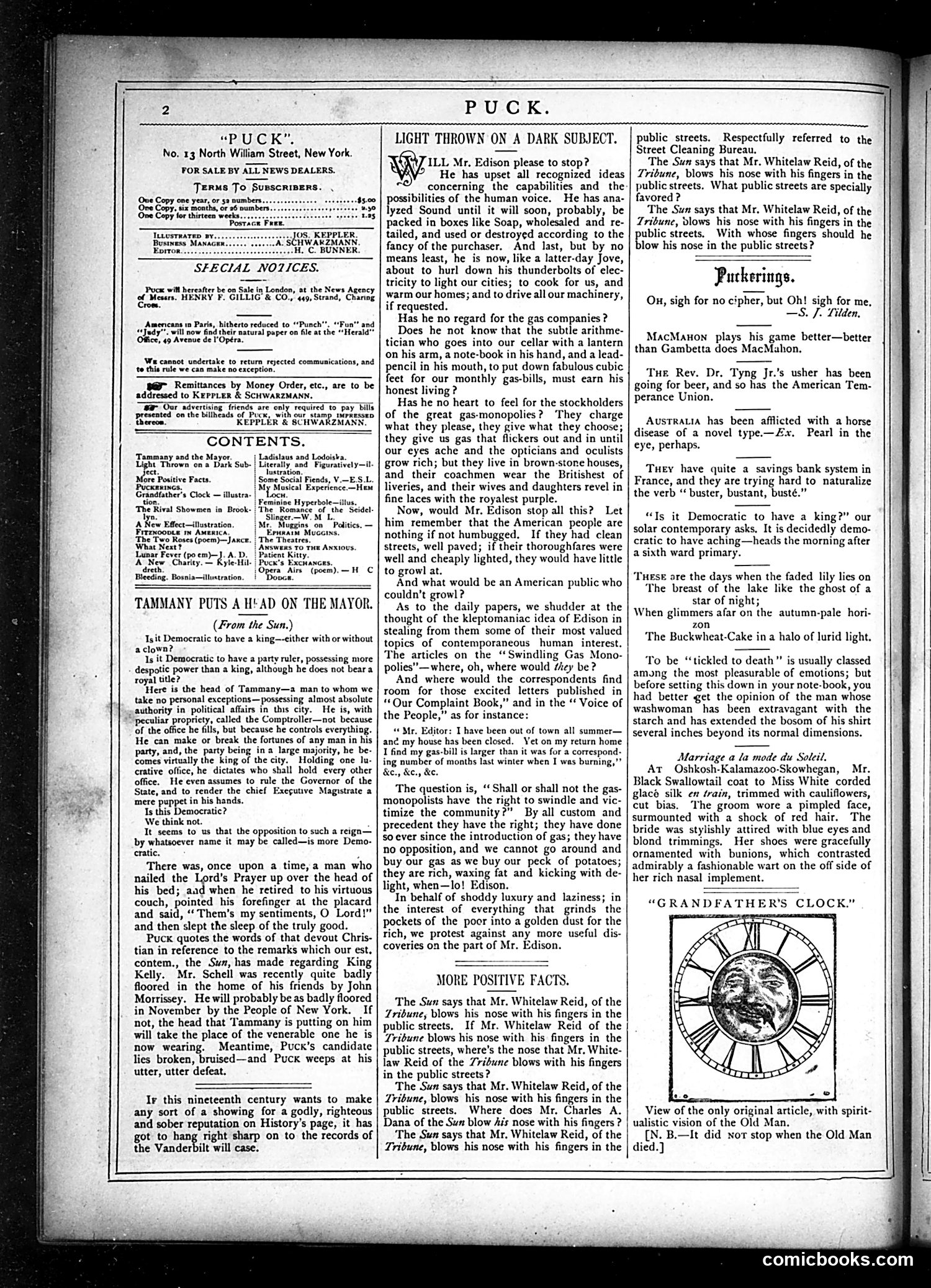
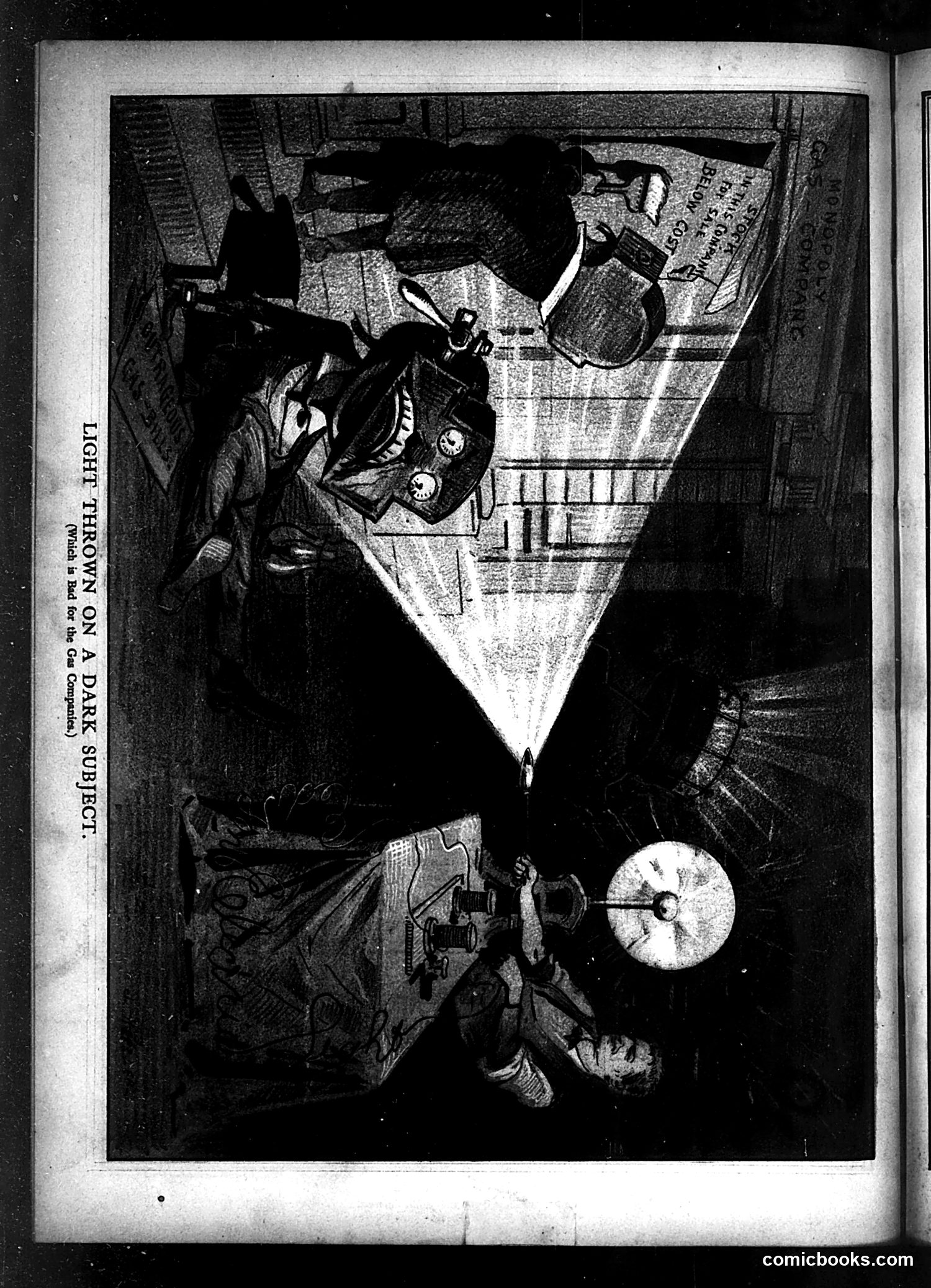
This page primarily contains **editorial content and advertisements** rather than a main cartoon. The visible sections include: **"Light Thrown on a Dark Subject"** - A satirical piece attacking Thomas Edison's claims about the human voice and electricity. The author mocks Edison's grandiose ideas about harnessing electricity to perform household tasks, suggesting Edison lacks regard for gas monopolies and working-class families who depend on gas services. The satire ridicules Edison as a "latter-day love" figure throwing "thunderbolts of electricity" to modernize cities—presenting his technological utopianism as impractical and potentially harmful to existing industries and workers. **"Tammany Puts a Head on the Mayor"** - Commentary on Democratic machine politics in New York, criticizing Tammany Hall's control over municipal leadership. The page reflects **late 19th-century anxieties** about technological disruption and political corruption.
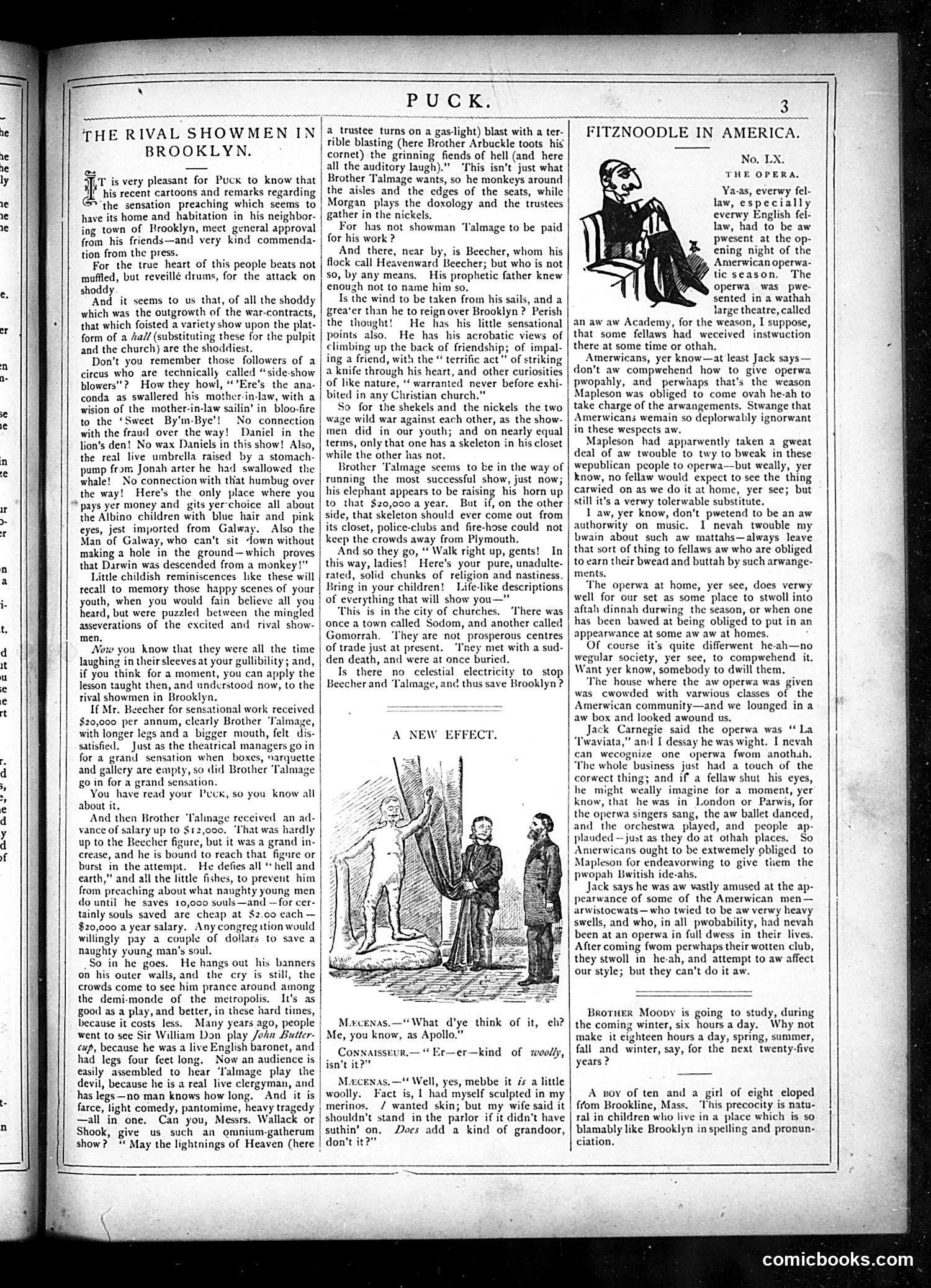
This satirical piece mocks competing theatrical entrepreneurs in Brooklyn, particularly focusing on showmen named Heecker and Talmage who are rivals for audience attention. The article suggests Heecker, described as sensational and mercenary, is trying to outdo a religious figure (Talmage) by offering increasingly spectacular entertainments—elephants, whales, and other novelties—to draw crowds. The satire critiques both men: Talmage for his self-righteous preaching and Heecker for crass commercialism. The piece humorously suggests their competition represents the absurd extremes of entertainment versus religion in Brooklyn society, with both exploiting public curiosity for profit or influence. The underlying joke is that both "showmen" use similar manipulative tactics despite their different venues.
This page primarily contains **"The Two Roses," a poem by James** about romantic longing, accompanied by reader letters to Puck's editor rather than editorial cartoons. The letters address various 1858 controversies: Mr. Brutus denies involvement in a maladjustment-of-justice case in Jerusalem; the Duke of Normandy responds to accusations about conquering competitors; and Henry Stanley disputes claims he crossed Africa or discovered Livingston. Christopher Columbus's "discovery" is humorously challenged—a correspondent insists he didn't discover America and doesn't know who did. Secretary of State Evarts defends himself against rumors of a damaging private letter. The satire here is **epistolary rather than visual**: Puck amplifies absurd public denials and self-justifications to mock the era's notable figures and their defensive posturing.
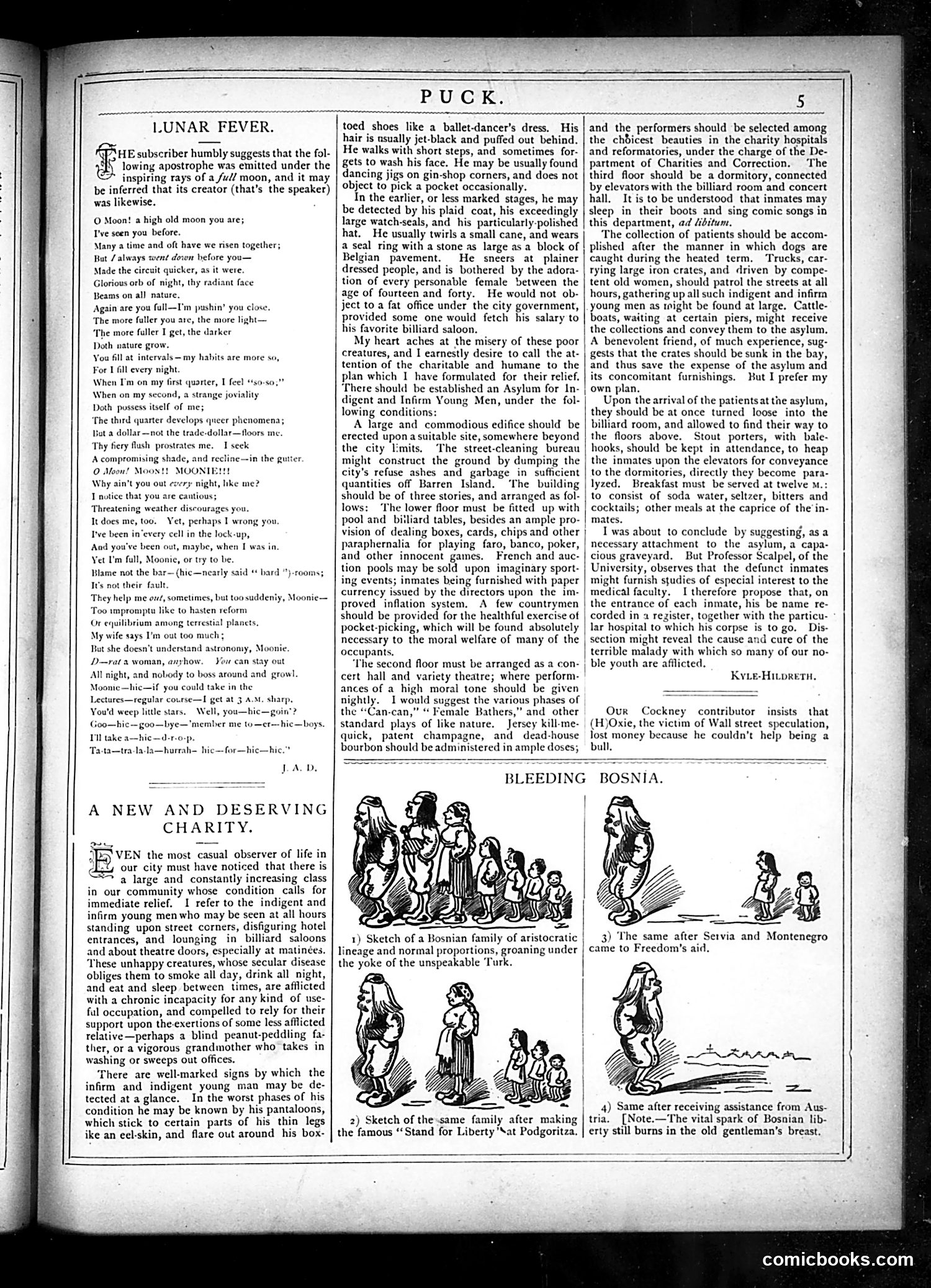
This cartoon comments on the humanitarian crisis in Bosnia following the Balkan Wars. The four sketches depict a Bosnian family's deteriorating condition: 1) **Initial state**: A family of aristocratic lineage under Ottoman rule ("the unspeakable Turk") 2) **After declaring independence**: Conditions worsen following the "Stand for Liberty" at Podgoritsa 3) **Receiving Austrian aid**: The family remains impoverished despite assistance 4) **Final state**: Minimal improvement, with a note that "the vital spark of Bosnian liberty still burns in the old gentleman's breast" The satire critiques the ineffectiveness of international intervention and independence movements in actually alleviating Bosnian suffering. The family's persistent poverty despite declarations of freedom and foreign aid suggests that political gestures fail to address real humanitarian needs.
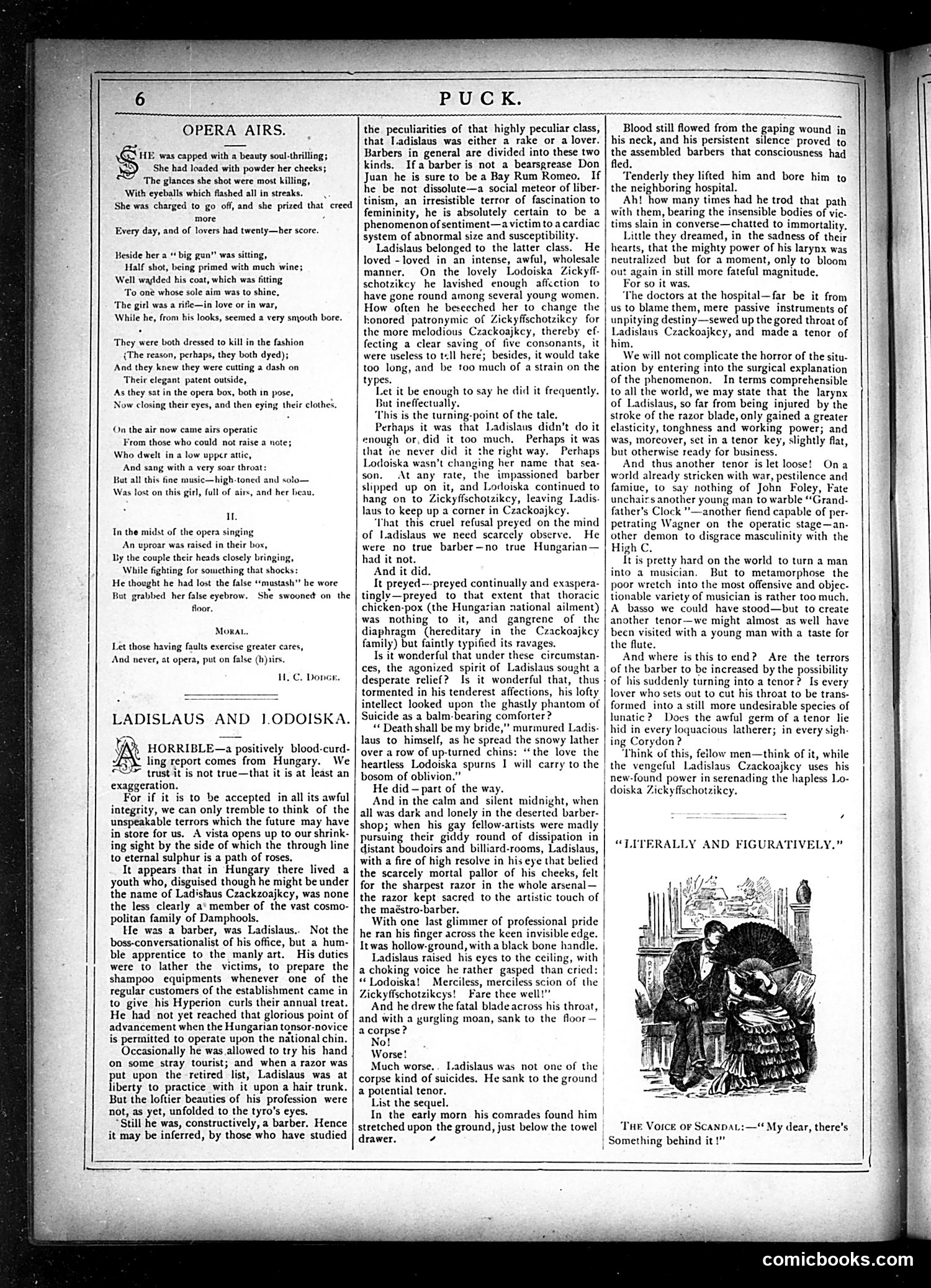
This page contains **literary content rather than political cartoons**. The main article is "Ladislaus and Lodoiska," a satirical story about a Hungarian barber named Ladislaus who becomes romantically entangled with a woman named Lodoiska. The narrative mocks his attempts at sophistication and romantic prowess, describing his theatrical gestures and ultimate failure—he apparently slits his throat over unrequited love. The single illustration labeled "The Voice of Scandal" shows a woman gossiping, likely commenting on the scandalous story. This appears to be **social satire rather than political commentary**, targeting romantic pretension and small-town gossip rather than any specific political figures or events. The humor is character-driven and domestic in nature.
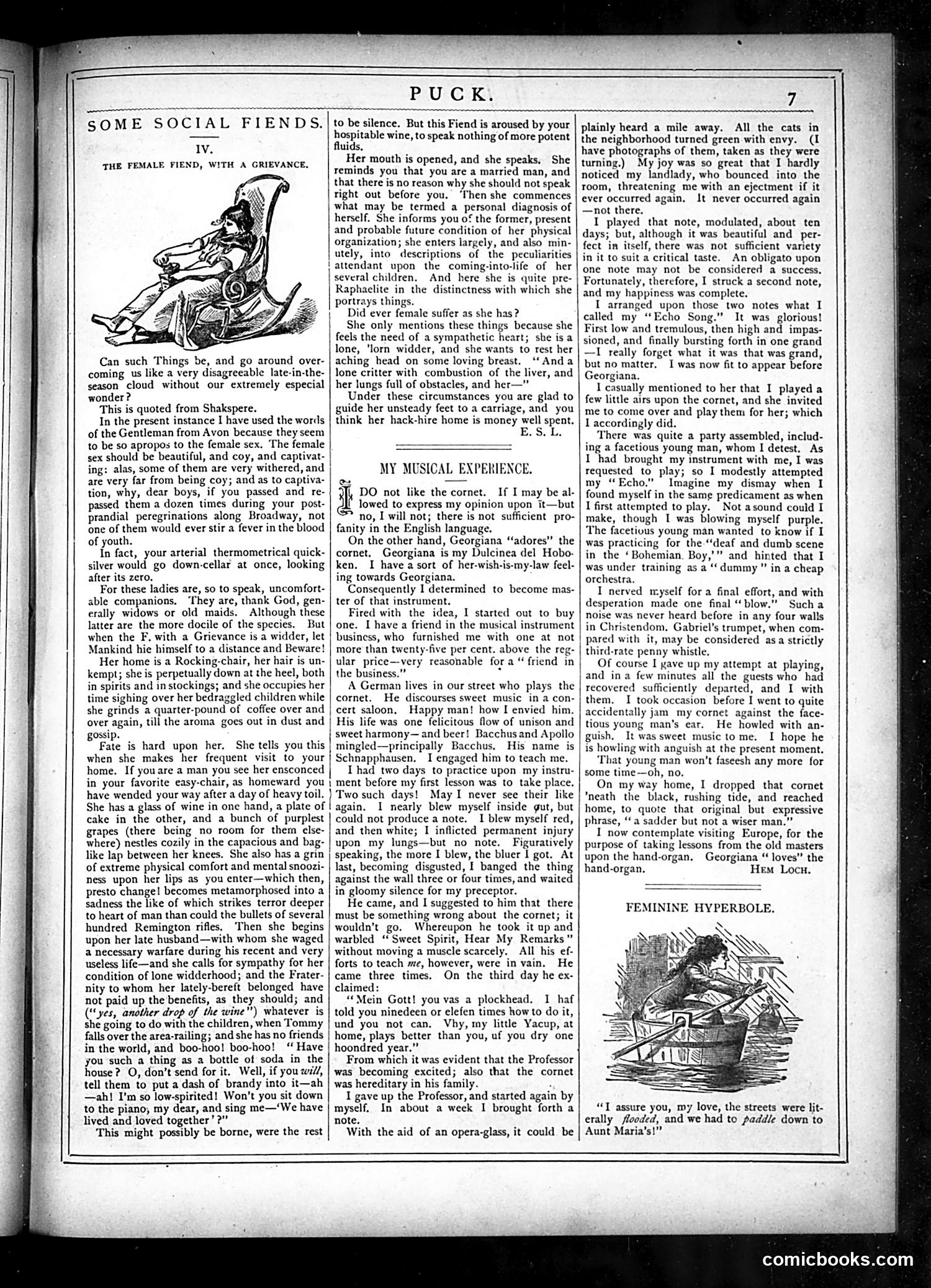
This page contains three separate humor pieces rather than political cartoons: 1. **"Some Social Fiends IV: The Female Fiend, With a Grievance"** — A satirical sketch about a complaining woman who visits her married friend to air grievances about her husband, his appearance, and their domestic life. The cartoon depicts her as an annoying social visitor spreading negativity. 2. **"My Musical Experience"** — A humorous first-person account of attempting to learn the cornet from an Italian street musician named Schnapphausen, with comedic descriptions of the author's terrible playing and the instructor's frustration. 3. **"Feminine Hyperbole"** — A brief joke about exaggeration, with an illustration showing a woman claiming city streets were literally "flooded" and required paddling to navigate. All three pieces are social humor targeting contemporary manners and behaviors.
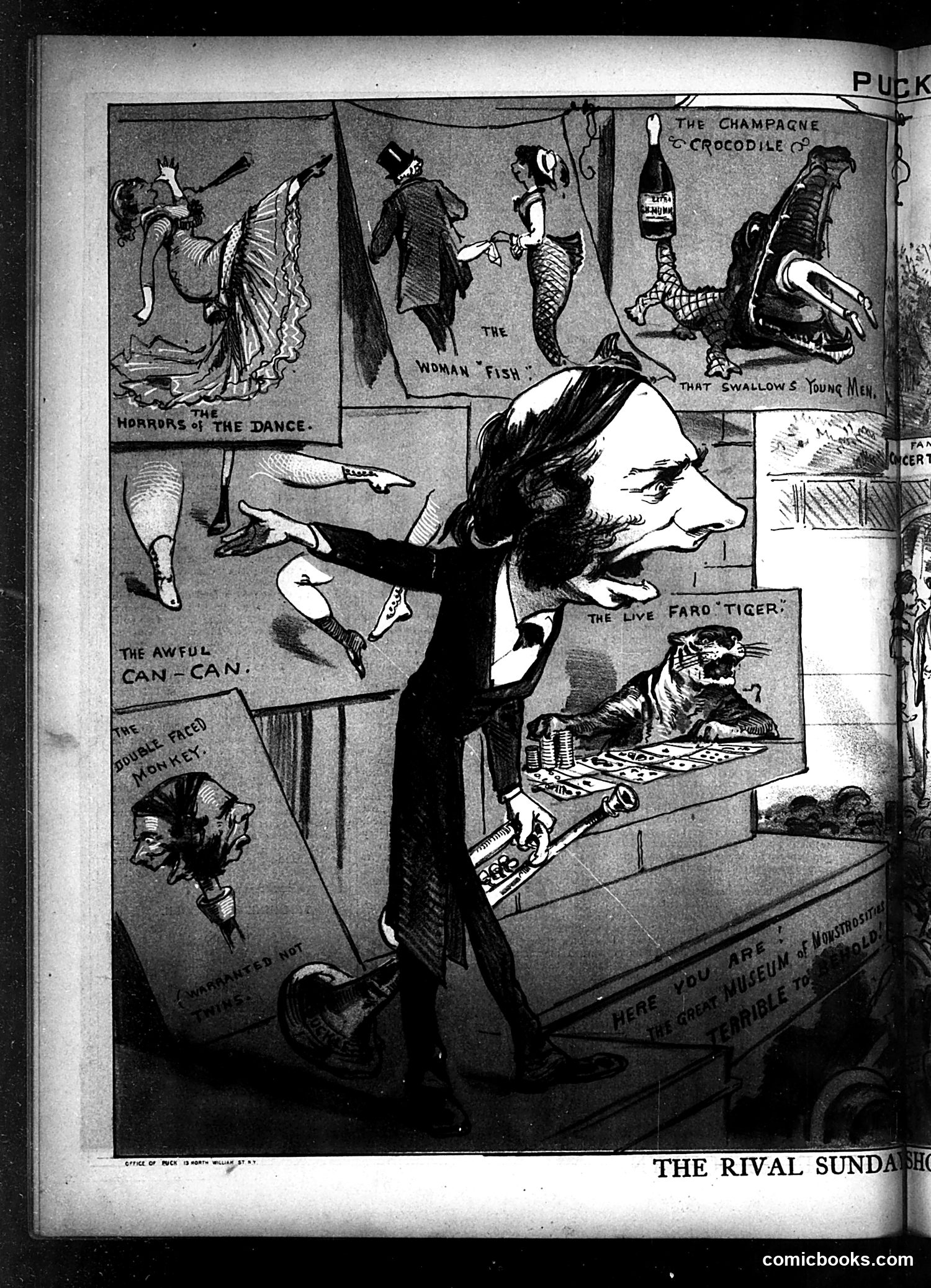
This is a satirical illustration from Puck magazine featuring a caricatured man with exaggerated facial features pointing at various vaudeville acts and entertainment attractions displayed on panels around him. The visible titles include "The Horrors of the Dance," "The Woman Fish," "The Awful Can-Can," "The Champagne Crocodile," "That Swallows Young Men," "The Live Faro Tiger," and references to a "Drunken Hot" and "Twisted Monkey." The cartoon appears to satirize either a specific impresario or the vaudeville/entertainment industry generally, critiquing sensationalized acts and morally questionable performances popular at the time. The exaggerated caricature suggests ethnic or national stereotyping common in Puck's satirical approach. The "Rival Sunda[y]" reference at bottom appears cut off.
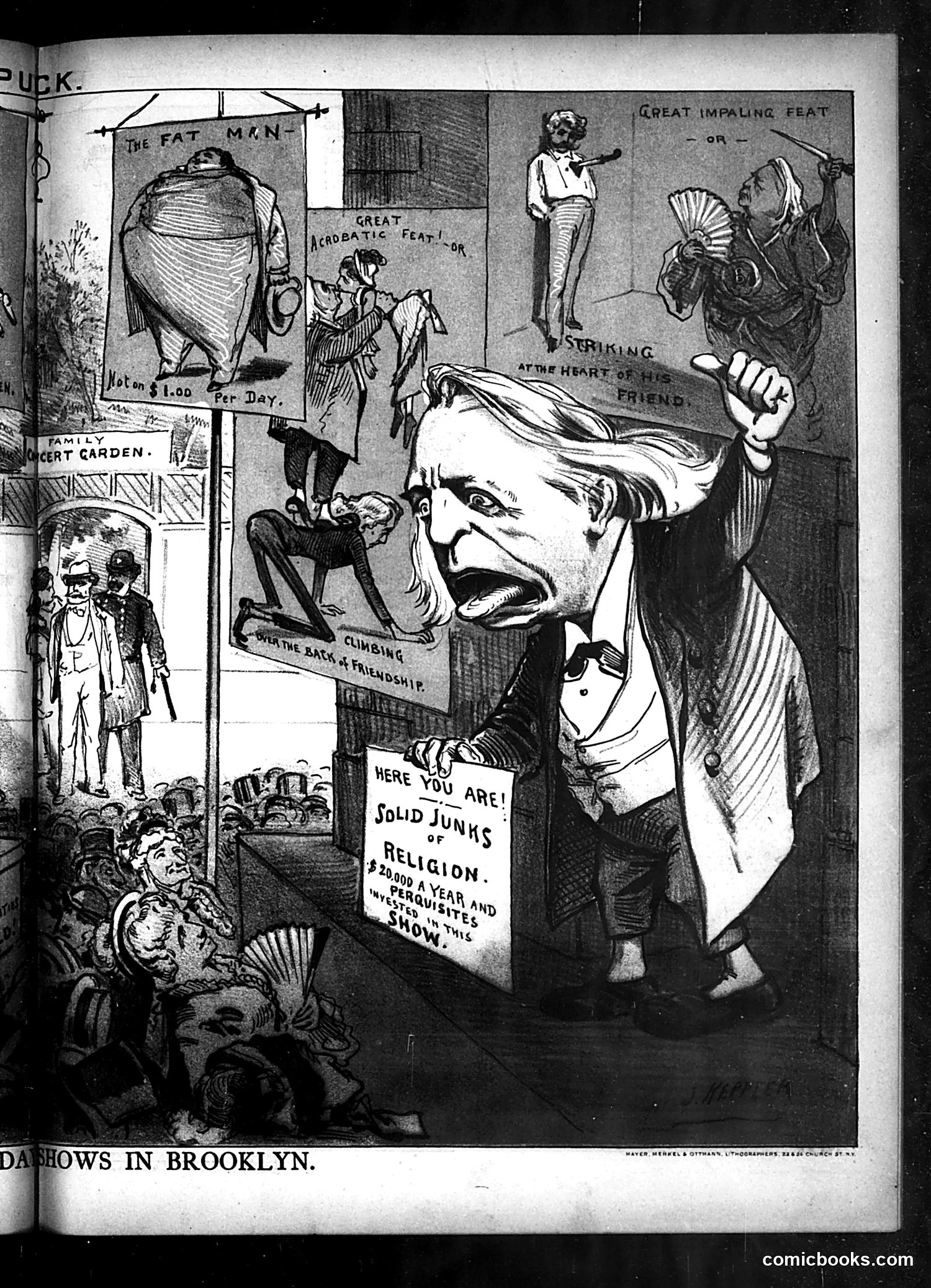
This Puck cartoon satirizes organized religion as a commercial enterprise. The large central figure—a well-dressed man in formal attire—displays a sign advertising "SOLID JUNKS OF RELIGION" with "$20,000 A YEAR AND INVESTMENT" required. He appears to be a religious charlatan or corrupt clergyman hawking faith as a profitable business. The smaller panels above depict various "acrobatic feats" and stunts labeled with phrases like "climbing over the backs of friendship" and "striking at the heart of his friend." These represent the dishonest practices religious institutions allegedly employ to extract money and loyalty from followers. The satire critiques how established religion functions as a money-making scheme rather than a genuine spiritual practice, exploiting believers' faith for financial gain.
This page contains three distinct sections: "The Romance of the Seidel-Slinger" (a poem with illustration), "Mr. Muggins Goes Into Politics" (a political satire), and theater reviews. The main political content is "Mr. Muggins Goes Into Politics," which satirizes a character advocating radical economic positions—specifically attacking labor movements, the "Greenback" currency, and "irredeemable currency." The piece mocks someone promoting populist monetary reforms, dismissing proposals for paper money and arguing gold's superiority. The satire targets late-19th-century debates over currency standards and labor politics, likely referencing Greenback Party or Populist movement positions that Puck's conservative editors opposed. The humor derives from presenting these radical economic ideas as absurd through the buffoonish "Mr. Muggins" character. The remaining content covers theater reviews and minor items.
This page contains the conclusion of a serialized story by James Payn titled "Patient Kitty," not a political cartoon. It's a Victorian-era romantic narrative about a young woman named Kitty whose life has been disrupted by scandal and misunderstanding involving a man named Frederick (Fred) Halland. The plot involves Kitty's suffering after false accusations regarding a crime, her separation from her beloved, and the eventual clearing of her name. The story emphasizes themes of patience, virtue, and faithful love—characteristic of 19th-century sentimental fiction. The narrator reflects on Kitty's constancy and how she ultimately finds happiness after her innocence is proven and she's reunited with her true love.
This page contains primarily text content—gossip columns, jokes, and brief satirical observations—rather than a major political cartoon. The visible illustration shows "Puck's Birthplace," depicting what appears to be a cherub or puck-like figure in classical style, serving as a decorative header. The textual content includes gossip about various public figures and social commentary typical of Puck's satirical format. References include observations about Wilhelm (likely Wilhelm II of Germany), discussions of social customs, and various anecdotes mocking contemporary figures and behaviors. Without clearer illustrations or specific named references, precise political identification is difficult. The overall tone reflects Puck's typical approach: mocking society's pretensions through humor and social observation rather than explicit political cartooning.
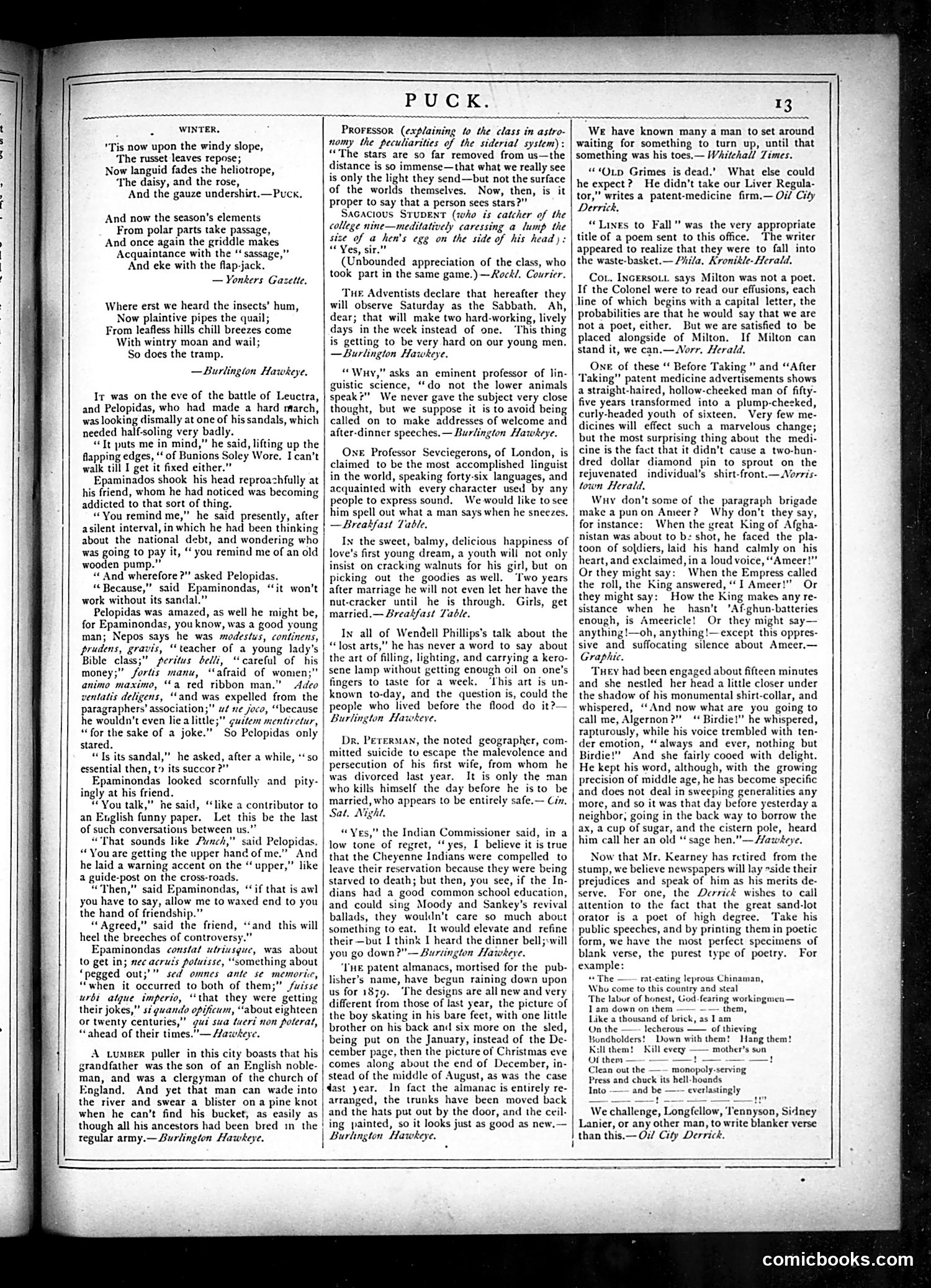
This page from *Puck* magazine appears to be primarily text-based content rather than a political cartoon. The left column contains winter poetry, while the right side features a column of brief satirical anecdotes and commentary labeled "PROFESSOR" at the top. The jokes target various subjects: a patient-medicine man's advertising claims; an inappropriate book title about waste; a Colonel's letter about probabilities; professors' linguistic abilities; and social commentary on matrimony, Native Americans, and Christmas celebrations. The content reflects turn-of-the-century American humor and social observation rather than focused political satire. Without clear illustrations or identification of specific political figures, the page functions as general social commentary using wit and anecdote—typical *Puck* format for filling editorial space with lighthearted cultural criticism.
This page is primarily **advertising and commercial content**, not satirical cartoons. The advertisements feature: - **Apollinaris Natural Mineral Water** ("Queen of Table Waters") - prominently promoted with testimonials from European medical authorities - **Paris London Styles Dress Materials** by Arnold, Constable & Co. - **Children's hosiery and undergarments** - **Vichy springs water** (French mineral water) - **Patent and trademark services** from Paul Goepel - **Dental offices** and a bookstore The page reflects **late 19th-century American consumer culture**, targeting affluent readers through endorsements by named European doctors and aristocrats—a marketing strategy suggesting foreign sophistication validated commercial products. No political satire or editorial cartoons are visible on this page.
This page is primarily **advertisements** rather than satirical content. It features various commercial notices from late 1870s New York businesses, including: - Pachtmann & Moelich (jewelry and watches) - Herring's Safes - Nicoll the Tailor - A Ducal Brunswick Government Bond offering - International Banking Company notice - Champagne and tobacco advertisements The only substantive content is a **financial notice** about Ducal Brunswick Government Bonds, promising "four times annually" returns with "no blanks." This appears to be investment advertising, though without additional context, the specific appeal or any satirical intent is unclear. The page functions primarily as a revenue source through paid advertisements rather than as a vehicle for political or social satire.
This Puck cartoon satirizes a domestic scene viewed from above. The title "Sorrow on a Dark Subject" appears on the left margin. The image shows what appears to be a bedroom interior with two figures and furniture, rendered in dark, dramatic contrast typical of late 19th-century satirical illustration. The specific joke or political reference is unclear from the visible elements alone. The overhead perspective and theatrical lighting suggest commentary on private domestic matters being exposed or scrutinized. Without additional context about the publication date or surrounding articles on this page, the exact target of the satire—whether social, political, or moral—cannot be definitively determined from the image and OCR text provided.