
Puck, 1878-10-23 · page 11 of 16
Puck — October 23, 1878 — page 11: what you’re looking at
What you’re looking at
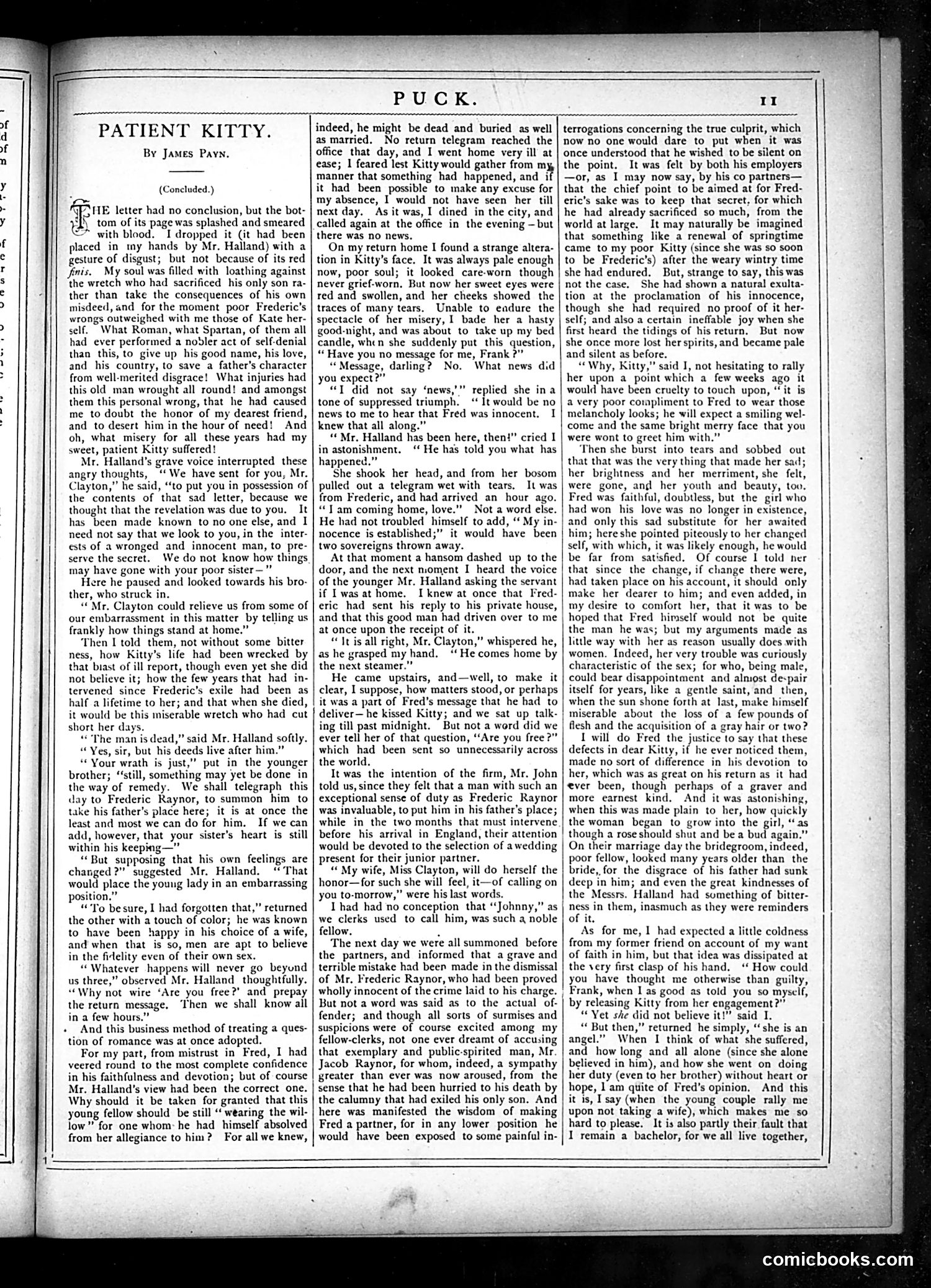
This page contains the conclusion of a serialized story by James Payn titled "Patient Kitty," not a political cartoon. It's a Victorian-era romantic narrative about a young woman named Kitty whose life has been disrupted by scandal and misunderstanding involving a man named Frederick (Fred) Halland. The plot involves Kitty's suffering after false accusations regarding a crime, her separation from her beloved, and the eventual clearing of her name. The story emphasizes themes of patience, virtue, and faithful love—characteristic of 19th-century sentimental fiction. The narrator reflects on Kitty's constancy and how she ultimately finds happiness after her innocence is proven and she's reunited with her true love.
📄 Transcribed text from this page (OCR, searchable)
Machine-transcribed from the original scan — historical spelling and the odd misread are preserved.
oe ¢ PATIENT KITTY. By James Payn, (Coneluded.) HE letter had no conclusion, but the bot- tom of its page was splashed and smeared * with blood. I dropped it (it had been placed in my hands by Mr. Halland) with a gesture of disgust; but not because of its red finis, My soul was filled with loathing against the wretch who had sacrificed his only son ra- ther than take the consequences of his own misdeed, and for the moment poor Frederic’s wrongs outweighed with me those of Kate her- self. What Roman, what Spartan, of them all had ever performed a nobler act of self-denial than this, to give up his good name, his love, and his country, to save a father’s character from well-merited disgrace! What injuries had this old_ man wrought all round! and amongst them this personal wrong, that he had caused me to doubt the honor of my dearest friend, and to desert him in the hour of need! And oh, what misery for all these years had my sweet, patient Kitty suffered! Mr. Halland’s grave voice interrupted these angry thoughts, “We have sent for you, Mr. Clayton,” he said, “to put you in possession of the contents of that sad letter, because we thought that the revelation was due to you. It has been made known to no one else, and 1 need not say that we look to you, in the inter- ests of a wronged and innocent man, to pre- serve the secret. We do not know how things may have gone with your poor sister—”” Here he paused and looked towards his bro- ther, who struck in. “Mr. Clayton could relieve us from some of our embarrassment in this matter by telling us frankly how things stand at home.” Then | told them, not without some bitter ness, how Kitty’s life had been wrecked by that biast of ill report, though even yet she did not believe it; how the few years that had in- tervened since Frederic’s exile had been as half a lifetime to her; and that when she died, it would be this miserable wretch who had cut short her da: “The man is dead,” said Mr. Halland softly. “Yes, sir, but his deeds live after him.” “Your wrath is just,”” put in the younger brother; “still, something may yet be done in the way of remedy. We shall telegraph this day to Frederic Raynor, to summon him to take his father’s place here; it is at once the least and most we can do for him. If we can add, however, that your sister’s heart is still within his keeping—"” “But supposing that his own feelings are changed?” suggested Mr. Halland. “That would place the young lady in an embarrassing position.” “To besure, I had forgotten that,” returned the other with a touch of color; he was known to have been happy in his choice of a wife, and when that is so, men are apt to believe in the fidelity even of their own sex. “Whatever happens will never go beyund us three,” observed Mr. Halland thoughtfully. “Why not wire ‘Are you free?" and prepay the return message, ‘Then we shall know all in a few hours.” + And this business method of treating a ques- tion of romance was at once adopted. For my part, from mistrust in Fred, I had veered round to the most complete confidence in his faithfulness and devotion; but of course Mr. Halland’s view had been the correct one. Why should it be taken for granted that this young fellow should be still “wearing the wil- low” for one whom: he had himself absolved from her allegiance to him? For all we knew, indeed, he might be dead and buried as well as married. No return telegram reached the office that day, and I went home very ill at ease; I feared lest Kitty would gather from m: manner that something had happened, and it it had been possible to make any excuse for my absence, I would not have seen her till next day. As it was, I dined in the city, and called again at the office in the evening —but there was no news. On my return home I found a strange altera- tion in Kitty’s face, It was always pale enough now, poor soul; it looked care-worn though never grief-worn, But now her sweet eyes were red and swollen, and her cheeks showed the traces of many tears. Unable to endure the spectacle of her misery, 1 bade her a hasty good-night, and was about to take up my bed. candle, whcn she suddenly put this question, “Have you no message for me, Frank ?” “Message, darling? No. What news did you expect?” “1 did not say ‘news,’” replied she ina tone of suppressed triumph. “It would be no news to me to hear that Fred was innocent. 1 knew that all along.” ‘« Mr. Halland has been here, then!” cried I in astonishment. ‘ He has told you what has happened.” She shook her head, and from her bosom pulled out a telegram wet with tears, It wa from Frederic, and had arrived an hour ago. “Tam coming home, love.” Not a word else. He had not troubled himself to add, ‘“ My in- nocence is established;” it would have been two sovereigns thrown away. At that moment a hansom dashed up to the door, and the next moment I heard the voice of the younger Mr. Halland asking the servant if Iwas at home. I knew at once that Fred- eric had sent his reply to his private house, and that this good man had driven over to me at once upon the receipt of it. “Iris all right, Mr. Clayton,” whispered he, as he grasped my hand. He comes home by the next steamer.” He came upstairs, and—well, to make it clear, I suppose, how matters stood, or perhaps it was a part of Fred's message that he had to deliver—he kissed Kitty; and we sat up talk- | ing till past midnight. | But not a word did we ever tell her of that question, “Are you free?” which had been sent so unnecessarily across the world. It was the intention of the firm, Mr. John told us, since they felt that a man with such an exceptional sense of duty as Frederic Raynor was invaluable, to put him in his father’s place; while in the two months that must intervene before his arrival in England, their attention would be devoted to the selection of a wedding present for their junior partner, “ My wife, Miss Clayton, will do herself the honor—for such she will feel, it—of calling on you to-morrow,” were his last word Thad had no conception that ‘ we clerks used to call him, was such a noble fellow. . The next day we were all summoned before the partners, and informed that a grave and terrible mistake had been made in the dismissal of Mr, Frederic Raynor, who had been proved wholly innocent of the crime laid to his charge. | But not a word was said as to the actual of- fender; and though all sorts of surmises and suspicions were of course excited among my fellow-clerks, not one ever dreamt of accusing that exemplary and public-spirited man, Mr. Jacob Raynor, for whom, indeed, a sympathy greater than ever was now aroused, from the sense that he had been hurried to his death by the calumny that had exiled his only son. And here was manifested the wisdom of making Fred a partner, for in any lower position he would have been exposed to some painful in- Johnny,” as | terrogations concerning the true culprit, which now no one would dare to put when it was once understood that he wished to be silent on the point. It was felt by both his employers —or, as I may now say, by his co partners— that the chief point to be aimed at for Fred- eric’s sake was to keep that secret, for which he had already sacrificed so much, from the world at large. It may naturally be imagined that something like a renewal of springtime came to my poor Kitty (since she was so soon to be Frederic’s) after the weary wintry time she had endured. But, strange to say, this was not the case. She had shown a natural exulta- tion at the proclamation of his innocence, though she had required no proof of it her- self; and also a certain ineffable joy when she first heard the tidings of his return, But now she once more lost her spirits, and became pale and silent as before. “Why, Kitty,” said I, not hesitating to rally her upon a point which a few weeks ago it would have been cruelty to touch upon, ‘it is a very poor compliment to Fred to wear those melancholy looks; he will expect a smiling wel- come and the same bright merry face that you were wont to greet him with.” ‘Then she burst into tears and sobbed out that that was the very thing that made her sad; her brightness and her merriment, she felt, were gone, ang her youth and beauty, too, Fred was faithful, doubtless, but the girl who had won his love was no longer in existence, and only this sad substitute for her awaited him; here she pointed piteously to her changed self, with which, it was likely enough, he would be far from satisfied. Of course I told ner that since the change, if change there were, had taken place on his account, it should only make her dearer to him; and even added, my desire to comfort her, that it was to be hoped that Fred himself would not be quite the man he was; but my arguments made as little way with her as reason usually does with women. Indeed, her very trouble was curiously characteristic of the sex; for who, being male, could bear disappointment and almost despair itself for years, like a gentle saint, and then, when the sun shone forth at last, make himself miserable about the loss of a few pounds of flesh and the acquisition of a gray hair or two? 1 will do Fred the justice to say that these defects in dear Kitty, if he ever noticed them, made no sort of difference in his devotion to her, which was as great on his return as it had ever been, though perhaps of a graver and more earnest kind. And it was astonishing, when this was made plain to her, how quickly the woman began to grow into the girl, “as though a rose should shut and be a bud again.” On their marriage day the bridegroom, indeed, poor fellow, looked many years older than the bride, for the disgrace of his father had sunk deep in him; and even the great kindnesses of the Messrs. Halland had something of bitter- ness in them, inasmuch as they were reminders of it, As for me, 1 had expected a little coldness from my former friend on account of my want of faith in him, but that idea was dissipated at the very first clasp of his hand. ‘* How could you have thought me otherwise than guilty, Frank, when 1 as good as told you so myscif, by releasing Kitty from her engagement?” “Yet she did not believe it!” said I. “ But then,” returned he simply, “she is an angel.” When I think of what she suffered, and how long and all alone (since she alone believed in him), and how she went on doing her duty (even to her brother) without heart or hope, 1 am quite of Fred’s opinion, And this | it is, Tsay (when the young couple rally me upon not taking a wife), which makes me so hard to please. It is also partly their fault that I remain a bachelor, for we all live together, comicbooks.com