
Puck, 1878-10-23 · page 10 of 16
Puck — October 23, 1878 — page 10: what you’re looking at
What you’re looking at
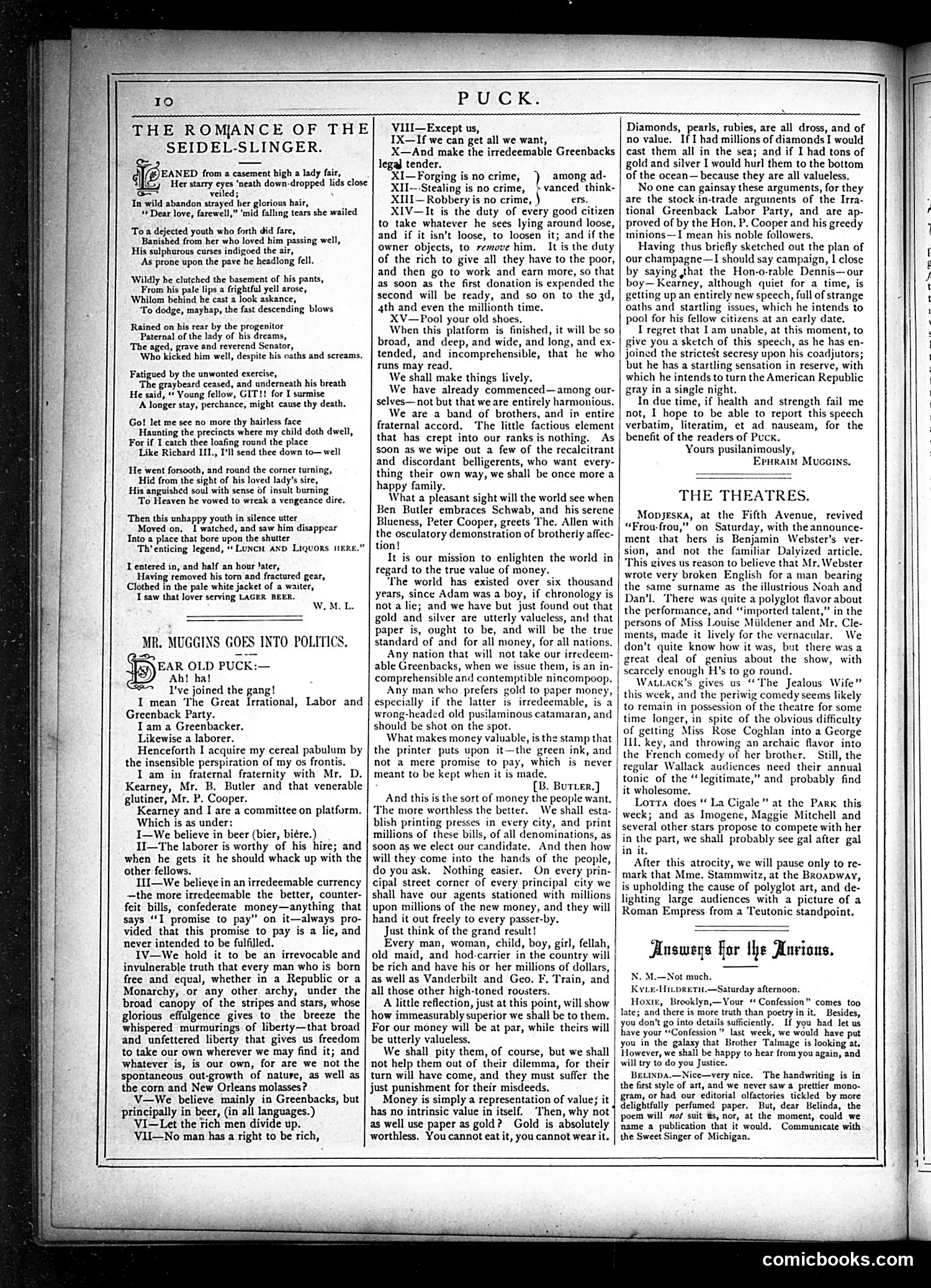
This page contains three distinct sections: "The Romance of the Seidel-Slinger" (a poem with illustration), "Mr. Muggins Goes Into Politics" (a political satire), and theater reviews. The main political content is "Mr. Muggins Goes Into Politics," which satirizes a character advocating radical economic positions—specifically attacking labor movements, the "Greenback" currency, and "irredeemable currency." The piece mocks someone promoting populist monetary reforms, dismissing proposals for paper money and arguing gold's superiority. The satire targets late-19th-century debates over currency standards and labor politics, likely referencing Greenback Party or Populist movement positions that Puck's conservative editors opposed. The humor derives from presenting these radical economic ideas as absurd through the buffoonish "Mr. Muggins" character. The remaining content covers theater reviews and minor items.
📄 Transcribed text from this page (OCR, searchable)
Machine-transcribed from the original scan — historical spelling and the odd misread are preserved.
10 PUCK. THE ROMANCE OF THE SEIDEL-SLINGER. ql (BEAxED. from a casement high a lady fair, i) Her starry eyes ‘neath down-dropped lids close Cam veiled; . In wild abandon strayed her glorious hair, ‘Dear love, farewell,” ‘mid falling tears she wailed Toa dejected youth who forth did fare, Banished from her who loved him passing well, His sulphurous curses indigoed the air, As prone upon the pave he headlong fell. Wildly he clutched the basement of his pants, From his pale lips a frightful yell arose, Whilom behind he cast a look askance, To dodge, mayhap, the fast descending blows Rained on his rear by the progenitor Paternal of the lady of his dreams, The aged, grave and reverend Senator, ‘Who kicked him well, despite his oaths and screams. Fatigued by the unwonted exercise, ‘The graybeard ceased, and underneath his breath He said, “ Young fellow, GIT!! for I surmise ‘A longer stay, perchance, might cause thy death. Go! let me see no more thy hairless face Haunting the precincts where my child doth dwell, For if I catch thee loafing round the place Like Richard IIT, I'll send thee down to— well He went forsooth, and round the corner turning, Hid from the sight of his loved lady’s sire, His anguished soul with sense of insult burning To Heaven he vowed to wreak a vengeance dire. Then this unhappy youth in silence utter Moved on, I watched, and saw him disappear Into a place that bore upon the shutter Th’ enticing legend, “Lunch AND Liquors neRe.” Lentered in, and half an hour ‘ater, Having removed his torn and fractured gear, Clothed in the pale white jacket of a waiter, Tsaw that lover serving LAGER BEER. MR. MUGGINS GOES INTO POLITICS. ay a EAR OLD PUCK:— Ah! hal I’ve joined the gang! I mean The Great Irrational, Labor and Greenback Party. Iam a Greenbacker. Likewise a laborer. Henceforth I acquire my cereal pabulum by the insensible perspiration of my os frontis. I am in fraternal fraternity with Mr. D. Kearney, Mr. B. Butler and that venerable glutiner, Mr. P. Cooper. Kearney and I are a committee on platform. Which is as under: I—We believe in beer (bier, biére.) I1—The laborer is worthy of his hire; and when he gets it he should whack up with the other fellows. I11—We believe in an irredeemable currency —the more irredeemable the better, counter- feit bills, confederate money—anything that says “I promise to pay” on it—always pro- vided that this promise to pay is a lie, and never intended to be fulfilled. IV—We hold it to be an irrevocable and invulnerable truth that every man who is born free and equal, whether in a Republic or a Monarchy, or any other archy, under the broad canopy of the stripes and stars, whose glorious effulgence gives to the breeze the whispered murmurings of liberty—that broad and unfettered liberty that gives us freedom to take our own wherever we may find it; and whatever is, is our own, for are we not the spontaneous out-growth of nature, as well as the corn and New Orleans molasses? V—We believe mainly in Greenbacks, but principally in beer, (in all languages.) VI—Let the rich men divide up. VIU—No man has a right to be rich, VIII—Except us, IX—If we can get all we want, X—And make the irredeemable Greenbacks legal tender. XI—Forging is no crime, ) among ad- XII---Stealing is no crime, > vanced think- XIII— Robbery is no crime, ers. XIV—It is the duty of every good citizen to take whatever he sees lying around loose, and if it isn’t loose, to loosen it; and if the owner objects, to remove him. It is the duty of the rich to give all they have to the poor, and then go to work and earn more, so that as soon as the first donation is expended the second will be ready, and so on to the 3d, 4th and even the millionth time. XV—Pool your old shoes. When this platform is finished, it will be so broad, and deep, and wide, and long, and ex- tended, and incomprehensible, that he who runs may read. We shall make things lively. We have already commenced—among our- selves—not but that we are entirely harmonious. We are a band of brothers, and in entire fraternal accord. ‘The little factious element that has crept into our ranks is nothing. As soon as we wipe out a few of the recalcitrant and discordant belligerents, who want every- thing their own way, we shall be once more a happy family. What a pleasant sight will the world see when Ben Butler embraces Schwab, and his serene Blueness, Peter Cooper, greets The. Allen with the osculatory demonstration of brotherly affec- tion! It is our mission to enlighten the world in regard to the true value of money. ‘The world has existed over six thousand years, since Adam was a boy, if chronology is not a lie; and we have but just found out that gold and silver are utterly valueless, and that paper is, ought to be, and will be the true standard of and for all money, for all nations. Any nation that will not take our irredeem- able Greenbacks, when we issue them, is an in- comprehensible and contemptible nincompoop. Any man who prefers gold to paper money, especially if the latter is irredeemable, is a wrong-headed old pusilaminous catamaran, and should be shot on the spot. What makes money valuable, is the stamp that the printer puts upon it—the green ink, and | not a mere promise to pay, which is never | meant to be kept when it is made. (B. Burter.] And this is the sort of money the people want. The more worthless the better. We shall esta- blish printing presses in every city, and print millions of these bills, of all denominations, as soon as we elect our candidate. And then how will they come into the hands of the people, do you ask. Nothing easier. On every prin- cipal street corner of every principal city we shall have our agents stationed with millions upon millions of the new money, and they will hand it out freely to every passer-by. Just think of the grand result! Every man, woman, child, boy, gitl, fellah, old maid, and hod-carrier in the country will be rich and have his or her millions of dollars, as well as Vanderbilt and Geo. F, Train, and all those other high-toned rousters. A little reflection, just at this point, will show how immeasurably superior we shall be to them. | For our money will be at par, while theirs will be utterly valueless. We shall pity them, of course, but we shall not help them out of their dilemma, for their turn will have come, and they must suffer the just punishment for their misdeeds. Money is simply a representation of value; it has no intrinsic value in itself. ‘Then, why not as well use paper as gold? Gold is absolutely worthless. You cannot eat it, you cannot wear it, Diamonds, pearls, rubies, are all dross, and of no value. If I had millions of diamonds I would cast them all in the sea; and if I had tons of gold and silver I would hurl them to the bottom of the ocean— because they are all valueless. No one can gainsay these arguments, for they are the stock-in-trade arguments of the Irra- tional Greenback Labor Party, and are ap- proved of by the Hon. P. Cooper and his greedy minions—I mean his noble followers. Having thus briefly sketched out the plan of our champagne—I should say campaign, I close by saying that the Hon-o-rable Dennis—our boy—Kearney, although quiet for a time, is getting up an entirely new specch, full of strange oaths and startling issues, which he intends to pool for his fellow citizens at an early date. I regret that Lam unable, at this moment, to give you a sketch of this speech, as he has en- joined the strictest secresy upon his coadjut but he has a startling sensation in reserve, with which he intends to turn the American Republic gray in a single night. In due time, if health and strength fail me not, I hope to be able to report this speech verbatim, literatim, et ad nauseam, for the benefit of the readers of Puck. Yours pusilanimously, Epuraim Mucoins. THE THEATRES. Mopjeska, at the Fifth Avenue, revived “Frou-frou," on Saturday, with the announce- ment that hers is Benjamin Webster’s ver- sion, and not the familiar Dalyized article. This gives us reason to believe that Mr. Webster wrote very broken English for a man bearing the same surname as the illustrious Noah and Dan’l. ‘There was quite a polyglot flavor about the performance, and “imported talent,” in the persons of Miss Louise Miildener and Mr, Cle- ments, made it lively for the vernacular. We don’t quite know how it was, but there was a great deal of genius about the show, with scarcely enough H’s to go round. Wattack’s gives us ‘The Jealous Wife” this week, and the periwig comedy seems likely to remain in possession of the theatre for some time longer, in spite of the obvious difficulty of getting Miss Rose Coghlan into a George Ill key, and throwing an archaic flavor into the French comedy of her brother. Still, the regular Wallack audiences need their annual tonic of the “legitimate,” and probably find it wholesome. Lorra does ‘ La Cigale” at the Park this weck; and as Imogene, Maggie Mitchell and several other stars propose to compete with her in the part, we shall probably see gal after gal in it. After this atrocity, we will pause only to re- mark that Mme. Stammwvitz, at the BRoapway, is upholding the cause of polyglot art, and de- lighting large audiences with a picture of a Roman Empress from a Teutonic standpoint, Answers for the Auvious. N. M.—Not much. Kyte-Hitpreti.— Hoxie, Brooklyn,—Your ‘ Confession” comes too turday afternoon. late; and there is more truth than poetry in it. Besides, you don’t go into details sufficiently. If you had let us have your “Confession” last week, we would have put you in the galaxy that Brother Talmage is looking at. However, we shall be happy to hear from you again, and will try to do you Justice. Betinpa.—Nice—very nice. The handwriting is in the first style of art, and we never saw a prettier mono- gram, or had our editorial olfactories tickled by more delightfully perfumed paper. But, dear Belinda, the poem will nof suit ts, nor, at the moment, could we name a publication that it would. Communicate with the Sweet Singer of Michigan. comicbooks.com