
Puck, 1878-10-23 · page 3 of 16
Puck — October 23, 1878 — page 3: what you’re looking at
What you’re looking at
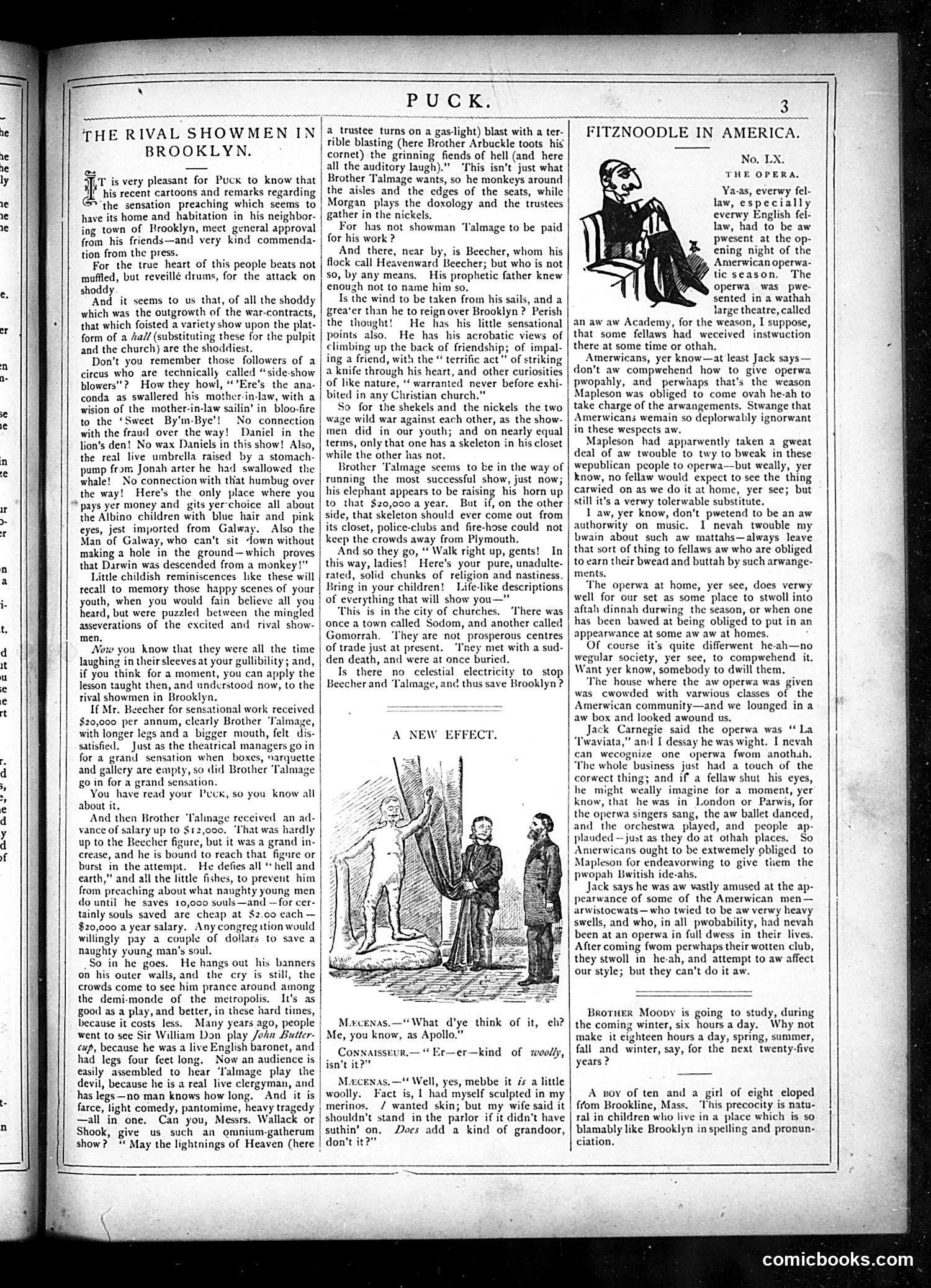
This satirical piece mocks competing theatrical entrepreneurs in Brooklyn, particularly focusing on showmen named Heecker and Talmage who are rivals for audience attention. The article suggests Heecker, described as sensational and mercenary, is trying to outdo a religious figure (Talmage) by offering increasingly spectacular entertainments—elephants, whales, and other novelties—to draw crowds. The satire critiques both men: Talmage for his self-righteous preaching and Heecker for crass commercialism. The piece humorously suggests their competition represents the absurd extremes of entertainment versus religion in Brooklyn society, with both exploiting public curiosity for profit or influence. The underlying joke is that both "showmen" use similar manipulative tactics despite their different venues.
📄 Transcribed text from this page (OCR, searchable)
Machine-transcribed from the original scan — historical spelling and the odd misread are preserved.
THE RIVAL SHOWMEN IN BROOKLYN. eat Ae ‘Ji, T is very pleasant for Puck to know that AIF his recent cartoons and remarks regarding ‘the sensation preaching which seems to have its home and habitation in his neighbor. ing town of Brooklyn, meet general approval from his friends—and very kind commenda- tion from the press. For the true heart of this people beats not muffled, but reveillé drums, for the attack on shoddy And it seems to us that, of all the shoddy which was the outgrowth of the war-contracts, that which foisted a variety show upon the plat- form of a /a// (substituting these for the pulpit and the church) are the shoddiest. Don’t you remember those followers of a | circus who are technically called “side-show blowers’? How they howl, ‘’Ere’s the ana- conda as swallered his mother-in-law, with a wision of the mother-in-law sailin’ in bloo-fire to the ‘Sweet By'm-Bye'! No connection | with the fraud over the way! Daniel in the lion’s den! No wax Daniels in this show! Also, the real live umbrella raised by a stomach- pump from Jonah arter he had swallowed the whale! No connection with that humbug ov the way! Here's the only place where you * pays yer money and gits yer-choice all about the Albino children with blue hair and pink eyes, jest_ imported from Galway, Also the Man of Galway, who can’t sit down without making a hole in the ground—which proves | that Darwin was descended from a monkey!" Little childish reminiscences like these will recall to memory those happy scenes of your youth, when you would fain believe all you | heard, but were puzzled between the mingled asseverations of the excited and rival show- men, Now you know that they were all the time laughing in their sleeves at your gullibility; and, if you think for a moment, you can apply the lesson taught then, and understood now, to the rival showmen in Brooklyn. If Mr. Beecher for sensational work received $20,000 per annum, clearly Brother ‘T'alm: with longer legs and a bigger mouth, felt dis- satisfied. Just as the theatrical managers go in for a grand sensation when boxes, narquette and gallery are empty, so did Brother ‘Talmage go in for a grand sensation. | You have read your Puck, so you know all about it. | And then Brother ‘Talmage received an ad- vance of salary up to $12,000. ‘That was hardly up to the Beecher figure, but it was a grand in- crease, and he is bound to reach that figure or burst in the attempt. He defies all “ hell and earth,” and all the little fishes, to prevent him from preaching about what naughty young men do until he saves 10,000 suuls—and —for cer- tainly souls saved are cheap at $2.00 cach — $20,000 a year salary. Any congreg tion would willingly pay a couple of dollars to save a naughty young man’s soul, So in he goes. He hangs out his banners on his outer walls, and the cry is still, the crowds come to see him prance around among the demi-monde of the metropolis. It’s as good as a play, and better, in these hard times, | because it costs less. Many years ago, people went to see Sir William Don play John Butter- cup, because he was a live English baronet, and had legs four feet long. Now an audience is easily assembled to hear ‘I'almage play the | devil, because he is a real live clergyman, and has legs—no man knows how long. And it is | farce, light comedy, pantomime, heavy tragedy | —all in’ one. Can you, Messrs. Wallack or | Shook, give us such an omnium-gatherum | show? “ May the lightnings of Heaven (here | | this way, ladies! a trustee turns on a gas-light) blast with a ter- rible blasting (here Brother Arbuckle toots his | cornet) the grinning fiends of hell (and here all the auditory laugh). ‘This isn’t just what Brother Talmage wants, so he monkeys around the aisles and the edges of the seats, while Morgan plays the doxology and the trustees gather in the nickels, For has not showman ‘Talmage to be paid for his work ? And there, near by, is Beecher, whom his flock call Heavenward Beecher; but who is not so, by any means, enough not to name him so. Is the wind to be taken from his sails, and a grea‘er than he to reign over Brooklyn ? Perish the thought! He has his little sensational points also. He has his acrobatic views of climbing up the back of friendship; of impal- ing a friend, with the “ terrific act” of striking a knife through his heart, and other curiosities of like nature, ‘‘ warranted never before exhi- bited in any Christian church. So for the shekels and the nickels the two wage wild war against each other, as the show- men did in our youth; and on nearly equal terms, only that one has a skeleton in his closet while the other has not. Brother Talmage seems to be in the way of running the most successful show, just now; his elephant appears to be raising his horn up to that $20,000 a year. But if, on the other side, that skeleton should ever come out from its closet, police-clubs and fire-hose could not keep the crowds away from Plymouth. And so they go, “Walk right up, gents! In Here’s your pure, unadulte- rated, solid chunks of religion and nastiness. Bring in your children! Life-like descriptions of everything that will show you—” This is in the city of churches. There was once a town called Sodom, and another called Gomorrah, ‘They are not’ prosperous centres of trade just at present. ‘They met with a sud- den death, and were at once buried. Is_ there celestial electricity to stop Beecher and ‘Talmage, and thus save Brooklyn ? M.rcenas.—‘“ What d'ye think of it, eh? Me, you know, as Apollo.” Connaisseur.— “ Er—er—kind of woolly, isn’t it? MA&CENA: woolly merinos. shouldn’t stand in the parlor if it didn't have suthin’ on, Does add a kind of grandoor, don't it?” —‘ Well, yes, mebbe it 7s a little act is, 1 had myself sculpted in my His prophetic father knew | Jand the orchestwa played, / wanted skin; but my wife said it | ffom Brookline, Mass, 3 FITZNOODLE IN AMERICA. No. LX. THE OPERA, Ya-as, everwy fel- law, especially everwy English fel- law, had to be aw pwesent at the op- ening night of the Amerwican operwa- 7 tic season. The operwa was pwe- sented in a wathah large theatre, called an aw aw Academy, for the weason, I suppose, that some fellaws had weceived instwuction there at some time or othah. Amerwicans, yer know—at least Jack says— don’t aw compwehend how to give operwa pwopahly, and perwhaps that's the weason Mapleson was obliged to come ovah he-ah to take charge of the arwangements. Stwange that Amerwicans wemain so deplorwably ignorwant in these wespects aw, Mapleson had apparwently taken a gweat deal of aw twouble to twy to bweak in these wepublican pcople to operwa—but weally, yer know, no fellaw would expect to see the thing carwied on as we do it at home, yer see; but still it’s a verwy tolerwable substitute. 1 aw, yer know, don’t pwetend to be an aw authorwity on music. I nevah twouble my bwain about such aw mattahs—always leave that sort of thing to fellaws aw who are obliged to earn their bwead and buttah by such arwange- ments, The operwa at home, yer see, does verwy well for our set as some place to stwoll into aftah dinnah durwing the season, or when one has been bawed at being obliged to put in an appearwance at some aw aw at homes. Of course it’s quite differwent he-ah—no wegular society, yer see, to compwehend it. Want yer know, somebody to dwill them. The house where the aw operwa was given was cwowded with varwious classes of the Amerwican community—and we lounged in a aw box and looked awound us. Jack Carnegie said the operwa was “La ‘Twaviata,” and I dessay he was wight. I nevah an wecognize one operwa fwom anothah. ‘The whole business just had a touch of the corwect thing; and if a fellaw shut his eyes, he might weally imagine for a moment, yer know, that he was in London or Parwis, for the operwa singers sang, the aw ballet danced, and people ap- plauded —just as they do at othah places. So | Amerwicans ought to be extwemely obliged to Mapleson for endeavorwing to give ti pwopah Bwitish ide-ahs. Jack says he was aw vastly amused at the ap- pearwance of some of the Amerwican men— arwistocwats—who twied to be aw verwy heavy swells, and who, in all pwobability, had nevah been at an operwa in full dwess in their lives. After coming fwom perwhaps their wotten club, they stwoll in he-ah, and attempt to aw affect our style; but they can’t do it aw. Brotuer Moopy is going to study, during the coming winter, six hours aday. Why not make it eighteen hours a day, spring, summer, fall and winter, say, for the next twenty-five years? A noy of ten and a girl of eight eloped ‘This precocity is natu- ral in children who live in a place which is so blamably like Brooklyn in spelling and pronun- ciation. comicbooks.com