
Puck, 1878-10-23 · page 7 of 16
Puck — October 23, 1878 — page 7: what you’re looking at
What you’re looking at
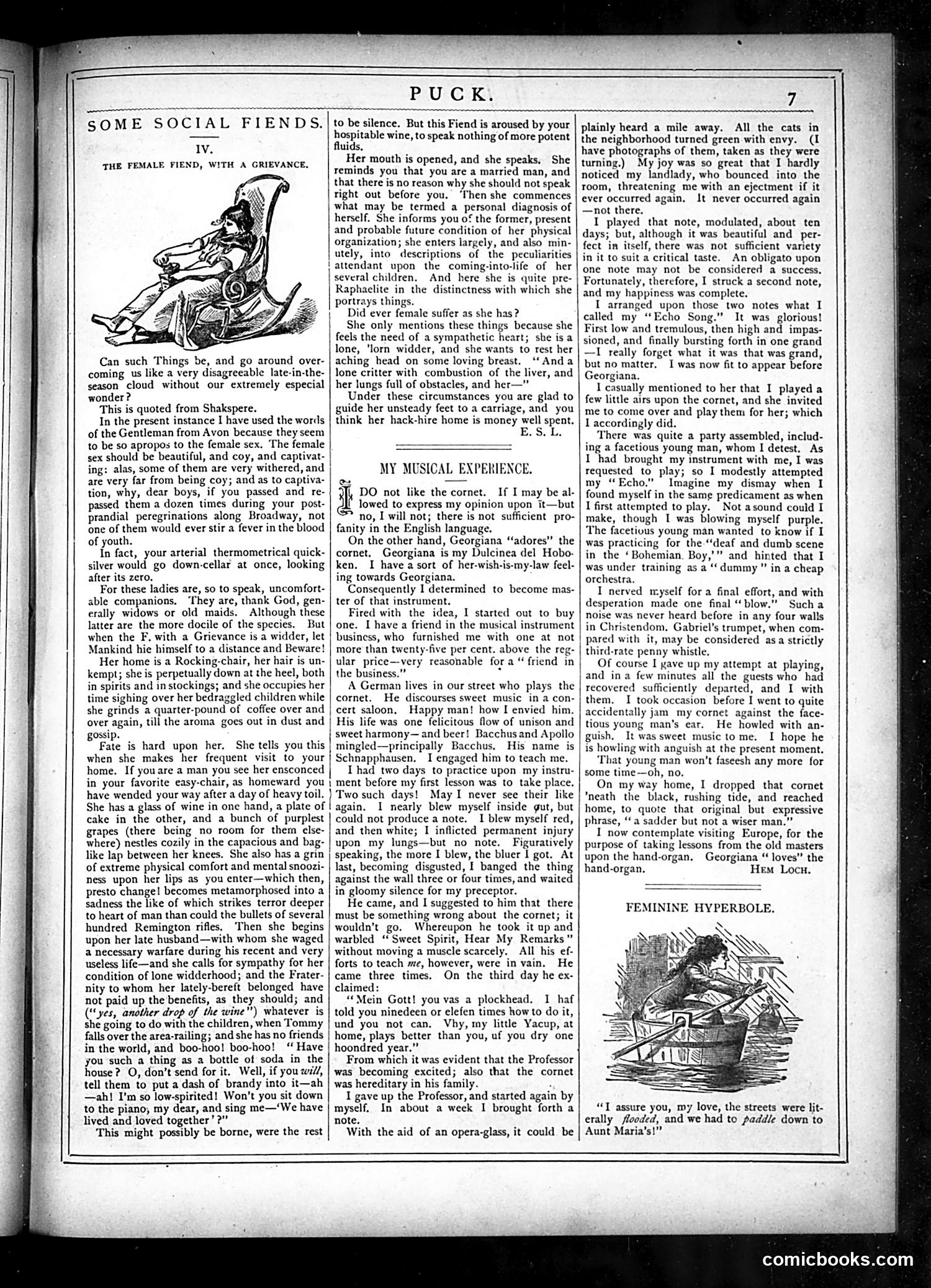
This page contains three separate humor pieces rather than political cartoons: 1. **"Some Social Fiends IV: The Female Fiend, With a Grievance"** — A satirical sketch about a complaining woman who visits her married friend to air grievances about her husband, his appearance, and their domestic life. The cartoon depicts her as an annoying social visitor spreading negativity. 2. **"My Musical Experience"** — A humorous first-person account of attempting to learn the cornet from an Italian street musician named Schnapphausen, with comedic descriptions of the author's terrible playing and the instructor's frustration. 3. **"Feminine Hyperbole"** — A brief joke about exaggeration, with an illustration showing a woman claiming city streets were literally "flooded" and required paddling to navigate. All three pieces are social humor targeting contemporary manners and behaviors.
📄 Transcribed text from this page (OCR, searchable)
Machine-transcribed from the original scan — historical spelling and the odd misread are preserved.
Sphesatioeles PUCK. SOME SOCIAL FIENDS. Iv. ‘THE FEMALE FIEND, WITH A GRIEVANCE. Can such Things be, and go around over- coming us like a very disagreeable late-in-the- season cloud without our extremely especial wonder? This is quoted from Shakspere. In the present instance I have used the words of the Gentleman from Avon because they seem to be so apropos to the female sex. The female sex should be beautiful, and coy, and captivat- | ing: alas, some of them are very withered, and | are very far from being coy; and as to captiva- tion, why, dear boys, if you passed and re- passed them a dozen times during your post- prandial peregrinations along Broadway, not one of them would ever stir a fever in the blood of youth. . | In fact, your arterial thermometrical quick- silver would go down-cellar at once, looking after its zero. For these ladies are, so to speak, uncomfort- able companions. ‘They are, thank God, gen- erally widows or old maids. Although these latter are the more docile of the species. But when the F, with a Grievance is a widder, let Mankind hie himself to a distance and Beware! Her home is a Rocking-chair, her hair is un- kempt; she is perpetually down at the heel, both in spirits and in stockings; and she occupies her time sighing over her bedraggled children while she grinds a quarter-pound of coffee over and over again, till the aroma goes out in dust and gossip. Fate is hard upon her. She tells you this when she makes her frequent visit to your home. If youare a man you see her ensconced in your favorite easy-chair, as homeward you have wended your way after a day of heavy toil. She has a glass of wine in one hand, a plate of cake in the other, and a bunch of purplest grapes (there being no room for them clse- where) nestles cozily in the capacious and bag- like lap between her knees. She also has a grin of extreme physical comfort and mental snoozi- ness upon her lips as you enter—which then, presto change! becomes metamorphosed into a sadness the like of which strikes terror deeper to heart of man than could the bullets of several hundred Remington rifles. Then she begins upon her late husband—with whom she waged a necessary warfare during his recent and very useless life—and she calls for sympathy for her condition of lone widderhood; and the Frater- nity to whom her lately-bereft belonged have not paid up the benefits, as they should; and (“yes, another drop of the wine") whatever is she going to do with the children, when Tommy falls over the area-railing; and she has no friends in the world, and boo-hoo! boo-hoo! “ Have you such a thing as a bottle of soda in the house? O, don’t send for it. Well, if you wil/, tell them to put a dash of brandy into it—ah —ah! I’m so low-spirited! Won't you sit down to the piano, my dear, and sing me—‘We have lived and loved together’ ?” This might possibly be borne, were the rest to be silence. But this Fiend is aroused by your hospitable wine, to speak nothing of more potent fluids, Her mouth is opened, and she speaks, She reminds you that you are a married man, and that there is no reason why she should not speak right out before you. ‘Then she commences what may be termed a personal diagnosis of herself. She informs you of the former, present and probable future condition of her physical organization; she enters largely, and also min- utely, into descriptions of the peculiarities ‘attendant upon the coming-into-life of her several children, And here she is quite pre- Raphaelite in the distinctness with which she portrays things. Did ever female suffer as she has? She only mentions these things because she | feels the need of a sympathetic heart; she is a lone, 'lorn widder, and she wants to rest her aching head on some loving breast. ‘‘Anda lone critter with combustion of the liver, and her lungs full of obstacles, and her—" Under these circumstances you are glad to guide her unsteady feet to a carriage, and you think her hack-hire home is money well spent. E.S. L. MY MUSICAL EXPERIENCE. I DO not like the cornet. If I may be al- lowed to express my opinion upon it—but no, I will not; there is not sufficient pro- fanity in the English language. On the other hand, Georgiana “adores” the cornet. Georgiana is my Dulcinea del Hobo- ken. I havea sort of her-wish-is-my-law feel- ing towards Georgiana. Consequently I determined to become mas- ter of that instrument. Fired with the idea, I started out to buy one. I have a friend in the musical instrument business, who furnished me with one at not more than twenty-five per cent. above the reg- ular price—very reasonable for a“ friend in the business.” J A German lives in our street who plays the cornet. He discourses sweet music in a con- | cert saloon, Happy man! how I envied him. | His life was one felicitous flow of unison and | sweet harmony—and beer! Bacchus and Apollo mingled—principally Bacchus. Schnapphausen. I engaged him to teach me. Thad two days to practice upon my instru- 1 ment before my first lesson was to take place. ) Two such days! May I never see their like again. I nearly blew myself inside gut, but could not produce a note. I blew myself red, and then white; I inflicted permanent injury upon my lungs—but no note. Figuratively speaking, the more I blew, the bluer I got. At last, becoming disgusted, I banged the thing against the wall three or four times, and waited in gloomy silence for my preceptor. He came, and I suggested to him that there must be something wrong about the cornet; it wouldn't go. Whereupon he took it up and warbled “Sweet Spirit, Hear My Remarks” without moving a muscle scarcely. All his ef- forts to teach me, however, were in vain. He came three times. On the third day he ex- claimed: “Mein Gott! you vas a plockhead. 1 haf told you ninedeen or elefen times how to do it, und you not can. Vhy, my little Yacup, at | home, plays better than you, uf you dry one hoondred year.”” From which it was evident that the Professor was becoming excited; also that the cornet was hereditary in his family. : I gave up the Professor, and started again by myself, In about a week I brought forth a note, With the aid of an opera-glass, it could be His name is | plainly heard a mile away. All the cats in the neighborhood turned green with envy. (I have photographs of them, taken as they were turning.) My joy was so great that I hardly noticed my landlady, who bounced into the room, threatening me with an ejectment if it ever occurred again, It never occurred again —not there, I played that note, modulated, about ten days; but, although it was beautiful and_per- fect in itself, there was not sufficient variety in it to suit a critical taste. An obligato upon one note may not be considered a success. Fortunately, therefore, I struck a second note, and my happiness was complete. I arranged upon those two notes what I called my “Echo Song.” It was glorious! First low and tremulous, then high and impas- sioned, and finally bursting forth in one grand —I really forget what it was that was grand, but no matter. I was now fit to appear before Georgiana. I casually mentioned to her that I played a few little airs upon the cornet, and she invited me to come over and play them for her; which L accordingly did. ‘There was quite a party assembled, includ- ing a facetious young man, whom I detest. As 1 had brought my instrument with me, I was requested to play; so I modestly attempted my “Echo,” Imagine my dismay when I found myself in the same predicament as when I first attempted to play. Not asound could I make, though I was blowing myself purple. ‘The facetious young man wanted to know if I was practicing for the “deaf and dumb scene in the ‘Bohemian. Boy,’” and hinted that I was under training as a “dummy” in a cheap orchestra. I nerved myself for a final effort, and with desperation made one final “blow.” Such a noise was never heard before in any four walls in Christendom. Gabriel's trumpet, when com- | pared with it, may be considered asa strictly | third-rate penny whistle. | Of course I yave up my attempt at playing, | and ina few minutes all the guests who had recovered sufficiently departed, and I with them. I took occasion before I went to quite accidentally jam my cornet against the face- tious young man’s ear. He howled with an- guish, It was sweet music to me. I hope he is howling with anguish at the present moment. ‘That young man won't faseesh any more for some time—oh, no, On my way home, I dropped that cornet ‘neath the black, rushing tide, and reached home, to quote that original but expressive phrase, “a sadder but not a wiser man.” I now contemplate visiting Europe, for the purpose of taking lessons from the old masters upon the hand-organ. Georgiana “ loves” the hand-organ. Hes Locu. “T assure you, my love, the streets were lit- erally flooded, and we had to paddle down to Aunt Maria’s!” comicbooks.com