
Puck, 1878-10-23 · page 13 of 16
Puck — October 23, 1878 — page 13: what you’re looking at
What you’re looking at
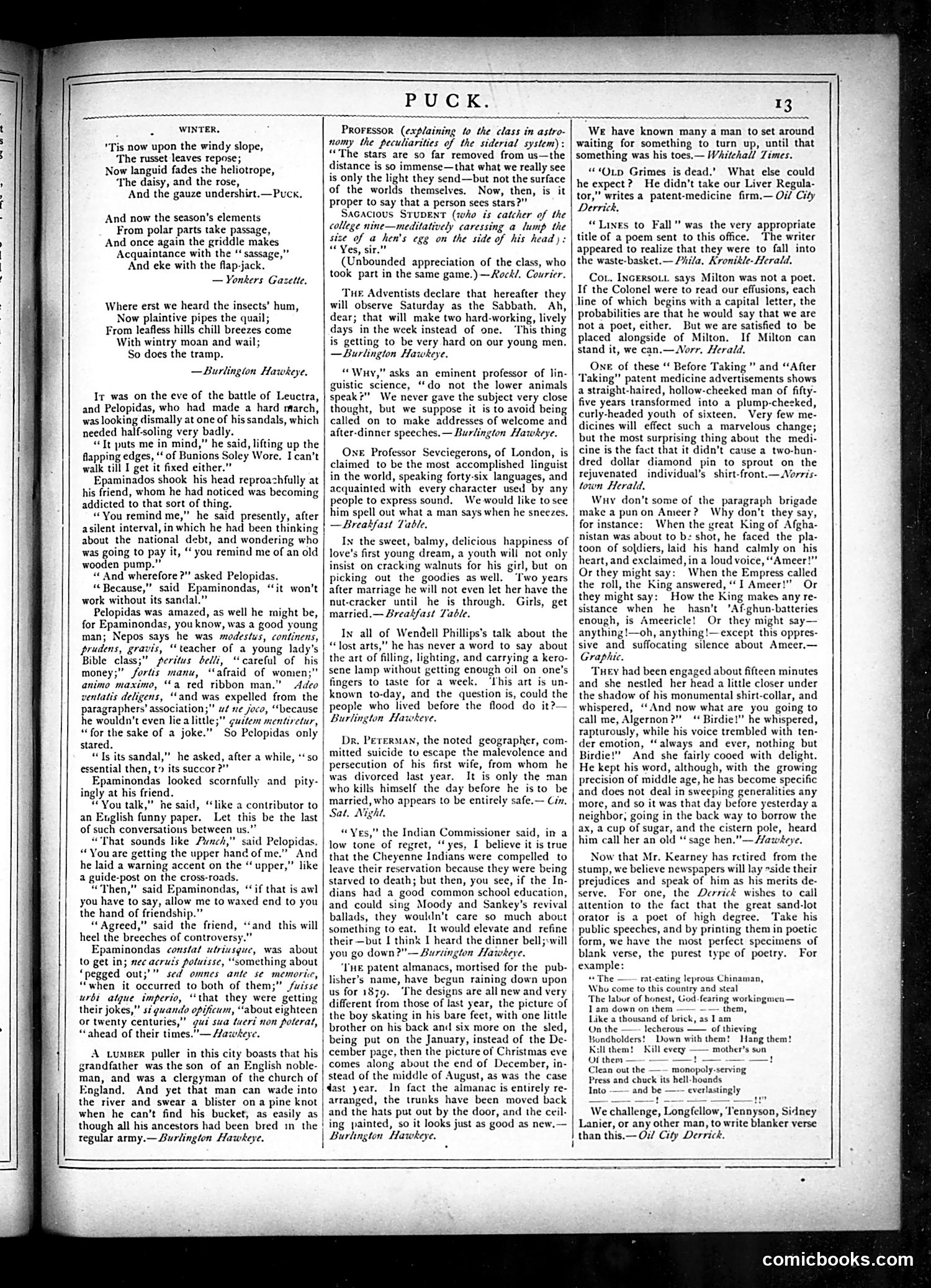
This page from *Puck* magazine appears to be primarily text-based content rather than a political cartoon. The left column contains winter poetry, while the right side features a column of brief satirical anecdotes and commentary labeled "PROFESSOR" at the top. The jokes target various subjects: a patient-medicine man's advertising claims; an inappropriate book title about waste; a Colonel's letter about probabilities; professors' linguistic abilities; and social commentary on matrimony, Native Americans, and Christmas celebrations. The content reflects turn-of-the-century American humor and social observation rather than focused political satire. Without clear illustrations or identification of specific political figures, the page functions as general social commentary using wit and anecdote—typical *Puck* format for filling editorial space with lighthearted cultural criticism.
📄 Transcribed text from this page (OCR, searchable)
Machine-transcribed from the original scan — historical spelling and the odd misread are preserved.
WINTER. "Tis now upon the windy slope, ‘The russet leaves repose; ow languid fades the heliotrope, ‘The daisy, and the rose, And the gauze undershirt.—Puck, And now the season’s elements From polar parts take passage, And once again the griddle makes Acquaintance with the “ sassage,”” ‘And eke with the flap-jack. — Yonkers Gazette, Where erst we heard the insects’ hum, Now plaintive pipes the quail; From leafless hills chill breezes come With wintry moan and wail; So does the tramp. —Burlington Hawkeye. Ir was on the eve of the battle of Leuctra, and Pelopidas, who had made a hard march, was looking dismally at one of his sandals, which needed half-soling very badly. “Tt puts me in mind,” he said, lifting up the flapping edges, ‘ of Bunions Soley Wore. I can’t walk till I get it fixed either.” Epaminados shook his head reproachfully at his friend, whom he had noticed was becoming addicted to that sort of thing. “You remind me,” he said presently, after asilent interval, in which he had been thinking about the national debt, and wondering who | was going to pay it, ‘ you remind me of an old wooden pump.” “ And wherefore ?” asked Pelopidas. “Because,” said Epaminondas, ‘it won't work without its sandal.” Pelopidas was amazed, as well he might be, for Epaminondas, you know, was a good young man; Nepos says he was modestus, continens, prudens, gravis, “teacher of a young lady’s Bible class;” peritus belli, “careful of bi money;” fortis manu, “afraid of women; animo maximo, “a red ribbon man.” Adeo ventatis deligens, “and was expelled from the paragraphers’ association;” wf ne joco, “because | he wouldn’t even lie alittle;” guétem mentiretur, | “for the sake of a joke.” stared. “Is its sandal,” he asked, after a while, ‘so essential then, t» its succor ?”” Epaminondas looked scornfully and_pity- ingly at his friend. “You talk,” he said, ‘like a contributor to an English funny paper. Let this be the last of such conversations between us.” So Pelopidas only “That sounds like Punch,” said Pelopidas. | “You are getting the upper hand of me.” And he laid a warning accent on the “ upper,” like a guide-post on the cross-roads. “Then,” said Epaminondas, “if that is awl you have to say, allow me to waxed end to you the hand of friendship.” “Agreed,” said the friend, ‘‘and this will heel the breeches of controversy.” Epaminondas constat utriusqgue, was about to get in; nec acruis potutsse, “something about ‘pegged out;’” sed omnes ante se memoric, “when it occurred to both of them;” /uisse urbi atgue imperio, ‘that they were getting their jokes,” s¢ guando opificum, “about eighteen or twenty centuries,” gui sua tueri non poterat, “ahead of their times.” — Hawkeye. A LuMper puller in this city boasts that his grandfather was the son of an English noble- man, and was a clergyman of the church of England. And yet that man can wade into | the river and swear a blister ona pine knot when he can’t find his bucket, as easily as though all his ancestors had been bred im the regular army.— Burlington Hawkeye. Proressor (explaining to the class in astro- nomy the peculiarities of the siderial system): “The stars are so far removed from us—the distance is so immense—that what we really see is only the light they send—but not the surface of the worlds themselves, Now, then, is it proper to say that a person sees stars?” Sacacious Stupent (who is catcher of the college nine—meditatively caressing a lump the size of a hen's egg on the side of his head): “Yes, sir.” (Unbounded appreciation of the class, who took part in the same game.) —Rock/. Courier. Tue Adventists declare that hereafter they will observe Saturday as the Sabbath. Ah, dear; that will make two hard-working, lively days in the week instead of one. This thing is getting to be very hard on our young men, —Burlington Hawkeye. “Wuy,” asks an eminent professor of lin- istic science, ‘do not the lower animals We never gave the subject very close thought, but we suppose it is to avoid being called on to make addresses of welcome and after-dinner speeches.— Burlington Hawkeye. One Professor Sevciegerons, of London, is claimed to be the most accomplished linguist in the world, speaking forty-six languages, and acquainted with every character used by any people to express sound. We would like to see him spell out what a man says when he sneezes. —Breakfast Table, In the sweet, balmy, delicious happiness of love's first young dream, a youth will not only insist on cracking walnuts for his girl, but on picking out the goodies as well. Two years after marriage he will not even let her have the nut-cracker until he is through. Girls, get married.— Breakfast Table. In all of Wendell Phillips's talk about the “lost arts,” he has never a word to say about the art of filling, lighting, and carrying a kero- sene lamp without getting enough oil on one’s fingers to taste for a week. ‘This art is un- known to-day, and the question is, could the people who lived before the flood do it? Burlington Hawkeye. Dr. Pererman, the noted geographer, com- mitted suicide to escape the malevolence and was divorced last year. It is only the man who kills himself the day before he isto be married, who appears to be entirely safe.— Cin. Sat. Night. “Yes,” the Indian Commissioner said, in a low tone of regret, “yes, I believe it is true that the Cheyenne Indians were compelled to leave their reservation because they were being starved to death; but then, you see, if the In- dians had a good common school education, and could sing Moody and Sankey’s revival | ballads, they wouldn't care so much about something to eat. It would elevate and refine | their—but I think I heard the dinner bell; .will | | ; , ‘ | Birdie!” | persecution of his first wife, from whom he | We have known many a man to set around waiting for something to turn up, until that something was his toes.— Whitehall Times. “‘O_p Grimes is dead.’ What else could he expect? He didn’t take our Liver Regula- tor,” writes a patent-medicine firm.— Oi/ City Derrick, “Lines to Fall" was the very appropriate title of a poem sent to this office. The writer appeared to realize that they were to fall into the waste-basket.— Phila, Kronikle-Herald, Co. INGERSOLL says Milton was not a poet. If the Colonel were to read our effusions, each line of which begins with a capital letter, the probabilities are that he would say that we are not a poet, either. But we are satisfied to be placed alongside of Milton, If Milton can stand it, we can.—Norr. Herald. One of these ‘ Before Taking " and “After ‘Taking” patent medicine advertisements shows a straight-haired, hollow-cheeked man of fifty- five years transformed into a plump-cheeked, curly-headed youth of sixteen. Very few me- dicines will effect such a marvelous change; but the most surprising thing about the medi- cine is the fact that it didn’t cause a two-hun- dred dollar diamond pin to sprout on the rejuvenated individual's shirt-front.—Norris- town Herald, Wav don’t some of the paragraph brigade make a punon Ameer? Why don’t they say, for instance: When the great King of Afgha- nistan was about to b: shot, he faced the pla- toon of soldiers, laid his hand calmly on_ his | heart, and exclaimed, in a loud voice, ““Ameer!”” Or they might say: When the Empress called the roll, the King answered, “I Ameer!” Or they might say: How the King makes any re- sistance when he hasn't 'Af-ghun-batteries enough, is Ameericle! Or they might say— anything!—oh, anything!—except this oppres- sive and suffocating silence about Ameer.— Graphic. ‘Tuey had been engaged about fifteen minutes and she nestled her head a little closer under the shadow of his monumental shirt-collar, and | whispered, “And now what are you going to call me, Algernon?” “Birdie!” he whispered, rapturously, while his voice trembled with ten- der emotion, “always and ever, nothing but And she fairly cooed with delight He kept his word, although, with the growing precision of middle age, he has become specific and does not deal in sweeping generalities any more, and so it was that day before yesterday a neighbor; going in the back way to borrow the ax, a cup of sugar, and the cistern pole, heard him call her an old “ sage hen.” — Hawheye. Now that Mr. Kearney has retired from the stump, we believe newspapers will lay *side their prejudices and speak of him as his merits de- serve. For one, the Derrick wishes to call attention to the fact that the great sand-lot orator is a poet of high degree. Take his public speeches, and by printing them in poetic form, we have the most perfect specimens of you go down?" —Burtinglon Haiwkeve. lisher’s name, have begun raining down upon | us for 1879. ‘The designs are all new and very | different from those of last year, the picture of the boy skating in his bare feet, with one little | brother on his back and six more on the sled, | being put on the January, instead of the De- | cember page, then the picture of Christmas eve comes along about the end of December, in- | stead of the middle of August, as was the case | dast year. In fact the almanac is entirely re- arranged, the trunks have been moved back | and the hats put out by the door, and the ce ing painted, so it looks just as good as new.— | Burlington Hawkeye. t blank verse, the purest type of poetry. For ‘Ine patent almanacs, mortised for the pub- | example: “The —— rat-eating leprous Chinaman, Who come to this country and steal ‘The labur of honest, God-fearing workingmen— lam down on them —— them, Like a thousand of brick, as Tam On the — lecherous of thieving Wondholders! Down with them! Hang them! Kill them! Kill every —— mother’s sun Of them — — Clean out the —— monopoly-serving Press and chuck its hell-hoands Into —— and be —— everlastingly We challenge, Longfellow, Tennyson, Sidney Lanier, or any other man, to write blanker verse i than this.— Oi/ City Derrick. comicbooks.com