
Puck, 1878-10-23 · page 6 of 16
Puck — October 23, 1878 — page 6: what you’re looking at
What you’re looking at
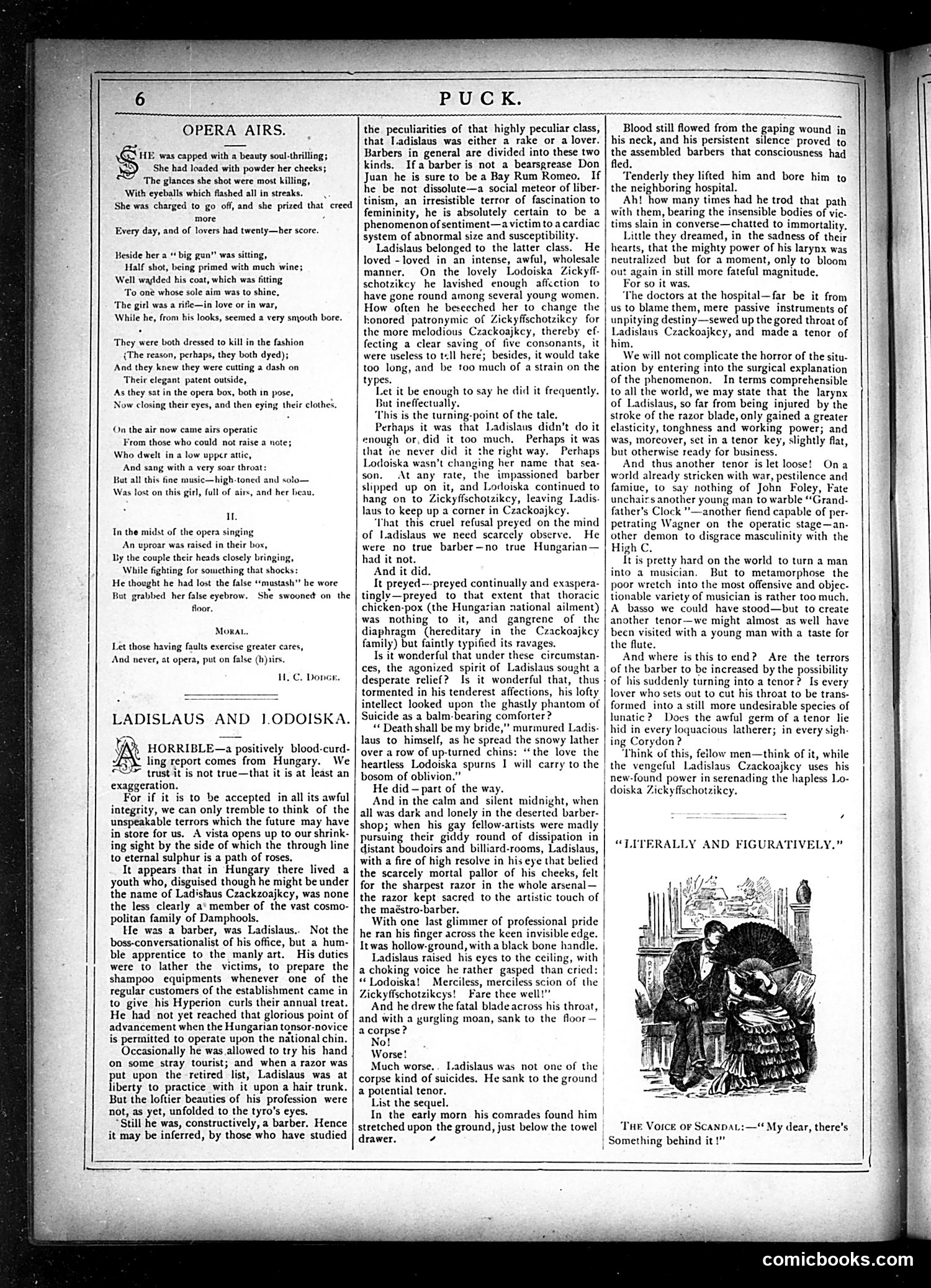
This page contains **literary content rather than political cartoons**. The main article is "Ladislaus and Lodoiska," a satirical story about a Hungarian barber named Ladislaus who becomes romantically entangled with a woman named Lodoiska. The narrative mocks his attempts at sophistication and romantic prowess, describing his theatrical gestures and ultimate failure—he apparently slits his throat over unrequited love. The single illustration labeled "The Voice of Scandal" shows a woman gossiping, likely commenting on the scandalous story. This appears to be **social satire rather than political commentary**, targeting romantic pretension and small-town gossip rather than any specific political figures or events. The humor is character-driven and domestic in nature.
📄 Transcribed text from this page (OCR, searchable)
Machine-transcribed from the original scan — historical spelling and the odd misread are preserved.
PUCK. OPERA AIRS. HE was capped with a beauty soul-thrilling; She had loaded with powder her cheeks; ‘The glances she shot were most killing, With eyeballs which flashed all in streaks. She was charged to go off, and she prized that creed more ‘ Every day, and of lovers had twenty—her score. Beside her a “ big gun” was sitting, Half shot, being primed with much wine; Well waglded his coat, which was fitting fo on’ whose sole aim was to shine, ‘The gitl was a rifle—in love or in war, While he, from his looks, seemed a very smouth bore. They were both dressed to kill in the fashion {The reason, perhaps, they both dyed); And they knew they were cutting a dash on ‘Their elegant patent outside, As they sat in the opera box, both in pose, Now closing their eyes, and then eying their clothes, On the air now came airs operatic From those who could not raise a note; Who dwelt in a low upper attic, And sang with a very soar throat: But all this fine music—high-toned and solo— Was lost on this gil, full of airs, and her beau. In the midst of the opera singing An uproar was raised in their box, Ly the couple their heads closely bringing, While fighting for something that shocks: He thought he had lost the false ‘‘mustash”” he wore But grabbed her false eyebrow. She swooned on the floor. Mora. Let those having faults exercise greater cares, And never, at opera, put on false (b)sirs. HL. C. Donce. LADISLAUS AND 1.ODOISK y HORRIBLE—a positively blood-curd- F< ling report comes from Hungary. We «*" trust it is not true—that it is at least an exaggeration. For if it is to be accepted in all its awful integrity, we can only tremble to think of the unspeakable terrors which the future may have in store for us. A vista opens up to our shrink- ing sight by the side of which the through line to eternal sulphur is a path of roses, It appears that in Hungary there lived a youth who, disguised though he might be under the name of Ladistaus Czackzoajkcy, was none the less clearly a‘ member of the vast cosmo- politan family of Damphools. He was a barber, was Ladislaus.. Not the boss-conversationalist of his office, but a hum- ble apprentice to the manly art. His duties were to lather the victims, to prepare the shampoo equipments whenever one of the regular customers of the establishment came in to give his Hyperion curls their annual treat. He had not yet reached that glorious point of advancement when the Hungarian tonsor-novice is permitted to operate upon the national chin. Occasionally he was allowed to try his hand on some stray tourist; and when a razor was ut upon the retired list, Ladislaus was at liberey to practice with it upon a hair trunk. But the loftier beauties of his profession were not, as yet, unfolded to the tyro’s eyes. “Still he was, constructively, a barber. Hence it may be inferred, by those who have studied | that ne never did it the right way. the peculiarities of that highly peculiar class, that Ladislaus was cither a rake or a lover. Barbers in general are divided into these two kinds. Ifa barber is not a bearsgrease Don Juan he is sure to be a Bay Rum Romeo. If he be not dissolute—a social meteor of liber- tinism, an irresistible terror of fascination to femininity, he is absolutely certain to be a phenomenon of sentiment—a victim to a cardiac system of abnormal size and susceptibility. Ladislaus belonged to the latter class. He loved -loved in an intense, awful, wholesale manner. On the lovely Lodoiska Zickyff- schotzikcy he lavished enough affection to have gone round among several young women, How often he beseeched her to change the honored patronymic of Zickyfischotzikcy for the more melodious Czackoajkcy, thereby ef- fecting a clear saving of five consonants, it were useless to tll here; besides, it would take too long, and be too much of a strain on the types. Let it be enough to say he did it frequently. But ineffectually, ‘This is the turning-point of the tale. Perhaps it was that Ladislaus didn’t do it enough or, did it too much, Perhaps it was Perhaps Lodoiska wasn’t changing her name that sea- son. At any rate, the impassioned barber slipped up on it, and Lodoiska continued to hang on to Zickyffschotzikcy, leaving Ladis- laus to keep up a corner in Czackoajkcy. ‘Vhat this cruel refusal preyed on the mind of Ladislaus we need scarcely observe. He were no true barber—no true Hungarian— had it not. And it did. It preyed—-preyed continually and exaspera- tingly—preyed to that extent that thoracic chicken-pox (the Hungarian national ailment) was nothing to it, and gangrene of the diaphragm (hereditary in the Czackoajkcy family) but faintly typified its ravages. Is it wonderful that under these circumstan- ces, the agonized spirit of Ladislaus sought a | desperate relief? Is it wonderful that, thus ; tormented in his tenderest affections, his lofty intellect looked upon the ghastly phantom of Suicide as a balm-bearing comforter? “Death shall be my bride,” murmured Ladis- laus to himself, as he spread the snowy lather over a row of up-turned chins: ‘the love the heartless Lodoiska spurns I will carry to the bosom of oblivion.” He did — part of the way. And in the calm and silent midnight, when all was dark and lonely in the deserted barber- shop; when his gay fellow-artists were madly pursuing their giddy round of dissipation in distant boudoirs and billiard-rooms, Ladislaus, with a fire of high resolve in his eye that belied the scarcely mortal pallor of his cheeks, felt for the sharpest razor in the whole arsenal— | the razor kept sacred to the artistic touch of the maéstro-barber, | With one last glimmer of professional pride | he ran his finger across the keen invisible edge. Itwas hollow-ground, with a black bone handle. | Ladislaus raised his eyes to the ceiling, with a choking voice he rather gasped than cried “‘ Lodoiska! Merciless, merciless scion of the Zicky fischotzike: Fare thee well | And he drew the fatal blade across his throat, and with a gurgling moan, sank to the floor — a corpse? No! Worse! Much worse, Ladislaus was not one of the | corpse kind of suicides. He sank to the ground a potential tenor. List the sequel. In the early morn his comrades found him stretched upon the ground, just below the towel drawer. ca Blood still flowed from the gaping wound in his neck, and his persistent silence proved to the assembled barbers that consciousness had fled. Tenderly they lifted him and bore him to the neighboring hospital. Ah! how many times had he trod that path with them, bearing the insensible bodies of vic- tims slain in converse—chatted to immortality, Little they dreamed, in the sadness of their hearts, that the mighty power of his larynx was neutralized but for a moment, only to bloom out again in still more fateful magnitude. For so it was, ‘The doctors at the hospital—far be it from us to blame them, mere passive instruments of unpitying destiny—sewed up the gored throat of Ladislaus Czackoajkcy, and made a tenor of him. We will not complicate the horror of the situ- ation by entering into the surgical explanation of the phenomenon, In terms comprehensible to all the world, we may state that the larynx of Ladislaus, so far from being injured by the stroke of the razor blade, only gained a greater elasticity, tonghness and working power; and was, moreover, set in a tenor key, slightly flat, but otherwise ready for business. And thus another tenor is let loose! Ona world already stricken with war, pestilence and famiue, to say nothing of John Foley, Fate unchairs another young man to warble “Grand- father's Clock "—another fiend capable of per- petrating Wagner on the operatic stage—an- other demon to disgrace masculinity with the High C. It is pretty hard on the world to turn a man into a musician. But to metamorphose the poor wretch into the most offensive and objec- tionable variety of musician is rather too much, A basso we could have stood—but to create another tenor—we might almost as well have been visited with a young man with a taste for the flute. And where is this to end? Are the terrors of the barber to be increased by the possibility of his suddenly turning into a tenor? Is every lover who sets out to cut his throat to be trans- formed into a still more undesirable species of lunatic ?- Does the awful germ of a tenor lie hid in every loquacious latherer; in every sigh- ing Corydon? ‘Think of this, fellow men—think of it, while the vengeful Ladislaus Czackoajkcy uses his | new-found power in serenading the hapless Lo- doiska Zickyfischotzikey. ‘Tue Voice or Scanpa Something behind it !” .i— My dear, there’s comicbooks.com