
A complete issue · 16 pages · 1878
Puck — September 25, 1878
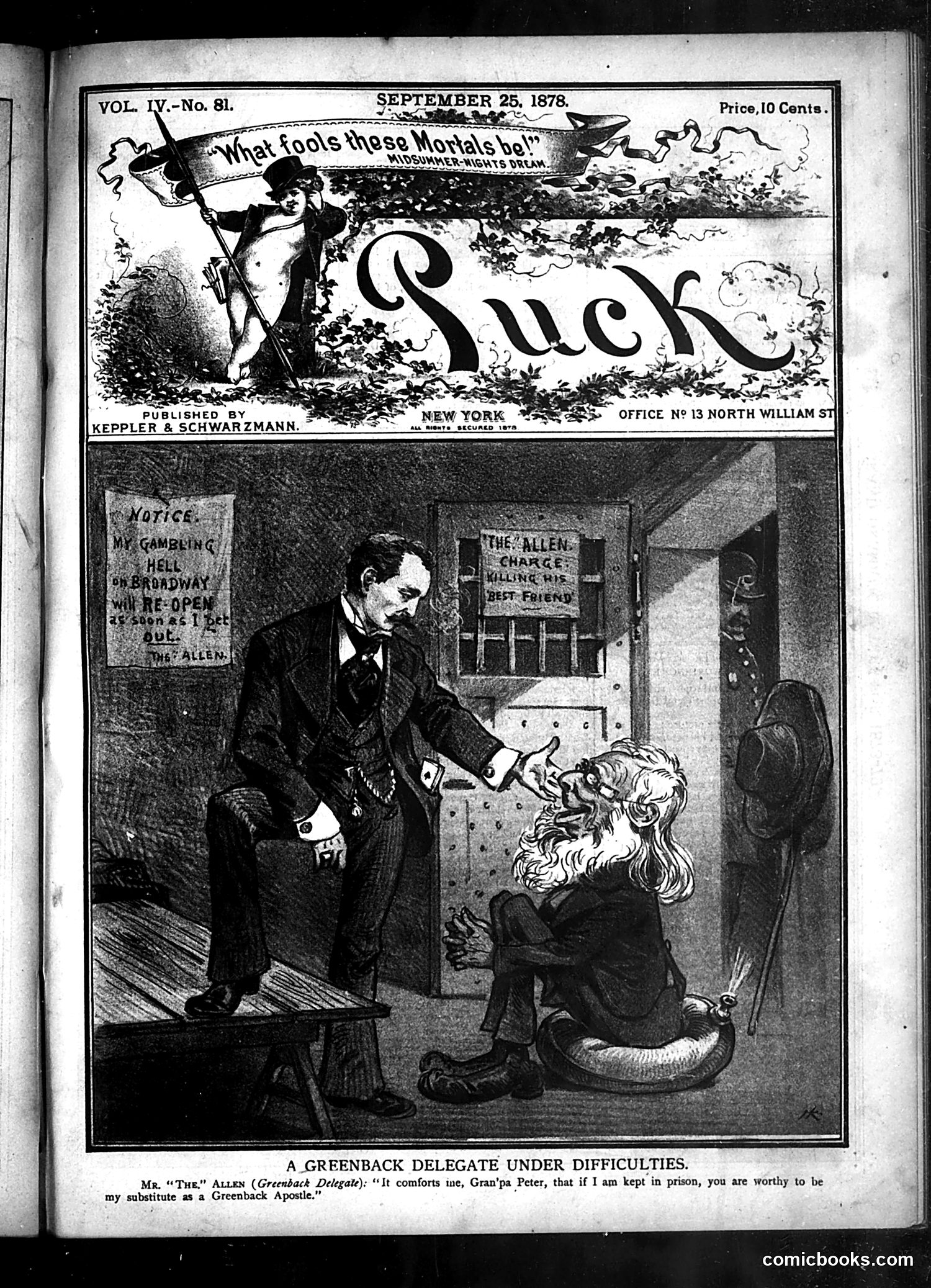
This cartoon satirizes the Greenback Party, a late-1870s political movement advocating for paper currency ("greenbacks") over gold-backed money. The caption identifies "The" Allen as a Greenback delegate imprisoned for unspecified reasons—likely debt or legal troubles. The satire works on two levels: Allen claims imprisonment makes him worthy as a Greenback "apostle" (echoing martyrdom rhetoric), while the cartoon mocks the party itself. The figure kneeling before Allen appears to be seeking his counsel or blessing despite—or because of—his incarceration. The joke suggests the Greenback Party attracted morally or legally questionable figures, and that their ideology attracted desperate followers. This reflects contemporary skepticism toward the party's economic proposals and its political viability in 1878.
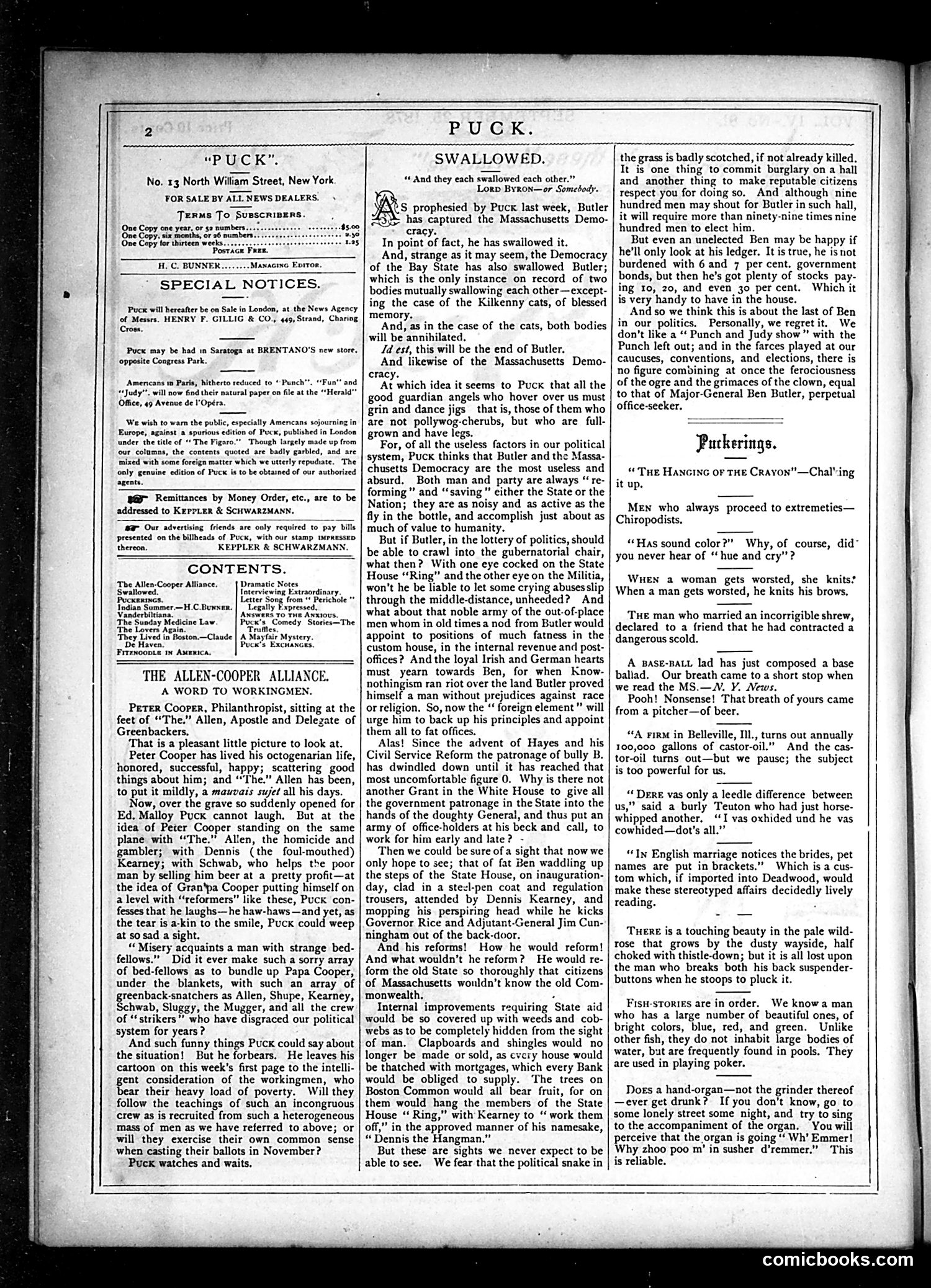
This page consists primarily of **editorial text and satirical commentary** rather than illustrated cartoons. The main article, "Swallowed," uses extended metaphor to critique Massachusetts Democratic politics. The piece satirizes how the Massachusetts Democracy has "swallowed" Butler (likely General Benjamin Butler, a prominent Massachusetts politician), comparing this to the Kilkenny cats from Irish folklore who devoured each other. The satire argues that both Butler and the Democratic party are "useless" political forces—noisy, active, but fundamentally unproductive. The commentary mocks the notion that either figure could meaningfully govern, suggesting they'd only waste resources. Other sections include brief satirical quips about politics, marriage, and social behavior, typical of Puck's mix of humor and social criticism.
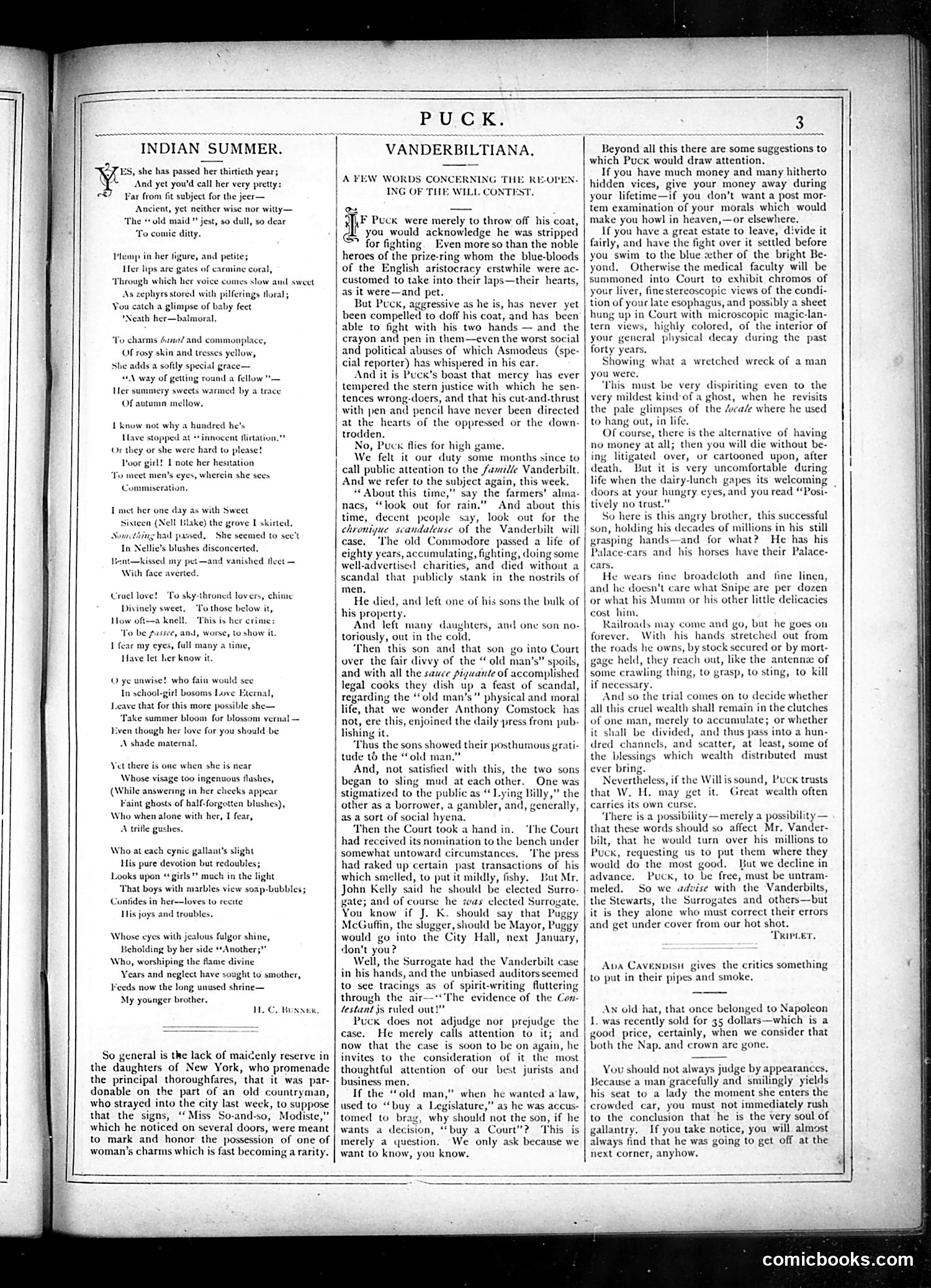
This page contains three distinct sections: 1. **"Indian Summer"** (left): A poem by H.C. Bunner celebrating the season, with no apparent political satire. 2. **"Vanderbiltiana"** (center): A satirical article mocking the Vanderbilt family's legal disputes. It references the "Surrogate Court" case involving "the old man" (likely Cornelius Vanderbilt) and his sons' contested will. The satire criticizes excessive wealth concentration and the family's costly litigation, suggesting their disputes highlight broader class inequalities. References to "Lying Billy" and other family members' scandals are mentioned. 3. **"Aux Cavendish"** (right): A brief note about acquiring Napoleon-related items, likely advertisement-adjacent content. The primary satire targets wealthy elites using their private disputes as commentary on American inequality.
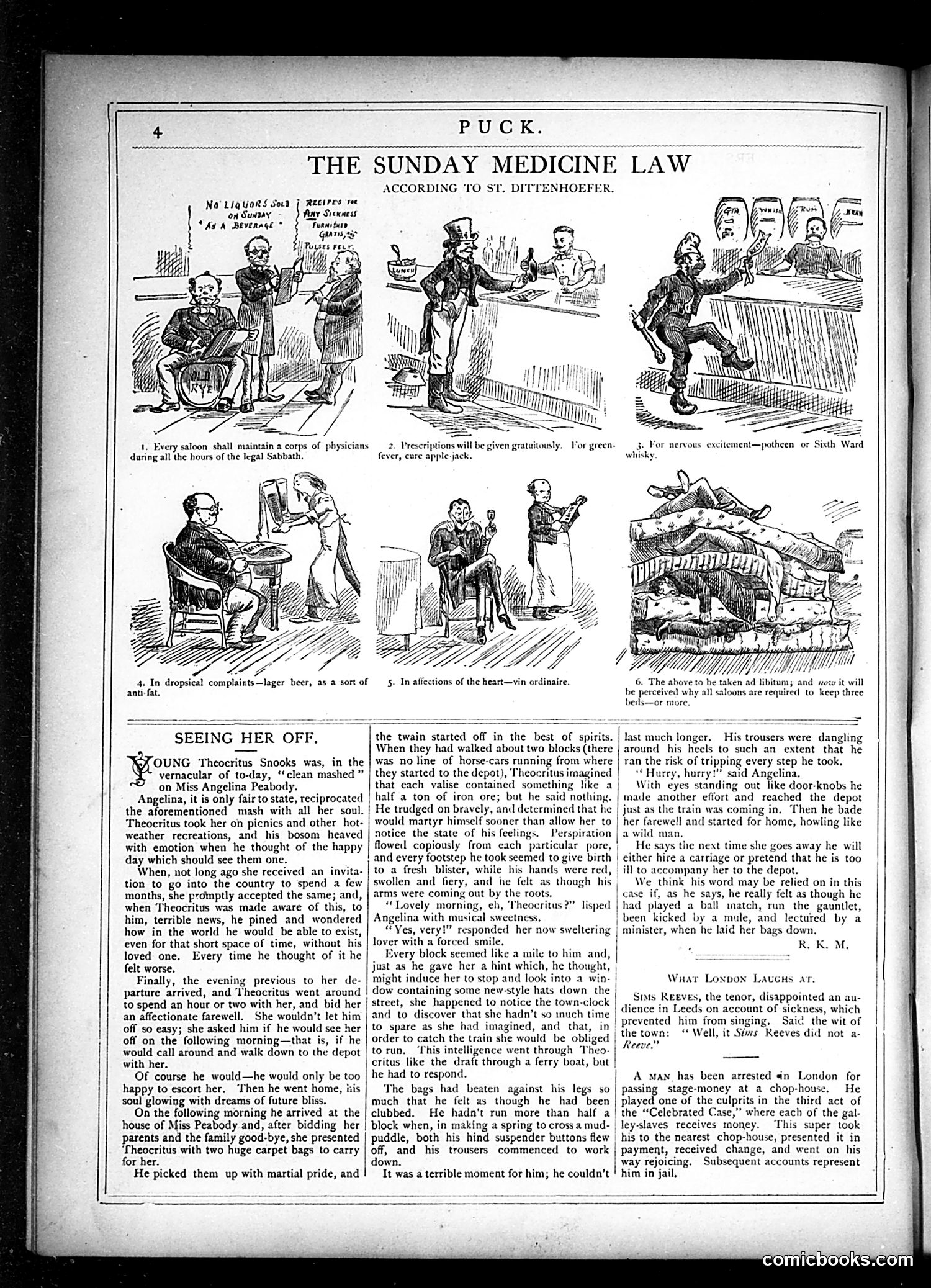
This satirical cartoon attacks a proposed law (likely from the 1870s-80s New York legislature) regulating Sunday medicine sales. The six panels mock increasingly absurd interpretations of the law through comedic scenarios: 1. A saloon maintains physicians on Sunday 2. Prescriptions given "gratuitously" with apple jack whiskey 3. Nervous excitement treated with "poteen or Seidl Wand whisky" 4. Tropical complaints treated with lager beer 5. Heart afflictions cured with "ordinaire" wine 6. A shoe salesman claims shoes are medicine to circumvent restrictions The cartoons ridicule what the artist saw as a hypocritical or poorly-drafted law that would allow alcohol sales under the guise of "medicine" while supposedly protecting Sunday commerce. The satire suggests the law's loopholes made it meaningless.
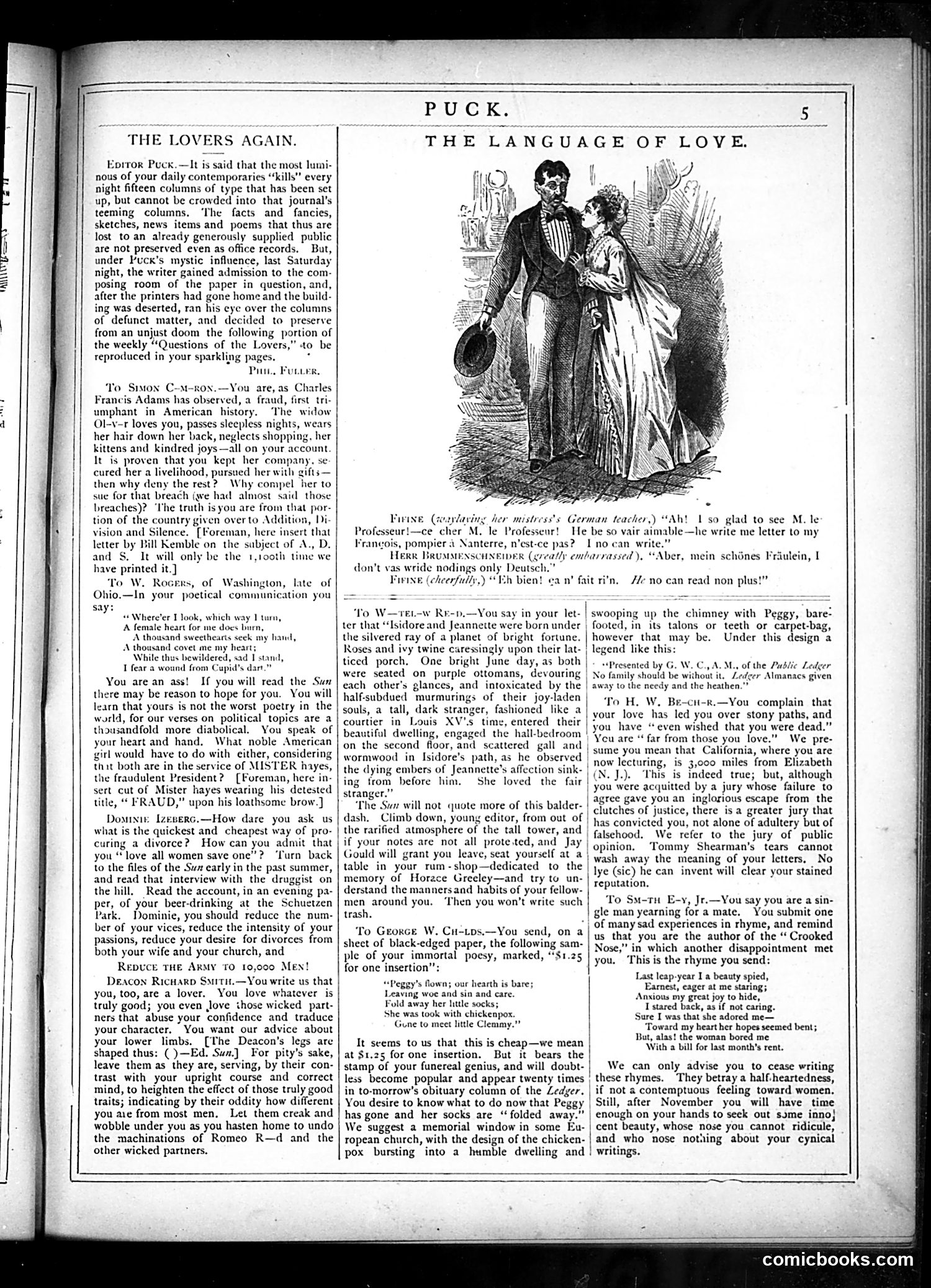
This page features a satirical illustration titled "The Language of Love" depicting a well-dressed man and woman in Victorian-era clothing. The accompanying text consists of humorous "advice column" responses addressing romantic situations. The cartoon satirizes courtship conventions of the era, showing an interaction between two figures whose body language and positioning suggest romantic or flirtatious engagement. The detailed Victorian dress and formal setting parody the artificiality of period courtship rituals. The text responses mock various lovers' complaints—infidelity, divorce complications, excessive poetry writing, and relationship drama. The satire targets both romantic pretension and the absurdity of advice-seeking about love. Puck's humor relies on exposing the gap between idealized romantic notions and messy human reality.
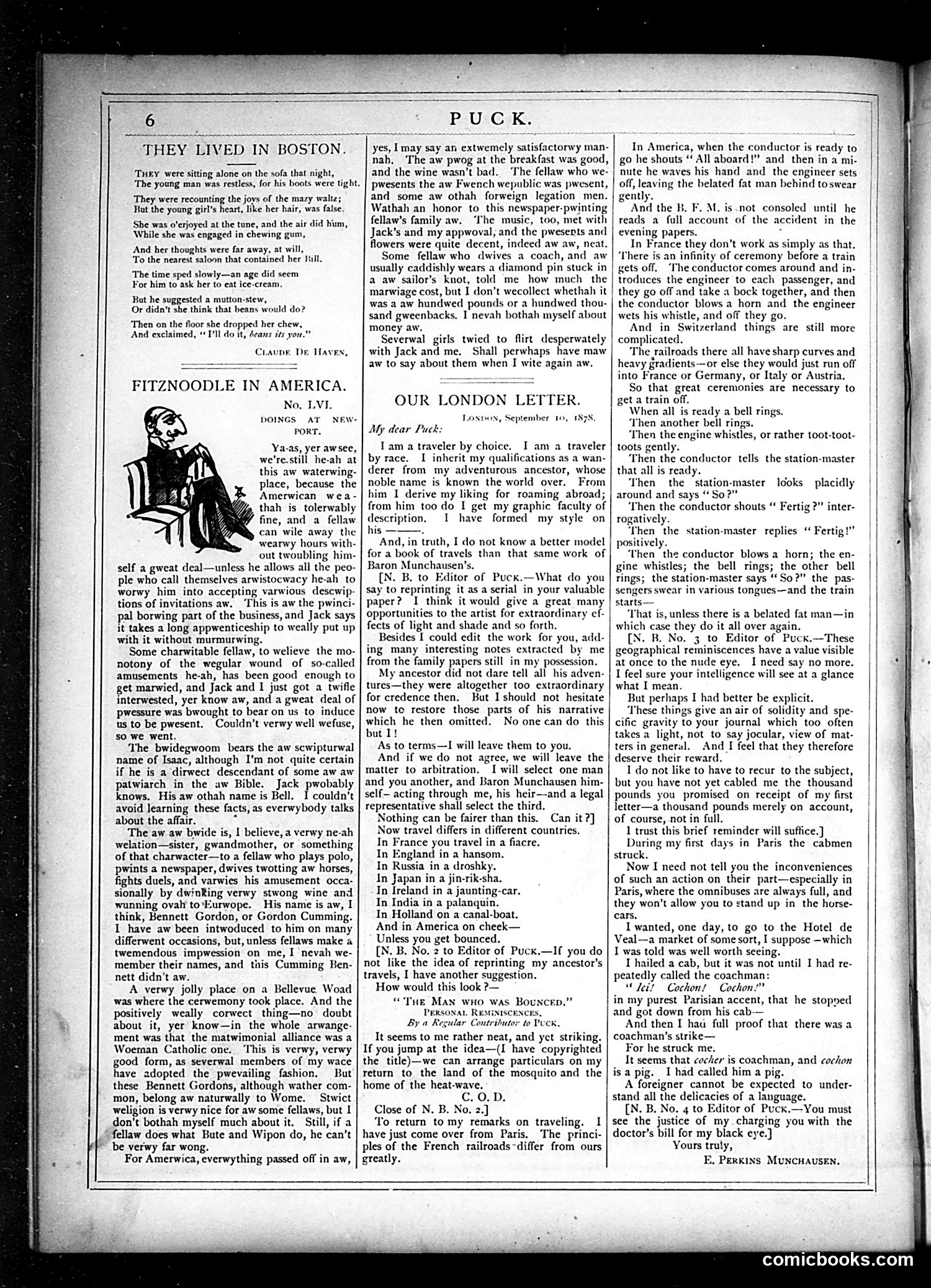
This cartoon depicts a portly gentleman identified as "Fitznoodle," apparently a British visitor to America. The satirical piece mocks British travelers' pretensions and cultural attitudes toward the United States. The text indicates Fitznoodle claims aristocratic credentials ("I inherit my qualifications as a wanderer from my adventurous ancestor") and positions himself as a sophisticated observer of American life. The humor targets both British snobbery toward America and the self-aggrandizing travel narratives popular among European visitors of the era. The accompanying "London Letter" section continues satirizing transatlantic cultural differences—contrasting French, British, and American customs regarding trains, carriages, and social conduct—suggesting Puck's consistent theme: mocking Old World pretension when confronted with American practicality.
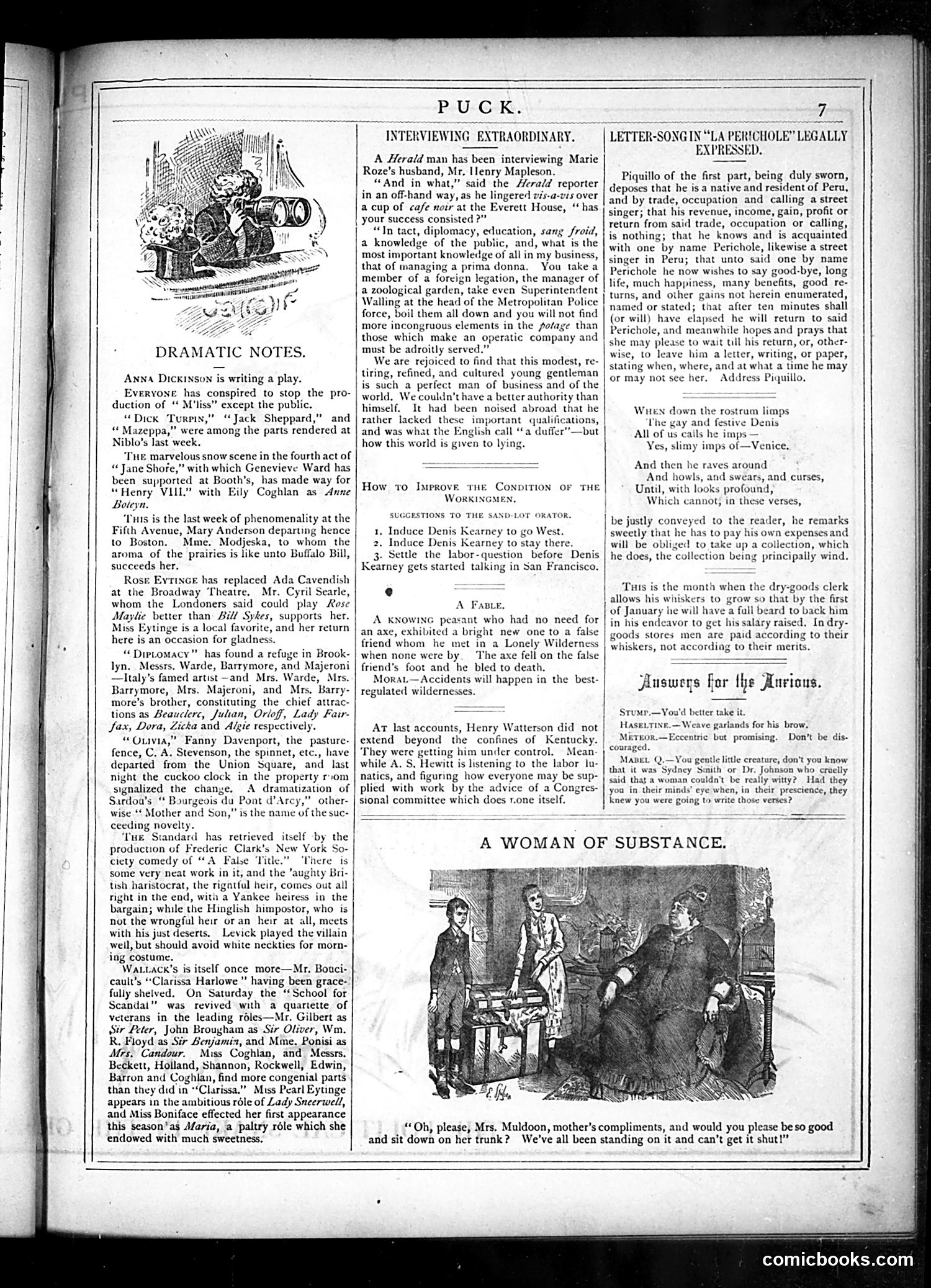
This page contains theatrical reviews and commentary rather than political cartoons. The main illustrated content is "A Woman of Substance," depicting a domestic scene where a woman requests her companion sit on a trunk, with the caption: "Oh, please, Mrs. Muldoon, mother's compliments, and would you please to be so good and sit down on her trunk? We've all been standing on it and can't get it shut!" The humor relies on a visual pun about a trunk (luggage) that won't close because people keep standing on it. The "Dramatic Notes" section reviews contemporary theater productions and performances, including plays and cast members of the era. The page also includes practical advice columns like "How to Improve the Condition of the Workingmen" and "Answers for the Curious," typical of Puck's satirical magazine format.
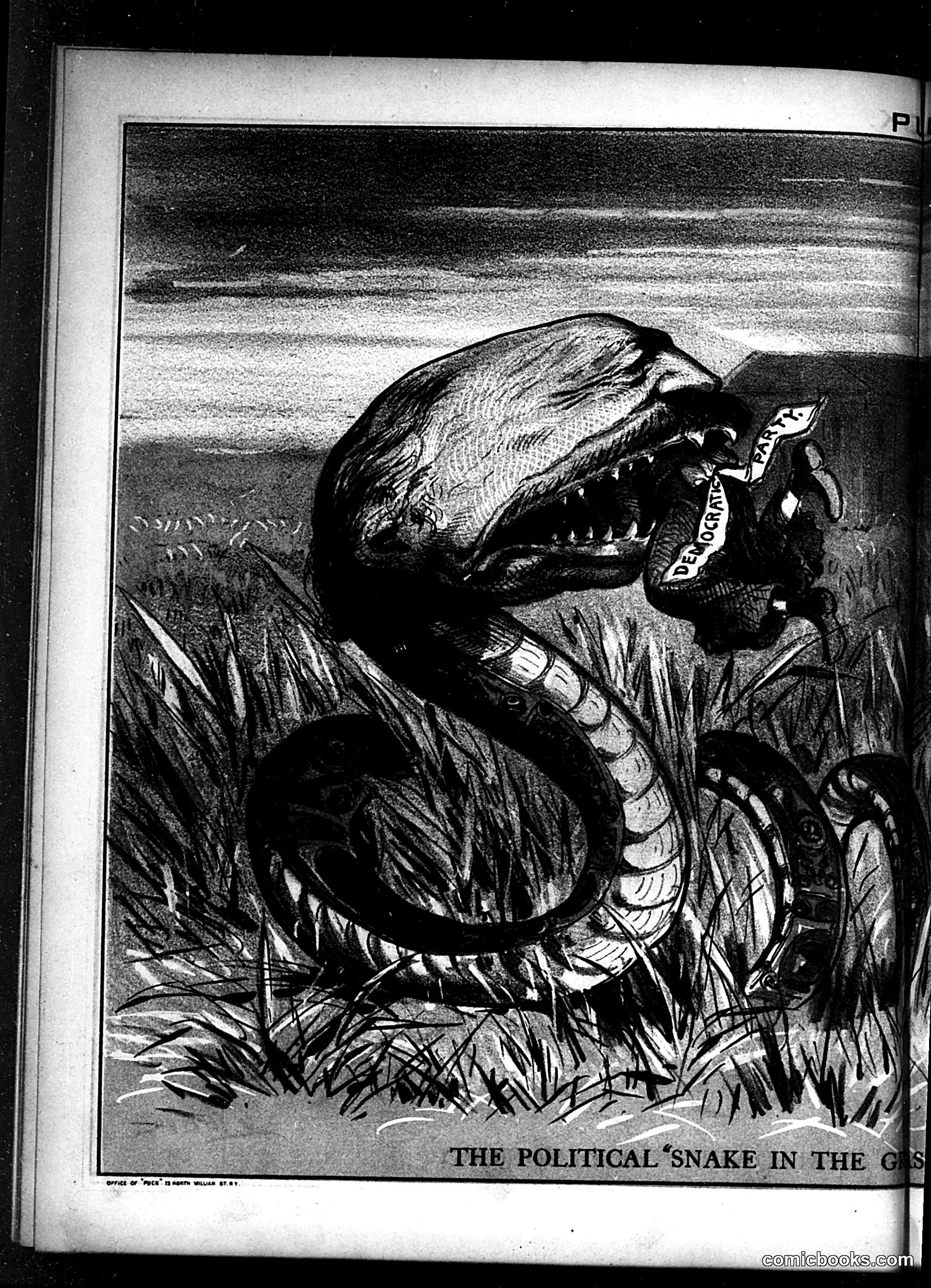
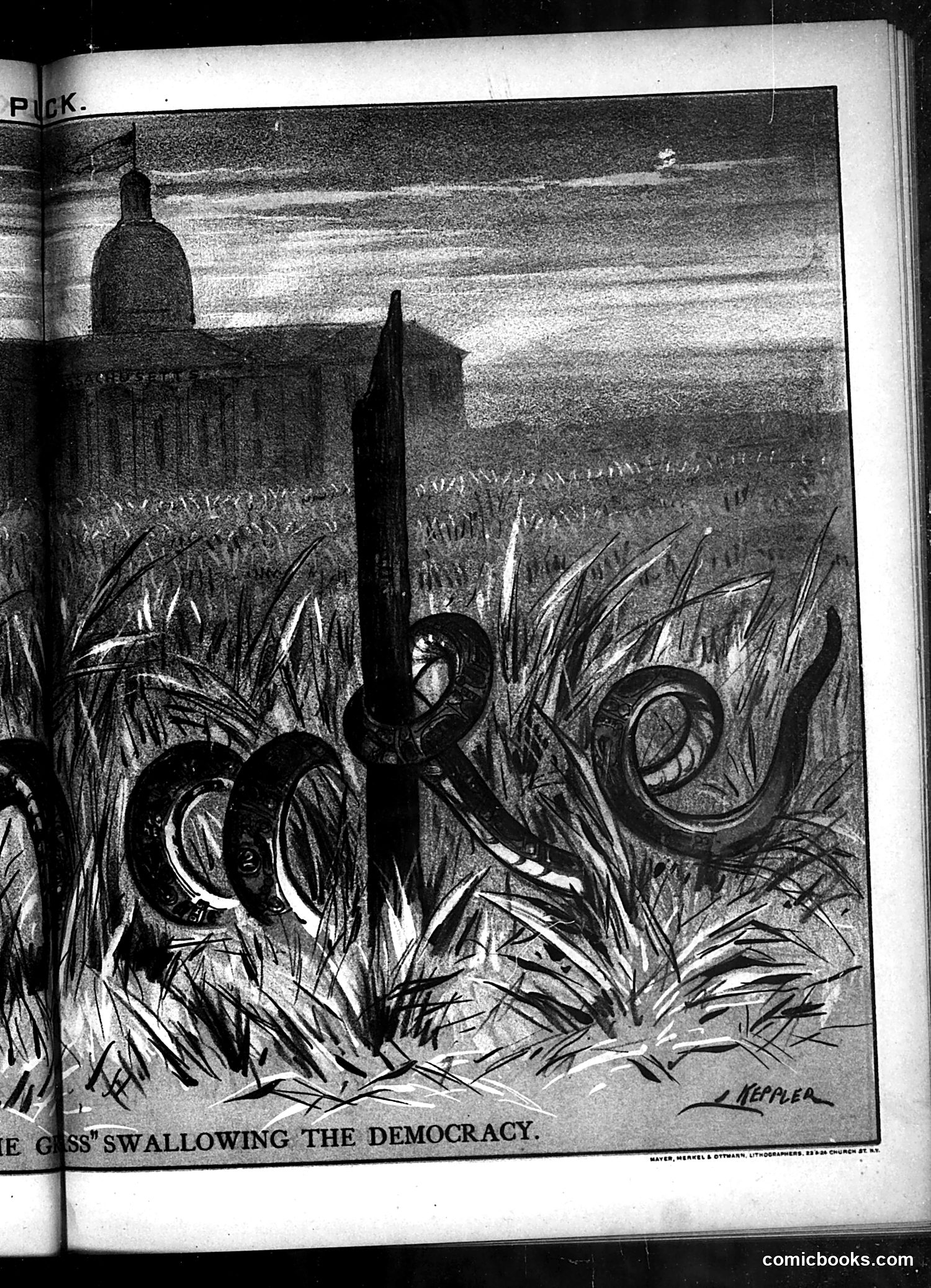
This political cartoon depicts a figure (identifiable by artist signature as by Keppler) in what appears to be a swamp or marshy setting, surrounded by coiled serpents. The figure seems to be consuming or "swallowing" democracy itself—represented perhaps by the architectural structure visible in the background, possibly the Capitol building. The cartoon critiques what it portrays as the dangerous consumption or destruction of democratic principles. The serpents likely symbolize threats or corrupting forces—possibly referring to political corruption, foreign influence, or authoritarian overreach. The marsh setting suggests moral degradation. Without the publication date visible, the specific political context remains unclear, though the imagery suggests anxieties about threats to American democratic institutions common to various periods in Puck's history.
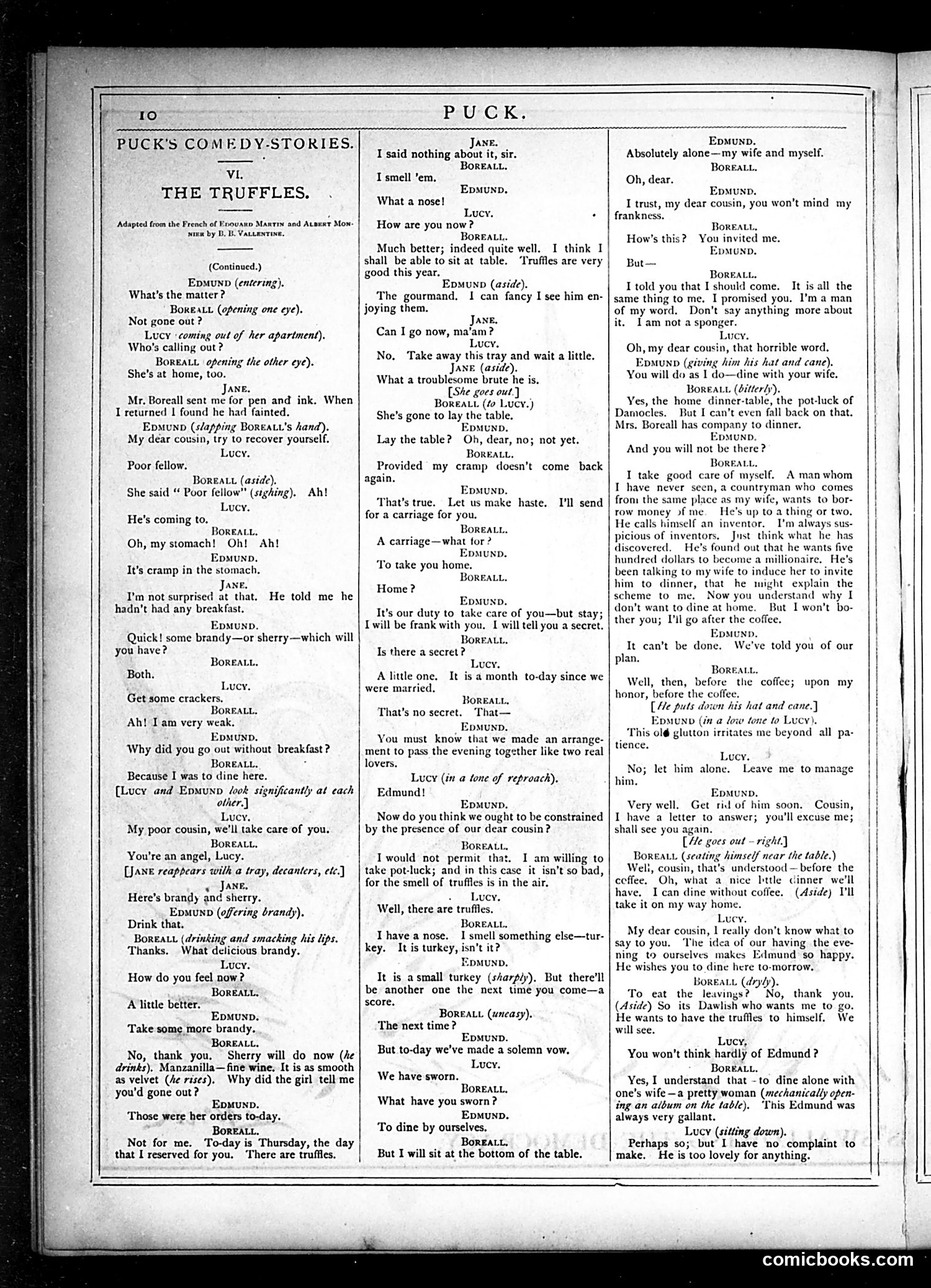
This page presents a serialized comedic dialogue adapted from French sources (credited to Eugène Moinaux and Albert Monnier). The story concerns domestic social comedy rather than political satire. The plot involves characters named Edmund, Boreall, Lucy, and Jane navigating a dinner invitation and romantic complications. Edmund has invited the rustic Boreall to dine, creating class-based comedy through contrasts in manners and sophistication. The dialogue plays on misunderstandings about "truffles" (an expensive delicacy), with Boreall's crude behavior and malapropisms providing humor typical of 19th-century popular comedy. This is literature/entertainment content rather than political cartooning—a serialized story designed for Puck's audience seeking humorous domestic narratives with working-class and genteel character types.
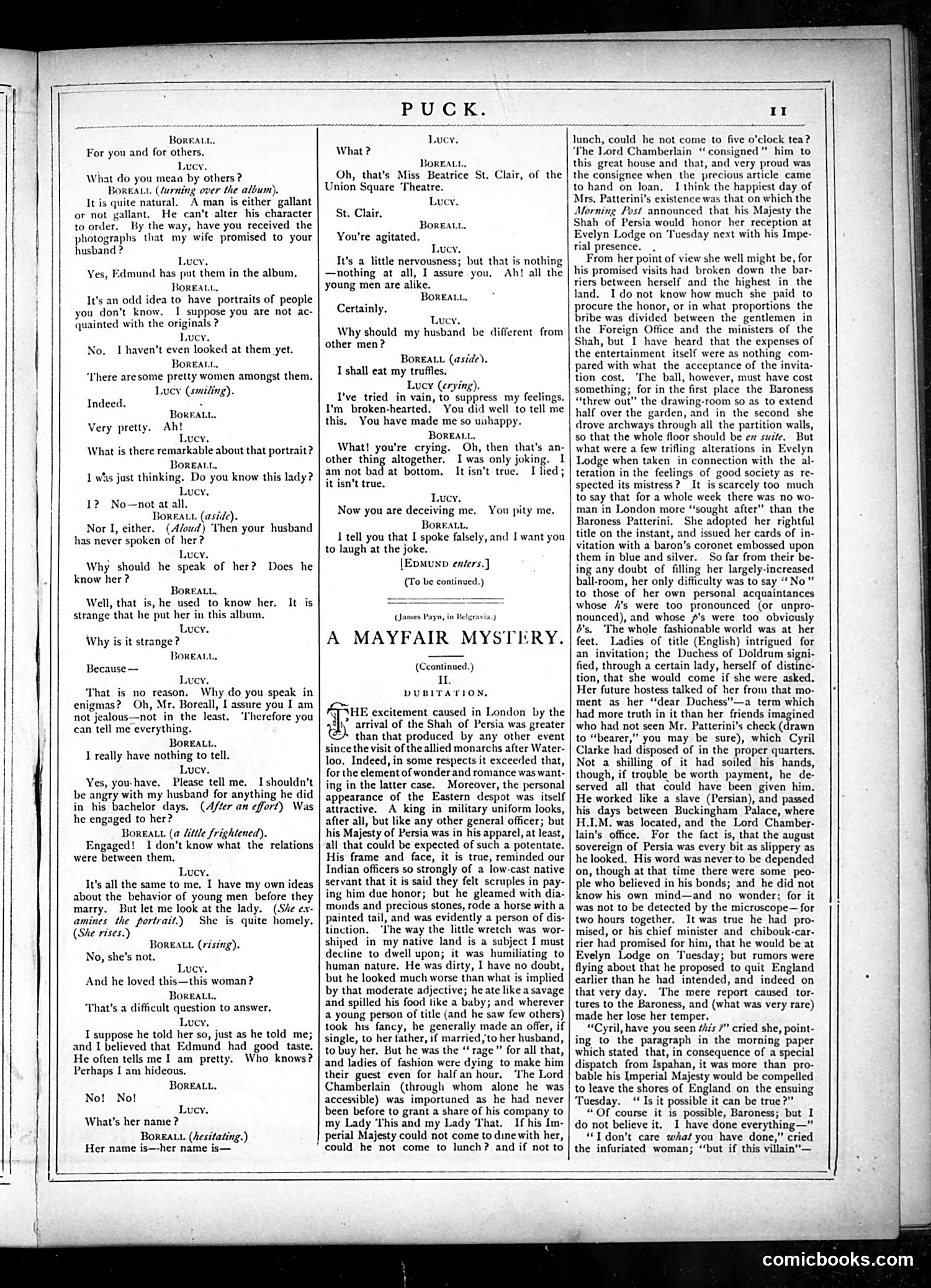
This page contains dialogue from a theatrical sketch called "A Mayfair Mystery" (continued from a previous section). The conversation involves characters named Boreall, Lucy, and Edmund discussing a scandal involving the Shah of Persia's visit to London. The satire centers on **social embarrassment and aristocratic pretension**: characters debate whether to acknowledge acquaintance with a woman of questionable reputation, and whether her presence will damage their social standing during an important diplomatic visit. The specific reference to the Shah of Persia appearing in London suggests this relates to an actual historical state visit that created social complications—likely involving questions of which society figures would be presented at court and which relationships were "acceptable" to acknowledge publicly. The humor exploits Victorian anxieties about propriety and status.
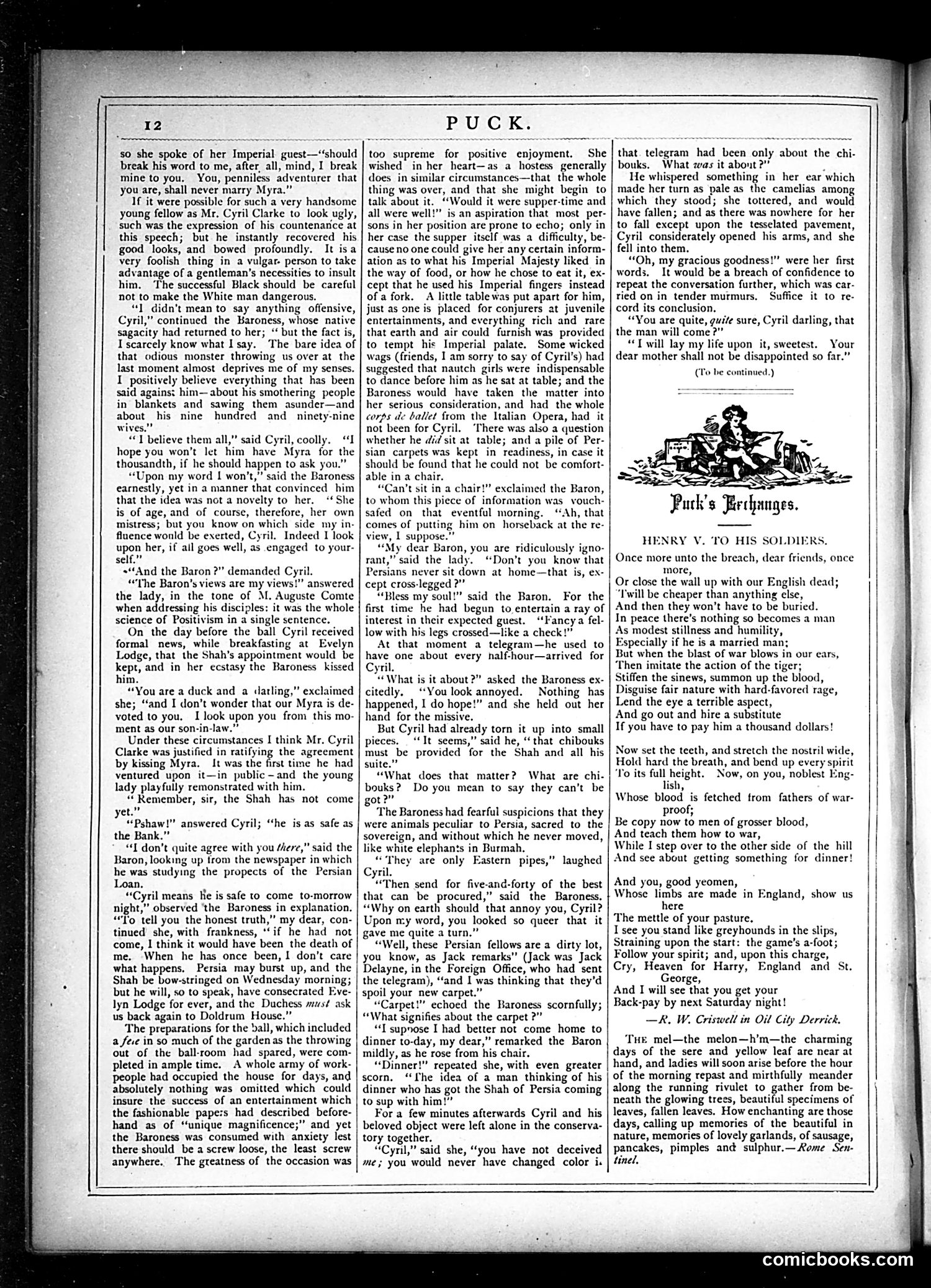
This page contains two distinct sections: **Main Text Article**: A satirical narrative mocking the social pretensions and etiquette obsessions of the wealthy elite, specifically depicting conflicts between a Baroness and a character named Cyril regarding proper conduct for entertaining an Imperial guest. The satire targets the absurdity of rigid social conventions—debates over whether guests should sit at tables, concerns about Persian carpets, and anxiety about appearing proper. **"Puck's Exchanges" Poem**: A patriotic verse addressed "Henry V to His Soldiers," celebrating English military courage and heritage. It appears designed to stir nationalist sentiment, contrasting English valor with other nations. The page demonstrates Puck's dual approach: mocking upper-class social vanity while promoting patriotic themes. The visual illustration (bottom right) appears to show figures in casual repose, likely complementing the satirical narrative about social pretension.
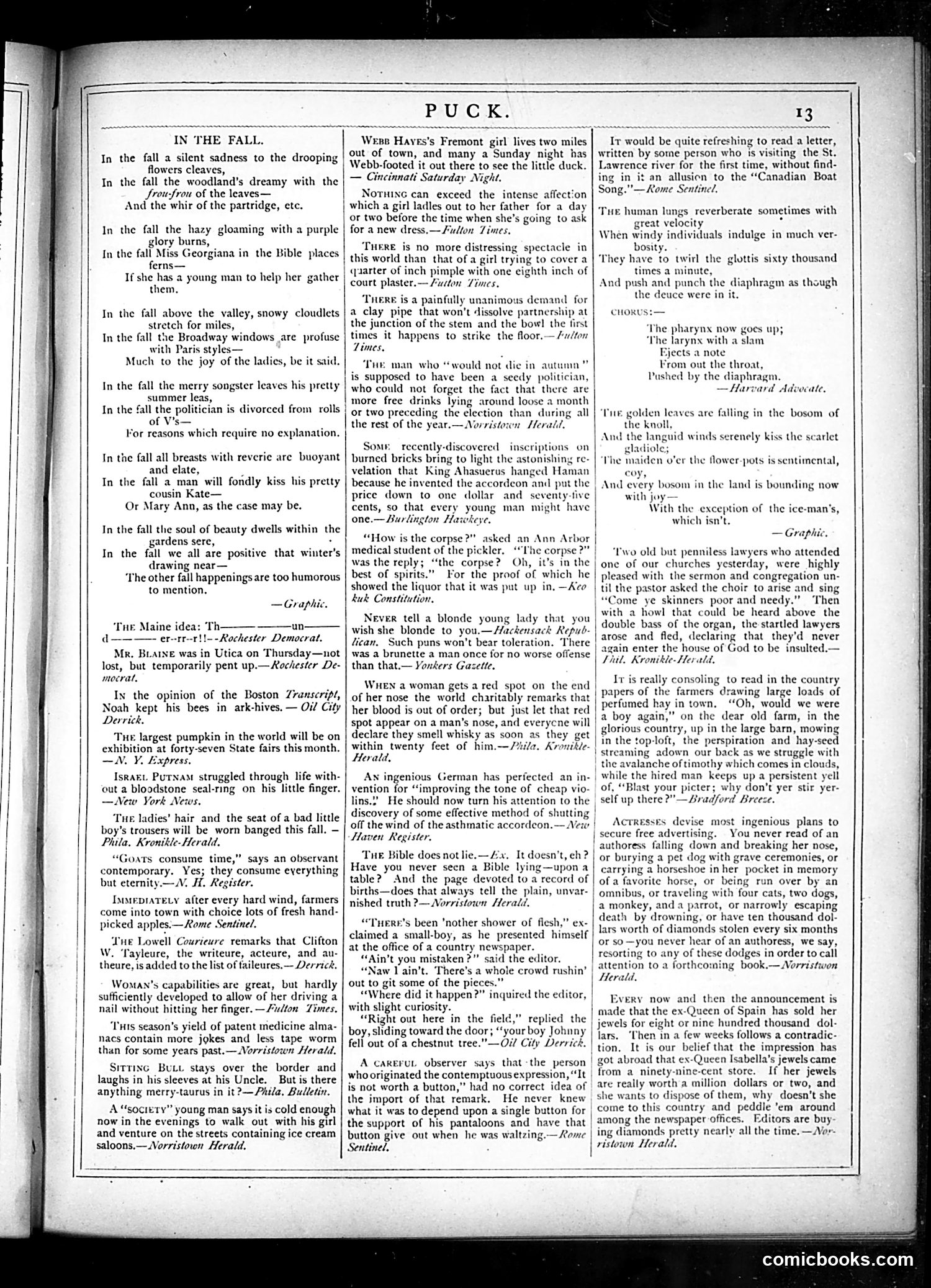
This page is primarily **text-based humor and commentary**, not political cartoons. It consists of short satirical pieces and jokes typical of Puck's format. The content includes brief quips mocking various subjects: autumn fashion, pimple-covering cosmetics, clay pipe dissolving, politicians' drinking habits, and invented products (like King Ahasuerus' accordion). Notable pieces mock women's appearance ("red spot on a woman's face"), German accordion improvements, and actresses' theatrical schemes. Several items satirize contemporary social behaviors and consumer culture. Without visible illustrations or identified public figures, these appear to be **general social satire** rather than targeted political commentary. The humor relies on exaggeration of everyday absurdities—typical of Puck's populist, sardonic approach to American life and manners.
This page is primarily **advertising content** rather than political satire or comics. It consists of commercial advertisements from late 19th-century New York businesses, including: - Arnold, Constable & Co. (fall clothing and household goods) - Apollinaris Natural Mineral Water - Hunyadi Janos aperient (medicinal product) - Vienna Coffee Pot and other housewares - Furniture and dental services - Photography studios - A tailor shop The only potentially satirical element is a small section titled "WHY IS IT?" critiquing dental practice standards, but this is minor consumer commentary rather than political cartoon work. **This is essentially a classified advertising page**, typical of Puck's revenue model, not a showcase of the magazine's satirical editorial content.
This page is **primarily advertising**, not editorial content or political satire. It contains various commercial advertisements from late 19th-century New York businesses, including: - Isaac Smith's Umbrellas - Best Marquis Cigarettes - Pachtmann & Moelich (watches and jewelry) - Herring's Safe Company - De Venoge Champagne - Dunlap & Co. (gentlemen's hats) - Otto Stietz Glass Letter Company The only substantive non-advertising content is a notice about **back issues of Puck available on demand** and **patent covers for filing Puck** ($1 each). There are no visible political cartoons, caricatures, or satirical content on this page—it serves as a revenue-generating advertising section for the magazine's publishers.
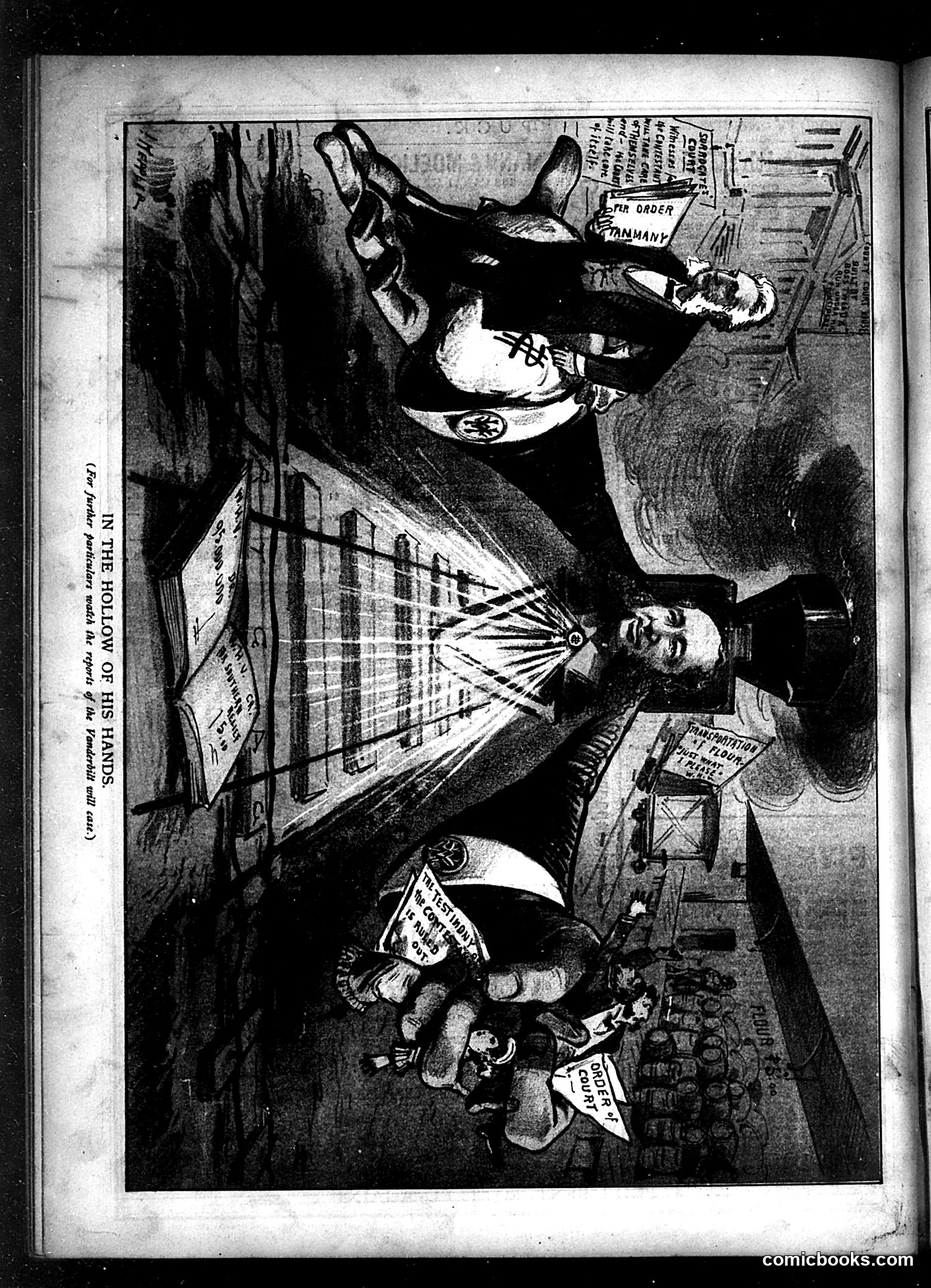
This Puck cartoon titled "In the Folly of His Hands" appears to satirize German colonial or imperial ambitions. The image shows a figure in military dress (likely representing Germany or a German leader) examining or manipulating what appears to be colonial territories or trade arrangements, suggested by the maps and documents visible in the scene. The cartoon uses caricature to mock German foreign policy, depicting the nation's grasp or control over various global interests. The specific references to "Order" and "Germany" visible on documents indicate this critiques German economic or political expansion. Without the publication date clearly visible, the exact historical moment remains unclear, though the style suggests early 20th-century Puck satire during a period of heightened European imperial competition.