
Puck, 1878-09-25 · page 12 of 16
Puck — September 25, 1878 — page 12: what you’re looking at
What you’re looking at
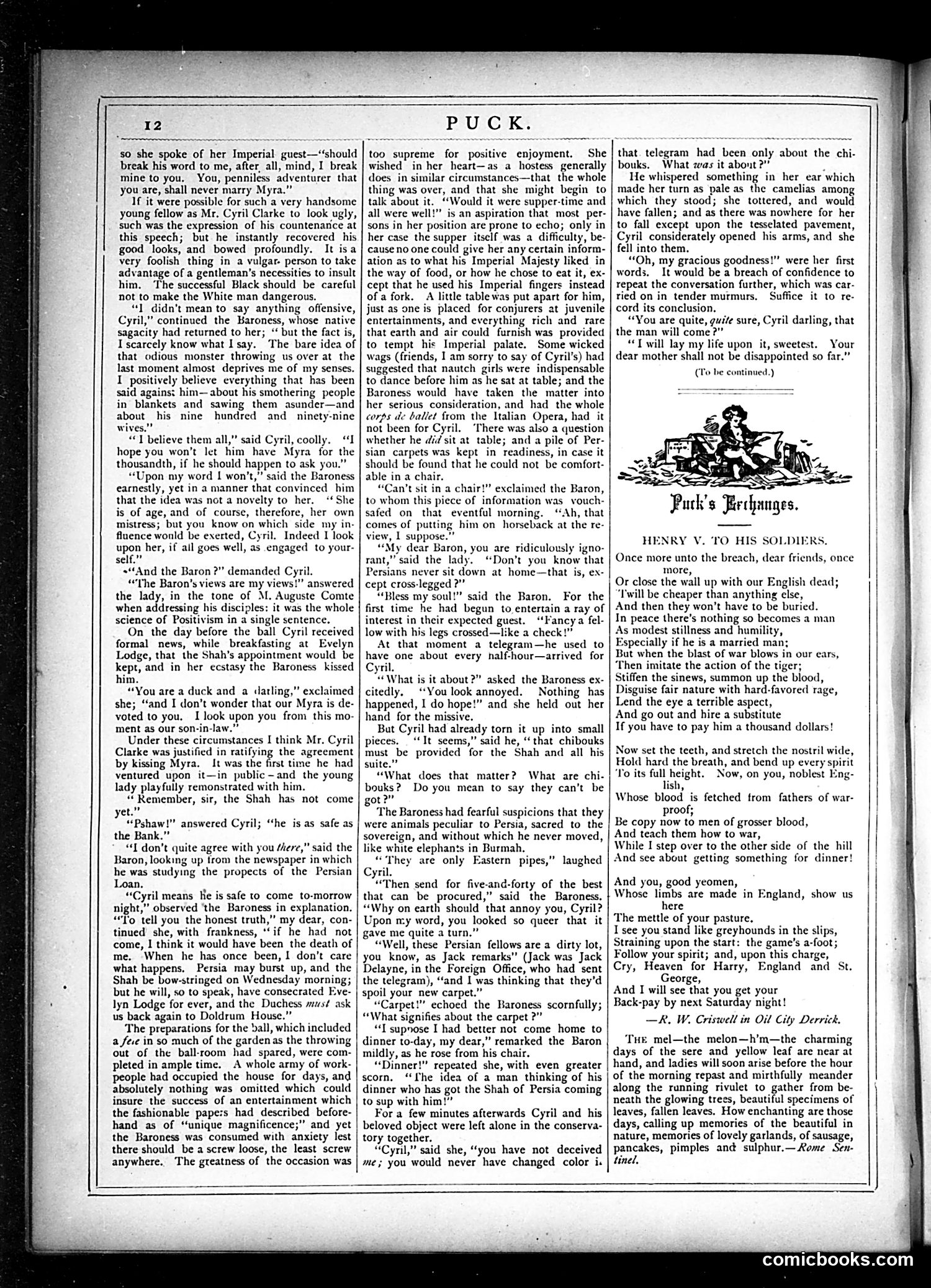
This page contains two distinct sections: **Main Text Article**: A satirical narrative mocking the social pretensions and etiquette obsessions of the wealthy elite, specifically depicting conflicts between a Baroness and a character named Cyril regarding proper conduct for entertaining an Imperial guest. The satire targets the absurdity of rigid social conventions—debates over whether guests should sit at tables, concerns about Persian carpets, and anxiety about appearing proper. **"Puck's Exchanges" Poem**: A patriotic verse addressed "Henry V to His Soldiers," celebrating English military courage and heritage. It appears designed to stir nationalist sentiment, contrasting English valor with other nations. The page demonstrates Puck's dual approach: mocking upper-class social vanity while promoting patriotic themes. The visual illustration (bottom right) appears to show figures in casual repose, likely complementing the satirical narrative about social pretension.
📄 Transcribed text from this page (OCR, searchable)
Machine-transcribed from the original scan — historical spelling and the odd misread are preserved.
so she spoke of her repair ee Pann break his word to me, after, all, mind, I break mine to you. You, penniless adventurer that you are, shall never marry Myra.” If it were possible for such a very handsome young fellow as Mr. Cyril Clarke to look ugly, such was the expression of his countenance at this speech; but he instantly recovered his good looks, and bowed profoundly. It isa very foolish thing in a vulgar. person to take advantage of a gentleman’s necessities to insult him, The successful Black should be careful not to make the White man dangerous. “I didn’t mean to say anything offensive, Cyril,” continued the Baroness, whose native sagacity had returned to her; ‘‘ but the fact is, Iscarcely know what I say. The bare idea of that odious monster throwing us over at the last moment almost deprives me of my senses. I positively believe everything that has been said agains: him— about his smothering people in blankets and sawing them asunder—and abate , his nine hundred and_ ninety-nine wil re believe them all,” said Cyril, coolly. “1 hope you won't let him have Myra for the thousandth, if he should happen to ask you.” “Upon my word | won’t,” said the Baroness earnestly, yet in a manner that convinced him that the idea was not a novelty to her. “She is of age, and of course, therefore, her own mistress; but you know on which side my in- fluence wonld be exerted, Cyril. Indeed I look upon her, if all goes well, a3 engaged to your- self.” “And the Baron ?” demanded Cyril. “The Baron’s views are my views!” answered the lady, in the tone of M. Auguste Comte when addressing his di it was the whole science of Positivism in a single sentence, On the day before the ball Cyril received formal news, while breakfasting at Evelyn Lodge, that the Shah's appointment would be kept, and in her ecstasy the Baroness kissed him. “You are a duck and a darling,” exclaimed she; “and I don't wonder that our Myra is de- voted to you. I look upon you from this mo- ment as our son-in-law.” Under these circumstances I think Mr. Cyril Clarke was justified in ratifying the agreement by kissing Myra. It was the first time he had ventured upon it—in public~and the young lady playfully remonstrated with him. “Remember, sir, the Shah has not come yet.” “Pshaw!” the Bank. “I don’t quite agree with you ¢here,” said the Baron, looking up from the newspaper in which he was studying the propects of the Persian Loan. “Cyril means He is safe to come to-morrow night,” observed ‘the Baroness in explanation. “To tell you the honest truth,” my dear, con- tinued she, with frankness, “if he had not come, | think it would have been the death of me. When he has once been, 1 don’t care what happens, Persia may burst up, and the Shah be bow-stringed on Wednesday morning; but he will, so to speak, have consecrated Eve- lyn Lodge for ever, and the Duchess must ask us back again to Doldrum House.” ‘The preparations for the ball, which included a feve in so much of the gardenas the throwing out of the ball-room had spared, were com- pleted in ample time. A whole army of work- ple had occupied the house for days, and dbsolutely nothing was omitted which could insure the success of an entertainment which the fashionable papezs had described before- hand as of “unique magnificence;” and yet the Baroness was consumed with anxiety lest there should be a screw loose, the least screw anywhere. The greatness of the occasion was answered Cyril; “he is as safe as PUCK. too supreme for positive enjoyment. She wished in her heart—as a hostess generally does in similar circumstances—that the whole thing was over, and that she might begin to talk about it. “Would it were supper-time and all were well!” is an aspiration that most per- sons in her position are prone to echo; only in her case the supper itself was a difficulty, be- cause no one could give her any certain inform- ation as to what his Imperial Majesty liked in the way of food, or how he chose to eat it, ex- cept that he used his Imperial fingers instead ofa fork. A little table was put apart for him, just as one is placed for conjurers at juvenile entertainments, and everything rich and rare that earth and air could furnish was provided to tempt his Imperial palate. Some wicked wags (friends, I am sorry to say of Cyril's) had suggested that nautch girls were indispensable to dance before him as he sat at table; and the Baroness would have taken the matter into her serious consideration, and had the whole corps de baliet from the Italian Opera, had it not been for Cyril. ‘There was also a question whether he did sit at table; and a pile of Per- sian carpets was kept in readiness, in case it should be found that he could not be comfort- able in a chair. “Can't sit in a chair!” exclaimed the Baron, to whom this piece of information was vouch- safed on that eventful morning. ‘Ah, that comes of putting him on horseback at the re- view, I suppose.” “My dear Baron, you are ridiculously igno- rant,” said the lady. “Don’t you know that Persians never sit down at home—that is, ex- cept cross-legged ?”” “Bless my soul!” said the Baron. For the first time he had begun to entertain a ray of interest in their expected guest. ‘Fancy a fel- low with his legs crossed—like a check!” At that moment a telegram—he used to have one about every nalf-hour—arrived for Cyril. “What is it about?” asked the Baroness ex- citedly. ‘You look annoyed. Nothing has happened, I do hope!” and she held out her hand for the missive. But Cyril had already torn it up into small pieces. ‘It seems,” said he, “that chibouks must be provided for the Shah and all his suite.” “What does that matter? What are chi- bouks? Do you mean to say they can’t be got?” The Baroness had fearful suspicions that they were animals peculiar to Persia, sacred to the sovereign, and without which he never moved, like white elephants in Burmah. “They are only Eastern pipes,” laughed “Then send for five-and-forty of the best that can be procured,” said the Baroness. “Why on earth should that annoy you, Cyril? Upon my word, you looked so queer ‘that it gave me quite a turn.” “Well, these Persian fellows are a dirty lot, you know, as Jack remarks” (Jack was Jack Delayne, in the Foreign Office, who had sent the telegram), “and I was thinking that they’d spoil your new carpet.” “Carpet!” echoed the Baroness scornfully; “What Fignifies about the carpet ?” “I supnose I had better not come home to dinner to-day, my dear,” remarked the Baron mildly, as he rose from his chair. “Dinner!” repeated she, with even greater scorn, ‘fhe idea of a man thinking of his dinner who has got the Shah of Persia coming to sup with him!” For a few minutes afterwards Cyril and his beloved object were left alone in the conserva- tory together. “Cymil,” said she, “you have not deceived me; you would never have changed color is that. telegram had been only about the chi- bouks. What zas it about ?” ; He whispered something in her ear which made her turn as pale as the camelias among which they stood; she tottered, and would have fallen; and as there was nowhere for her to fall except upon the tesselated pavement, Cyril considerately opened his arms, and she fell into them. “Oh, my gracious goodness!” were her first words. It would be a breach of confidence to repeat the conversation further, which was car- tied on in tender murmurs. Suffice it to re- cord its conclusion, “You are quite, guife sure, Cyril darling, that the man will come ?” “Twill lay my life upon it, sweetest. Your dear mother shall not be disappointed so far.” (To be continued.) HEN Once more unto the breach, dear feiehay once more, Or close the wall up with our English dead; ‘Iwill be cheaper than anything else, And then they won't have to be buried. In peace there’s nothing so becomes a man As modest stillness and humility, Especially if he is a married man; But when the blast of war blows in our ears, ‘Then imitate the action of the tiger; Stiffen the sinews, summon up the blood, Disguise fair nature with hard-favored rage, Lend the eye a terrible aspect, And go out and hire a substitute If you have to pay him a thousand dollars! Now set the teeth, and stretch the nostril wide, Hold hard the breath, and bend up every spirit ‘Yo its full height. Now, on you, noblest Eng- lish, Whose blood is fetched from fathers of war- proof; Be copy now to men of grosser blood, And teach them how to war, While I step over to the other side of the hill And see about getting something for dinner! And you, good yeomen, Whose limbs are made in England, show us here The mettle of your pasture, I see you stand like greyhounds in the slips, Straining upon the start: the game's a-foot; Follow your spirit; and, upon this charge, Cry, Heaven for Harry, England and St. George, And I will see eat you get your Back-pay by next Saturday night! —R. W. Criswell in Oil City Derrick. THe mel—the melon—h’m—the charming days of the sere and yellow leaf are near at hand, and ladies will soon arise before the hour of the morning repast and mirthfully meander along the running rivulet to gather from be- neath the glowing trees, beautiful specimens of leaves, fallen leaves, How enchanting are those days, calling up memories of the beautiful in nature, memories of lovely garlands, of sausage, pancakes, pimples and sulphur.—Xome Sen- tinel, comicbooks.com