
Puck, 1878-09-25 · page 10 of 16
Puck — September 25, 1878 — page 10: what you’re looking at
What you’re looking at
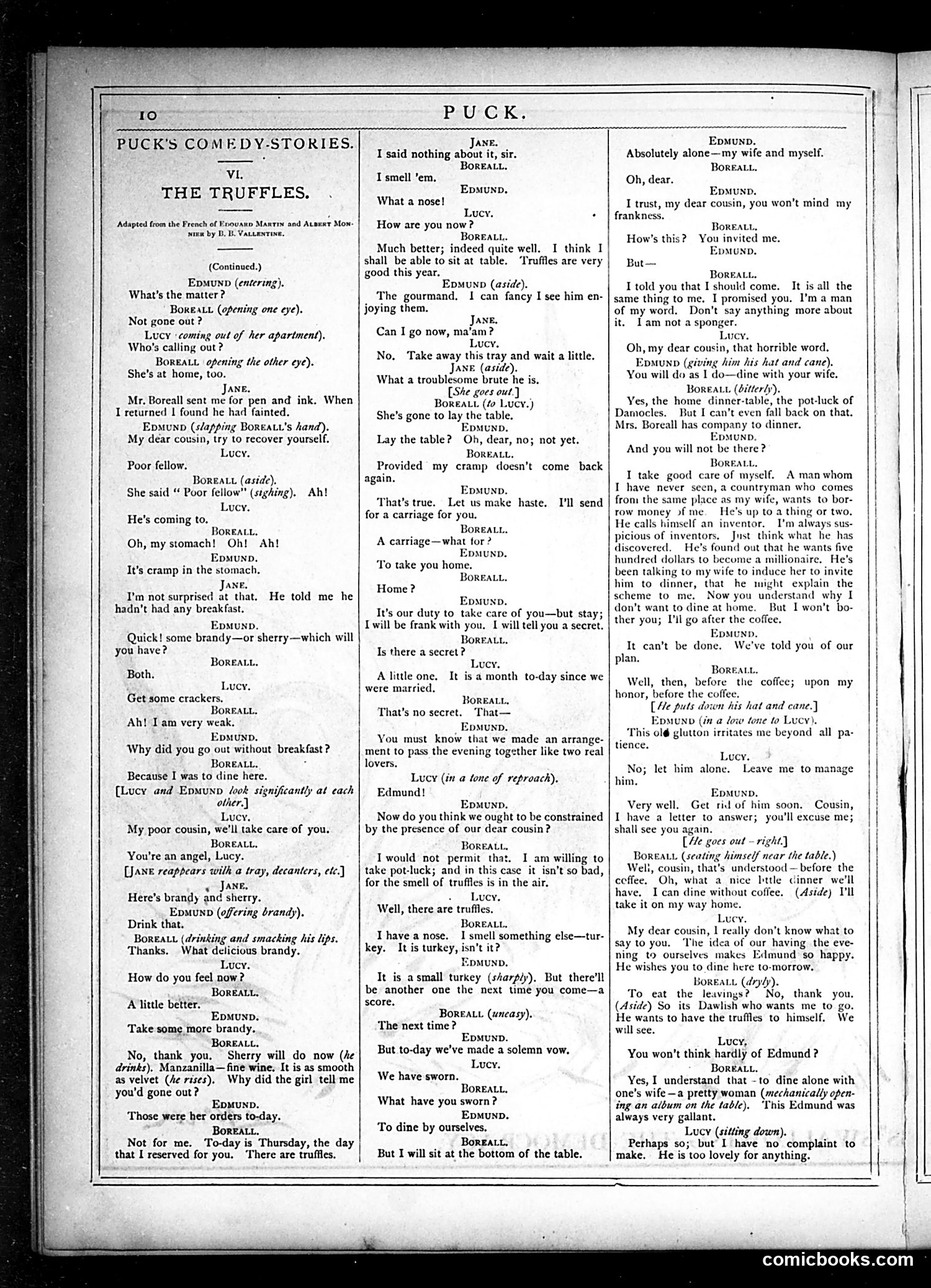
This page presents a serialized comedic dialogue adapted from French sources (credited to Eugène Moinaux and Albert Monnier). The story concerns domestic social comedy rather than political satire. The plot involves characters named Edmund, Boreall, Lucy, and Jane navigating a dinner invitation and romantic complications. Edmund has invited the rustic Boreall to dine, creating class-based comedy through contrasts in manners and sophistication. The dialogue plays on misunderstandings about "truffles" (an expensive delicacy), with Boreall's crude behavior and malapropisms providing humor typical of 19th-century popular comedy. This is literature/entertainment content rather than political cartooning—a serialized story designed for Puck's audience seeking humorous domestic narratives with working-class and genteel character types.
📄 Transcribed text from this page (OCR, searchable)
Machine-transcribed from the original scan — historical spelling and the odd misread are preserved.
10 PUCK. PUCK’s COMEDY-STORIES. Vi. THE TRUFFLES. ‘Adapted from the French of Enouann Marri and Ataext Mow- tex by B, B. VaLLanTine. (Continued.) EpMunp (entering). What's the matter? Boreatt (opening one eye). Not gone out ? Lucy ‘coming out of her apartment), Who's calling out? BoreALt. opening the other eye). She's at home, too. Jane. Mr. Boreall sent me for pen and ink, When T returned | found he had fainted. Epaunp (slapping Boreatt's hand). My dear cousin, try to recover yourself. Lucy. Poor fellow. Boreatt (aside), She said “ Poor fellow” (sighing). Lucy. He's coming to. Boreat, Oh, my stomach! Oh! Epmunp. It’s cramp in the stomach. Ah! Ah! Jane. I'm not surprised at that. He told me he hadn't had any breakfast. Epmunp. Quick! some brandy—or sherry—which will you have? Borea. Both, Lucy, Get some crackers. BorEAtL. Ah! Iam very weak, Epmunp. Why did you go out without breakfast ? Boreatt. ¥ Because I was to dine here. (Lucy and Epmunp /ook significantly at each ober Lucy, My poor cousin, we'll take care of you. Boreatt, You're an angel, Lucy. Dane reappears wilh a tray, decanters, ete.) « JANe. Here's brandy and sherry. Epaunp (offering brandy). Drink that. Boreatt (drinking and smacking his lips. Thanks. What delicious brandy. Lucy. How do you feel now? Boreat. A little better. Epmunp. Take some more brandy, Boreatt. No, thank you, Sherry will do now (he drinks), Manzanilla—fine wine. It is as smooth as velvet (4e rises). Why did the girl tell me you'd gone out? Epmunp. ‘Those were her orders to-day. Boreatt. Not for me. To-day is Thursday, the day that I reserved for you, There are truffles. Jane. I said nothing about it, sir. Boreatt, I smell 'em. Epunp, What a nose! Lucy, . How are you now? BorEALL. Much better; indeed quite well. shall be able to sit at table. good this year. I think I Epaunp (aside). ‘The gourmand, 1 can fancy I see him en- joying them. Jane. Can I go now, ma‘am? Lucy. Take away this tray and wait a little. Jane (aside). What a troublesome brute he is. [She goes out] Boreatt (fo Lucy.) She's gone to lay the table. SDMUND. Lay the table? Oh, dear, no; not yet. Boreatt, Provided my cramp doesn’t come back again. No, MUND,. ‘That's true. Let us make haste. for a carriage for you. I'll send Bore. A carriage—what for? EpMunp. ‘To take you home. Boreatt. Home? Epsunp. It’s our duty to take care of you—but stay; Iwill be frank with you, I will tell you a secret. Boreaut, Is there a secret? Lucy. A little one. It is a month to-day since we were married, BoREALL. That's no secret. That— Epmuni You must know that we made an arrange- ment to pass the evening together like two real lovers, Lucy (in @ tone of reproach). Edmund! Epmunp. Now do you think we ought to be constrained by the presence of our dear cousin ? Borea I would not permit th I am willing to take pot-luck; and in this case it isn’t so bad, for the smell of truffles is in the air, + Lucy, Well, there are truffles. Boreatt. Thave a nose. 1 smell something else—tur- key. It is turkey, isn’t it? Epmunb. It is asmall turkey (sharpiy), But there'll be another one the next time you come—a score. Boreatt (uneasy). The next time? Epmunb. But to-day we've made a solemn vow, Lucy. We have sworn. Boreatt, What have you sworn? EpMunp. To dine by ourselves, BoreEAtt, But I will sit at the bottom of the table. ‘Truffles are very Epmunp. Absolutely alone—my wife and myself. Boreatt. Oh, dear. Epmunp. I trust, my dear cousin, you won't mind my frankness. Boreatr, How’s this? You invited me. Epmunp, But— BoreAtt. I told you that I should come. It is all the same thing to me. I promised you. I’m a man of my word, Don’t say anything more about it. Lam not a sponger. Lucy, Oh, my dear cousin, that horrible word, SDMUND (giving him his hat and cane). You will do as 1 do—dine with your wife. Boreatt (bitterly). Yes, the home dinner-table, the pot-luck of Damocles. But I can’t even fall back on that. Mrs. Boreall has company to dinner. Epmunb. And you will not be there? Boreatt, I take good care of myself. A man whom I have never seen, a countryman who comes from the same place as my wife, wants to bor- row money of me. He’s up to a thing or two. He calls himself an inventor. I'm always sus- picious of inventors, Just think what he has discovered. He’s found out that he wants five hundred dollars to become a millionaire. He's been talking to my wife to induce her to invite him to dinner, that he might explain the scheme to me. Now you understand why I don’t want to dine at home. But I won't bo- ther you; I'll go after the coffee. Epmunp. It can’t be done. We've told you of our plan. BoreALL. Well, then, before the coffee; upon my honor, before the coffee. [He puts down his hat and cane} Epawnp (in @ dow tone to Lucy). This ol@ glutton irritates me beyond all pa- tience. Lucy. No; let him alone. Leave me to manage him. EpMunb. Very well. Get rid of him soon. Cousin, I have a letter to answer; you'll excuse me; shall see you again. [He goes out - right] Boreaut (seating himself near the table.) Well, cousin, that’s understood — before the ceffee, Oh, what a nice ttle dinner we'll have. I can dine without coffee. (Aside) Vl take it on my way home. Lucy. My dear cousin, | really don’t know what to say to you. ‘The idea of our having the eve- ning to ourselves makes Edmund so happy. He wishes you to dine here to-morrow. Boreatt (diy). To eat the leavings? No, thank you. (Aside) So its Dawlish who wants me to go. He wants to have the truffles to himself. We will see. Lucy, You won’t think hardly of Edmund ? Boreaut. Yes, I understand that -to dine alone with one’s wife—a pretty woman (mechanically open- ing an album on the table). ‘This Edmund was always very gallant. Lucy (sitting down). Perhaps so; but I have no complaint to make. He is too lovely for anything. comicbooks.com \ {