
Puck, 1878-09-25 · page 6 of 16
Puck — September 25, 1878 — page 6: what you’re looking at
What you’re looking at
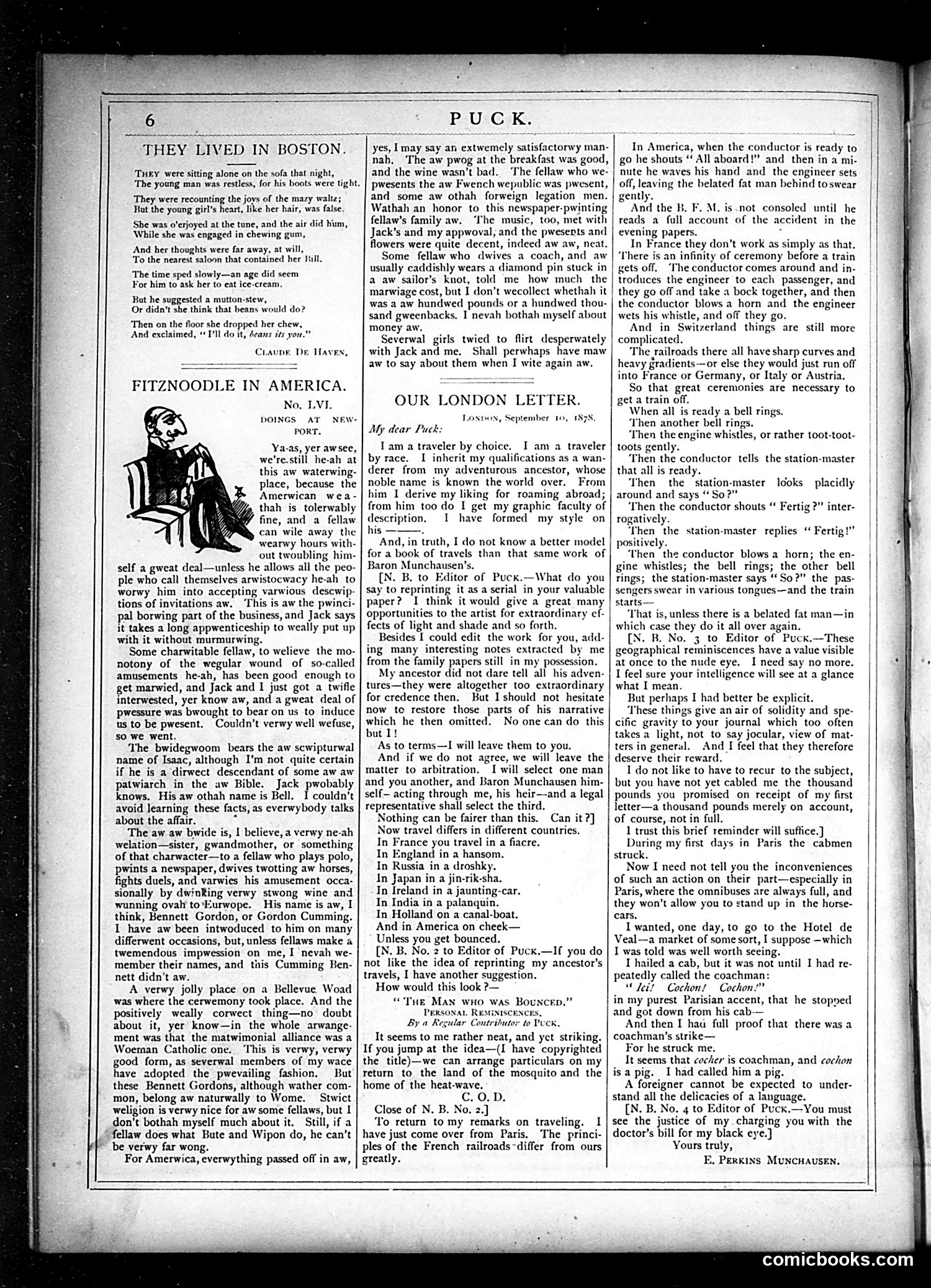
This cartoon depicts a portly gentleman identified as "Fitznoodle," apparently a British visitor to America. The satirical piece mocks British travelers' pretensions and cultural attitudes toward the United States. The text indicates Fitznoodle claims aristocratic credentials ("I inherit my qualifications as a wanderer from my adventurous ancestor") and positions himself as a sophisticated observer of American life. The humor targets both British snobbery toward America and the self-aggrandizing travel narratives popular among European visitors of the era. The accompanying "London Letter" section continues satirizing transatlantic cultural differences—contrasting French, British, and American customs regarding trains, carriages, and social conduct—suggesting Puck's consistent theme: mocking Old World pretension when confronted with American practicality.
📄 Transcribed text from this page (OCR, searchable)
Machine-transcribed from the original scan — historical spelling and the odd misread are preserved.
6 THEY LIVED IN BOSTON. ‘Tuxy were sitting alone on the sofa that night, The young man was restless, for his boots were tight. They were recounting the joys of the mazy waltz; But the young girl's heart, like her hair, was false. She was o'erjoyed at the tune, and the air did hum, While she was engaged in chewing gum, And her thoughts were far away, at will, To the nearest saloon that contained her Ill. The time sped slowly—an age did seem For him to ask her to eat ice-cream. But he suggested a mutton-stew, Or didn’t she think that beans would do? ‘Then on the floor And exclaimed, she dropped her chew, Till do it, deans its you.” Chaupe De Haves, FITZNOODLE IN AMERICA. o, LVI. DOINGS AT PORT. NEW: Ya-as, yer awsee, we're.still he-ah at this aw waterwing- place, because the Amerwican wea- thah is tolerwably fine, and a fellaw can wile away the wearwy hours with- out twoubling him- self a gweat deal—unless he allows all the peo- ple who call themselves arwistocwacy he-ah to worwy him into accepting varwious descwip- tions of invitations aw. ‘This is aw the pwinci- pal borwing part of the business, and Jack says it takes a long appwenticeship to weally put up with it without murmurwing. Some charwitable fellaw, to welieve the mo- notony of the wegular wound of so-called amusements he-ah, has been good enough to get marwied, and Jack and I just got a twifle interwested, yer know aw, and a gweat deal of pwessure was bwought to bear on us to induce us to be pwesent. Couldn’t verwy well wefuse, so we went. The bwidegwoom bears the aw scwipturwal name of Isaac, although I'm not quite certain if he is a dirwect descendant of some aw aw patwiarch in the aw Bible. Jack pwobably knows. His aw othah name is Bell. 1 couldn’t avoid learning these facts, as everwybody talks about the affair. % The aw aw bwide is, I believe, a verwy ne-ah welation—sister, gwandmother, or something of that charwacter—to a fellaw who plays polo, pwints a newspaper, dwives twotting aw horses, fights duels, and varwies his amusement occa- sionally by dwinking verwy stwong wine and wunning oval to'Eurwope. His name is aw, I think, Bennett Gordon, or Gordon Cumming. I have aw been intwoduced to him on many differwent occasions, but, unless fellaws make a twemendous impwession on me, I nevah we- member their names, and this Cumming Ben- nett didn’t aw. A verwy jolly place on a Bellevue Woad was where the cerwemony took place. And the positively weally corwect thing—no doubt about it, yer know—in the whole arwange- ment was that the matwimonial alliance was a Woeman Catholic one. ‘This is verwy, verwy good form, as severwal members of my wace have adopted the pwevailing fashion. But these Bennett Gordons, although wather com- mon, belong aw naturwally to Wome. Stwict weligion is verwy nice for aw some fellaws, but I don’t bothah myself much about it. Still, if a fellaw does what Bute and Wipon do, he can’t be verwy far wong. For Amerwica, everwything passed off in aw, PUCK. yes, I may say an extwemely satisfactorwy man- nah, The aw pwog at the breakfast was good, and the wine wasn’t bad. ‘The fellaw who we- pwesents the aw Fwench wepublic was pwesent, and some aw othah forweign legation men. Wathah an honor to this newspaper-pwinting fellaw’s family aw. ‘The music, too, met with Jack's and my appwoval, and the pwesents and flowers were quite decent, indeed aw aw, neat Some fellaw who dwives a coach, and a usually caddishly wears a diamond pin stu a aw sailor’s knot, told me how much marwiage cost, but I don’t wecollect whethah it was a aw hundwed pounds or a hundwed thou- sand gweenbacks. I nevah bothah myself about money aw. Severwal girls twied to flirt desperwately with Jack and me. Shall perwhaps have maw aw to say about them when I wite again aw. OUR LONDON LETTER. Loxpox, September 10, 1878. My dear Puck: Iam a traveler by choice. I am a traveler by race. I inherit my qualifications as a wan- derer from my adventurous ancestor, whose noble name is known the world over. From him I derive my liking for roaming abroad; from him too do I get my graphic faculty of description. I have formed my style on his ———. And, in truth, I do not know a better model for a book of travels than that same work of Baron Munchausen’s. [N. B. to Editor of Puck.—What do you say to reprinting it as a serial in your valuable paper? I think it would give a great many opportunities to the artist for extraordinary cf- fects of light and shade and so forth. Besides I could edit the work for you, add- ing many interesting notes extracted by me from the family papers still in my possession. My ancestor did not dare tell all his adven- tures—they were altogether too extraordinary for credence then. But I should not hesitate now te restore those parts of his narrative which he then omitted. No one can do this but I! As to terms—lI will leave them to you. And if we do not agree, we will leave the matter to arbitration. I will select one man and you another, and Baron Munchausen him- self— acting through me, his heir—and a legal representative shall select the third. Nothing can be fairer than this. Can it ?] Now travel differs in different countries. In France you travel in a fiacre. In England in a hansom. In Russia in a droshky. In Japan in a jin-rik-sha. In Ireland in a jaunting-car. In India in a palanquin. In Holland on a canal-boat. And in America on cheek— Unless you get bounced. [N. B. No, 2 to Editor of Puck.—If you do not like the idea of reprinting my ancestor’s travels, I have another suggestion. How would this look ?— “Tue Man wo was Bounce.” PERSONAL REMINISCENCES, By a Regular Contributor to Peck. It seems to me rather neat, and yct striking. If you jump at the idea—(I have ‘copyrighted the title)—we can arrange particulars on my return to the land of the mosquito and the home of the heat-wave. Cc. 0. D. Close of N. B. No. 2.] ‘To return to my remarks on traveling. 1 have just come over from Paris. The princi- ples of the French railroads-differ from ours greatly. the | In America, when the conductor is ready to go he shouts “ All aboard!” and then in a mi- nute he waves his hand and the engineer sets off, leaving the belated fat man behind to swear gently. And the B. F reads a full a evening papers. In France they don’t work as simply as that. ‘There is an infinity of ceremony before a train gets off. ‘The conductor comes around and in- troduces the engineer to each passenger, and they go off and take a bock together, and then the conductor blows a horn and the engineer wets his whistle, and off they go. And in Switzerland things are still more complicated. The railroads there all have sharp curves and heavy gradients—or else they would just run off into France or Germany, or Italy or Austria. So that great ceremonies are necessary to get a train off. When all is ready a bell rings. ‘Then another bell rings. ‘Then the engine whistles, or rather toot-toot- toots gently. ‘Then the conductor tells the station-master that all is ready. ‘Then the station-master around and says “So?” ‘Then the conductor shouts “ Fertig?” inter- rogatively. then the station-master replies ‘ Fertig!” positively. ‘Then the conductor blows a horn; the en- gine whistles; the bell rings; the other bell rings; the station-master says “So?” the pas- sengers swear in various tongues—and the train arts— ‘That is, unless there is a belated fat man—in which case they do it all over again [N. B. No. 3 to Editor of Puck.—These geographical reminiscences have a value visible at once to the nude eye. I need say no more. I feel sure your intelligence will see at a glance what I mean. But perhaps I had better be explicit. ‘These things give an air of solidity and spe- cific gravity to your journal which too often takes a light, not to say jocular, view of mat- ters in general. And _I feel that they therefore deserve their reward, I do not like to have to recur to the subject, but you have not yet cabled me the thousand pounds you promised on receipt of my first letter—a thousand pounds merely on account, of course, not in full. 1 trust this brief reminder will suffice.) During my first days in Paris the cabmen struck. Now I need not tell you the inconveniences of such an action on their part—especially in Paris, where the omnibuses are always full, and they won’t allow you to stand up in the horse- cars. I wanted, one day, to go to the Hotel de Veal—a market of some sort, I suppose —which I was told was well worth seeing. Thailed a cab, but it was not until I had re- peatedly called the coachman: “Tei! Cochon! Cochon!” in my purest Parisian accent, that he stopped and got down from his cab— And then I had full proof that there was a coachman’s strike— For he struck me. It seems that cocher is coachman, and cochon isa pig. I had called him a pig. A foreigner cannot be expected to under- stand all the delicacies of a language. LN. B. No, 4 to Editor of Puck.—You must see the justice of my charging you with the doctor’s bill for my black eye.] Yours truly, E. Perkins MuncHAUsEN, M. isnot consoled until he count of the accident in the looks _placidly comicbooks.com