
Puck, 1878-09-25 · page 3 of 16
Puck — September 25, 1878 — page 3: what you’re looking at
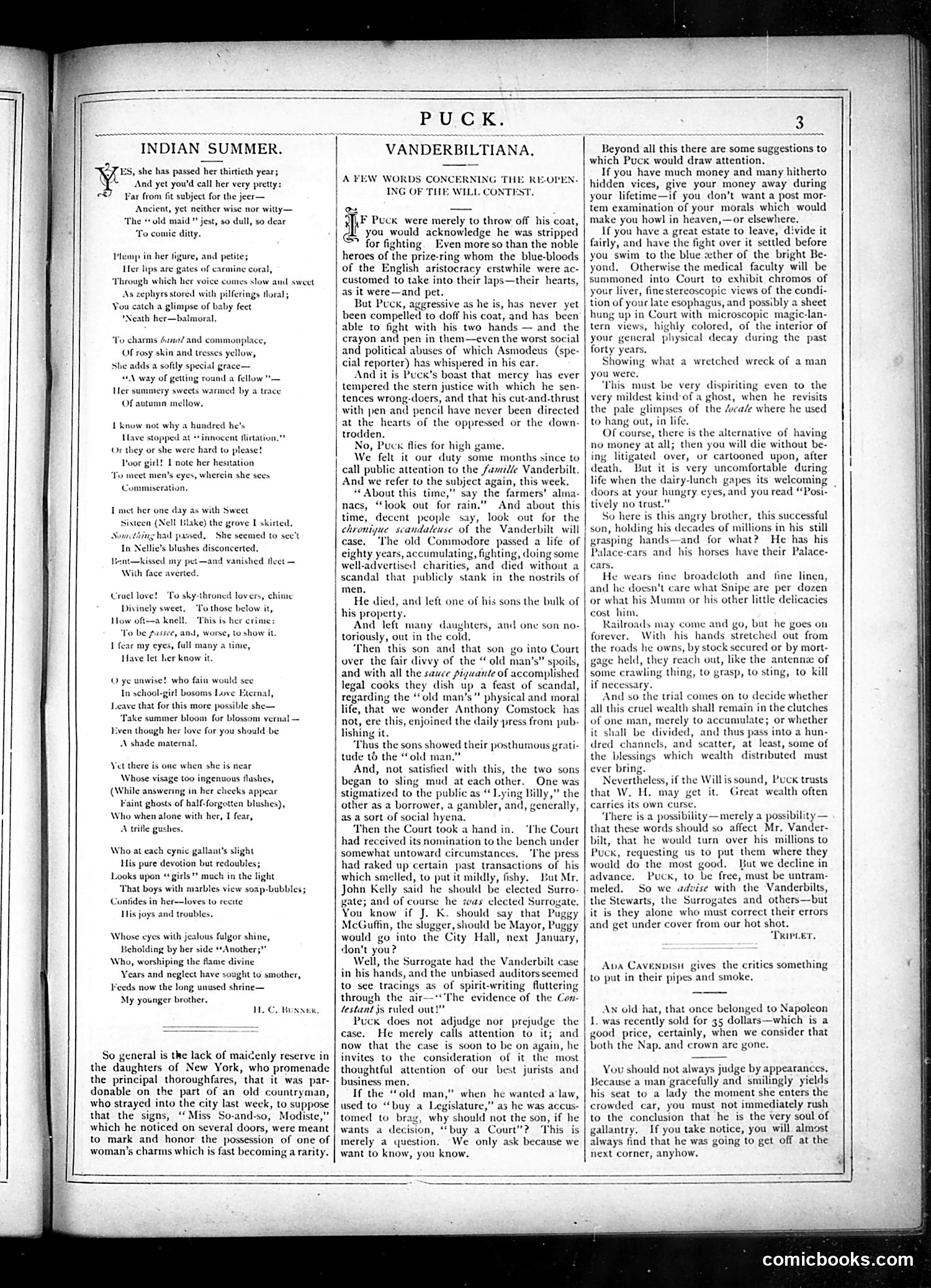
What you’re looking at
This page contains three distinct sections: 1. **"Indian Summer"** (left): A poem by H.C. Bunner celebrating the season, with no apparent political satire. 2. **"Vanderbiltiana"** (center): A satirical article mocking the Vanderbilt family's legal disputes. It references the "Surrogate Court" case involving "the old man" (likely Cornelius Vanderbilt) and his sons' contested will. The satire criticizes excessive wealth concentration and the family's costly litigation, suggesting their disputes highlight broader class inequalities. References to "Lying Billy" and other family members' scandals are mentioned. 3. **"Aux Cavendish"** (right): A brief note about acquiring Napoleon-related items, likely advertisement-adjacent content. The primary satire targets wealthy elites using their private disputes as commentary on American inequality.
📄 Transcribed text from this page (OCR, searchable)
Machine-transcribed from the original scan — historical spelling and the odd misread are preserved.
INDIAN SUMMER. S, she has passed her thirtieth year; And yet you'd call her very pretty: Far from fit subject for the jeer— Ancient, yet neither wise nor witty— ‘The “old maid” jest, so dull, so dear To comic ditty. Vamp in her figure, and petite; Her lips are gates of carmine coral, ‘Through which her voice comes slow and sweet As zephyrs stored with pilferings floral; You catch a glimpse of baby feet 'Neath her—balmoral. ‘To charms dne/ and commonplace, Of rosy skin and tresses yellow, she adds a softly special grace— “«.\ way of getting round a fellow "— Her summery sweets warmed by a trace Of autumn mellow, I know Hay ot why a hundred he's stopped at +innoe Or they of she were hard to pl Poor girl! I note her h ‘To meet men’s eyes, wherein she sees station Commiseration. met her one day as with Sweet Sixteen (Nell Ijlake) the grove I skirted. mcthing haat passed, She seemed to sec’t In Nellie’s blushes disconcerted. nt—kissed my pet — With face averted. ind vanished fleet — Cruel love! To sky-throned lov ers, chime Divinely sweet, ‘To those below it, How oft—a knell. ‘This is her crime: ‘Yo be passe, and, worse, to show it. I fear my eyes, full many a time, Mave let her know it. © ye unwise! who fain would see In school-girl bosoms Love Eternal, ¢ that for this more possible she— Take summer bloom for blossom vernal — Even though her love for you should be <A shade maternal. Yet there is one when she is near Whose visage too ingenuous flushes, (While answering in her cheeks appear Faint ghosts of half-forgetten blushes), Who when alone with her, I fear, A trifle gushes. Who at each cynic gallant’s slight His pure devotion but redoubles; Looks upon * girls’ much in the light ‘That boys with marbles view soap-bubbles; Contides in her—loves to recite is joys and troubles, Whose eyes with jealous fulgor shine, Heholding by her side “Another; Who, worshiping the flame divine Years and neglect have sought to smother, Feeds now the long unused shrine— My younger brother. H.C. Buxsex So general is the lack of maicenly reserve in the daughters of New York, who promenade the principal thoroughfares, that it was par- donable on the part of an old countryman, who strayed into the city last week, to suppose that the signs, ‘‘ Miss So-and-so, Modiste,” which he noticed on several doors, were meant to mark and honor the possession of one of woman's charms which is fast becoming a rarity. tempered the stern justice with which he sen- | trodden. | scandal that publicly stank in the nostrils of PUCK. VANDERBILTIANA, A FEW WORDS CONCERNING THE RE-OPE ING OF THE WILL CONTEST. eo 5 f) F Puck were merely to throw off his coat, Al you would acknowledge he was stripped ” for fighting. Even more so than the noble heroes of the prize-ring whom the blue-bloods of the English aristocracy erstwhile were ac- customed to take into their laps—their hearts, as it were—and pet. | But Puck, aggressive as he is, has never yet been compelled to doff his coat, and has been able to fight with his two hands — and the crayon and pen in them—even the worst social and political abuses of which Asmodeus (spe- cial reporter) has whispered in his ear. And it is Puck's boast that mercy has ever tences wrong-doers, and that his cut-and-thrust with pen and pencil have never been directed at the hearts of the oppressed or the down. No, Puck flies for high game. We felt it our duty some months since to call public attention to the famil/e Vanderbilt. And we refer to the subject again, this week. “About this time,” say the farmers’ alma- nacs, “look out for rain.” And about this time, decent people say, look out for the chronique scandaleuse of the Vanderbilt will case. ‘The old Commodore passed a life of eighty years, accumulating, fighting, doing some well-advertised charities, and died without a men, He died, and left one of his sons the bulk of his property. And left many daughters, and one son no- toriously, out in the cold. ‘Then this son and that son go into Court over the fair divvy of the “ old man’s” spoils, and with all the sauce piguante of accomplished legal cooks they dish up a feast of scandal, regarding the “old man's” physical and moral life, that we wonder Anthony Comstock has not, ere this, enjoined the daily press from pub- lishing it. ‘Thus the sons showed their posthumous grati- tude td the “old man,” And, not satisfied with this, the two sons began to sling mud at each other. One was stigmatized to the public as “ Lying Billy,” the other as a borrower, a gambler, and, generally, as a sort of social hyena, Then the Court took a hand in. ‘The Court had reccived its nomination to the bench under somewhat untoward circumstances, ‘Ihe press had raked up certain past transactions of his which smelled, to put it mildly, fishy. But Mr. John Kelly said he should be elected Surro gate; and of course he was elected Surrogate. | You know if J. K. should say that Puggy McGuffin, the slugger, should be Mayor, Puggy would go into the City Hall, next January, don’t you? Well, the Surrogate had the Vanderbilt case in his hands, and the unbiased auditors seemed to see tracings as of spirit-writing fluttering through the air—**The evidence of the Con- testant js ruled out Puck does not adjudge nor prejudge the case. He merely calls attention to it; and now that the case is soon to be on again, he invites to the consideration of it the most thoughtful attention of our best jurists and business men. If the “old man,” when he wanted a’law, used to “buy a Legislature,” as he was accus- tomed to brag, why should not the son, if he wants a decision, ‘buy a Court’? This is merely a question. We only ask because we want to know, you know. Beyond all this there are some suggestions to which Puck would draw attention. If you have much money and many hitherto | hidden vices, give your money away during your lifetime—if you don't want a post mor- tem examination of your morals which would make you howl in heaven,—or elsewhere. If you have a great estate to leave, divide it fairly, and have the fight over it settled before you swim to the blue wther of the bright Be- yond. Otherwise the medical faculty will be summoned into Court to exhibit chromos of our liver, finestereoscopic views of the condi- ion of your late esophagus, and possibly a sheet hung up in Court with microscopic magic-lan- tern views, highly colored, of the interior of your general physical decay during the past forty years, Showin, you were, ‘This must be very dispiriting even to the very mildest kindof a ghost, when he revisits the pale glimpses of the /oca/e where he used to hang out, in life. Of course, there is the alternative of having no money at all; then you will die without be- ing litigated over, or cartooned upon, after death. But it is very uncomfortable during life when the dairy-lunch gapes its welcoming doors at your hungry eyes, and you read “Posi- tively no trust.” So here is this angry brother, this successful son, holding his decades of millions in his still grasping hands—and for what? He has his Palace-cars and his horses have their Palace- cars. He wears fine broadcloth and fine linen, and he doesn’t care what Snipe are per dozen or what his Mumm or his other little delicacies cost him. Railroads may come and go, but he goes on forever. With his hands stretched out from the roads he owns, by stock secured or by mort- gage held, they reach out, like the antennx of some crawling thing, to grasp, to sting, to kill if necessary. And so the trial comes on to decide whether Ul this cruel wealth shall remain in the clutches of one man, merely to accumulate; or whether it shall be divided, and thus pass into a hun- dred channels, and scatter, at least, some of the blessings which wealth distributed must ever bring Nevertheless, if the Willis sound, Puck trusts that W. H. may get it. Great wealth often carries its own curse ‘There is a possibility—merely a possibility that these words should so affect Mr. Vander- bilt, that he would turn over his millions to Puck, requesting us to put them where they would do the most good. But we decline in advance. Puck, to be free, must be untram- meled. So we advise with the Vanderbilts, the Stewarts, the Surrogates and others—but what a wretched wreck of a man | it is they alone who must correct their errors and get under cover from our hot shot. TRIPLET. Apa Cave to put in thei bIsH gives the critics something pipes and smoke. Ax old hat, that once belonged to Napoleon 1. was recently sold for 35 dollars—which is a good price, certainly, when we consider that both the Nap. and crown are gone. You should not always judge by appearances. Because a man gracefully and smilingly yields his seat to a lady the moment she enters the crowded car, you must not immediately rush to the conclusion that he is the very soul of gallantry. If you take notice, you will almost always find that he was going to get off at the next corner, anyhow. comicbooks.com