
Puck, 1878-09-25 · page 11 of 16
Puck — September 25, 1878 — page 11: what you’re looking at
What you’re looking at
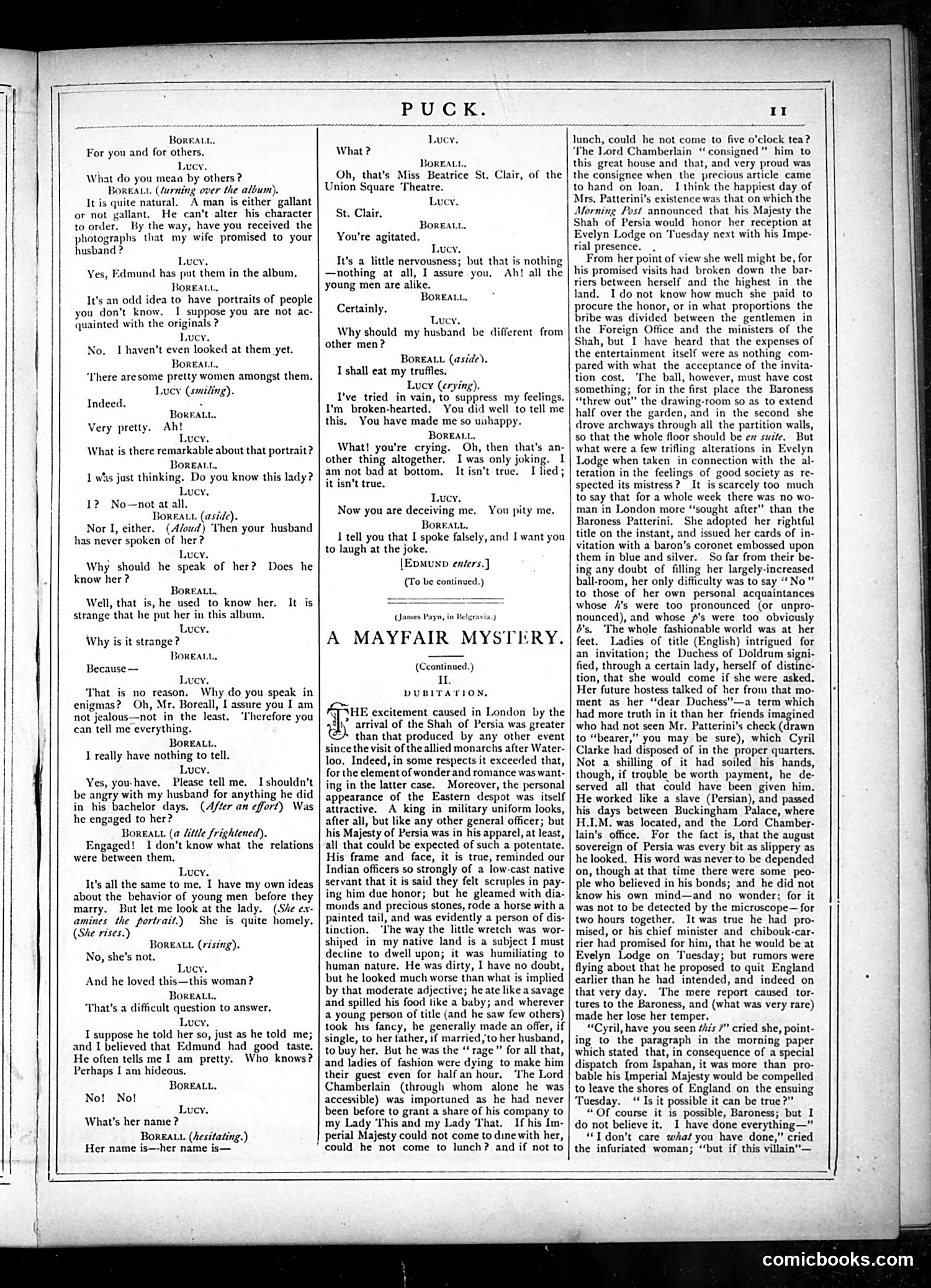
This page contains dialogue from a theatrical sketch called "A Mayfair Mystery" (continued from a previous section). The conversation involves characters named Boreall, Lucy, and Edmund discussing a scandal involving the Shah of Persia's visit to London. The satire centers on **social embarrassment and aristocratic pretension**: characters debate whether to acknowledge acquaintance with a woman of questionable reputation, and whether her presence will damage their social standing during an important diplomatic visit. The specific reference to the Shah of Persia appearing in London suggests this relates to an actual historical state visit that created social complications—likely involving questions of which society figures would be presented at court and which relationships were "acceptable" to acknowledge publicly. The humor exploits Victorian anxieties about propriety and status.
📄 Transcribed text from this page (OCR, searchable)
Machine-transcribed from the original scan — historical spelling and the odd misread are preserved.
Borat For you and for others. Lucy, What do you mean by others? BOREALI. (turning over the album). It is quite natural. A man is either gallant or not gallant. He can’t alter his character to order. By the way, have you received the photographs that my wife promised to your husband ? Lucy. Yes, Edmund has put them in the album. Horear, It’s an odd idea to have portraits of people you don’t know. I suppose you are not ac- quainted with the originals ? Lucy. No. I haven’t even looked at them yet. BoREALt, ‘There aresome pretty women amongst them. Lucy (smiling). Indeed. . Borrauu. Very pretty. Ah! Lucy. What is there remarkable about that portrait? Boreatt. ust thinking. Do you know this lady? Lucy. 1? No—not at all. Boreatt (aside). Nor I, either. (Aloud) Then your husband has never spoken of her? . Lucy. Why should he speak of her? Does he know her? Twas Boreaut. Well, that is, he used to know her. strange that he put her in this album, It is Lucy, Why is it strange? Boreann. Because — Lucy. ‘That is no reason. Why do you speak in enigmas? Oh, Mr. Boreall, { assure you I am not jealous—not in the least. ‘Therefore you can tell me everything. BoREALL, I really have nothing to tell. Lucy. Yes, you-have. Please tell me. I shouldn't be angry with my husband for anything he did in his bachelor days. (After an effort) Was he engaged to her? Boreatt (a little frightened). Engaged! 1 don’t know what the relations were between them. Lucy. It’s all the same to me, I have my own ideas about the behavior of young men before they marry. But let me look at the lady. (She ex- amines the portrait.) She is quite homely. (She rises.) Boreatt (rising). No, she’s not. Lucy, And he loved this—this woman? Boreati, ‘That’s a difficult question to answer. Lucy, I suppose he told her so, just as he told me; and I believed that Edmund had good taste, He often tells me I am pretty. Who knows? Perhaps I am hideous, Bore, No! No! Lucy. What's her name ? Boreat (hesitating.) Her name is—-her name is— PUCK. Lucy. What ? Boreat Oh, that’s Miss Beatrice St. Clair, of the Union Square ‘Theatre. Lucy. St. Clair, Boreatt. You're agitated. Lucy. It's a little nervousness; but that is nothing —nothing at all, I assure you. Ah! all the young men are alike. Boreau. Certainly. Lucy. Why should my husband be different from other men? Boreatt (aside). I shall eat my truffles. Lucy (crying). I've tried in vain, to’ suppress my feelings. I'm broken-hearted. You did well to tell me this, You have made me so unhappy. BoREALL. What! you're crying. Oh, then that’s an- other thing altogether. I was only joking. I am not bad at bottom. It isn’t true. I lied; it isn’t true. Lucy. Now you are deceiv Boreatt, I tell you that I spoke falsely, and I want you to laugh at the joke. [Epaunp enters.] You pity me. ig me. (To be continued.) A MAYFAIR MYSTERY. (Ccontinued.) IL. DUBITATION, HE excitement caused in London by the ‘ili? arrival of the Shah of Persia was greater @ than that produced by any other event since the visit of the allied monarchs after Water- loo, Indeed, in some respects it exceeded that, for the element of wonder and romance was want- ing in the latter case. Moreover, the personal appearance of the Eastern despot was itself attractive. A king in military uniform looks, after all, but like any other general officer; but his Majesty of Persia was in his apparel, at least, all that could be expected of such a potentate. His frame and face, it is true, reminded our Indian officers so strongly of a low-cast native servant that it is said they felt scruples in pay- ing him due honor; but he gleamed with dia- monds and precious stones, rode a horse with a painted tail, and was evidently a person of dis- tinction, ‘I'he way the little wretch was wor- shiped in my native land is a subject I must decline to dwell upon; it was humiliating to human nature. He was dirty, I have no doubt, but he looked much worse than what is implied by that moderate adjective; he ate like a savage and spilled his food like a baby; and wherever a young person of title (and he saw few others) took his fancy, he generally made an offer, if single, to her father, if married,'to her husband, to buy her, But he was the “rage"’ for all that, and ladies of fashion were dying to make him their guest even for half an hour. ‘The Lord Chamberlain (through whom alone he was accessible) was importuned as he had never been before to grant a share of his company to my Lady ‘This and my Lady That. If his Im- perial Majesty could not come to dine with her, could he not come to lunch? and if not to It lunch, could he not come to five o'clock tea? ‘The Lord Chamberlain “consigned” him to this great house and that, and very proud was the consignee when the precious article came to hand on loan. I think the happiest day of Mrs, Patterini’s existence was that on which the Morning Post announced that his Majesty the Shah of Persia would honor her reception at Evelyn Lodge on ‘Tuesday next with his Impe- rial presence. From her point of view she well might be, for his promised visits had broken down the bar- riers between herself and the highest in the land. Ido not know how much she paid to procure the honor, or in what proportions the bribe was divided between the gentlemen in the Foreign Office and the ministers of the Shah, but I have heard that the expenses of the entertainment itself were as nothing com- pared with what the acceptance of the invita- tion cost. ‘The ball, however, must have cost something; for in the first place the Baroness “threw out” the drawing-room so as to extend half over the garden, and in the second she drove archways through all the partition so that the whole floor should be ev suit what were a few trifling alterations in Evelyn Lodge when taken in connection with the al- teration in the feelings of good society as re- spected its mistress? It is scarcely too much to say that for a whole week there was no wo- man in London more “sought after” than the Baroness Patterini, She adopted her rightful title on the instant, and issued her cards of in- vitation with a baron’s coronet embossed upon them in blue and silver. So far from their be- ing any doubt of filling her largely-increased bail-room, her only difficulty was to say “*No” to those of her own personal acquaintances whose /’s were too pronounced (or unpro- nounced), and whose /’s were too obviously 6's, The whole fashionable world was at her feet. Ladies of title (English) intrigued. for an invitation; the Duchess of Doldrum signi- fied, through a certain lady, herself of distine- tion, that she would come if she were asked. Her future hostess talked of her from that mo- ment as her ‘dear Duchess’—a term which had more truth in it than her friends imagined who had not seen Mr. Patterini’s check (drawn to “bearer,” you may be sure), which Cyril Clarke had disposed of in the proper quarters, Not a shilling of it had soiled his hands, though, if trouble be worth payment, he de- served all that could have been given him. He worked like a slave (Persian), and passed his days between Buckingham Palace, where H.I.M. was located, and the Lord Chamber- lai office. For the fact is, that the august sovereign of Persia was every bit as slippery as he looked. His word was never to be depended on, though at that time there were some peo- ple who believed in his bonds; and he did not know his own mind—and no wonder; for it was not to be detected by the microscope—for two hours together, It was true he had pro- mised, or his chief minister and chibouk-car- rier had promised for him, that he would be at Evelyn Lodge on Tuesday; but rumors were flying abovt that he proposed to quit England earlier than he had intended, and indeed on that very day. The mere report caused tor- tures to the Baroness, and (what was very rare) made her lose her temper. “Cyril, have you seen /iis 7” cried she, point- ing to the paragraph in the morning paper which stated that, in consequence of a special dispatch from Ispahan, it was more than pro- bable his Imperial Majesty would be compelled to leave the shores of England on the ensuing Tuesday. ‘Is it possible it can be true?” “Of course it is possible, Baroness; but I do not believe it. I have done everything—” “I don’t care what you have done,” cried the infuriated woman; ‘‘but if this villain’— comicbooks.com