
A complete issue · 16 pages · 1878
Puck — September 11, 1878
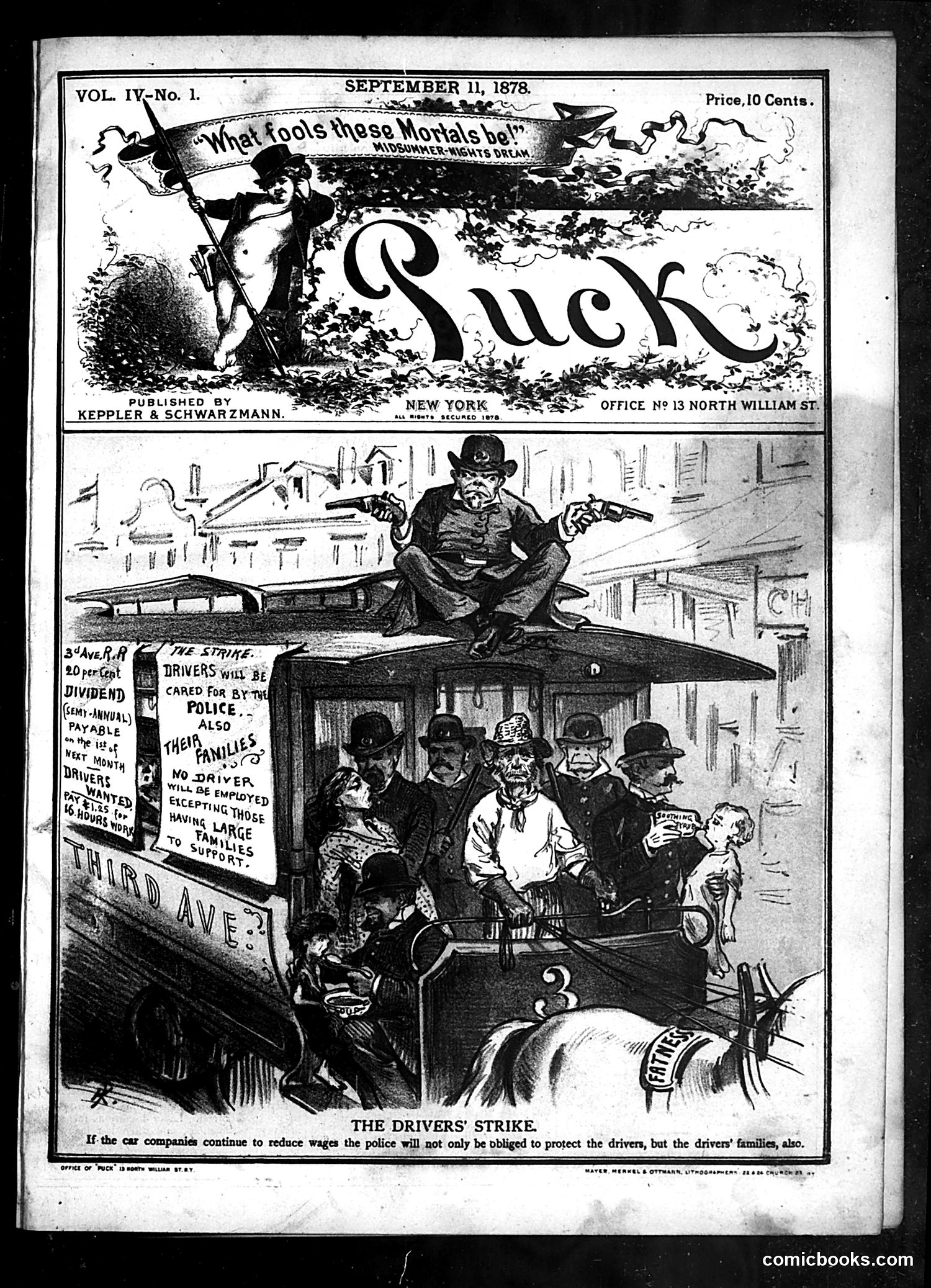
This Puck cartoon satirizes a streetcar drivers' strike in New York City. The main image shows a policeman perched atop a car full of strikebreakers and strikers' families, wielding guns to enforce operations despite the labor action. The left panel advertises a notice seeking replacement drivers willing to work 16-hour days for reduced wages—the very conditions sparking the strike. The satire's point: Puck criticizes the police's role protecting corporate interests over workers. The caption warns that if companies continue wage cuts, police won't only protect drivers but also their starving families—implying the strike represents legitimate worker desperation, not lawlessness. The cartoon takes labor's side against both employers and the state apparatus supporting them.
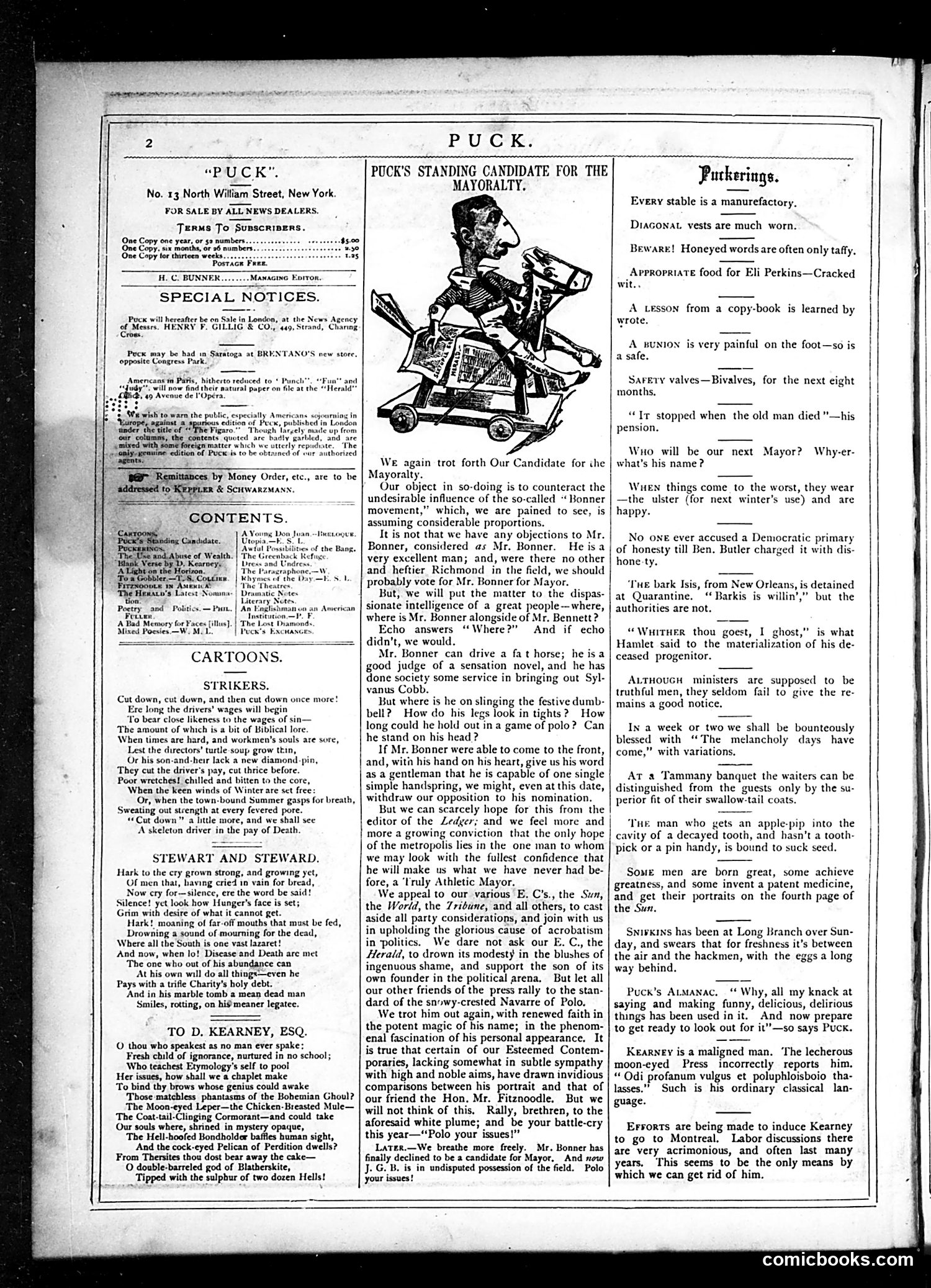
The main cartoon depicts **"Puck's Standing Candidate for the Majority"** — a grotesque caricature of a man riding what appears to be a mechanical or unstable contraption. The accompanying editorial text discusses a mayoral candidate, likely **Mr. Bonner**, critiquing his nomination despite concerns about his qualifications. The satire attacks the political machinery of the Democratic primary, questioning why Bonner is the party's choice when someone like Mr. Bennett might be more suitable. The text expresses skepticism about Bonner's actual abilities and fitness for office, sarcastically hoping he'll make a "Truly Athletic Mayor." The exaggerated, unbalanced imagery of the riding figure suggests the candidate is unstable or ridiculous — a common Puck visual metaphor for flawed political choices.
This page contains two distinct sections: **Left column ("The Use and Abuse of Wealth"):** A lengthy editorial essay criticizing wealthy philanthropists, particularly Judge Hilton, for ostentatious charity that garners public praise. The text argues their donations are self-serving and highlights the hypocrisy of the wealthy, citing examples like the "Yellow Fever Sufferers" fund and recent railroad strikes. It positions charity as a tool for reputation-building rather than genuine compassion. **Right column ("Light on the Horizon"):** A political opinion piece advocating for Mrs. Jenks's return to public life, praising her past work. The author expresses cautious optimism about improving political conditions, though uncertain about future progress. **Center section:** "Blank Verse by D. Kearney," a poem using harsh, crude language to attack capitalism, corrupt politicians, and wealthy elites—reflecting Gilded Age class tensions. The page represents Puck's satirical engagement with wealth inequality and political corruption.
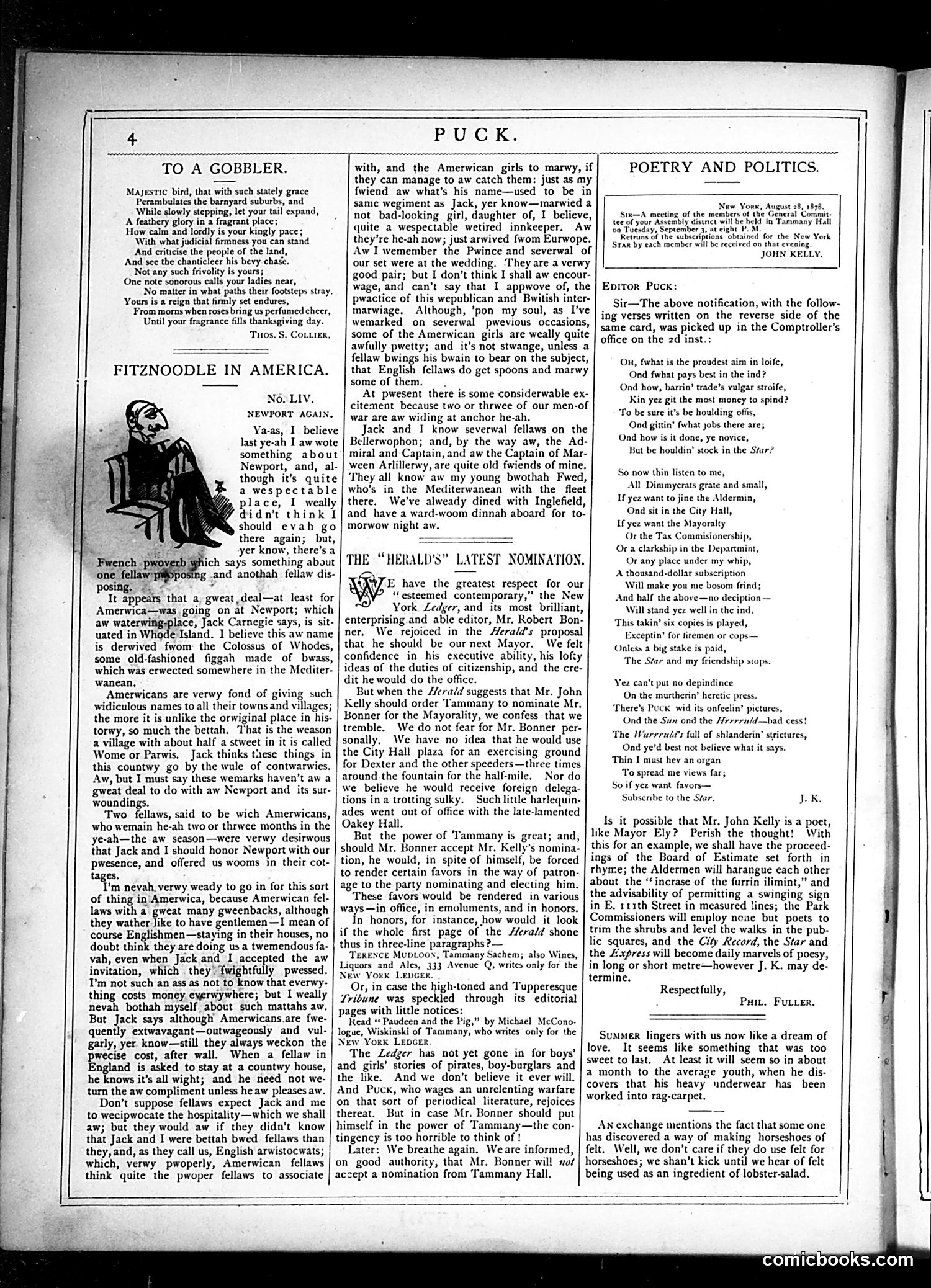
This cartoon satirizes a British visitor's naive observations about American life. "Fitznoodle" (a stock character representing an upper-class Englishman) expresses bewilderment at American customs, particularly regarding class mobility and social mixing. The text mocks his condescending surprise that working-class Americans (like "Jack") can marry respectable women and achieve social standing without inherited wealth or aristocratic connections. The satire targets British class snobbery by presenting Fitznoodle's shock at American egalitarianism as absurd. The accompanying verses reinforce this: Americans don't require titles or genealogy for respectability—a concept that apparently baffles and unsettles the rigid British social hierarchy Fitznoodle represents. The humor lies in inverting who appears foolish: the Englishman, not the democratic Americans.
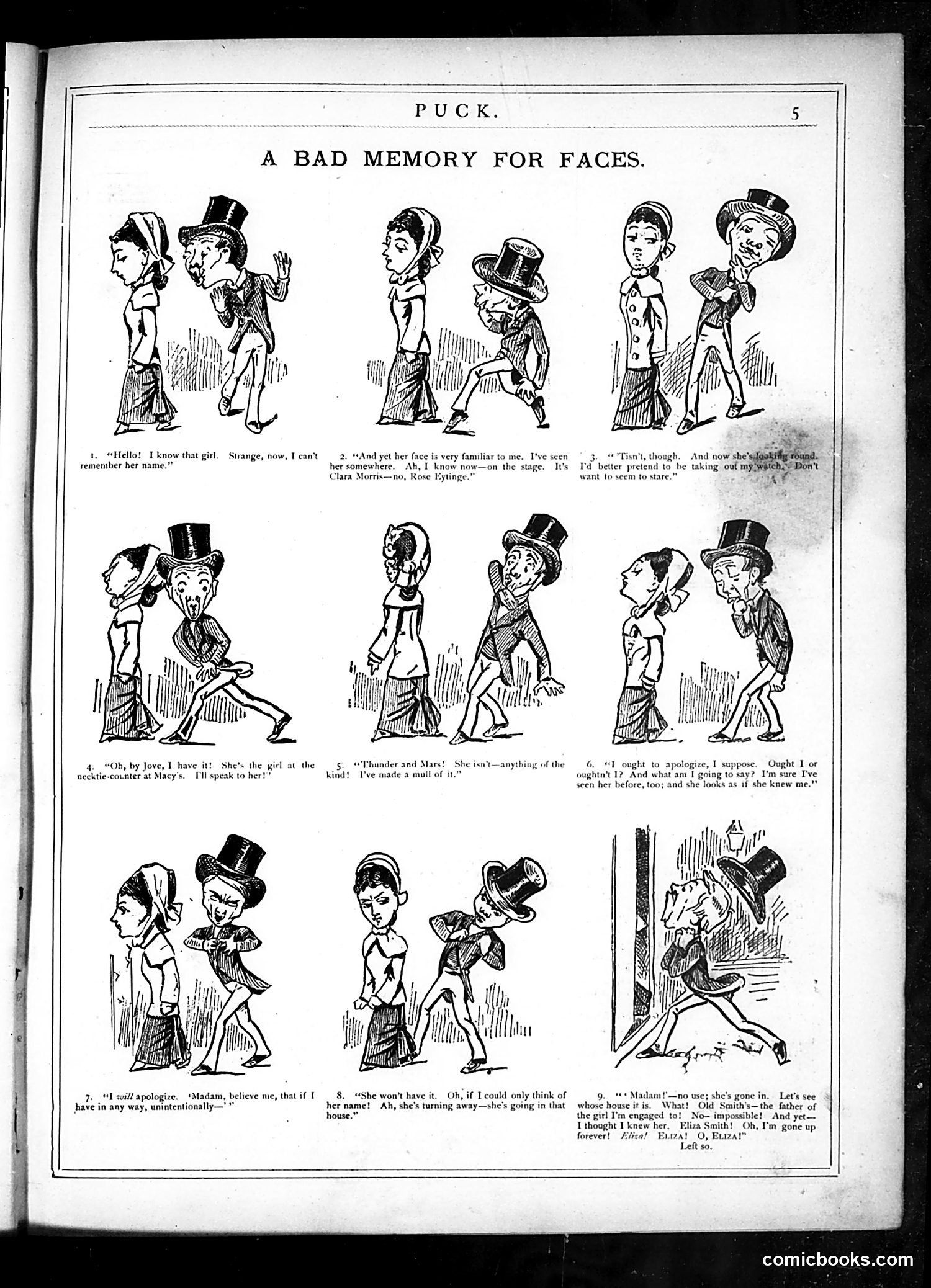
This Puck cartoon satirizes the social embarrassment of encountering someone whose name one cannot recall. The nine sequential panels show various awkward encounters between acquaintances—a man greeting a woman he claims not to remember, gentlemen encountering actresses or performers, and similar situations of mutual recognition despite claimed forgetfulness. The humor relies on the universal social anxiety of failing to remember someone's name or face. The exaggerated facial expressions and body language—the embarrassed postures, gestures of confusion, and dramatic reactions—amplify the discomfort of these encounters. While not explicitly political, it reflects Victorian-era social conventions emphasizing proper etiquette and the importance of remembering one's acquaintances in society. The cartoon satirizes both genuine forgetfulness and the social pretense of people claiming not to remember those they'd prefer to avoid.
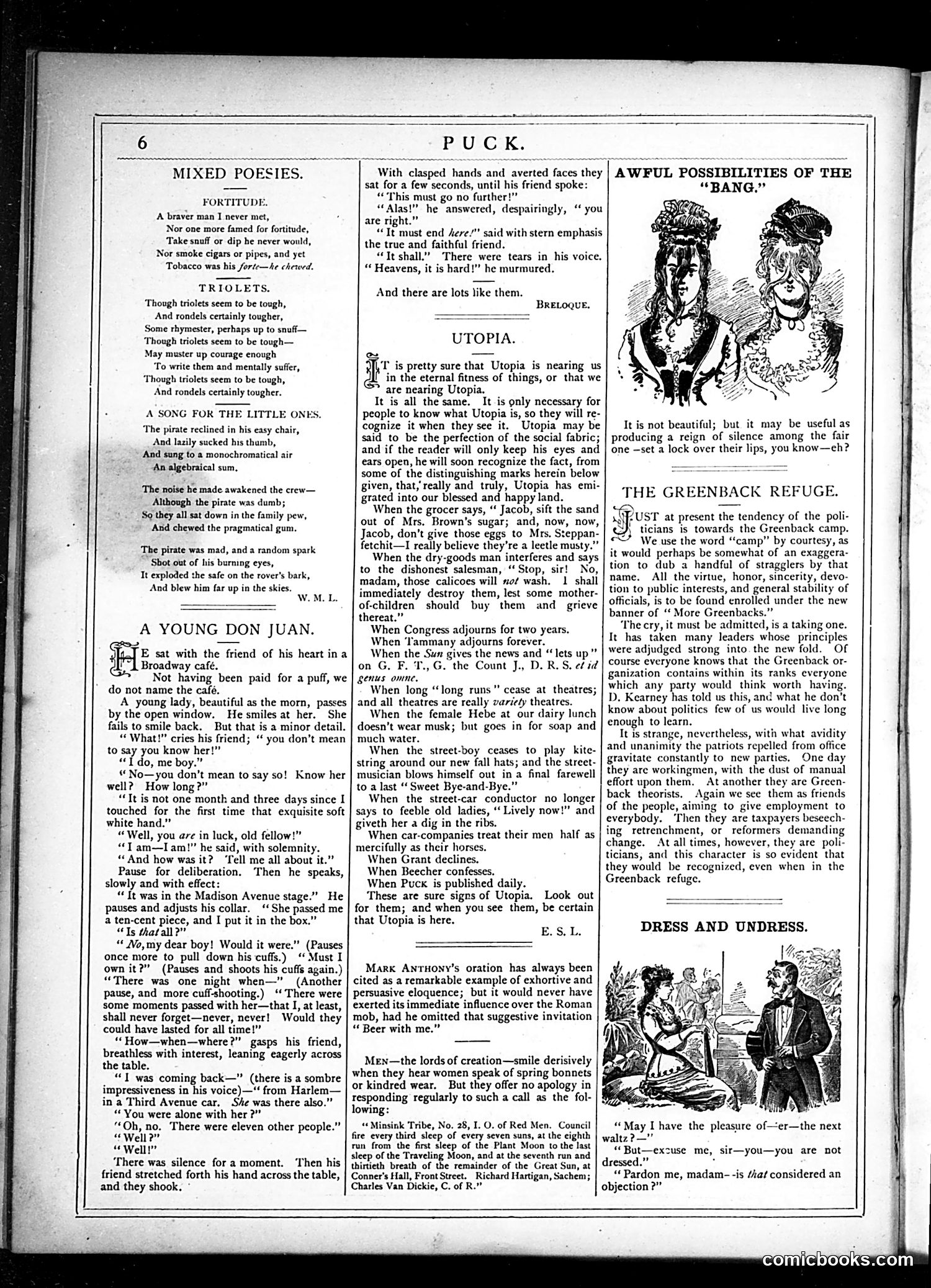
This page contains mixed satirical content rather than a single unified cartoon. **"Awful Possibilities of the 'Bang'"** (top right): A sketch mocking the recently popularized "bang" hairstyle worn by women. The exaggerated caricature shows a woman with an absurdly large, puffed fringe, suggesting the style was considered ridiculous or unflattering by Puck's editors and male-oriented audience. **Other content**: The page includes poems ("Fortitude," "Triolets") and prose pieces satirizing contemporary social issues—including commentary on Utopia, Greenback political movements, and gender relations. "A Young Don Juan" appears to mock youthful male pretension. The overall thrust reflects Puck's approach: mixing visual caricature with literary satire to mock fashion trends, political ideologies, and social pretensions of the era.
This page contains primarily **text content rather than cartoons**. The main feature is "The Paraphone: Prof. Edison's Masterpiece," a humorous essay about Thomas Edison's alleged invention of a machine that can extract humor from printed matter and reproduce it audibly. The satire targets Edison's prolific inventiveness and public reputation as a near-magical innovator. The joke assumes readers will find it absurd that Edison would waste his genius creating a device for mechanical laughter—mocking both Edison's actual lesser inventions and the era's sometimes uncritical veneration of technological progress. The page concludes with "Rhymes of the Day," unrelated verse commentary. No specific political figures or events are referenced; this is social satire about American attitudes toward technology and inventors.
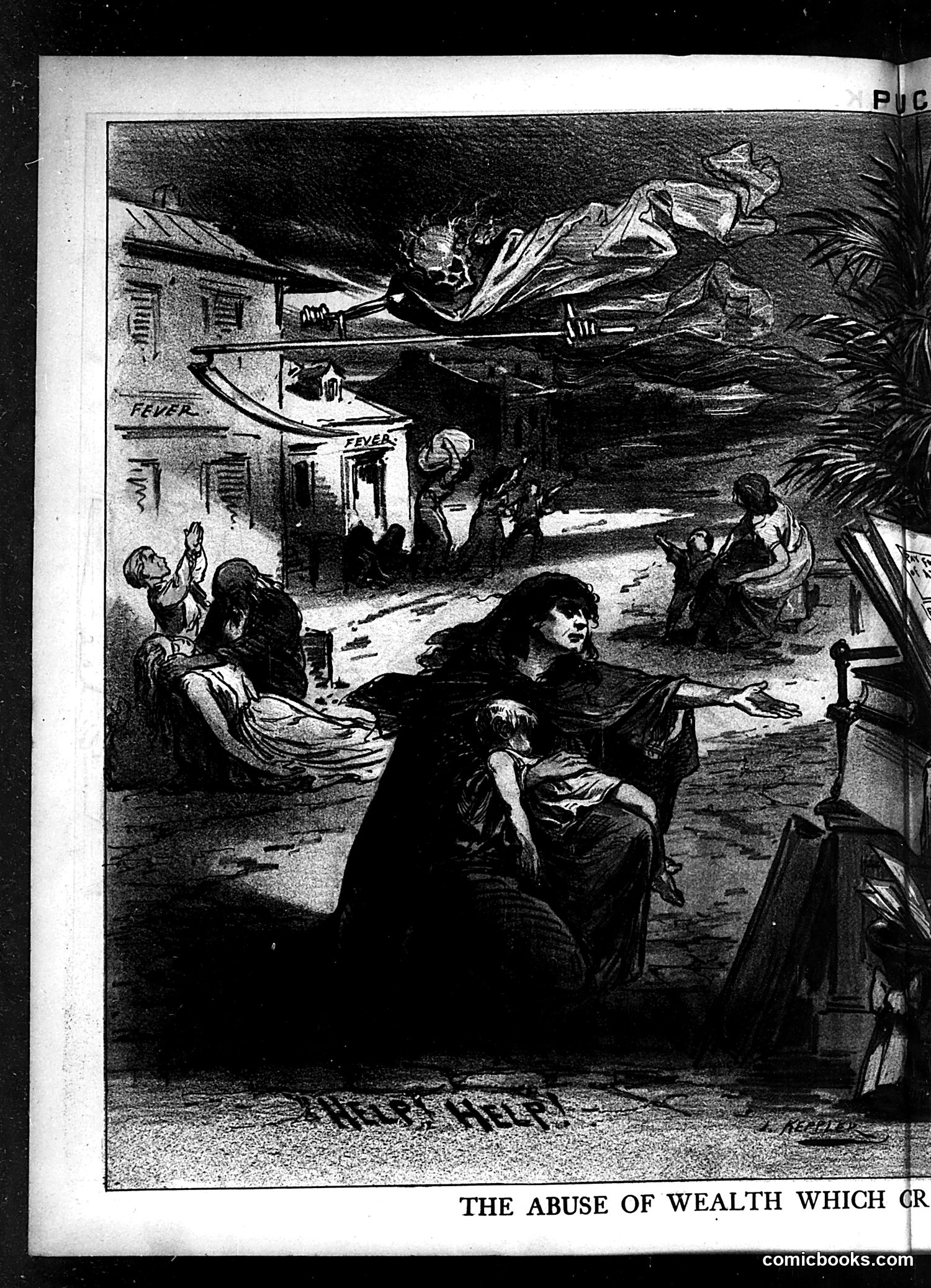
This political cartoon depicts a nighttime street scene showing wealthy individuals indifferent to human suffering. In the foreground, destitute figures—including a woman and child—appear to be begging or in distress on the street. Buildings labeled "FEVER" suggest a disease outbreak, possibly cholera or similar epidemic affecting the poor. In the sky, an angel or supernatural figure hovers, seemingly witnessing the scene. The composition contrasts the misery of the impoverished masses with the apparent wealth and privilege visible in the background. The incomplete caption suggests this critiques how wealthy people's greed or neglect contributes to urban poverty and disease. This reflects Gilded Age social commentary on the wealth gap and moral failures of the rich toward the suffering poor.
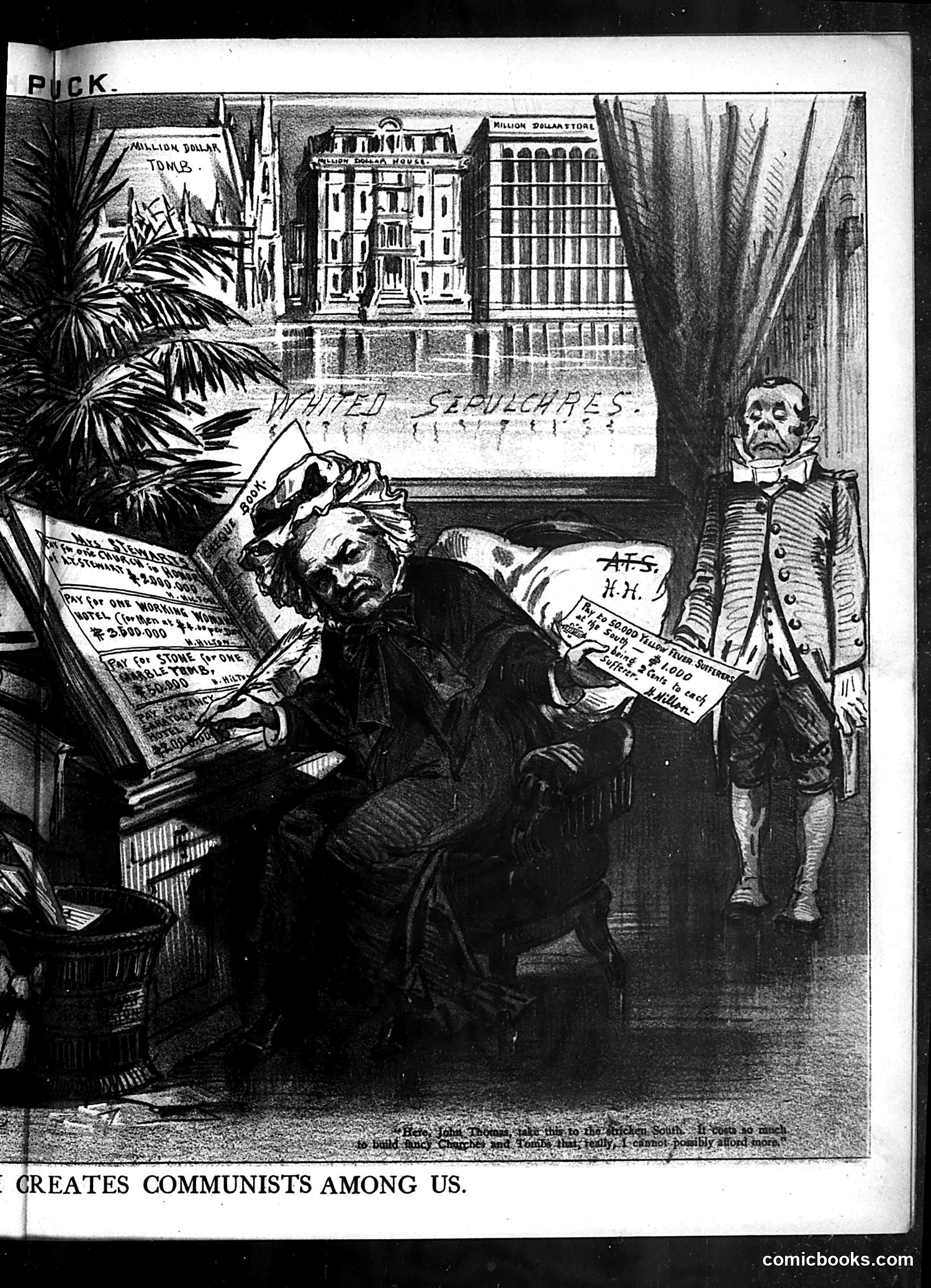
This Puck cartoon satirizes what appears to be concerns about labor conditions and radicalization. A well-dressed man examines documents labeled with references to working conditions ("ONE WORKDAY HOTEL CROWDED & FILTHY," "STONE PILE," etc.). Behind him stands a skeletal figure wearing "A.F.S. K.H." (possibly labor organization initials), representing how poor labor conditions breed communism. The cartoon critiques that terrible working environments—overcrowded housing, exploitative labor, low wages—create radical political movements among workers. The wealthy figure's apparent shock suggests the cartoon blames capitalism's harsh conditions, not ideology itself, for communism's appeal. The "Million Dollar Store" building in the background contrasts sharply with the workers' plight, emphasizing economic inequality as the true problem.
This page contains theatrical and literary criticism rather than political cartoons. The content discusses: **Theatrical Reviews**: Commentary on productions at various theaters including discussions of actors like Mary Anderson and Jenny Ward, evaluating their performances in contemporary plays. **Dramatic Notes**: Brief critiques of theatrical productions and performers' abilities. **Literary Notes**: Reviews of new publications, including a magazine called *The Theatre*, books on topics like "How to Parse," and other literary works. **"Answers for the Curious"**: A humorous advice column addressing reader questions. The page appears to be primarily editorial/critical content rather than satirical cartoons. Without visible illustrations accompanying these sections, the satire—if present—relies on written wit in the theater and book reviews rather than visual caricature.
This page contains two articles rather than political cartoons. The main piece, "An Englishman on an American Institution," discusses Sir John Lubbock's observations about American customs and social habits. The second article, "The Lost Diamonds," appears to be a fictional story about valuable gems. The content focuses on cultural commentary—an Englishman's perspective on American society and institutions—which was typical Puck fare: satirizing American customs through foreign observation. However, without visible illustrations accompanying these texts, the page appears to be primarily literary satire rather than visual cartoon commentary. The articles reflect Puck's role as a satirical publication offering social criticism through humorous essays and stories rather than primarily through drawn images on this particular page.
This page consists primarily of **text narrative rather than a political cartoon**—it appears to be a serialized story or satirical piece titled "PUCK." The narrative describes a dramatic confrontation between a narrator and a suspicious man regarding Bank of England notes. The "customer" is described with menacing physical characteristics (demonic intensity, threatening appearance), creating Gothic tension. The story involves accusations of theft and criminality, with references to "a blackleg—a card-sharper—a man of straw." The dialogue suggests social commentary about class, dishonesty, and trust in financial institutions. **Without visible illustrations accompanying this text**, the precise satirical target remains unclear, though the Bank of England reference and criminal scheming suggest commentary on financial fraud or monetary instability relevant to Puck's era.
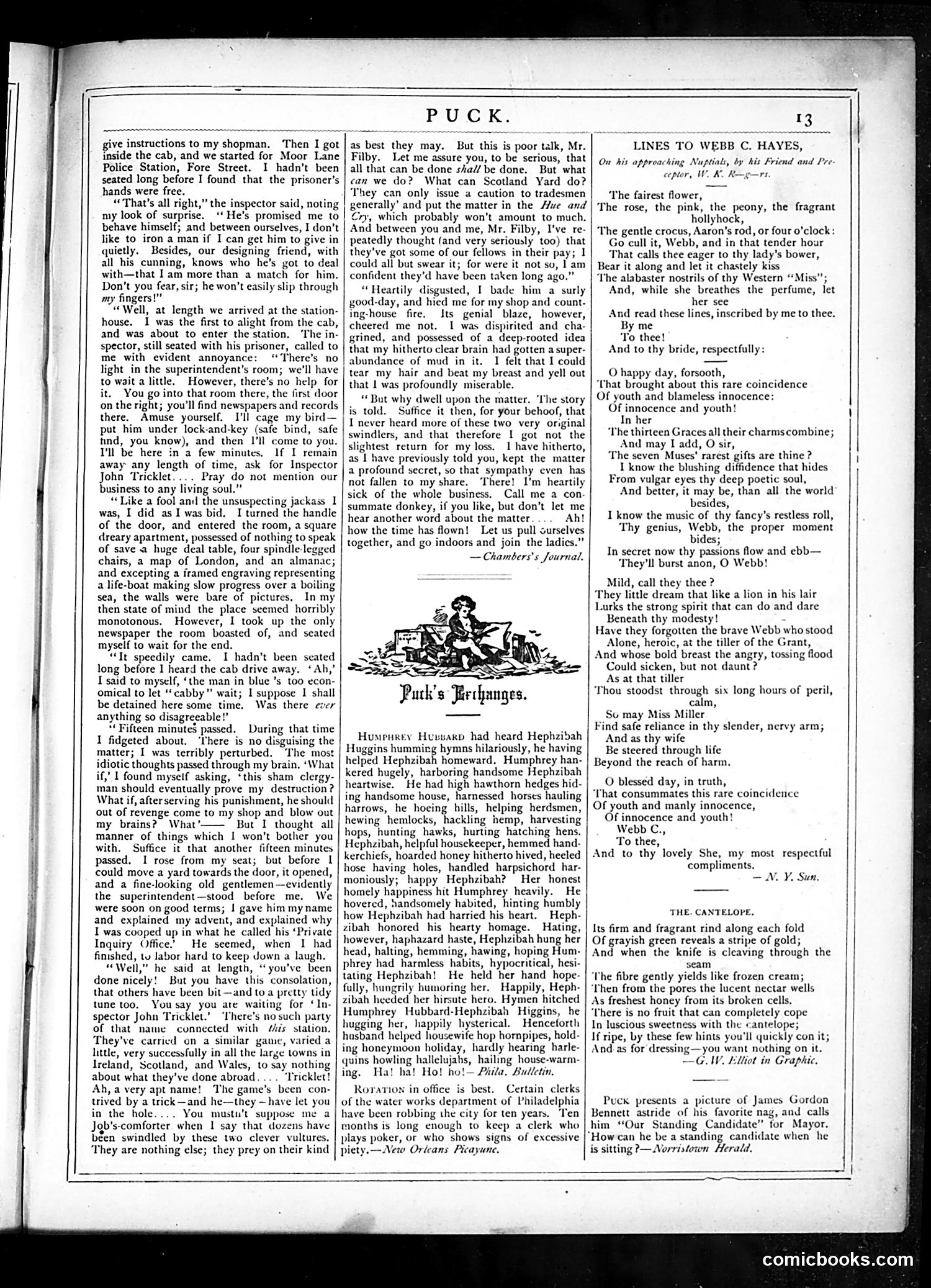
This page contains primarily literary content rather than political cartoons. The main feature is "Puck's Pickings," a satirical narrative about Humphrey Hubbard's courtship of Hephzibah Higgins. The story mocks romantic conventions through exaggerated, humorous descriptions of the couple's attributes and behavior. The page also includes several poetry submissions titled "Lines to Webb C. Hayes" and "The Cantelope," which appear to be reader contributions rather than editorial content. A small illustration at bottom shows James Gordon Bennett's satirical portrait related to his "Our Standing Candidate" for Mayor, though details are unclear from the image quality. The content reflects Puck's satirical approach to social customs and public figures of its era.
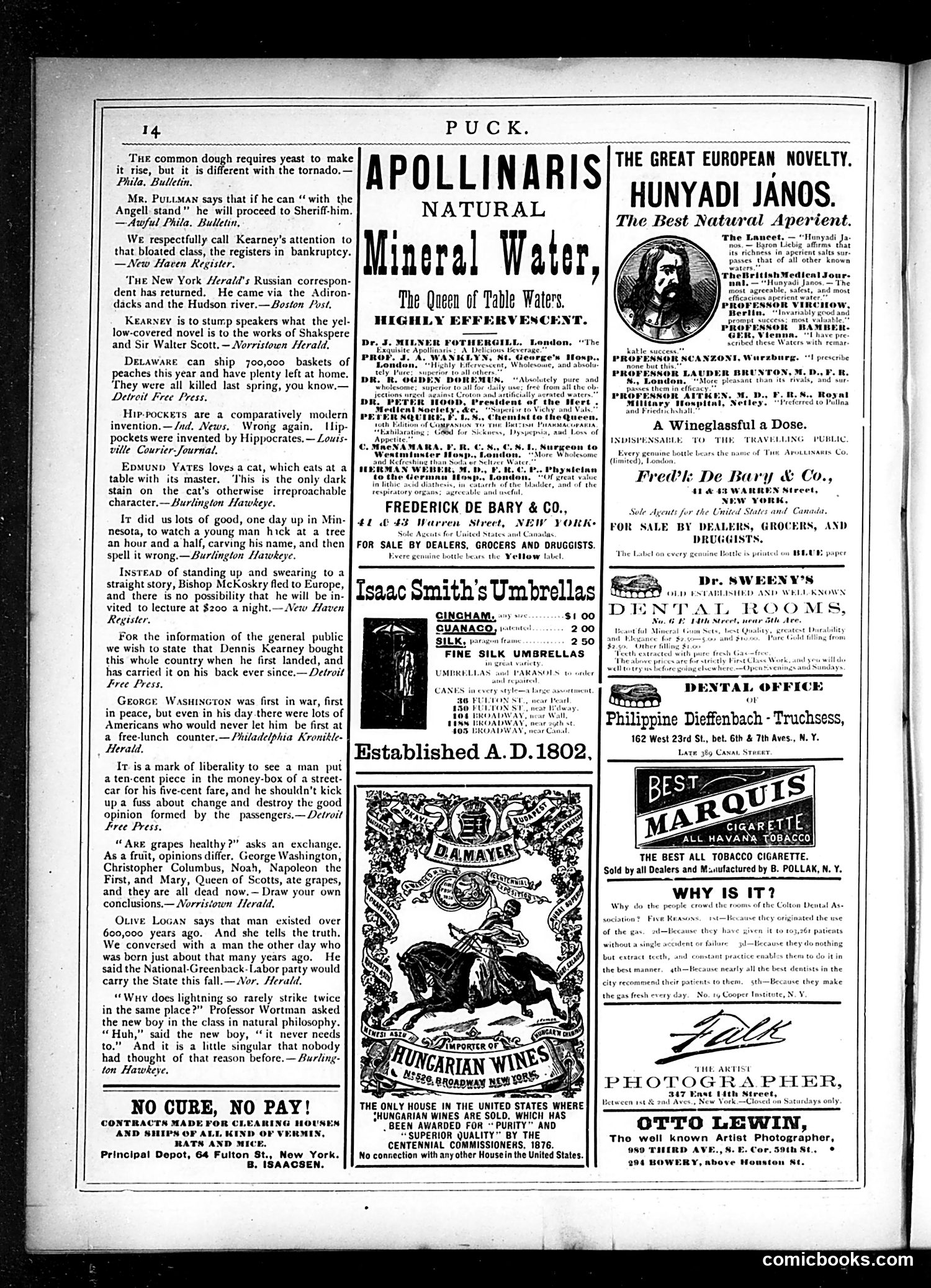
This page is primarily **advertising**, not political satire. The dominant content includes ads for Apollinaris Natural Mineral Water ("The Queen of Table Waters"), Isaac Smith's Umbrellas, Dr. Sweeny's Dental Rooms, and Best Marquis Cigarettes. The only substantive editorial content consists of brief satirical **news commentary items** in the left column—short quips about contemporary topics like yeast in bread-making, Kearney (likely labor figure Dennis Kearney), bankruptcy registers, Russian correspondents, and peaches. These are typical Puck humor: pithy observations on minor cultural and political matters rather than sustained political cartooning. The page represents Puck's **mixed editorial-advertising model**, where satirical commentary shares space with commercial promotions.
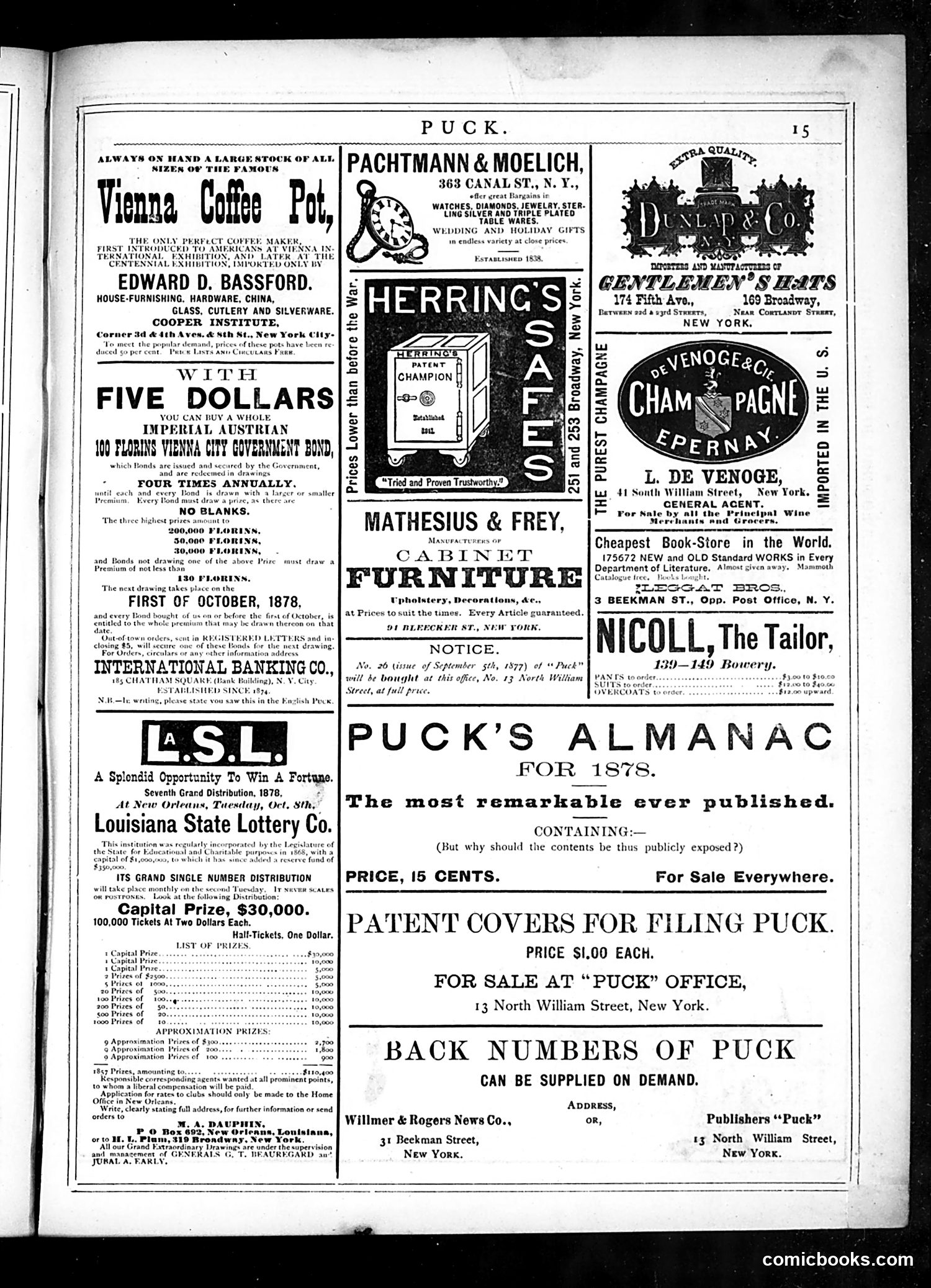
This page is primarily **advertising**, not editorial content or political cartoons. It features commercial advertisements for various 19th-century businesses and products: Vienna Coffee Pots, watches and jewelry (Pachtmann & Moelich), champagne (Devonge & Co.), furniture (Mathesius & Frey), a tailor service (Nicoli), and the Louisiana State Lottery. The only satirical element is a small notice about the **Louisiana State Lottery**, which advertises its "Grand Single Number Distribution." This likely represents contemporary social satire about widespread gambling schemes that preyed on Americans seeking quick wealth. The page also advertises **Puck's Almanac for 1878** and back issues of Puck magazine itself, indicating this is a back-matter/revenue page rather than editorial space.
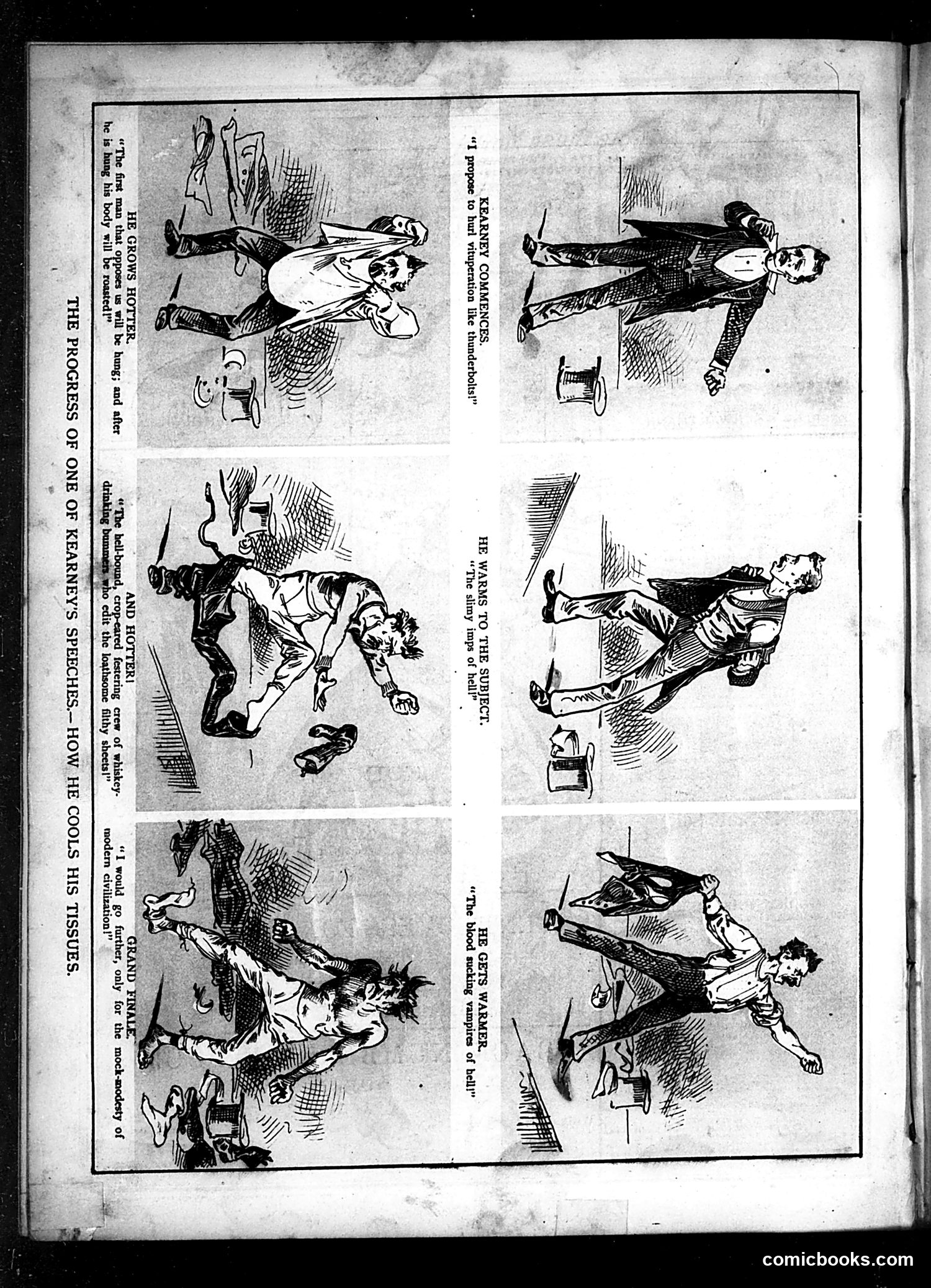
This Puck page satirizes the **progress of railways and their disruptive social effects**. The title "The Progress of One of Kearsarge's Predecessors" suggests this depicts an earlier railroad development. Each panel shows a figure being increasingly disrupted by railway expansion: 1. **Top panels** show well-dressed gentlemen relatively unaffected 2. **Middle panels** depict growing chaos—men knocked over, belongings scattered 3. **Bottom panels** show complete disorder—figures sprawling, possessions flying The satirical point: as railroads advance through populated areas, they create escalating mayhem for existing residents and property owners. The progression visualizes how "progress" (the railroad) devastates those in its path, suggesting railways are more destructive force than civilized improvement. This likely critiques 19th-century railroad expansion's disregard for established communities and individual welfare.