
Puck, 1878-09-11 · page 10 of 16
Puck — September 11, 1878 — page 10: what you’re looking at
What you’re looking at
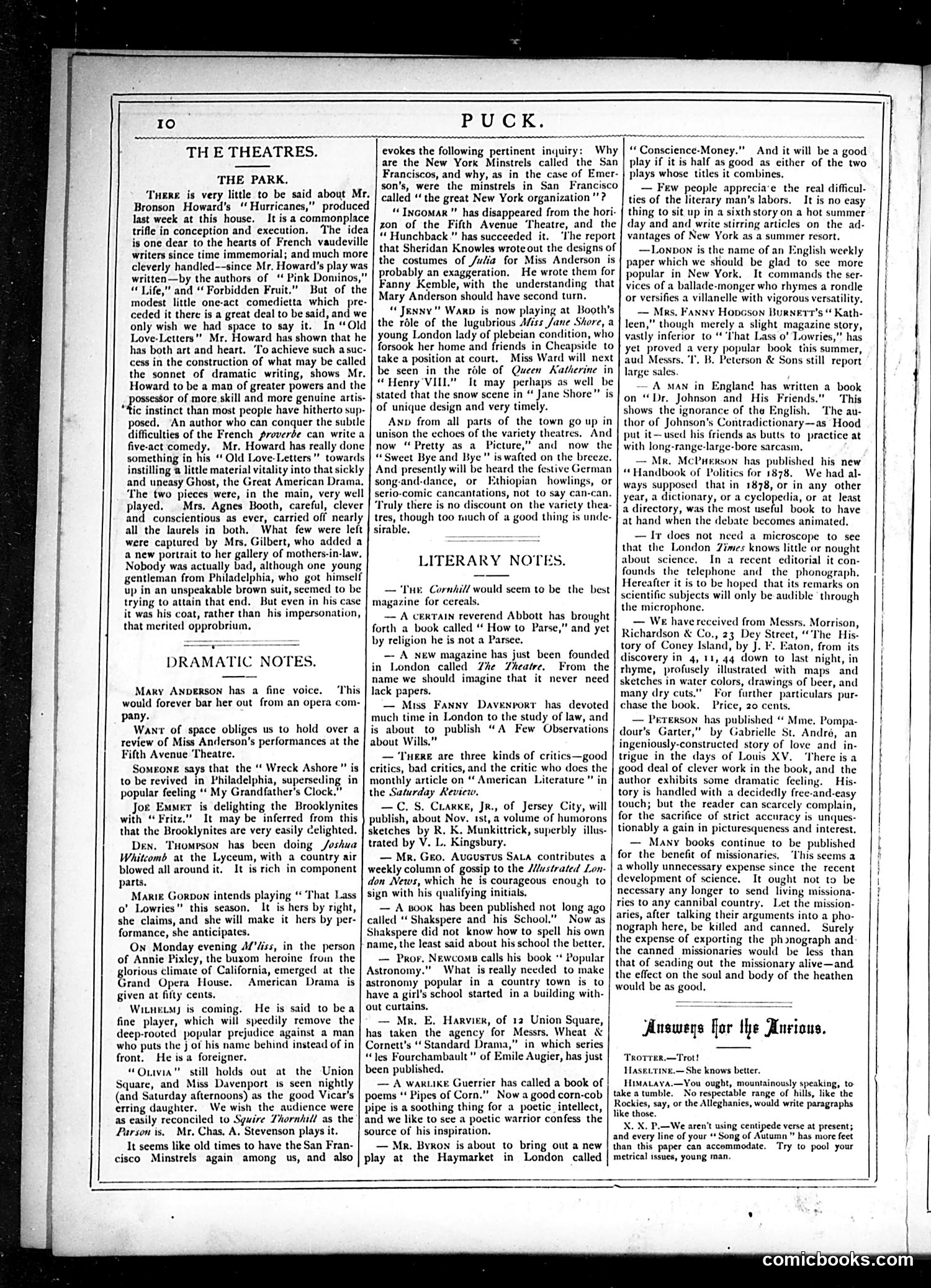
This page contains theatrical and literary criticism rather than political cartoons. The content discusses: **Theatrical Reviews**: Commentary on productions at various theaters including discussions of actors like Mary Anderson and Jenny Ward, evaluating their performances in contemporary plays. **Dramatic Notes**: Brief critiques of theatrical productions and performers' abilities. **Literary Notes**: Reviews of new publications, including a magazine called *The Theatre*, books on topics like "How to Parse," and other literary works. **"Answers for the Curious"**: A humorous advice column addressing reader questions. The page appears to be primarily editorial/critical content rather than satirical cartoons. Without visible illustrations accompanying these sections, the satire—if present—relies on written wit in the theater and book reviews rather than visual caricature.
📄 Transcribed text from this page (OCR, searchable)
Machine-transcribed from the original scan — historical spelling and the odd misread are preserved.
10 PUCK. TH E THEATRES. THE PARK. ‘Tnere is very little to be said about Mr. Bronson Howard's “ Hurricanes," produced last week at this house. It is a commonplace trifle in conception and execution. The idea is one dear to the hearts of French vaudeville writers since time immemorial; and much more cleverly handled—-since Mr. Howard's play was written—by the authors of ‘ Pink Dominos,” “ Life,” and “ Forbidden Fruit.” But of the modest little one-act comedietta which pre- ceded it there is a great deal to be said, and we only wish we had space to say it. In “Old Love-Letters" Mr, Howard has shown that he has both art and heart. To achieve such asuc- cess in the construction of what may be called the sonnet of dramatic writing, shows Mr. Howard to be a man of greater powers and the ossessor of more skill and more genuine arti: “ic instinct than most people have hitherto sup- posed, ‘An author who can conquer the subtle difficulties of the French proverde can write a five-act comedy. Mr. Howard has really done something in his ‘‘ Old Love-Letters ” towards instilling @ little material vitality into that sickly and uneasy Ghost, the Great American Drama. ‘The two pieces were, in the main, very well played. Mrs. Agnes Booth, careful, clever and conscientious as ever, carried off nearly all the laurels in both, What few were left were captured by Mrs, Gilbert, who added a a new portrait to her gallery of mothers-in-law, Nobody was actually bad, although one young gentleman from Philadelphia, who got himself up in an unspeakable brown suit, seemed to be trying to attain that end. But even in his case it was his coat, rather than his impersonation, that merited opprobrium, DRAMATIC NOTES. Mary Anperson has a fine voici ‘This would forever bar her out from an opera com- pany. Wanr of space obliges us to hold over a review of Miss Anderson's performances at the Fifth Avenue Theatre. Someone says that the ‘ Wreck Ashore" is to be revived in Philadelphia, superseding in popular feeling ‘« My Grandfather's Clock.” Joe Emmet is delighting the Brooklynites with “Fritz.” It may be inferred from this that the Brooklynites are very easily celighted. Den. ‘THompson has been doing Joshua Whitcomb at the Lyceum, with a country air blowed all around it. It is rich in component parts, Marie Gorpon intends playing ‘ That Lass o' Lowries” this season, It is hers by right, she claims, and she make it hers by per- formance, she anticipates. On Monday evening A/’4iss, in the person of Annie Pixley, the buxom heroine from the lorious climate of California, emerged at the Grand Opera House. American Drama. is given at filty cents. Witnetay is coming. He is said to bea fine player, which will speedily remove the deep-rooted popular prejudice against a man who puts the j of his name behind instead of in front. He is a foreigner. “Ontvia" still holds out at the Union Square, and Miss Davenport is seen nightly (and Saturday afternoons) as the good Vicar's erring daughter. We wish the audience were as easily reconciled to Sguire Thornhill as the Parson is. Mr, Chas, A, Stevenson plays it. It seems like old times to have the San Fran- evokes the following pertinent inquiry: Why are the New York Minstrels called the San Franciscos, and why, as in the case of Emer- son's, were the minstrels in San Francisco called ‘‘ the great New York organization "? “Incomar”’ has disappeared from the hori- zon of the Fifth Avenue Theatre, and the “ Hunchback.” has succeeded it. ‘Ihe report that Sheridan Knowles wrote out the designs of the costumes of Julia for Miss Anderson is probably an exaggeration, He wrote them for Fanny Kemble, with the understanding that Mary Anderson should have second turn. “Jenny” Warp is now playing at Booth's the role of the lugubrious Afiss Jane Shore, a young London lady of plebeian condition, who forsook her home and friends in Cheapside to take a position at court. Miss Ward will next be seen in the role of Queen Katherine in “Henry VILL" It may perhaps as well be stated that the snow scene in “ Jane Shore”’ is of unique design and very timely. Anp from all parts of the town go up in unison the echoes of the variety theatres. And now ‘Pretty as a Picture,” and now the “Sweet Bye and Bye " is wafted on the breeze. And presently will be heard the festive German song-and-dance, or Ethiopian howlings, or serio-comic cancantations, not to say can-can. ‘Truly there is no discount on the variety thea- tres, though too much of a good thing is unde- sirable, LITERARY NOTES. — Tne Cornhill would seem to be the best magazine for cereals, — A cerrain reverend Abbott has brought forth a book called “‘ How to Parse,” and yet by religion he is not a Parsee, — A NEW magazine has just been founded in London called Zhe Theatre, From the name we should imagine that it never need lack papers. — Miss Fanny Davenrort has devoted much time in London to the study of law, and is about to publish “A Few Observations about Wills.” — Tuere are three kinds of crit critics, bad critics, and the critic who doe monthly article on “ American Literature the Saturday Review, —C. S, Crarke, Jr. of Jersey City, will publish, about Nov. 1st, a volume of humorons sketches by R. K. Munkittrick, superbly illus- trated by V. L. Kingsbury. — Mr. Geo. Aucustus Sata contributes a weekly column of gossip to the Mustrated Lon- don News, which he is courageous enough to sign with his qualifying initials. — A Book has been published not long ago called “ Shakspere and his School.” Now as Shakspere did not know how to spell his own name, the least said about his school the better, — Pror. Newcoms calls his book ** Popular Astronomy." What is really needed to make astronomy popular in a country town is to have a girl's school started in a building with- out curtains, — Mr. E. Harvier, of 12 Union Square, has taken the agency for Messrs, Wheat & Cornett’s ‘Standard Drama,” in which series “Jes Fourchambault " of Emile Augier, has just been published. — A war.ike Guerrier has called a book of poems * Pipes of Corn.” Now a good corn-cob pipe is a soothing thing for a poetic intellect, and we like to sce a poetic warrior confess the source of his inspiration. — MR. Byron is about to bring out a new 's—good s the in cisco Minstrels again among us, and also play at the Haymarket in London called take a tumble. “Conscience-Money.” And it will be a good play if it is half as good as either of the two plays whose titles it combines. — Few people apprecia‘e the real difficul- ties of the literary man’s labors. It is no easy thing to sit up in a sixth story on a hot summer day and and write stirring articles on the ad- vantages of New York as a summer resort. —Lonpon is the name of an English weekly paper which we should be glad to see more popular in New York. It commands the ser- vices of a ballade-monger who rhymes a rondle or versifies a villanelle with vigorous versatility. — Mrs. ny Hopcson Burnett's “ Kath- leen,” though merely a slight magazine story, vastly inferior to “ ‘hat Lass o' Lowries,” has yet proved a very popular book this summer, aud Messrs. ‘I’, B. Peterson & Sons still report large sales. A man in England has written a book on “Dr. Johnson and His Friends." ‘This shows the ignorance of the English. The au- thor of Johnson's Contradictionary—as Hood put it—used his friends as butts to practice at with long-range-large-bore sarcasm, — Mr. McPHerson has published his new “Handbook of Politics for 1878. We had al- ways supposed that in 1878, or in any other year, a dictionary, or a cyclopedia, or at least a directory, the most useful book to have at hand when the debate becomes animated. — Ir does not need a microscope to see that the London Zimes knows little or nought about science. In a recent editorial it con- founds the telephone and the phonograph. Hereafter it is to be hoped that its remarks on scientific subjects will only be audible ‘through the microphon — WE have received from Messrs. Morrison, Richardson & Co., 23 Dey Street, “The His- tory of Coney Island, by J. l'. Eaton, from its discovery in 4, 44 down to last night, in thyme, profusely illustrated with maps and sketches in water colors, drawings of beer, and many dry cul For further particulars pur- chase the book, Price, 20 cents. — Pererson has published “ Mme, Pompa- dour’s Garter,” by Gabrielle St. André, an ingeniously-constructed story of love and in- trigue in the days of Louis XV. ‘There isa good deal of clever work in the book, and the author exhibits some dramatic feeling. His- tory is handled with a decidedly free-and-easy touch; but the reader can scarcely complain, for the sacrifice of strict accuracy is unques- tionably a gain in picturesqueness and interest. — Many books continue to be published for the benefit of missionaries. ‘This seems a a wholly unnecessary expense since the recent development of science. It ought not to be necessary any longer to send living missiona- ries to any cannibal country. Let the mission- aries, after talking their arguments into a pho- nograph here, be killed and canned. Surely the expense of exporting the phonograph and the canned missionaries would be less than that of seading out the missionary alive—and the effect on the soul and body of the heathen would be as good. Answers for the Aurious. Trorre: rot! HMaseuting.— She knows better. Himatava.—You ought, mountainously speaking, to No respectable range of hills, like the , would write paragraphs Rockies, say, or the Alleghani like those. P.—We aren't using centipede verse at present; and every line of your “ Song of Autumn” has more feet than this paper can accommodate. Try to pool your metrical issues, young man. comicbooks.com