
Puck, 1878-09-11 · page 6 of 16
Puck — September 11, 1878 — page 6: what you’re looking at
What you’re looking at
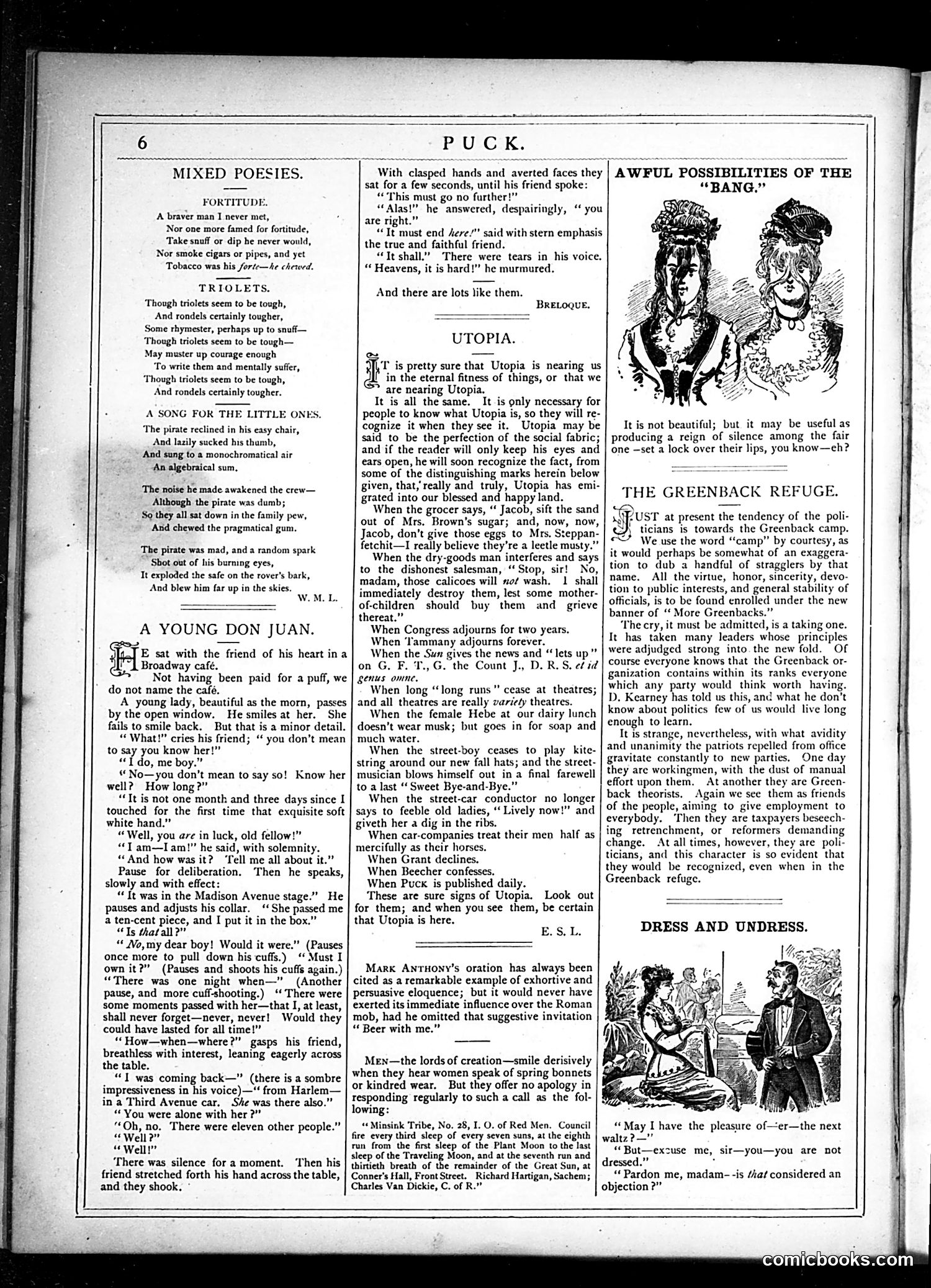
This page contains mixed satirical content rather than a single unified cartoon. **"Awful Possibilities of the 'Bang'"** (top right): A sketch mocking the recently popularized "bang" hairstyle worn by women. The exaggerated caricature shows a woman with an absurdly large, puffed fringe, suggesting the style was considered ridiculous or unflattering by Puck's editors and male-oriented audience. **Other content**: The page includes poems ("Fortitude," "Triolets") and prose pieces satirizing contemporary social issues—including commentary on Utopia, Greenback political movements, and gender relations. "A Young Don Juan" appears to mock youthful male pretension. The overall thrust reflects Puck's approach: mixing visual caricature with literary satire to mock fashion trends, political ideologies, and social pretensions of the era.
📄 Transcribed text from this page (OCR, searchable)
Machine-transcribed from the original scan — historical spelling and the odd misread are preserved.
MIXED POESIES. FORTITUDE. A braver man I never met, Nor one more famed for fortitude, ‘Take snuff or dip he never would, Nor smoke cigars or pipes, and yet Tobacco was his forte—he chewed. TRIOLETS. ‘Though triolets seem to be tough, And rondels certainly tougher, Some rhymester, perhaps up to snuff— ‘Though triolets seem to be tough— May muster up courage enough ‘To write them and mentally suffer, ‘Though triolets seem to be tough, And rondels certainly tougher. A SONG FOR THE LITTLE ONES. ‘The pirate reclined in his easy chair, And lazily sucked his thumb, And sung to a monochromatical air An algebraical sum, The noise he made awakened the crew— Although the pirate was dumb; So they all sat down in the family pew, And chewed the pragmatical gum. The pirate was mad, anda random spark Shot out of his burning eyes, It exploded the safe on the rover’s bark, And blew him far up in the skies. W.M.L. A YOUNG DON JUAN. sat with the friend of his heart ina roadway café. Not having been paid for a puff, we do not name the café, A young lady, beautiful as the morn, passes by the open window. He smiles at her. She fails to smile back. But that is a minor detail. “ What!” cries his friend; “ you don’t mean to say you know her!’" “Ido, me boy.” **No—you don’t mean to say so! Know her well? How long?” “It is not one month and three days since I touched for the first time that exquisite soft white hand.” “Well, you are in luck, old fellow!” “T am—I am!” he said, with solemnity. “And how was it? ‘Tell me all about it.” Pause for deliberation. Then he speaks, slowly and with effect: “It was in the Madison Avenue stage.” He pauses and adjusts his collar. ‘She passed me a ten-cent piece, and I put it in the box.” “Ts thatall?” “No, my dear boy! Would it were.” (Pauses once more to pull down his cuffs.) ‘ Must I own it?” (Pauses and shoots his cuffs again.) “There was one night when—” (Another pause, and more cuff-shooting.) ‘There were some moments passed with her—that I, at least, shall never forget—never, never! Would they could have lasted for all time!” “How—when—where?” gasps his friend, breathless with interest, leaning eagerly across the table. “I was coming back—” (there is a sombre impressiveness in his voice)—“ from Harlen— in a Third Avenue car. She was there also.” “You were alone with her ?” "Oh, no. There were eleven other people.” “Well?” “Well!” ‘There was silence fora moment. ‘Then his friend stretched forth his hand across the table, and they shook. PUCK. With clasped hands and averted faces they sat for a few seconds, until his friend spoke: “This must go no further!” “Alas!” he answered, despairingly, “ you are right.” “Tt must end here!" said with stern emphasis the true and faithful friend. “Tt shall.” There were tears in his voice. “ Heavens, it is hard!” he murmured. And there are lots like them. BRELOQUE. UTOPIA. Ao is pretty sure that Utopia is nearing us in the eternal fitness of things, or that we > are nearing Utopia. It is all the same. It is only necessary for peaple to know what Utopia is, so they will re- cognize it when they see it. Utopia may be said to be the perfection of the social fabric; and if the reader will only keep his eyes and ears open, he will soon recognize the fact, from some of the distinguishing marks herein below given, that,’really and truly, Utopia has emi- grated into our blessed and happy land. When the grocer says, “ Jacob, sift the sand out of Mrs. Brown’s sugar; and, now, now, Jacob, don't give those eggs to Mrs. Steppan- fetchit—I really believe they're a leetle musty.” When the dry-goods man interferes and says to the dishonest salesman, ‘Stop, sir! No, madam, those calicoes will nof wash. 1 shall immediately destroy them, lest some mother- of-children should buy them and grieve thereat.” When Congress adjourns for two years. When ‘Tammany adjourns forever. When the Sun gives the news and “lets up” on G, F. ‘T.,G. the Count J., D. R.S. ef id genus omne. When long “long runs” cease at theatres; and all theatres are really variety theatres. When the female Hebe at our dairy lunch doesn’t wear musk; but goes in for soap and much water. When the street-boy ceases to play kite- string around our new fall hats; and the street- musician blows himself out in a final farewell to a last “ Sweet Bye-and-Bye.” When the street-car conductor no longer says to feeble old ladies, “Lively now!” and giveth her a dig in the ribs. When car-companies treat their men half as mercifully as their horses. When Grant declines. When Beecher confesses. When Puck is published daily. These are sure signs of Utopia. Look out for them; and when you see them, be certain that Utopia is here. Mark ANTHONY’s oration has always been cited as a remarkable example of exhortive and persuasive eloquence; but it would never have exerted its immediate influence over the Roman mob, had he omitted that suggestive invitation “Beer with me.” Men—the lords of creation—smile derisively when they hear women speak of spring bonnets or kindred wear. But they offer no apology in responding regularly to such a call as the fol- lowing: “Minsink Tribe, No. 28, I. O. of Red Men. Council fire every third sleep of every seven suns, at the eighth run from the first sleep of the Plant Moon to the last sleep of the Traveling Moon, and at the seventh run and thirtieth breath of the remainder of the Great Sun, at Conner’s Hall, Front Street. Richard Hartigan, Sachem; Charles Van Dickie, C. of R.”” AWFUL POSSIBILITIES OF THE “BANG.” It is not beautiful; but it may be useful as producing a reign of silence among the fair one —set a lock over their lips, you know—eh? THE GREENBACK REFUGE. roa a s\FUST at present the tendency of the poli- SW ticians is towards the Greenback camp. © We use the word “camp” by courtesy, as it would perhaps be somewhat of an exaggera- tion to dub a handful of stragglers by that name. All the virtue, honor, sincerity, devo- tion to public interests, and general stability of officials, is to be found enrolled under the new banner of “‘ More Greenbacks.” ‘Thecry, it must be admitted, is a taking one. It has taken many leaders whose principles were adjudged strong into. the new fold. Of course everyone knows that the Greenback or- ganization contains within its ranks everyone which any party would think worth having. D. Kearney has told us this, and what he don’t know about politics few of us would live long enough to learn. It is strange, nevertheless, with what avidity and unanimity the patriots repelled from office gravitate constantly to new parties. One day they are workingmen, with the dust of manual effort upon them. At another they are Green- back theorists. Again we see them as friends of the people, aiming to give employment to everybody. ‘Then they are taxpayers beseech- ing retrenchment, or reformers demanding change. At all times, however, they are poli- ticians, and this character is so evident that they would be recognized, even when in the Greenback refuge. “May Ihave the pleasure of—er—the next waltz ?—"" “But—excuse me, sir—you—you are not dressed.” 5 “Pardon me, madam--is /saf considered an objection ?” a Comicbooks.com