
Puck, 1878-09-11 · page 4 of 16
Puck — September 11, 1878 — page 4: what you’re looking at
What you’re looking at
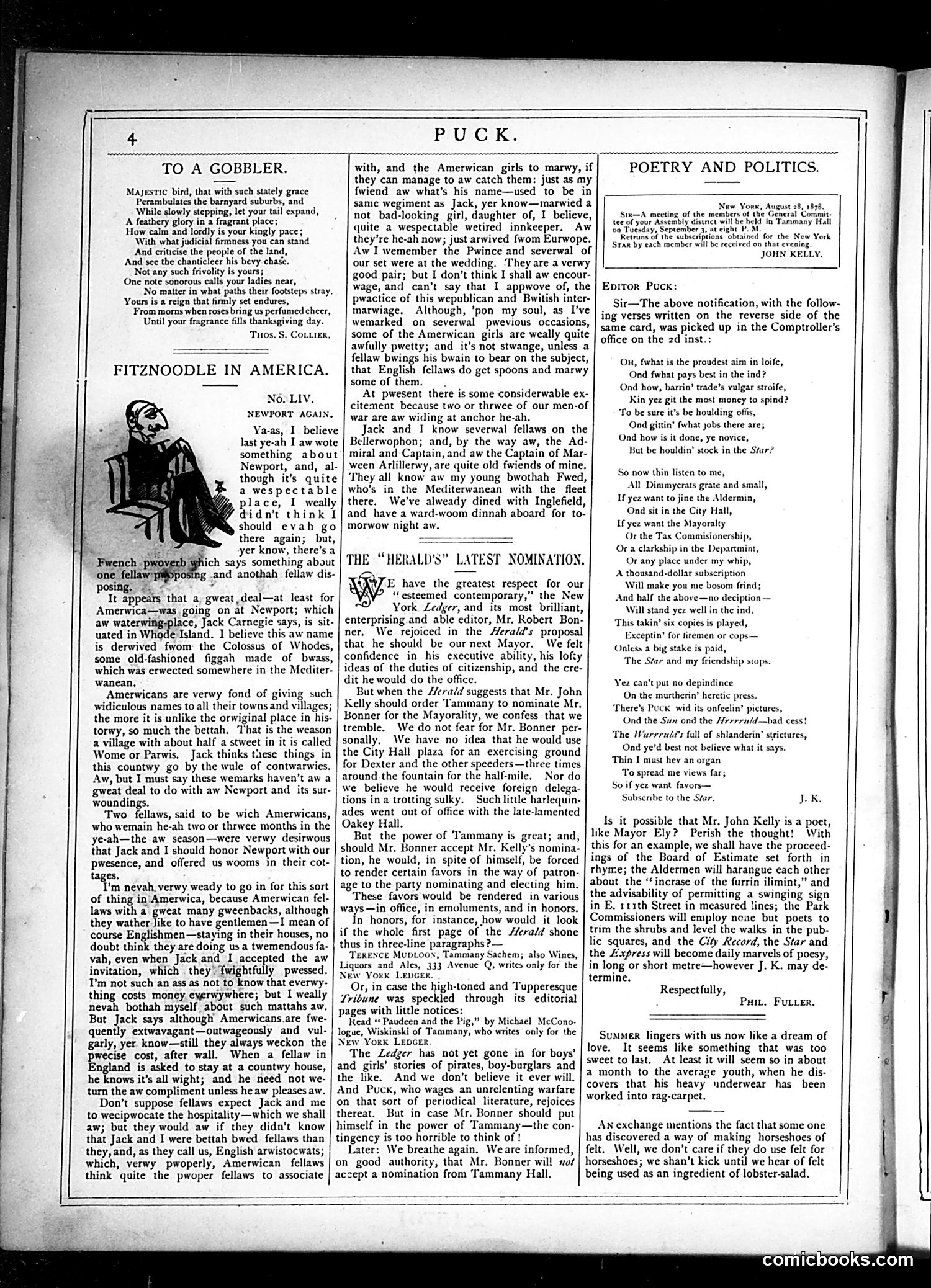
This cartoon satirizes a British visitor's naive observations about American life. "Fitznoodle" (a stock character representing an upper-class Englishman) expresses bewilderment at American customs, particularly regarding class mobility and social mixing. The text mocks his condescending surprise that working-class Americans (like "Jack") can marry respectable women and achieve social standing without inherited wealth or aristocratic connections. The satire targets British class snobbery by presenting Fitznoodle's shock at American egalitarianism as absurd. The accompanying verses reinforce this: Americans don't require titles or genealogy for respectability—a concept that apparently baffles and unsettles the rigid British social hierarchy Fitznoodle represents. The humor lies in inverting who appears foolish: the Englishman, not the democratic Americans.
📄 Transcribed text from this page (OCR, searchable)
Machine-transcribed from the original scan — historical spelling and the odd misread are preserved.
PUCK. TO A GOBBLER. Majestic bird, that with such stately grace Perambulates the barnyard suburbs, and While slowly stepping, let your tail expand, A feathery glory in a fragrant place; How calm and lordly is your kingly pace; With what judicial firmness you can stand And criticise the people of the land, And see the chanticleer his bevy chase. Not any such frivolity is yours; One note sonorous calls your ladies near, No matter in what paths their footsteps stray. Yours is a reign that firmly set endures, From morns when roses bring us perfumed cheer, Until your fragrance fills thanksgiving day. Tuos. S. Couuier, FITZNOODLE IN AMERICA. No. Liv. NEWPORT AGAIN, Ya-as, I believe last ye-ah I aw wote something about Newport, and, al- though it's quite a wespectable place, I weally didn't think I should evah go there again; but, yer know, there's a ich says something about g and anothah fellaw dis- ts y Lae sprees that a, gweat,deal—at least for Amerwica—was going on at Newport; which aw waterwing-place, Jack Carnegie says, is sit- uated in Whode Island. I believe this aw name is derwived fwom: the Colossus of Whodes, some old-fashioned figgah made of bwass, which was erwected somewhere in the Mediter- wanean. Amerwicans are verwy fond of giving such widiculous names to all their towns and villages; the more it is unlike the orwiginal place in his- torwy, so much the bettah. That is the weason a village with about half a stweet in it is called Wome or Parwis, Jack thinks these things in this countwy go by the wule of contwarwies. Aw, but I must say these wemarks haven’t aw a gweat deal to do with aw Newport and its sur- woundings. F Two fellaws, to be wich Amerwicans, who wemain he-ah two or thrwee months in the ye-ah—the aw season—were verwy desirwous that Jack and I should honor Newport with our pwesence, and offered us wooms in their cot- es, m nevah, verwy weady to go in for this sort of thing in:Amerwica, because Amerwican fel- laws with a gweat many gweenbacks, although they wather like to have gentlemen—I mean of course Englishmen—staying in their houses, no doubt think they are doing us a twemendous fa- yah, even when Jack and I accepted the aw invitation, which . they! fwightfully pwessed. I'm not such an ass as not to know that everwy- thing costs money eyerwywhere; but I weally nevah bothah myself about such mattahs aw. But Jack says although Amerwicans.are fwe- quently extwavagant—outwageously and vul- garly, yer know—still they always weckon the pwecise cost, after wall. When a fellaw in England is asked to stay at a countwy house, mass it’s all wight; and he need not we- turn the aw compliment unless he aw pleases aw. Don’t suppose fellaws expect Jack and me to wecipwocate the hospitality—which we shall aw; but they would aw if they didn’t know that Jack and I were bettah bwed fellaws than they, and, as they call us, English arwistocwats; which, verwy pwoperly, Amerwican fellaws think quite the pwoper fellaws to associate with, and the Amerwican girls to marwy, if they can manage to aw catch them: just as my fwiend aw what's his name—used to be in same wegiment as Jack, yer know—marwied a not bad-looking girl, daughter of, I believe, quite a wespectable wetired innkeeper. Aw they’re he-ah now; just arwived fwom Eurwope. Aw I wemember the Pwince and severwal of our set were at the wedding. ‘They are a verwy good pair; but I don’t think I shall aw encour- wage, and can’t say that I appwove of, the pwactice of this wepublican and Bwitish inter- marwiage. Although, ‘pon my soul, as I’ve wemarked on severwal pwevious occasions, some of the Amerwican girls are weally quite awfully pwetty; and it’s not stwange, unless a fellaw bwings his bwain to bear on the subject, that English fellaws do get spoons and marwy some of them. At pwesent there is some considerwable ex- citement because two or thrwee of our men-of war are aw widing at anchor he-ah. Jack and I know severwal fellaws on the Bellerwophon; and, by the way aw, the Ad- miral and Captain, and aw the Captain of Mar- ween Arlillerwy, are quite old fwiends of mine. ‘They all know aw my young bwothah Fwed, who’s in the Mediterwanean with the fleet there. We've alweady dined with Inglefield, and have a ward-woom dinnah aboard for to- morwow night aw. THE “HERALD'S” LATEST NOMINATION. ATE have the greatest respect for our “esteemed contemporary,” the New York Ledger, and its most brilliant, enterprising and able editor, Mr. Robert Bon- ner, We rejoiced in the Herald's proposal that he should be our next Mayor. We felt confidence in his executive ability, his lofty ideas of the duties of citizenship, and the cre- dit he would do the office. But when the //era/d suggests that Mr. John Kelly should order ‘fammany to nominate Mr. Bonner for the Mayorality, we confess that we tremble. We do not fear for Mr. Bonner per- sonally. We have no idea that he would use the City Hall plaza for an exercising ground for Dexter and the other speeders—three times around the fountain for the half-mile. Nor do we believe he would receive foreign delega- tions ina trotting sulky. Such little harlequin- ades went out of office with the late-lamented Oakey Hall. But the power of Tammany is great; and, should Mr. Bonner accept Mr. Kelly’s nomina- tion, he would, in spite of himself, be forced to render certain favors in the way of patron- age to the party nominating and electing him. These favors would be rendered in various ways —in office, in emoluments, and in honors. In honors, for instance, how would it look if the whole first page of the Hera/d shone thus in three-line paragraphs ?— TeReNce MuDLOON, Tammany Sachem; also Wines, Liquors and Ales, 333 Avenue Q, writes only for the New York Lepcer. Or, in case the high-toned and Tupperesque Tribune was speckled through its editorial pages with little notices: Read “ Paudeen and the Pig,” by Michael McCono- logue, Wiskinski of Tammany, who writes only for the New York Lepcer. The Ledger has not yet gone in for boys’ and girls’ stories of pirates, boy-burglars and the like. And we don't believe it ever will. And Puck, who wages an unrelenting warfare on that sort of periodical literature, rejoices thereat. But in case Mr. Bonner should put himself in the power of Tammany—the con- tingency is too horrible to think of ! Later: We breathe again. Weare informed, on good authority, that Mr. Bonner will not accept a nomination from Tammany Hall. New York, August 2 Sim—A meeting of the members of the General tee of your Assembly district will be held in Tamma oa Tuesday, September 3, at eight P. M Retruns of the subscriptions obtained for the New York Stan by each member will be rece’ Epitor Puck: Sir—The above notification, with the follow- ing verses written on the reverse side of the same card, was picked up in the Comptroller's office on the 2d inst.: On, fwhat is the proudest aim in loife, Ond fwhat pays best in the ind? Ond how, barrin’ trade's vulgar stroife, Kin yez git the most money to spind? ‘To be sure it’s be houlding offis, Ond gittin’ fwhat jobs there are; Ond how is it done, ye novice, But be houldin’ stock in the Star? So now thin listen to me, All Dimmycrats grate and small, If yez want to jine the Aldermin, Ond sit in the City Hall, If yee want the Mayoralty Or the Tax Commisionersbip, Or a clarkship in the Departmint, Or any place under my whip, A thousand-dollar subscription Will make you me bosom frind; And half the above—no deciption— Will stand yez well in the ind. ‘This takin’ six copies is played, Exceptin’ for firemen or cops— Onless a big stake is paid, The Star and my friendship stops Yez can't put no depindince On the murtherin’ heretic press. ‘There’s Puck wid its onfeelin’ pictures, Ond the Sun ond the Hrrrruld—bad cess! ‘The Wurrruld’s fall of shlanderin’ strictures, Ond ye'd best not believe what it says. Thin I must hev an organ To spread me views far; So if yez want favors— Subsenbe to the Star. JK. Is it possible that Mr. John Kelly is a poet, like Mayor Ely? Perish the thought! With this for an example, we shall have the proceed- ings of the Board of Estimate set forth in rhyme; the Aldermen will harangue each other about the ‘‘incrase of the furrin ilimint,” and the advisability of permitting a swinging sign in E. 111th Street in measured lines; the Park Commissioners will employ none but poets to trim the shrubs and level the walks in the pub- lic squares, and the City Record, the Star and the Express will become daily marvels of poesy, in long or short metre—however J. K. may de- termine, Respectfully, Puit. FULLER. Summer lingers with us now like a dream of love. It seems like something that was too sweet to last. At least it will seem so in about a month to the average youth, when he dis- covers that his heavy underwear has been worked into rag-carpet. An exchange mentions the fact that some one has discovered a way of making horseshoes of felt, Well, we don’t care if they do use felt for horseshoes; we shan’t kick until we hear of felt being used as an ingredient of lobster-salad.