
Puck, 1878-09-11 · page 7 of 16
Puck — September 11, 1878 — page 7: what you’re looking at
What you’re looking at
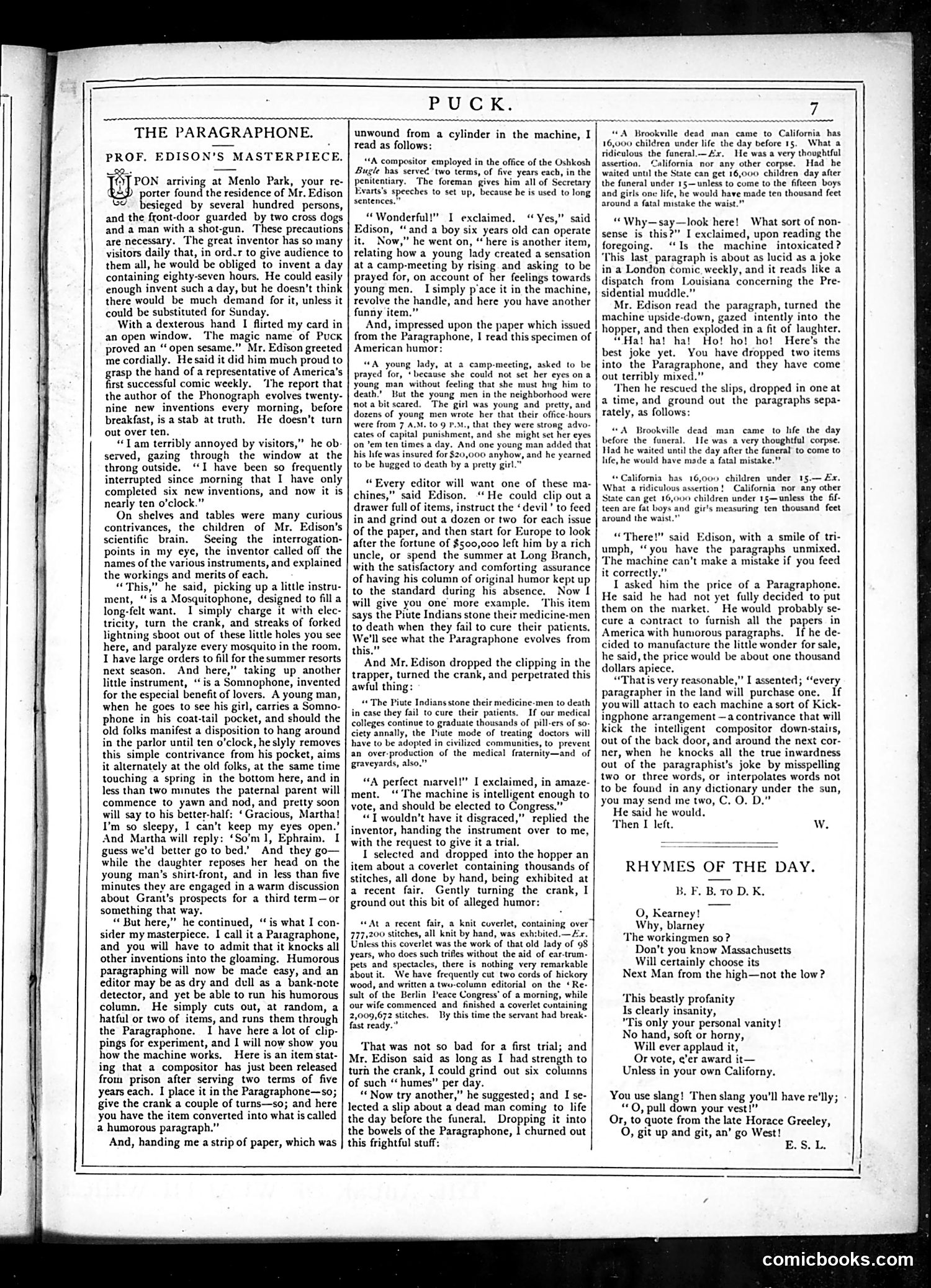
This page contains primarily **text content rather than cartoons**. The main feature is "The Paraphone: Prof. Edison's Masterpiece," a humorous essay about Thomas Edison's alleged invention of a machine that can extract humor from printed matter and reproduce it audibly. The satire targets Edison's prolific inventiveness and public reputation as a near-magical innovator. The joke assumes readers will find it absurd that Edison would waste his genius creating a device for mechanical laughter—mocking both Edison's actual lesser inventions and the era's sometimes uncritical veneration of technological progress. The page concludes with "Rhymes of the Day," unrelated verse commentary. No specific political figures or events are referenced; this is social satire about American attitudes toward technology and inventors.
📄 Transcribed text from this page (OCR, searchable)
Machine-transcribed from the original scan — historical spelling and the odd misread are preserved.
THE PARAGRAPHONE. PROF. EDISON’S MASTERPIECE. ay PON arriving at Menlo Park, your re- ( orter found the residence of Mr. Edison od Besieged by several hundred persons, and the front-door guarded by two cross dogs and a man with a shot-gun. These precautions are necessary. The great inventor has so many visitors daily that, in ord.r to give audience to them all, he would be obliged to invent a day containing eighty-seven hours. He could easily enough invent such a day, but he doesn’t think there would be much demand for it, unless it could be substituted for Sunday. With a dexterous hand I flirted my card in an open window. ‘The magic name of Puck proved an “open sesame.” Mr. Edison greeted me cordially. He said it did him much proud to rasp the hand of a representative of America’s first successful comic weekly. ‘The report that the author of the Phonograph evolves twenty- nine new inventions every morning, before breakfast, is a stab at truth, He doesn’t turn out over ten. “Lam terribly annoyed by visitors,” he ob served, gazing through the window at the throng outside. “I have been so frequently interrupted since morning that I have only completed six new inventions, and now it is nearly ten o’clock.”” On shelves and tables were contrivances, the children of Mr. Edison's scientific brain. Seeing the interrogation- points in my eye, the inventor called off the names of the various instruments, and explained the workings and merits of each. “This,” he said, picking up a little instru- ment, “is a Mosquitophone, designed to fill a long-felt want. I simply charge it with elec- tricity, turn the crank, and streaks of forked lightning sboot out of these little holes you see here, and paralyze every mosquito in the room. I have large orders to fill for the summer resorts next season. And here,” taking up another little instrument, ‘‘ is a Somnophone, invented for the especial benefit of lovers. A young man, when he goes to see his girl, carries a Somno- phone in his coat-tail pocket, and should the old folks manifest a disposition to hang around in the parlor until ten o'clock, he slyly removes this simple contrivance from his pocket, aims it alternately at the old folks, at the same time touching a spring in the bottom here, and in less than two minutes the paternal parent will commence to yawn and nod, and pretty soon will say to his better-half; ‘Gracious, Martha! I'm so sleepy, I can’t keep my eyes open.’ And Martha will reply: ‘So'm I, Ephraim. I guess we'd better go to bed.’ And they go— while the daughter reposes her head on the young man’s shirt-front, and in less than five minutes they are engaged in a warm discussion about Grant’s prospects for a third term—or something that way. “ But here,” he continued, ‘is what I con- sider my masterpiece. 1 call it a Paragraphone, and you will have to admit that it knocks all other inventions into the gloaming. Humorous paragraphing will now be mace easy, and an editor may be as dry and dvll as a bank-note detector, and yet be able to run his humorous column, He simply cuts out, at random, a hatful or two of items, and runs them through the Paragraphone. I have here a lot of clip- pings for experiment, and I will now show you how the machine works. Here is an item stat- ing that a compositor has just been released from prison after serving two terms of five years each. I place it in the Paragraphone—so; give the crank a couple of turns—so; and here you have the item converted into what is called a humorous paragraph.” And, handing me a strip of paper, which was many curious PUCK. 7. unwound from a cylinder in the machine, I read as follows: “A compositor employed in the office of the Oshkosh Bugle has servee two terms, of five years each, in the penitentiary. The foreman gives him all of Secretary Evarts's speeches to set up, because he is used to long sentences.” “Wonderful!” I exclaimed. “Yes,” said Edison, ‘and a boy six years old can operate it. Now,” he went on, “here is another item, relating how a young lady created a sensation at a camp-meeting by rising and asking to be prayed for, on account of her feelings towards young men. I simply p‘ace it in the machine, revolve the handle, and here you have another funny item.” And, impressed upon the paper which issued from the Paragraphone, I read this specimen of American humor: “A young lady, at a camp-meeting, asked to be prayed for, ‘because she could not set her eyes on a young man without feeling that she must hng him to death.’ ut the young men in the neighborhood were not a bit scared. “The girl was young and pretty, and dozens of young men wrote her that their office:-hours were from 7 A.M. to 9 P.at., that they were strong advo- cates of capital punishment, and she might set her eyes on ’em ten times a day. And one young man added that his life was insured for $20,000 anyhow, and he yearned to be hugged to death by a pretty girl.” “Every editor will want one of these ma- chines,” said Edison. ‘He could clip outa drawer full of items, instruct the ‘devil’ to feed in and grind out a dozen or two for each issue of the paper, and then start for Europe to look after the fortune of $500,000 left him bya rich uncle, or spend the summer at Long Branch, with the satisfactory and comforting assurance of having his column of original humor kept up to the standard during his absence. Now I will give you one more example. ‘This item says the Piute Indians stone their medicine-men to death when they fail to cure their patients, We'll see what the Paragraphone evolves from this.” And Mr. Edison dropped the clipping in the trapper, turned the crank, and perpetrated this awful thing: “« The Piute Indians stone their medicine-men to death in case they fail to cure their patients. If our medical colleges continue to graduate thousands of pill-ers of so- ciety anally, the Piute mode of treating doctors will have to be adopted in civilized communities, to prevent an over-production of the medical fraternity—and of graveyards, also,” “A perfect marvel!” I exclaimed, in amaze- ment. ‘“ The machine is intelligent enough to vote, and should be elected to Congress.” “T wouldn't have it disgraced,” replied the inventor, handing the instrument over to me, with the request to give it a trial. I selected and dropped into the hopper an item about a coverlet containing thousands of stitches, all done by hand, being exhibited at a recent fair, Gently turning the crank, I ground out this bit of alleged humor: “Ata recent fair, a knit coverlet, containing over] 777,200 stitches, all knit by hand, was exh:bited.—Z-r. | Unless this coverlet was the work of that old lady of 98 years, who does such trifles without the aid of ear-trum- pets and spectacles, there is nothing very remarkable about it. We have frequently cut two cords of hickory wood, and written a two-column editorial on the ‘Re- sult of the Berlin Peace Congress’ of a morning, while our wife commenced and finished a coverlet cuntaining 2,009,672 stitches. By this time the servant had break- fast ready. ‘That was not so bad for a first trial; and Mr. Edison said as long as I had strength to turn the crank, I could grind out six colurnns of such “‘ humes” per day. “Now try another,” he suggested; and I se- lected a slip about a dead man coming to life the day before the funeral. Dropping it into the bowels of the Paragraphone, | churned out “A Brookville dead man came to California has yoo children under life the day before 15. What a ridiculous the funeral.— Ax. He was a very thoughtful assertion. California nor any other corpse. Had he waited until the State can get 16,000 children day after the funeral under 15—unless to come to the fifteen boys and girls one life, he would have made ten thousand feet around a fatal mistake the waist.” “Why—say—look here! What sort of non- sense is this?” I exclaimed, upon reading the foregoing. ‘Is the machine intoxicated? ‘This last_ paragraph is about as lucid as a joke in a London comic, weekly, and it reads like a dispatch from Louisiana concerning the Pre- sidential muddle, Mr. Edison read the paragraph, turned the machine upside-down, gazed intently into the hopper, and then exploded in a fit of laughter, “Ha! ha! hat Ho! ho! ho! Here’s the best joke yet. You have dropped two items into the Paragraphone, and they have come out terribly mixed.” ‘Then he rescued the slips, dropped in one at a time, and ground out the paragraphs sepa- rately, as follows: “A. Brookville dead man came to hfe the day before the funeral. Me was a very thoughtful corpse. Had he waited until the day after the funeral to come to fe, he would have made a fatal mistake.” “California has 16,000 children under 15.— Ex. What a ridiculous assertion! California nor any other State can get 16,000 children under 15—unless the fif- teen are fat boys and gir's measuring ten thousand feet around the waist.”” “There!” said Edison, with a smile of tri- umph, “you have the paragraphs unmixed. The machine can’t make a mistake if you feed it correctly.” I asked him the price of a Paragraphone. He said he had not yet fully decided to put them on the market. He would probably se- cure a contract to furnish all the papers in America with humorous paragraphs. If he de- cided to manufacture the little wonder for sale, he said, the price would be about one thousand dollars apiece. “Thatis very reasonable,” I assented; “every paragrapher in the land will purchase one. If youwill attach to each machine a sort of Kick- ingphone arrangement —a contrivance that will kick the intelligent compositor down-stairs, out of the back door, and around the next cor- ner, when he knocks all the true inwardness out of the paragraphist’s joke by misspelling two or three words, or interpolates words not to be found in any dictionary under the sun, you may send me two, C. O. D.” He said he would. Then I left. Ww. RHYMES OF THE DAY. BF. B.70 D.K. O, Kearney! Why, blarney ‘The workingmen so? Don't you know Massachusetts Will certainly choose its Next Man from the high—not the low? ‘This beastly profanity Is clearly insanity, 'Tis only your personal vanity! No hand, soft or horny, Will ever applaud it, Or vote, ¢’er award it— Unless in your own Californy. You use slang! ‘Then slang you'll have re'lly; “0, pull down your vest!” Or, to quote from the late Horace Greeley, O, git up and git, an’ go West! this frightful stuff: E.S, L. comicbooks.com