
Puck, 1878-09-11 · page 3 of 16
Puck — September 11, 1878 — page 3: what you’re looking at
What you’re looking at
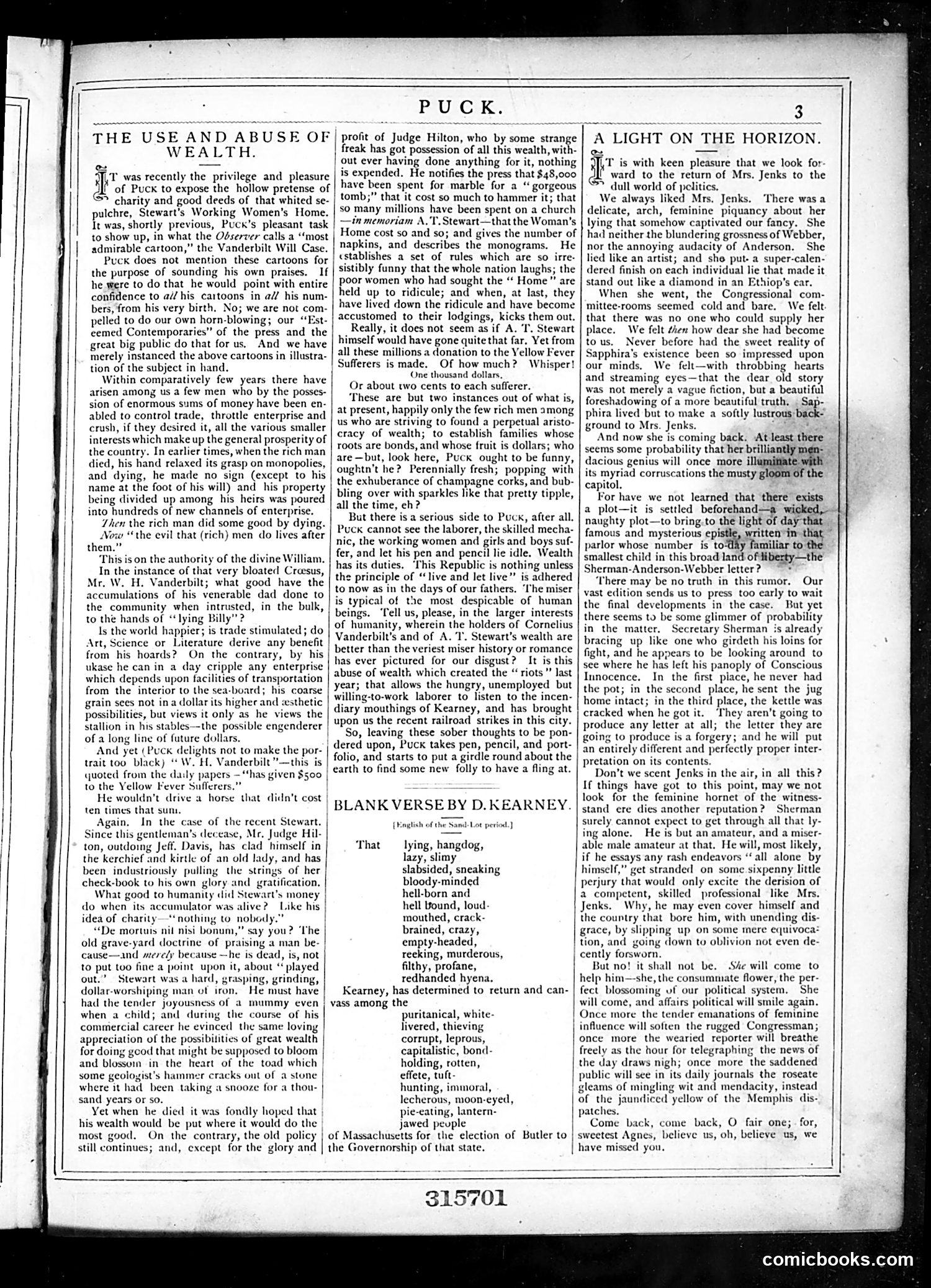
This page contains two distinct sections: **Left column ("The Use and Abuse of Wealth"):** A lengthy editorial essay criticizing wealthy philanthropists, particularly Judge Hilton, for ostentatious charity that garners public praise. The text argues their donations are self-serving and highlights the hypocrisy of the wealthy, citing examples like the "Yellow Fever Sufferers" fund and recent railroad strikes. It positions charity as a tool for reputation-building rather than genuine compassion. **Right column ("Light on the Horizon"):** A political opinion piece advocating for Mrs. Jenks's return to public life, praising her past work. The author expresses cautious optimism about improving political conditions, though uncertain about future progress. **Center section:** "Blank Verse by D. Kearney," a poem using harsh, crude language to attack capitalism, corrupt politicians, and wealthy elites—reflecting Gilded Age class tensions. The page represents Puck's satirical engagement with wealth inequality and political corruption.
📄 Transcribed text from this page (OCR, searchable)
Machine-transcribed from the original scan — historical spelling and the odd misread are preserved.
THE USE AND ABUSE OF WEALTH. Tr was recently the privilege and pleasure p) of Puck to expose the hollow pretense of charity and good deeds of that whited se- pulchre, Stewart’s Working Women's Home. It was, shortly previous, Puck’s pleasant task | to show up, in what the Odserver calls a “most admirable cartoon,” the Vanderbilt Will Case. Puck does not mention these cartoons for the purpose of sounding his own praises. If he were to do that he would point with entire confidence to a//his cartoons in a// his num- bers, from his very birth. No; we are not com- pelled to do our own horn-blowing; our “‘Est- eemed Contemporaries” of the press and the great big public do that for us. And we have merely instanced the above cartoons in illustra- tion of the subject in hand. Within comparatively few years there have arisen among us a few men who by the posses- sion of enormous sums of money have been en- abled to control trade, throttle enterprise and crush, if they desired it, all the various smaller interests which make up the general prosperity of the country. In earlier times, when the rich man died, his hand relaxed its grasp on monopolies, and dying, he made no sign (except to his name at the foot of his will) and his property being divided up among his heirs was poured into hundreds of new channels of enterprise. Then the rich man did some good by dying. Now “the evil that (rich) men do lives after them. | ‘This is on the authority of the divine William. In the instance of that very bloated Croesus, Mr. W. H. Vanderbilt; what good have the accumulations of his venerable dad done to the community when intrusted, in the bulk, to the hands of ‘lying Billy" ? Is the world happier; is trade stimulated; do Art, Science or Literature derive any benefit from his hoards? On the contrary, by his ukase he can in a day cripple any enterprise which depends upon facilities of transportation from the interior to the sea-board; his coarse grain sees not ina dollar its higher and sesthetic possibilities, but views it only as he views the stallion in his stables—the possible engenderer | of a long line of future dollars. And yet (Puck delights not to mak trait too black) ‘“ W. H. Vanderbilt” he por- this quoted from the daily papers — “has given $500 | to the Yellow Fever Sufferer He wouldn’t drive a horse that didn't cost ten times that sums, Again, Since this gentleman’s decease, Mr, Judge Hil- ton, outdoing Jeff. Davis, has clad himself in the kerchief and kirtle of an old lady, and has been industriously pulling the strings of her check-book to his own glory and gratification. What good to humanity «id $ do when its accumulator was alive ? idea of charity—* nothing to nobod “De mortuis nil nisi bonum,” say you? ‘The old grave-yard doctrine of praising a man be- | cause—and merely because —he is dead, is, not to put too fine a point upon it, about “played out.’ Stewart was a hard, grasping, grinding, dollar-worshiping man of iron, He must ha had the tender joyousness of a mummy even when a child; and during the course of his commercial career he evinced the same loving appreciation of the possibilities of great wealth for doing good that inight be supposed to bloom and blossuin in the heart of the toad which | some geologist's hammer cracks out of a stone where it had been taking & snooze for a thou- sand years or so. Yet when he died it was fondly hoped that his wealth would be put where it would do the most good. On the contrary, the old policy still continues; and, except for the glory and In the case of the recent Stewart, Us money | ike his | PUCK. profit of Judge Hilton, who by some strange freak has got possession of all this wealth, with- out ever having done anything for it, nothing is expended. He notifies the press that $48,000 have been spent for marble for a “gorgeous tomb;” that it cost so much to hammer it; that so many millions have been spent on a church —in memoriam \,'T.Stewart—that the Woman's. Home cost so and so; and gives the number of napkins, and describes the monograms. He «stablishes a set of rules which are so irre- sistibly funny that the whole nation laughs; the poor women who had sought the “ Home” are held up to ridicule; and when, at last, they have lived down the ridicule and have become accustomed to their lodgings, kicks them out. Really, it does not seem as if A. ‘I’. Stewart himself would have gone quite that far. Yet from all these millions a donation to the Yellow Fever Sufferers is made. Of how much? Whisper! One thousand dollars, Or about two cents to each sufferer. ‘These are but two instances out of what is, at present, happily only the few rich men among us who are striving to found a perpetual aristo- cracy of wealth; to establish families whose roots are bonds, and whose fruit is dollars; who are —but, look here, Puck ought to be funny, oughtn’t he? Perennially fresh; popping with the exhuberance of champagne corks, and bub- bling over with sparkles like that pretty tipple, all the time, eh? But there is a serious side to Puck, after all, Puck cannot see the laborer, the skilled mecha- nic, the working women and girls and boys suf- fer, and let his pen and pencil lie idle, Wealth has its duties. ‘This Republic is nothing unless the principle of “live and let live” is adhered to now as in the days of our fathers. ‘he miser is typical of the most despicable of human beings. ‘Tell us, please, in the larger interests of humanity, wherein the holders of Cornelius Vanderbilt’s and of A. T. Stewart’s wealth are better than the veriest miser history or romance has ever pictured for our disgust? It is this abuse of wealth which created the “ riots” last year; that allows the hungry, unemployed but willing-to-work laborer to listen to the incen- diary mouthings of Kearney, and has brought upon us the recent railroad strikes in this city. So, leaving these sober thoughts to be pon- dered upon, Puck takes pen, pencil, and port- folio, and starts to put a girdle round about the earth to find some new folly to have a fling at. BLANK VERSE BY D. KEARNEY. [English of the Sand-Lot period.) That lying, hangdog, lazy, slimy slabsided, sneaking bloody-minded hell-born and hell Wound, loud- mouthed, crack- brained, crazy, empty-headed, reeking, murderous, filthy, profane, redhanded hyena. Kearney, has determined to return and can- vass among the puritanical, white- livered, thieving corrupt, leprous, capitalistic, bond- holding, rotten, | effete, tuft- hunting, immoral, lecherous, moon-eyed, pie-eating, lantern- jawed peuple | of Massachusetts for the election of Butler to the Governorship of that state. 3 A LIGHT ON THE HORIZON. os a sh is with keen pleasure that we look for ward to the return of Mrs. Jenks to the dull world of pelitics. We always liked Mrs. Jenks. ‘There was a delicate, arch, feminine piquancy about her lying that somehow captivated our fancy. She had neither the blundering grossness of Webber, nor the annoying audacity of Anderson. She lied like an artist; and sho put- a super-calen- dered finish on each individual lie that made it stand out like a diamond in an Ethiop's ear. When she went, the Congressional com- mittee-rooms seemed cold and bare. We felt that there was no one who could supply her place. We felt tien how dear she had become tous. Never before had the sweet reality of Sapphira’s existence been so impressed upon our minds. We felt—with throbbing hearts and streaming eyes—that the dear old story was not merely a vague fiction, but a beautiful foreshadowing of a more beautiful truth. . Sap- phira lived but to make a softly lustrous back- ground to Mrs. Jenk : And now she is coming back. At least there seems some probability that her brilliantly - dacious genius will once more ill with its myriad corruscations the musty gloom of the capitol. For have we not learned that there exists a plot—it is settled beforehand. wicked, naughty plot—to bring,to the light of day that famous and mysterious epistle, written’in that ~ parlor whose number is to-day familiar to the smallest child in this broad land of fi —the Sherman-Anderson-Webber letter? . ‘There may be no truth in this rumor. Our vast edition sends us to press too early to wait the final developments in the case. But yet there seems to be some glimmer of probability in the matter. Secretary Sherman is already bracing up like one who girdeth his loins for fight, and he appears to be looking around to see where he has left his panoply of Conscious Innocence. In the first place, he never had the pot; in the second place, he sent the jug home intact; in the third place, the kettle was cracked when he got it. They aren’t going to produce any letter at all; the letter they are going to produce is a forgery; and he will put an entirely different and perfectly proper inter- pretation on its contents. Don’t we scent Jenks in the air, in all this? If things have got to this point, may we not look for the feminine hornet of the witness- stand ere dies another reputation? Sherman surely cannot expect to get through all that ly- ing alone. He is but an amateur, and a miser- able male amateur at that. He will, most likely, if he essays any rash endeavors “all alone by himself,” get stranded on some. sixpenny little perjury that would only excite the derision of a competent, skilled professional like Mrs. Jenks. Why, he may even cover himself and the country that bore him, with unending dis- grace, by slipping up on some mere equivoca: tion, and going down to oblivion not even de- cently forsworn. But no! it shall not be. Ske will come to help him—she, the consummate flower, the per- fect blossoming uf our political system. She will come, and affairs political will smile again. Once more the tender emanations of feminine | influence will soften the rugged Congressman; once more the wearied reporter will breathe freely as the hour for telegraphing the news of the day draws nigh; once more the saddened public will see in its daily journals the roseate gleams of mingling wit and mendacity, instead of the jaundiced yellow of the Memphis. dis- patches. Come back, come back, O fair one; for, sweetest Agnes, believe us, oh, believe us, we have missed you. comicbooks.com