
A complete issue · 16 pages · 1878
Puck — August 14, 1878
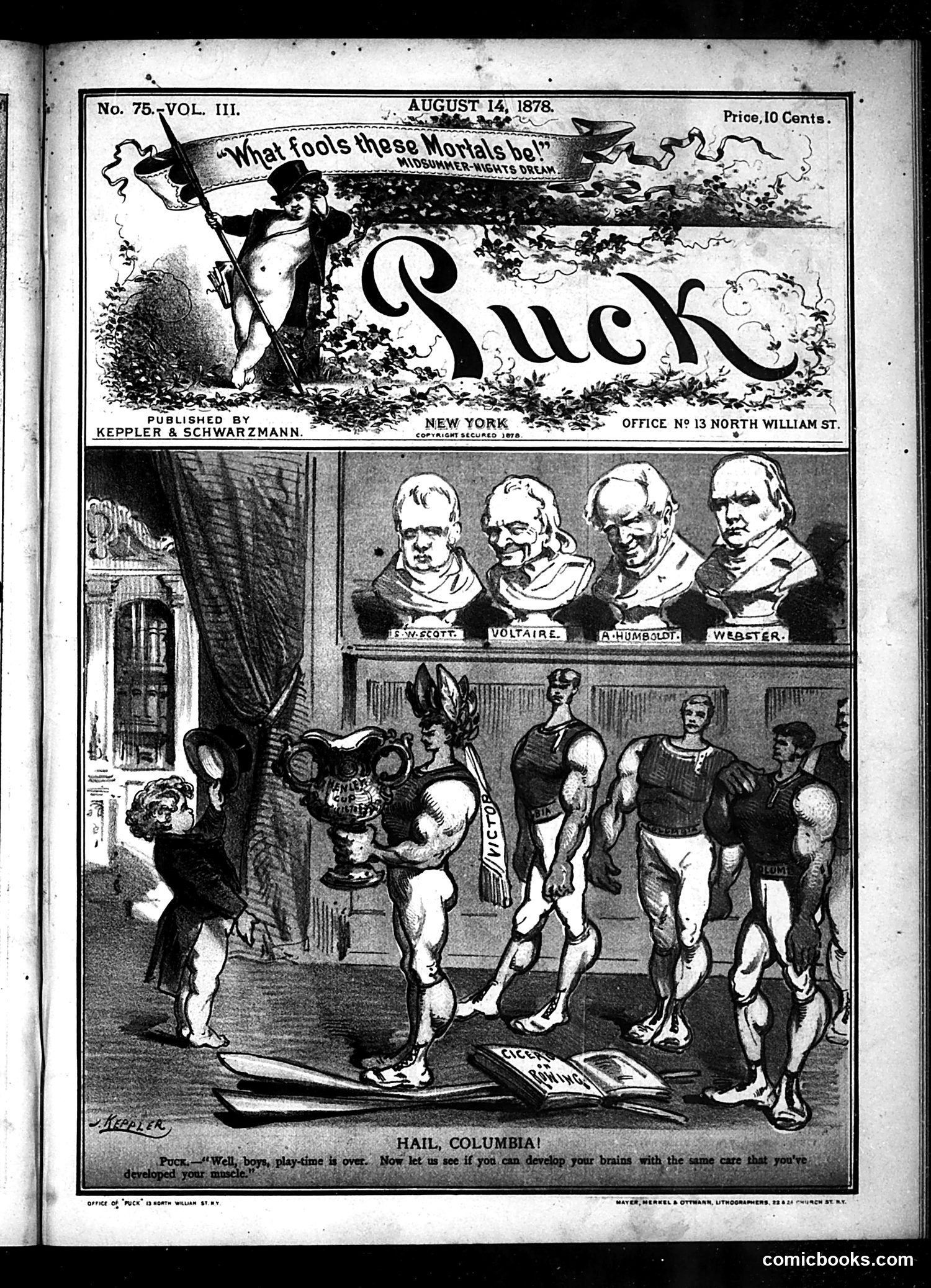
This cartoon, titled "Hail, Columbia!" satirizes American intellectuals and their reverence for European philosophy. The four busts displayed—labeled E.W. Scott, Voltaire, A. Humboldt, and Webster—represent European thinkers alongside American figures. The main scene shows a muscular figure performing gymnastics while others observe. The caption's dialogue suggests Puck is mocking Americans who prioritize developing their minds through abstract European philosophy while neglecting practical physical development: "Now let us see if you can develop your brains with the same care that you've developed your muscles." The satire critiques the American intellectual class's excessive admiration of European thought and their perceived imbalance between physical and mental cultivation.
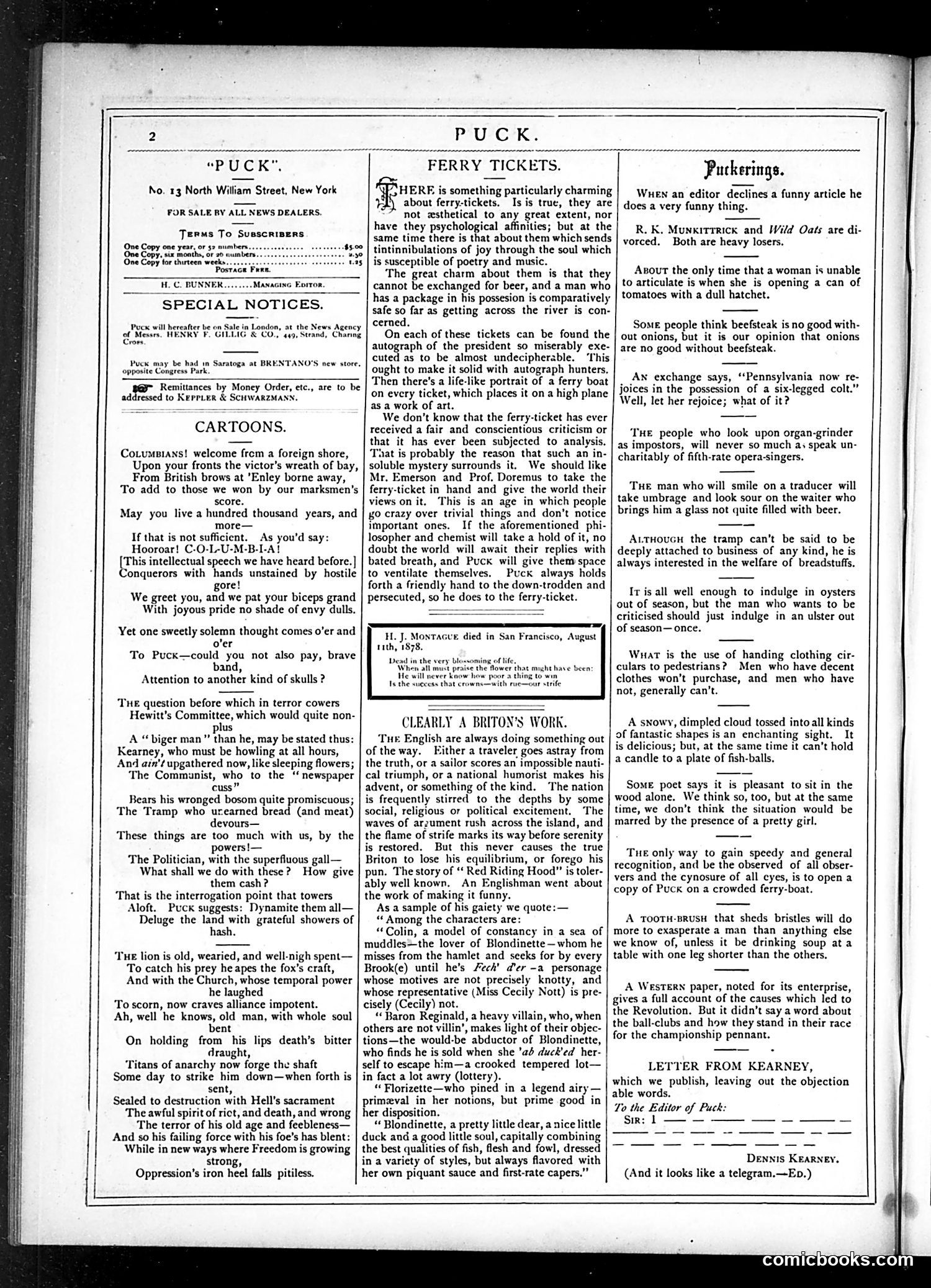
This page consists primarily of **editorial commentary and humor pieces rather than political cartoons**. The content includes: **"Ferry Tickets"** section discusses the charm of ferry tickets as collectibles, noting they've attracted autograph hunters and spawned discussion among philosophers and chemists. **"Clearly a Briton's Work"** satirizes English cultural productivity, suggesting the English constantly produce something notable—whether serious (like "Red Riding Hood") or trivial. The piece lists various English literary/cultural achievements with gentle mockery. **Multiple short humor items** address contemporary social observations: women opening tomato cans, betterment without onions, Pennsylvania's "blessed cold," and organ-grinder imposters. The page reflects **Puck's satirical approach to everyday social commentary** rather than partisan politics. The humor targets general human foibles and minor cultural absurdities rather than specific political figures or events.
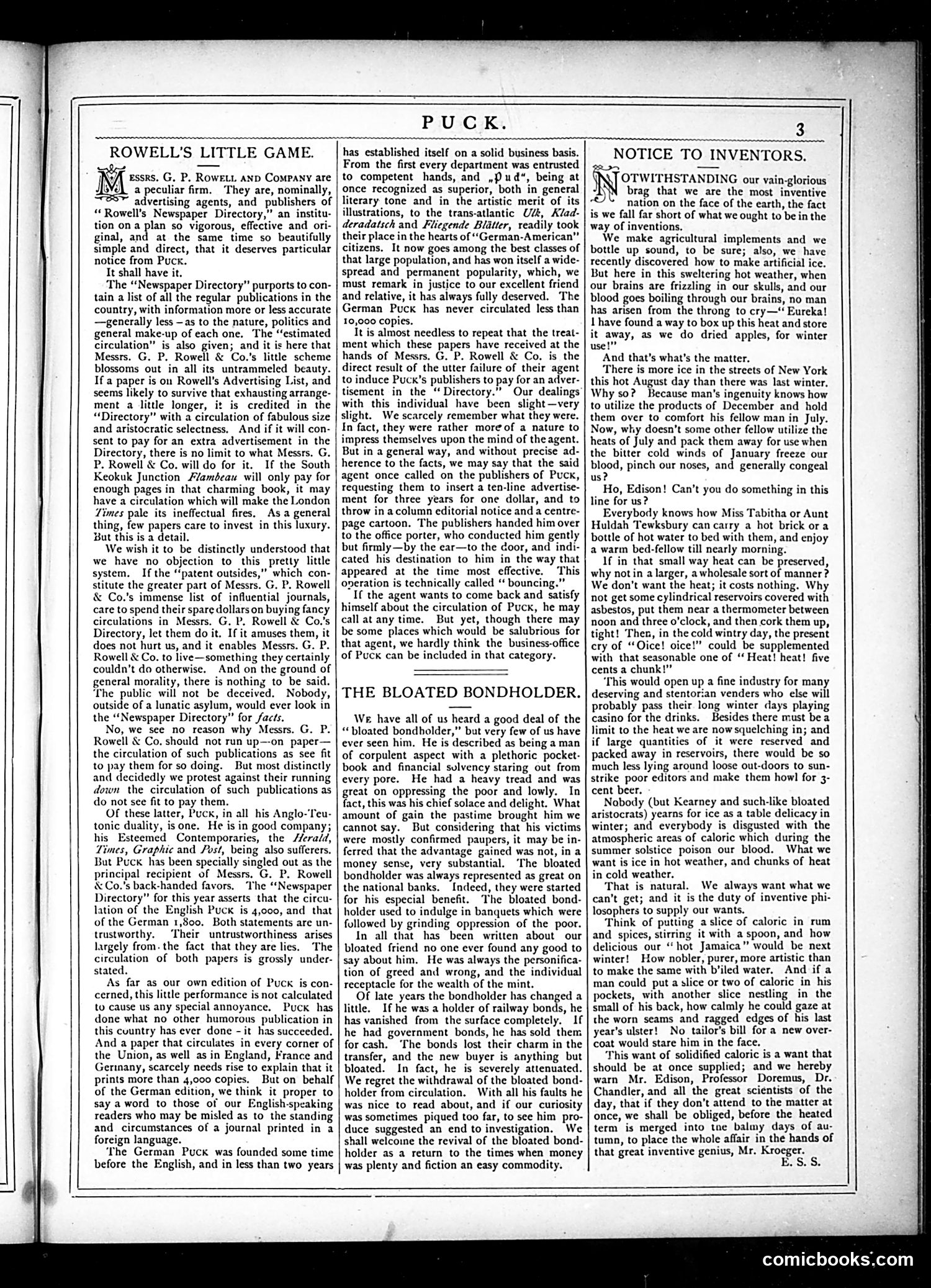
This page consists primarily of **three editorial articles rather than political cartoons**. The content addresses: 1. **Rowell's Little Game** — criticism of G.P. Rowell & Company, advertising agents, for their "Newspaper Directory" listing inaccurate circulation figures. Puck accuses them of understating their own publication's circulation while exaggerating others', allegedly to manipulate advertising placements. 2. **Notice to Inventors** — humorous advice on various impractical inventions, including artificial ice and heat-preservation methods for winter food storage. 3. **The Bloated Bondholder** — satirizes wealthy bondholders who profit from national debt while opposing aid to the poor. The piece criticizes their self-interested financial practices and suggests renewed public scrutiny of such figures. The satire targets business corruption and economic inequality of the era.
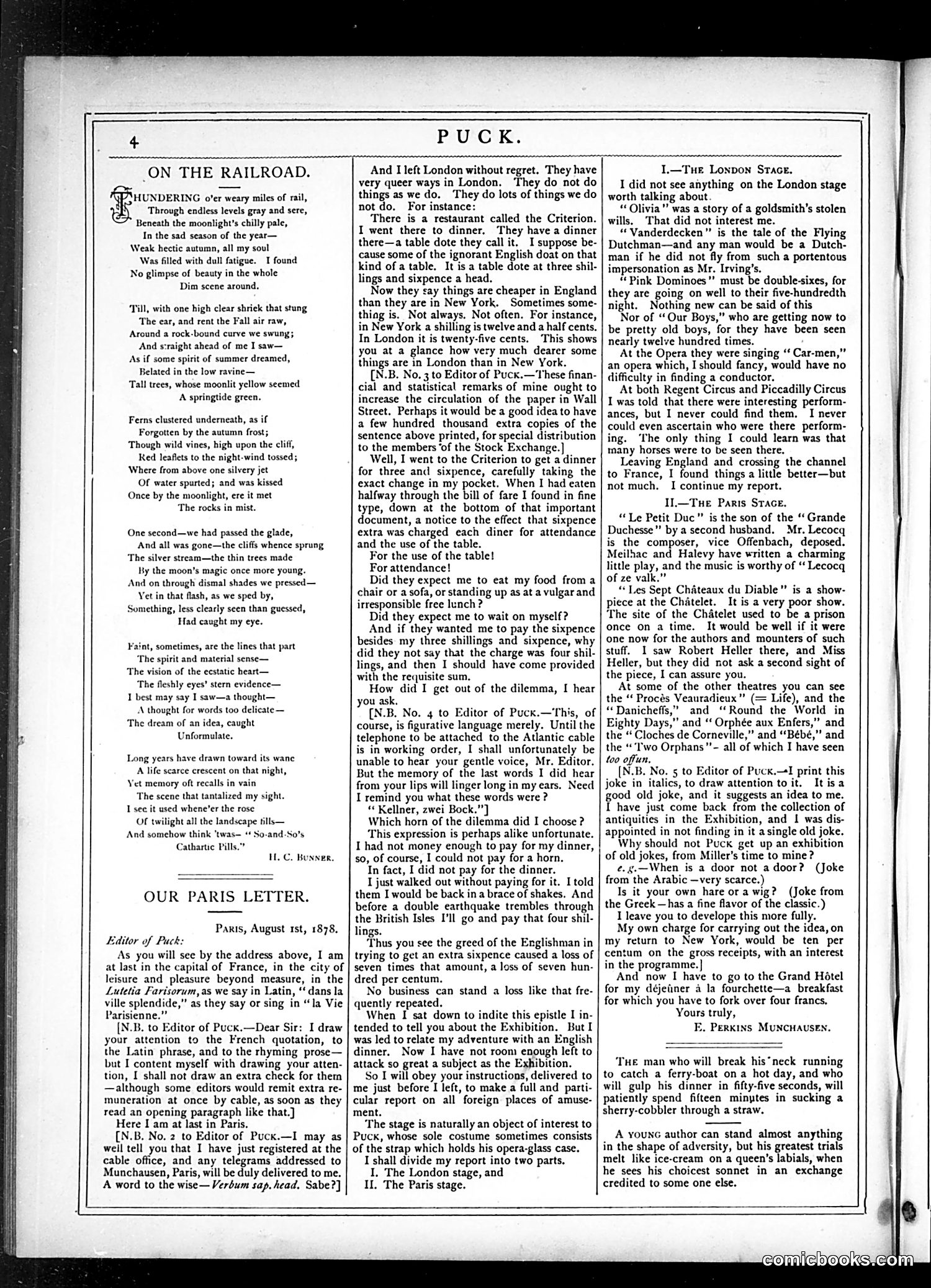
This page contains three separate sections rather than a unified cartoon: 1. **"On the Railroad"** - A poem by H.C. Bunner describing tedious train travel, with no apparent satirical target. 2. **"The London Stage"** and **"The Paris Stage"** - Theater reviews discussing London and Paris productions, including opera and comedies. These are straightforward critical commentary on European theatrical offerings. 3. **"Our Paris Letter"** - A correspondent's account of Parisian life, including complaints about English tourists and restaurant pricing disparities between London and Paris. **No clear political satire is evident.** This appears to be a miscellaneous editorial/entertainment page mixing travel writing, theater criticism, and social observation rather than political cartooning. The humor is mild and observational rather than pointed satire.
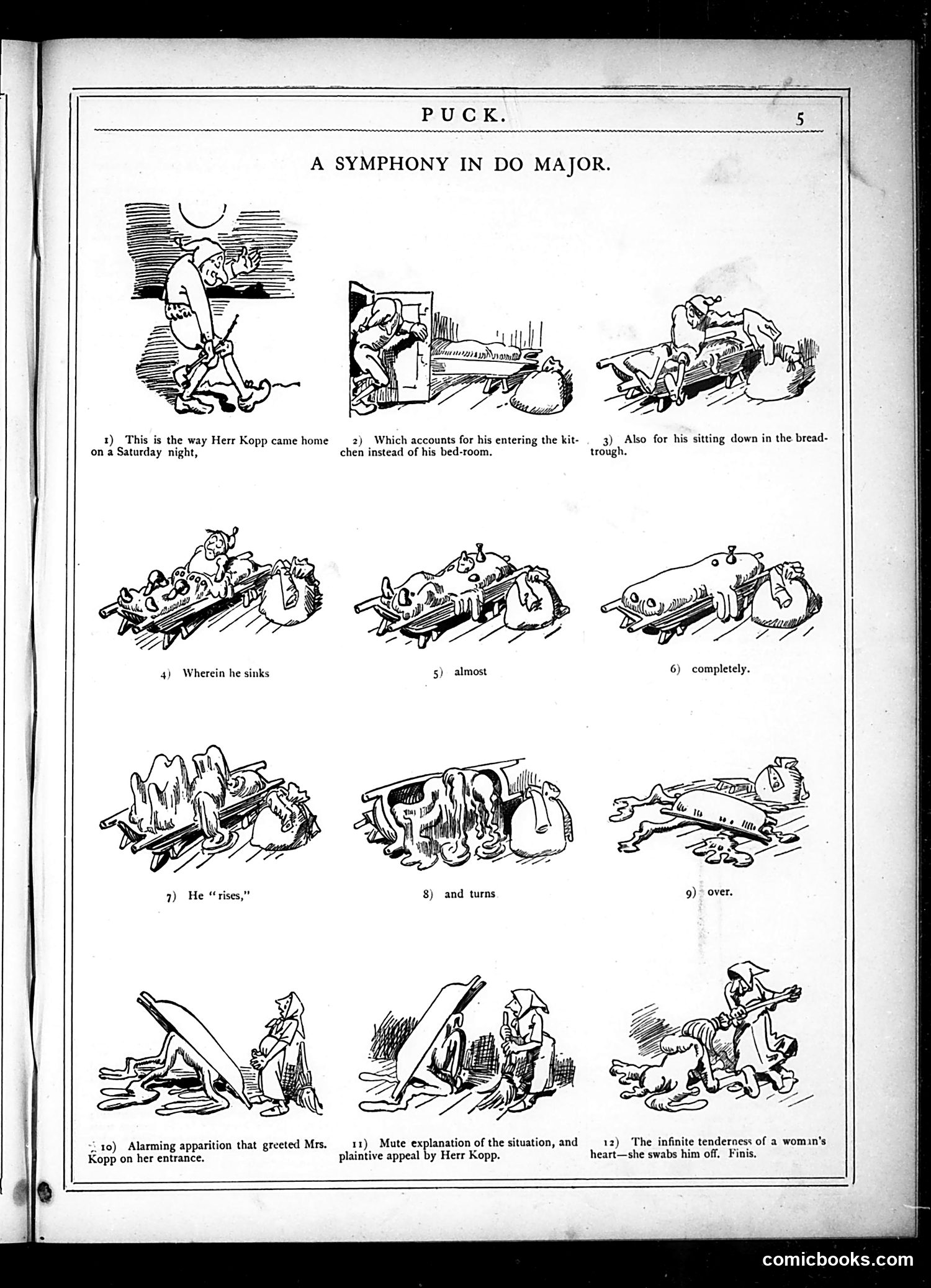
This is a visual pun comic strip following "Herr Kopp" (a German character, suggested by the German name) coming home drunk on a Saturday night. The "symphony in do major" refers to the sound of falling objects—specifically, crockery and dishes ("do" evoking the clinking sounds). The narrative sequence shows: Kopp stumbling into the kitchen instead of his bedroom, sitting in the breadtrough, sinking into dishwater, nearly submerging, and emerging covered in dishware. His wife's reaction progresses from shock to attempting to clean him up before ultimately swabbing him off in resignation—"the infinite tenderness of a woman's heart." The humor relies on slapstick physical comedy and the implicit German stereotype of heavy drinking, popular in 19th-century American satire.
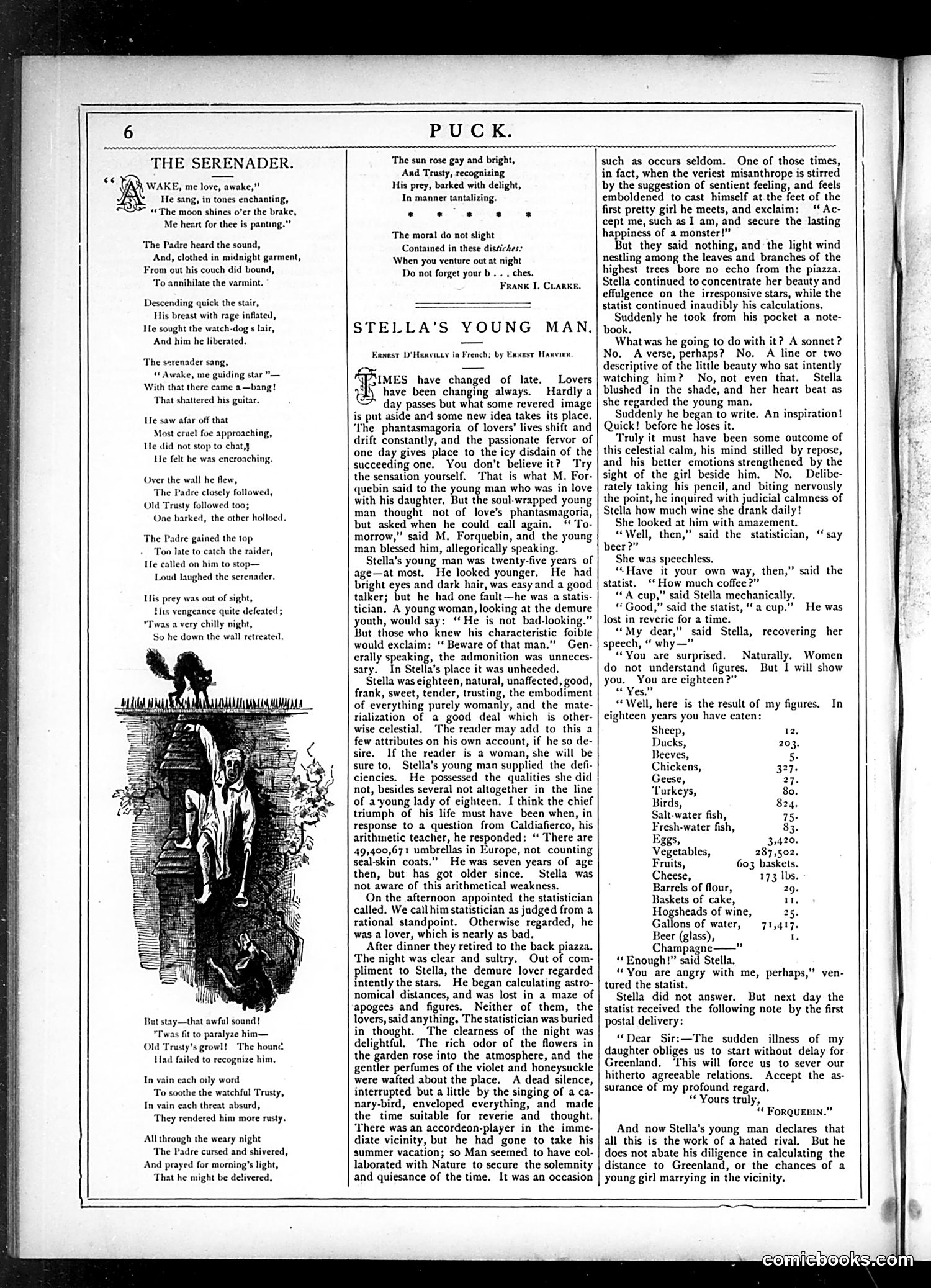
This page contains literary content rather than political satire. It features "The Serenader," a poem about romantic courtship, and "Stella's Young Man," a prose story by Ernest d'Hervilly translated from French. The narrative concerns a statistician lover who calculates astronomical data and distances rather than expressing genuine emotion. The story satirizes excessive rationalism and emotional coldness in romance—the statistician's obsession with numbers and calculations makes him an inadequate suitor despite possessing Stella's other ideal qualities. The accompanying illustration shows figures in what appears to be a garden or courtyard scene, supporting the romantic narrative. This reflects late-19th-century satirical humor mocking overly intellectual, emotionally-detached men and the tension between rational analysis and human feeling.
This page contains three distinct pieces of satirical content: 1. **"Ah, Why?" - A Blue-Bellied Temperance Ballad**: A poem mocking temperance advocates, using dialect and humorous scenarios about working-class people trying to improve their finances through abstinence—suggesting the movement's unrealistic expectations. 2. **"A Protest Against the Wicked Dailies"**: A letter from "Mrs. Baker Beane" criticizing newspapers for publishing sensationalist stories about fortune-tellers, con artists, and swindlers. She argues these accounts encourage fraud rather than preventing it, and calls for newspapers to stop covering such schemes entirely. 3. **"Foreign Correspondence"**: A letter from Brooklyn (July 30, 1878) describing infrastructure improvements, municipal salary reform, and urban development—likely praising civic progress and modernization efforts. The page satirizes both temperance movements and press sensationalism while celebrating urban development.
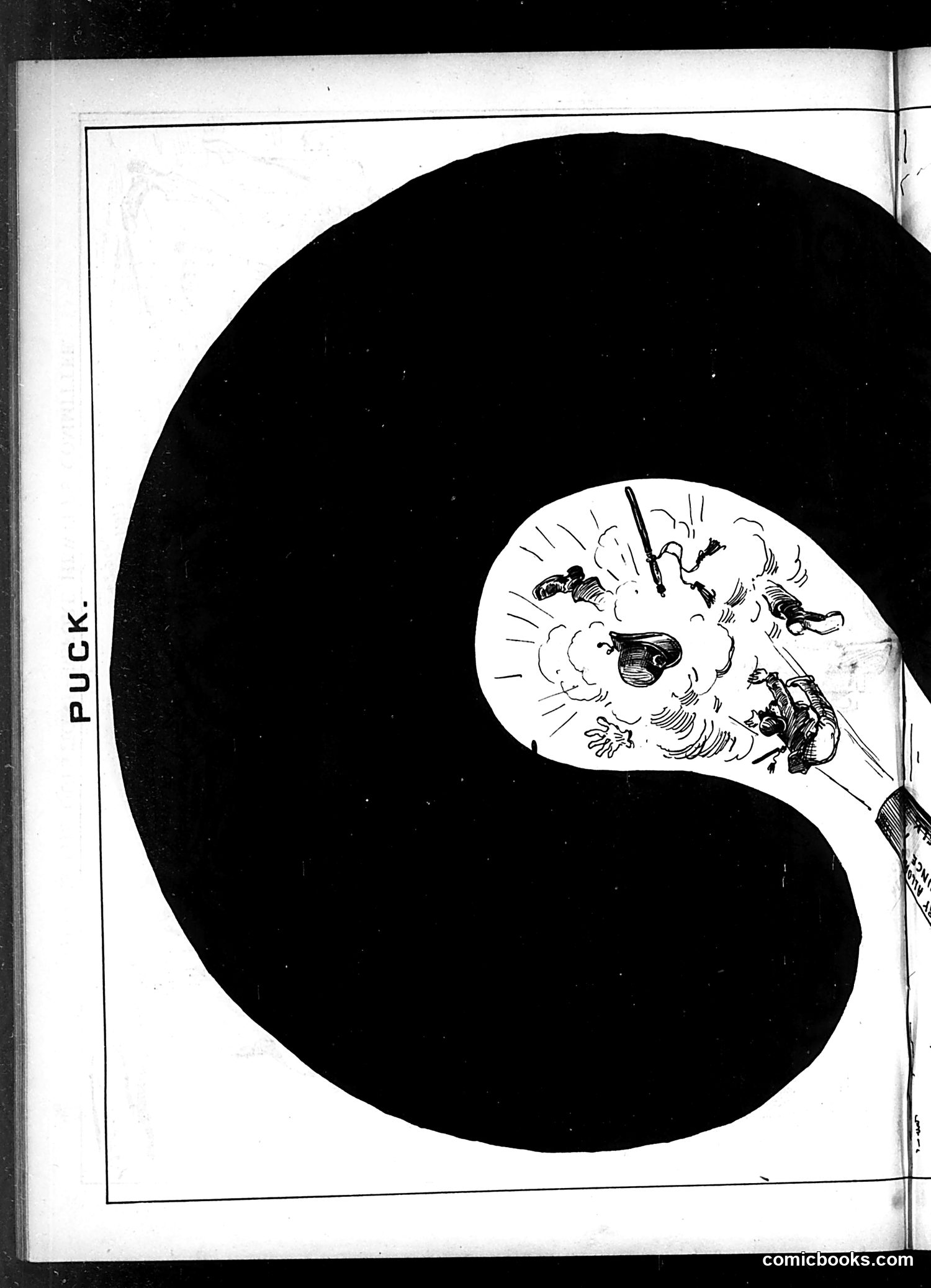
This is a Puck magazine page labeled "PUCK" on the left margin. The cartoon depicts a large black yin-yang symbol, with the white section containing a detailed illustration of what appears to be a chaotic scene with multiple figures in conflict or struggle, rendered in fine cross-hatching detail. Without clearer context from the OCR text (which appears incomplete or corrupted), I cannot definitively identify the specific political figures, historical event, or satirical point this cartoon references. The yin-yang composition suggests a commentary on opposing forces or balance of power, and the turbulent scene within the white section indicates conflict or turmoil. The style and composition suggest early-to-mid 20th century political satire, but determining the precise meaning requires additional historical or textual context not clearly legible here.
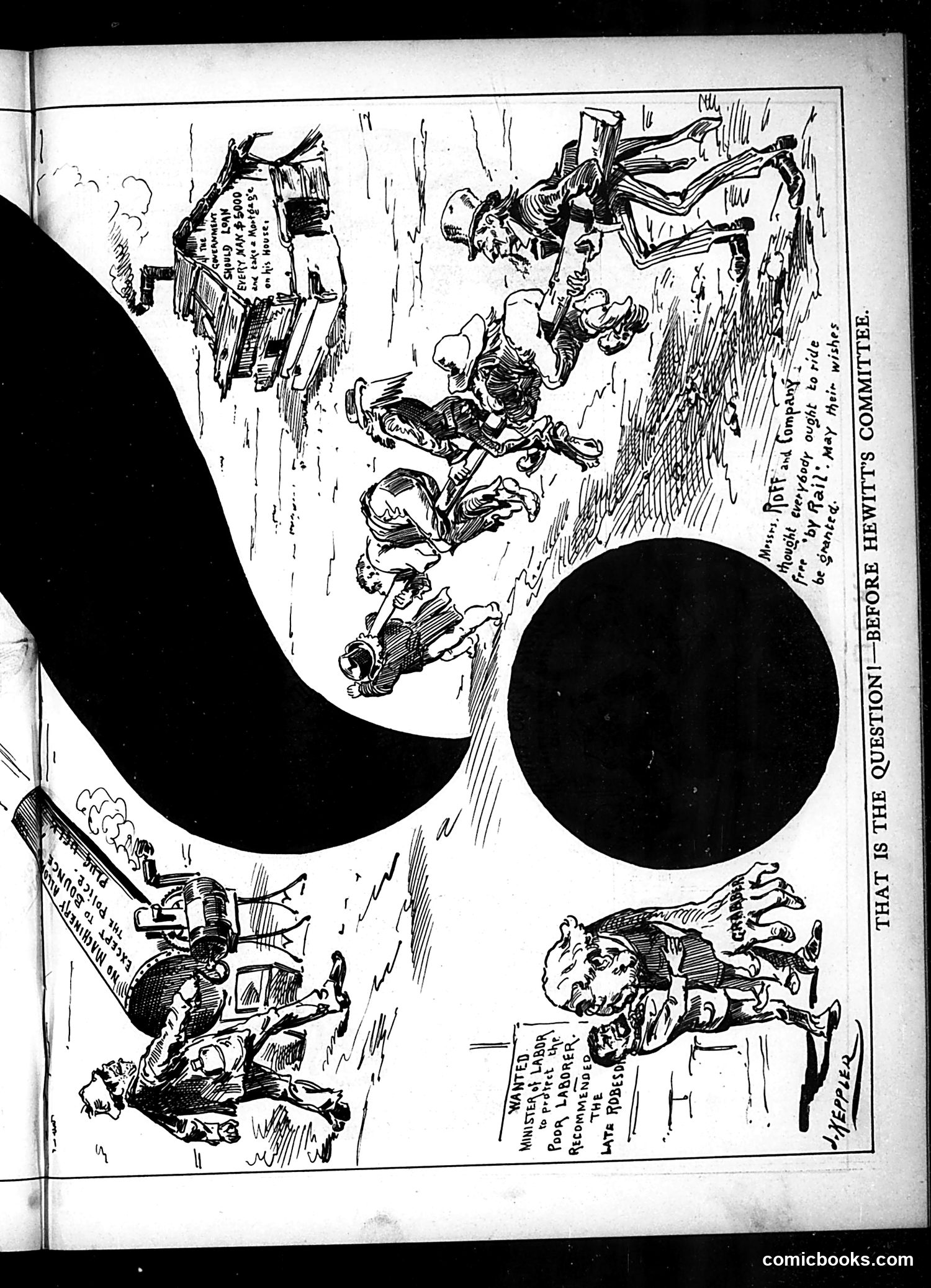
This Puck magazine page presents a satirical cartoon titled "THAT IS THE QUESTION—BEFORE HEWITT'S COMMITTEE" (visible on the right side). The cartoon appears to critique a political committee's investigation, likely from the Gilded Age era based on the art style. The image shows caricatured figures in apparent chaos or distress, with two large black circles (possibly representing empty spaces where specific details were removed or censored). The scattered composition and exaggerated expressions suggest mockery of the committee members or witnesses involved. The satire likely targets the committee's ineffectiveness, confused proceedings, or inability to reach clear conclusions. Without clearer text or date visibility, I cannot identify specific committee members or the precise political controversy being lampooned, though "Hewitt" may reference a historical congressional figure of that era.
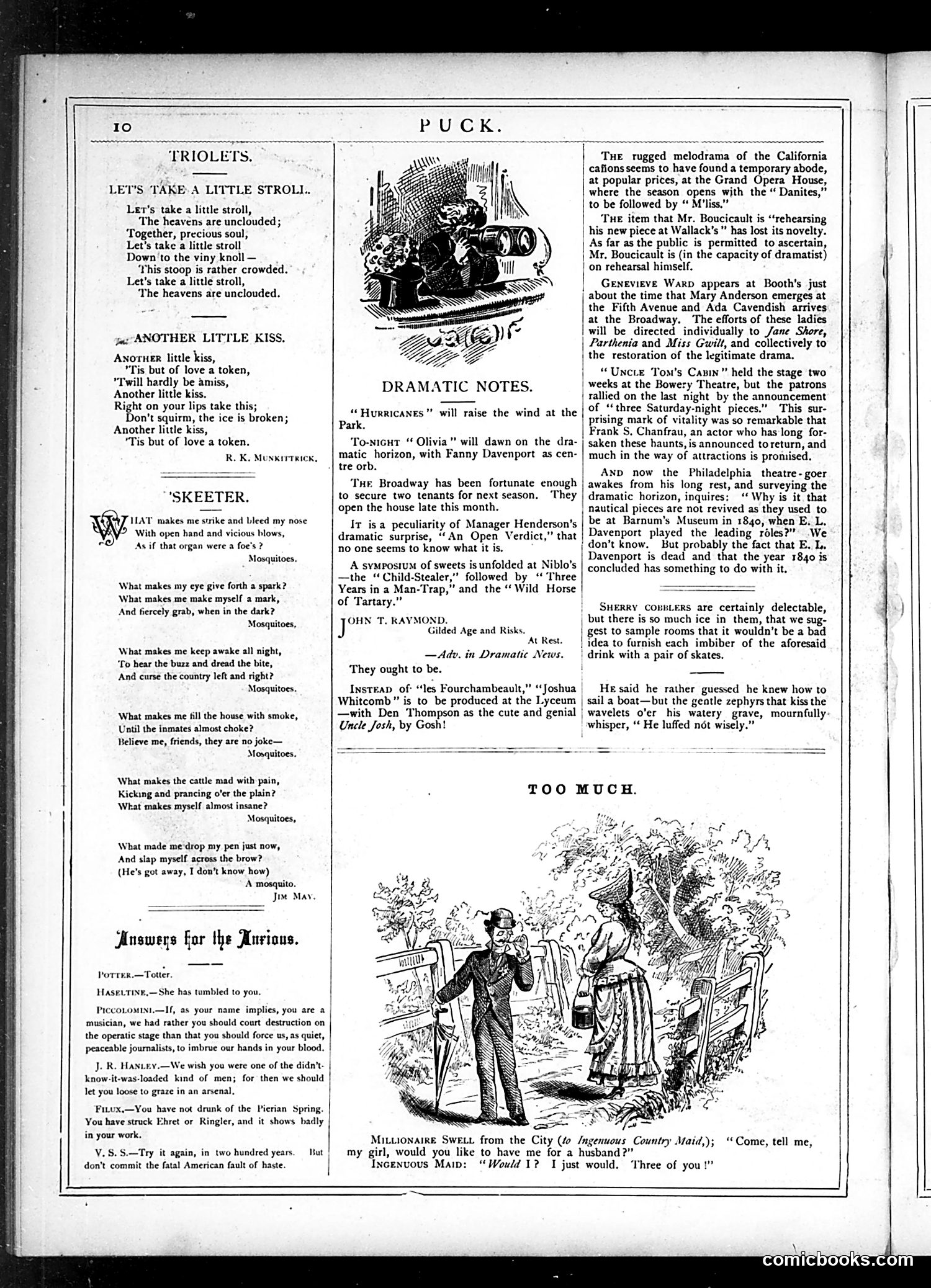
This page contains literary content rather than political cartoons. The main items are: **"Triolets"** and **"Skkeeter"**: Poetry pieces, with "Skkeeter" appearing to be humorous verse about mosquitoes that "make me strike and bleed my nose." **"Dramatic Notes"**: Theater reviews mentioning productions like "Hurricanes," "Olivia," and "Uncle Tom's Cabin," plus gossip about actors and Broadway happenings. **"Too Much"**: A cartoon showing a well-dressed man proposing to a working-class woman with the caption about offering marriage. The joke appears to mock class differences and romantic presumptions. **"Answers for the Anxious"**: An advice column addressing readers' questions, including one about being heckled at a musical performance. The page is primarily entertainment-focused rather than politically satirical.
This page contains a **serialized short story** titled "For Better, for Worse?" rather than a political cartoon. The narrative, continued from a previous issue, depicts a domestic drama between a married couple—Edgar and Florence—whose relationship is strained by Edgar's emotional distance and absorption in his work. The story explores **Victorian-era marriage anxieties**: Florence feels neglected despite Edgar's financial provision; Edgar remains emotionally guarded, suspicious that Florence only married him for money. The text emphasizes their mutual misunderstandings and the era's gender dynamics regarding women's roles and romantic expectations. This appears to be **serialized fiction entertainment** rather than satirical commentary, offering contemporary readers insight into early 20th-century attitudes toward marriage, class, and spousal relationships.
This page contains serialized fiction and social commentary rather than political cartoons. The main content is "Part III" of a story about Edgar and various romantic entanglements, along with "The Modern School Teacher" poem on the right. The bottom section, "Puck's Briefings," contains brief satirical news items and jokes about contemporary topics: a Kentucky horse-race with lotteries, a politician buying ideas from a "hireling press," and various other social observations. The illustration shows what appears to be figures in period dress, though details are unclear from this reproduction. The content satirizes 1890s social institutions—education, journalism, gambling—through witty commentary rather than visual caricature. Without knowing the publication date, specific historical context remains difficult to pin down precisely.
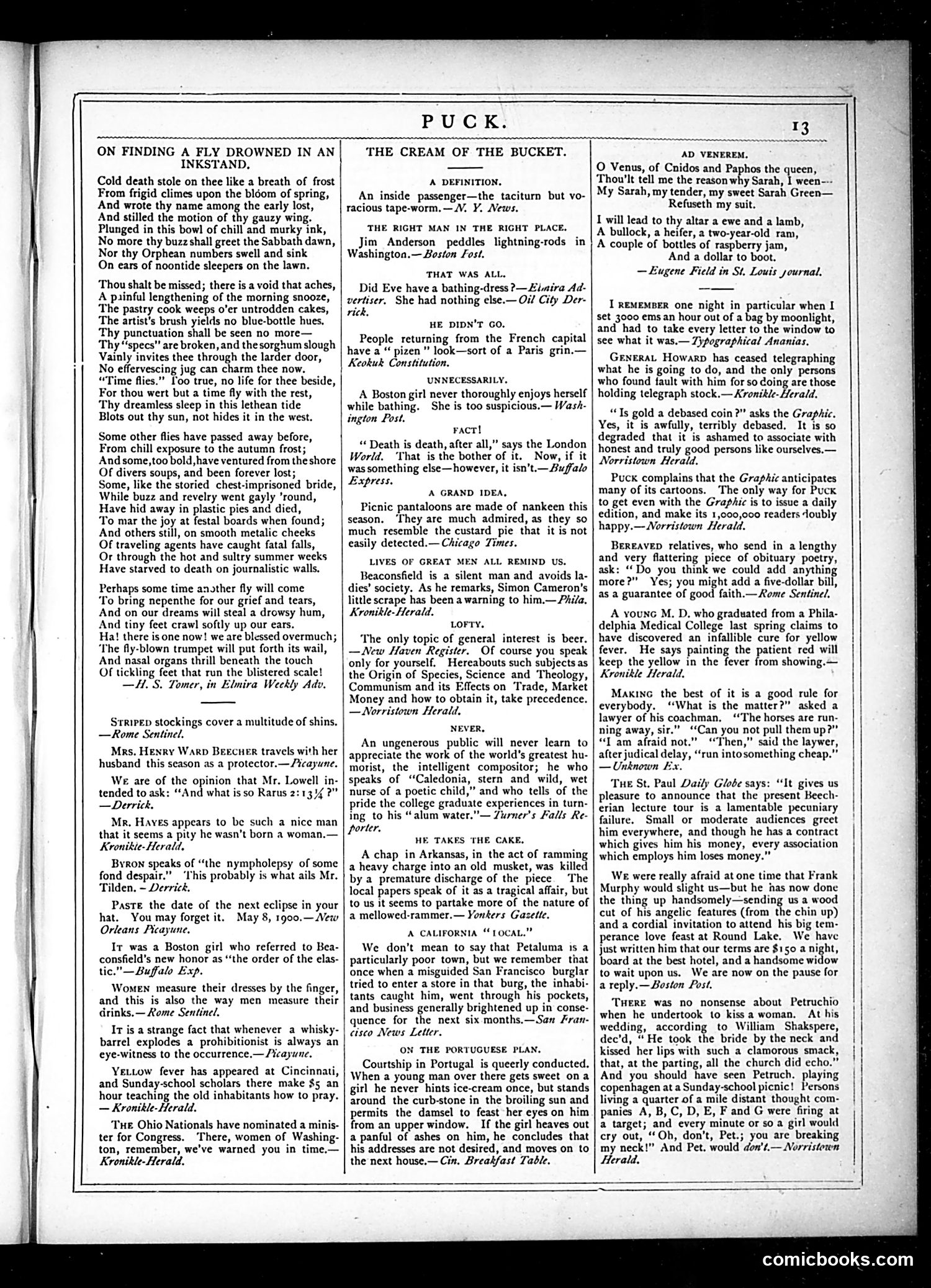
This page contains primarily **text content** rather than illustrated cartoons—it's a collection of satirical short pieces, jokes, and commentary typical of Puck's humor section. The pieces mock various contemporary subjects: a Boston girl's suspicious nature about bathing suits, ineffective prohibitionists, pretentious composers and artists, and bureaucratic absurdities. One item references a "California 'local'" involving a poor town and a store burglary—likely mocking sensationalized Western frontier stories. Several items appear to reference current events or public figures (Jim Anderson, portraits in Portuguese courtship customs), but **without visible illustrations or clearer context, specific identifications cannot be reliably determined**. The overall tone is characteristic of Puck: irreverent, urbane, and focused on social pretension and human folly rather than specific political figures.
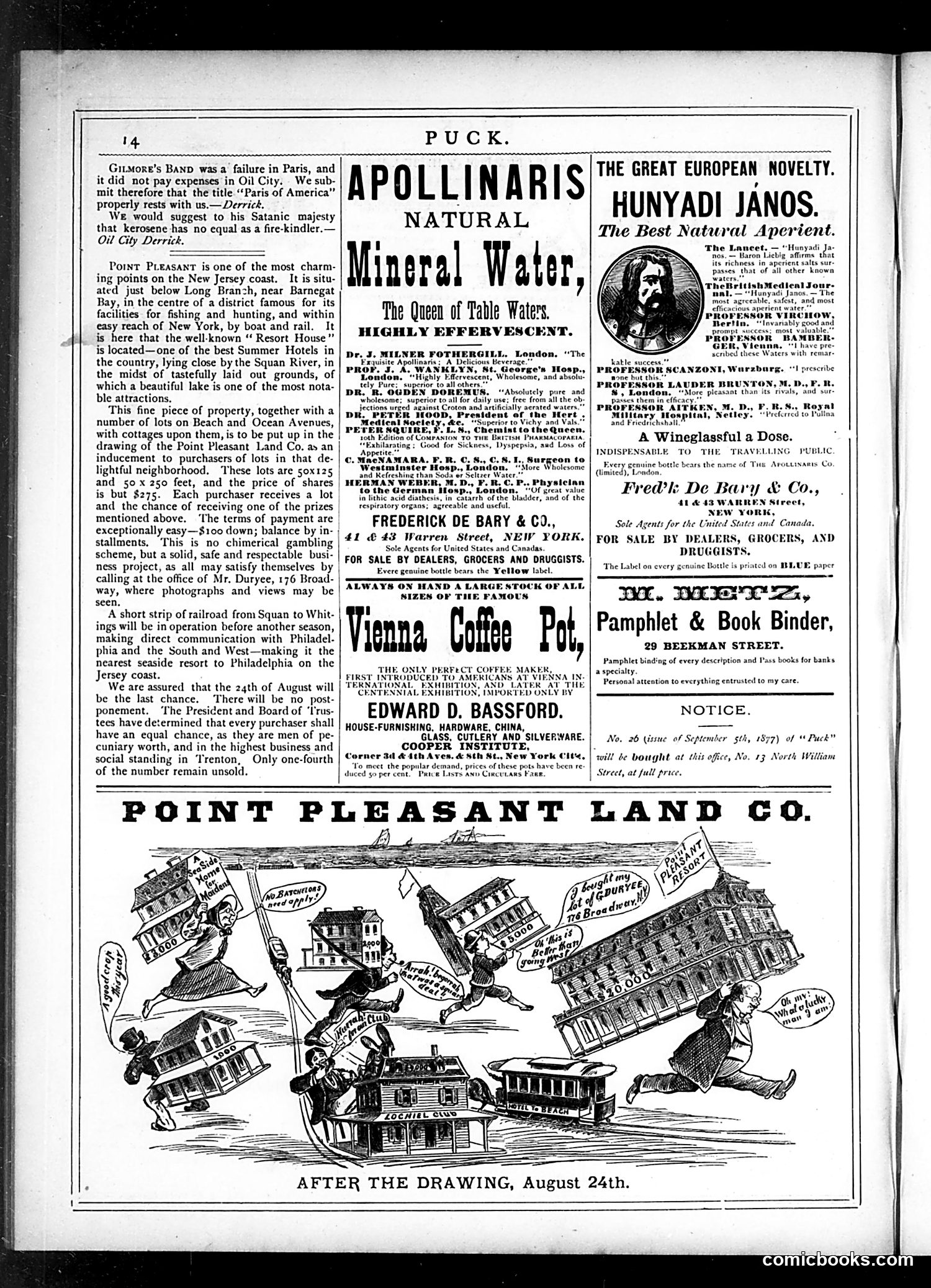
This page is primarily **advertisements** rather than political satire. The main illustration—labeled "Point Pleasant Land Co." with subtitle "After the Drawing, August 24th"—depicts a speculative real estate scheme as chaotic comedy. The cartoon shows multiple figures juggling or dropping buildings and property documents, with speech bubbles suggesting confusion and mismanagement. This satirizes the rampant land speculation and real estate fraud common in the 1870s Gilded Age. The scattered buildings, frantic poses, and characters' apparent distress mock investors and promoters making unrealistic promises about property developments. The "drawing" reference suggests a lottery or raffle scheme—a common fraudulent tactic for selling land. The surrounding advertisements (mineral water, coffee pots, binding services) are typical Puck revenue sources.
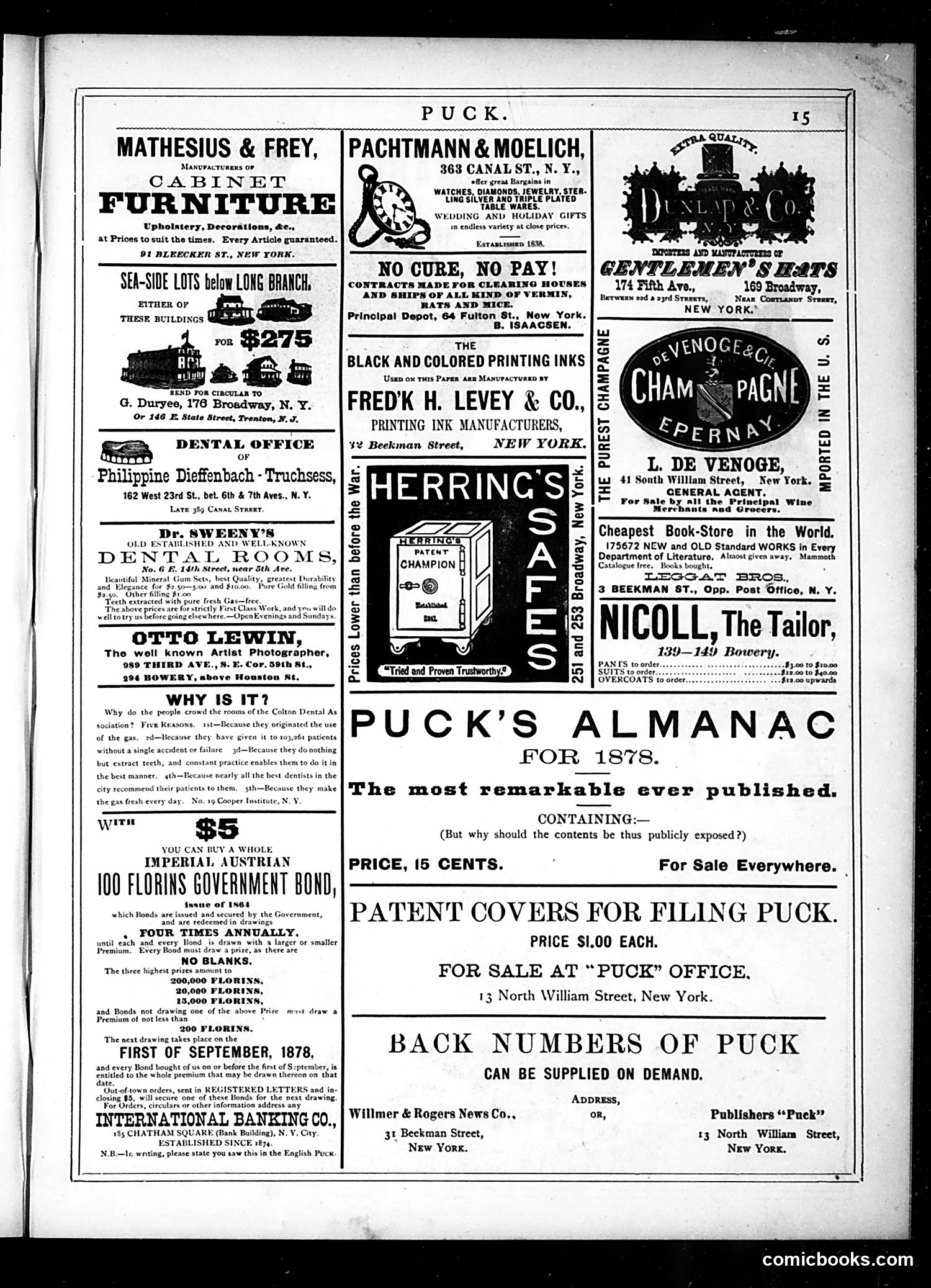
This page is primarily **advertising and promotional content** for Puck magazine itself, rather than satirical cartoons. The main content advertises **Puck's Almanac for 1878**, described as "the most remarkable ever published," priced at 15 cents. The text teases readers with "(but why should the contents be thus publicly exposed?)" — a self-promotional joke suggesting the almanac contains valuable or surprising material. The page also promotes **patent filing covers** for organizing Puck issues ($1.00 each) and announces that **back numbers can be supplied on demand** through their offices. The remaining space comprises typical period advertisements for furniture, printing inks, watches, hats, tailoring services, and financial instruments—standard commercial fare for 19th-century magazines. No specific political satire is evident on this particular page.
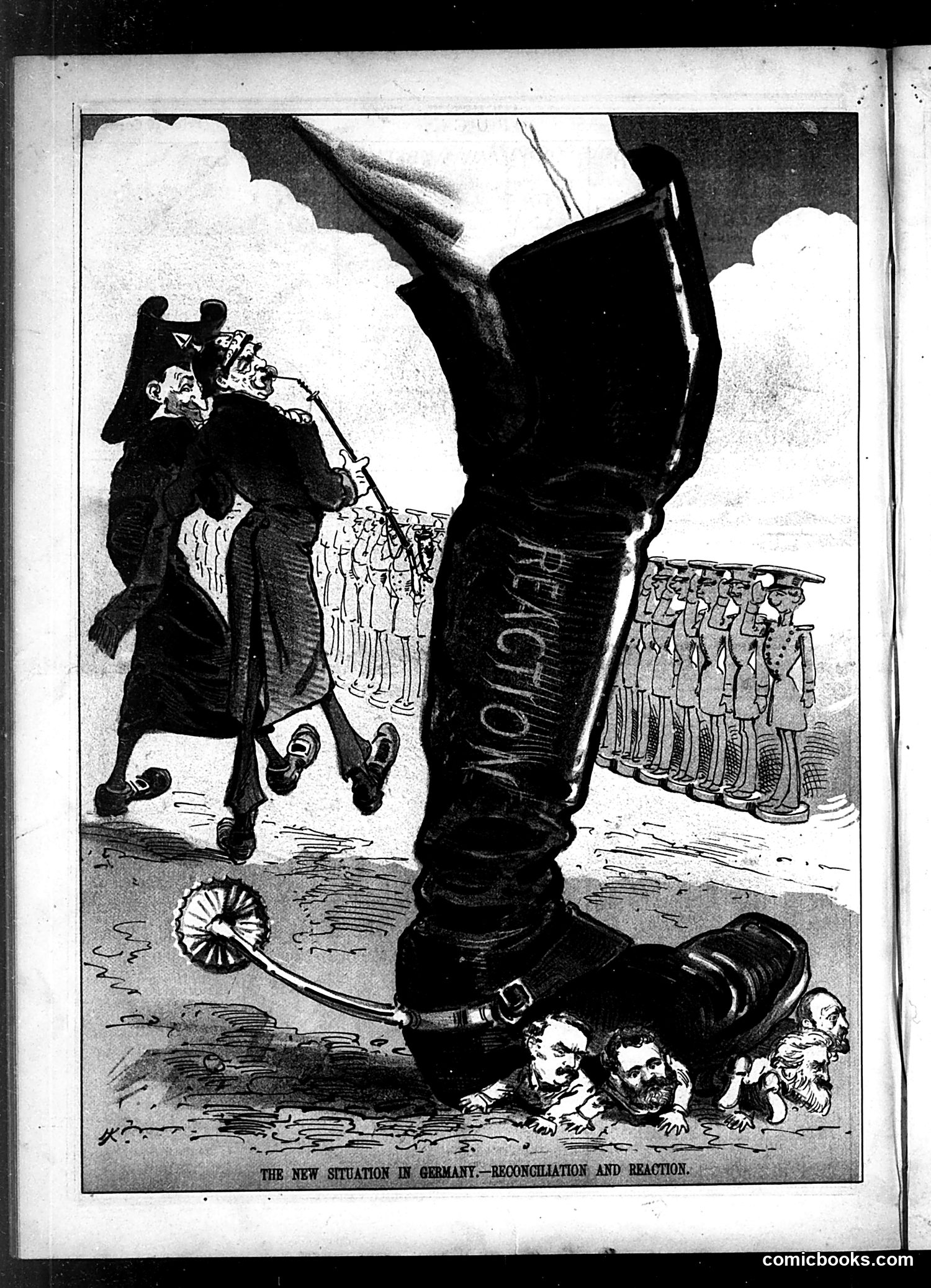
This Puck cartoon satirizes post-WWI German politics, likely from the early 1920s. A massive military boot labeled "Militarism" crushes small figures beneath it, while German military and political leaders (depicted with exaggerated features characteristic of the era) stand in the background, appearing to march or assemble. The satire critiques the failure of German "reconciliation and reaction"—suggesting that despite post-war political reforms, militaristic forces remained dominant. The trampled figures represent the German people or democratic hopes, crushed under the boot of resurgent militarism. The cartoon warns that German authoritarianism and military culture persisted despite the Weimar Republic's establishment, foreshadowing later developments in German history.