
Puck, 1878-08-14 · page 11 of 16
Puck — August 14, 1878 — page 11: what you’re looking at
What you’re looking at
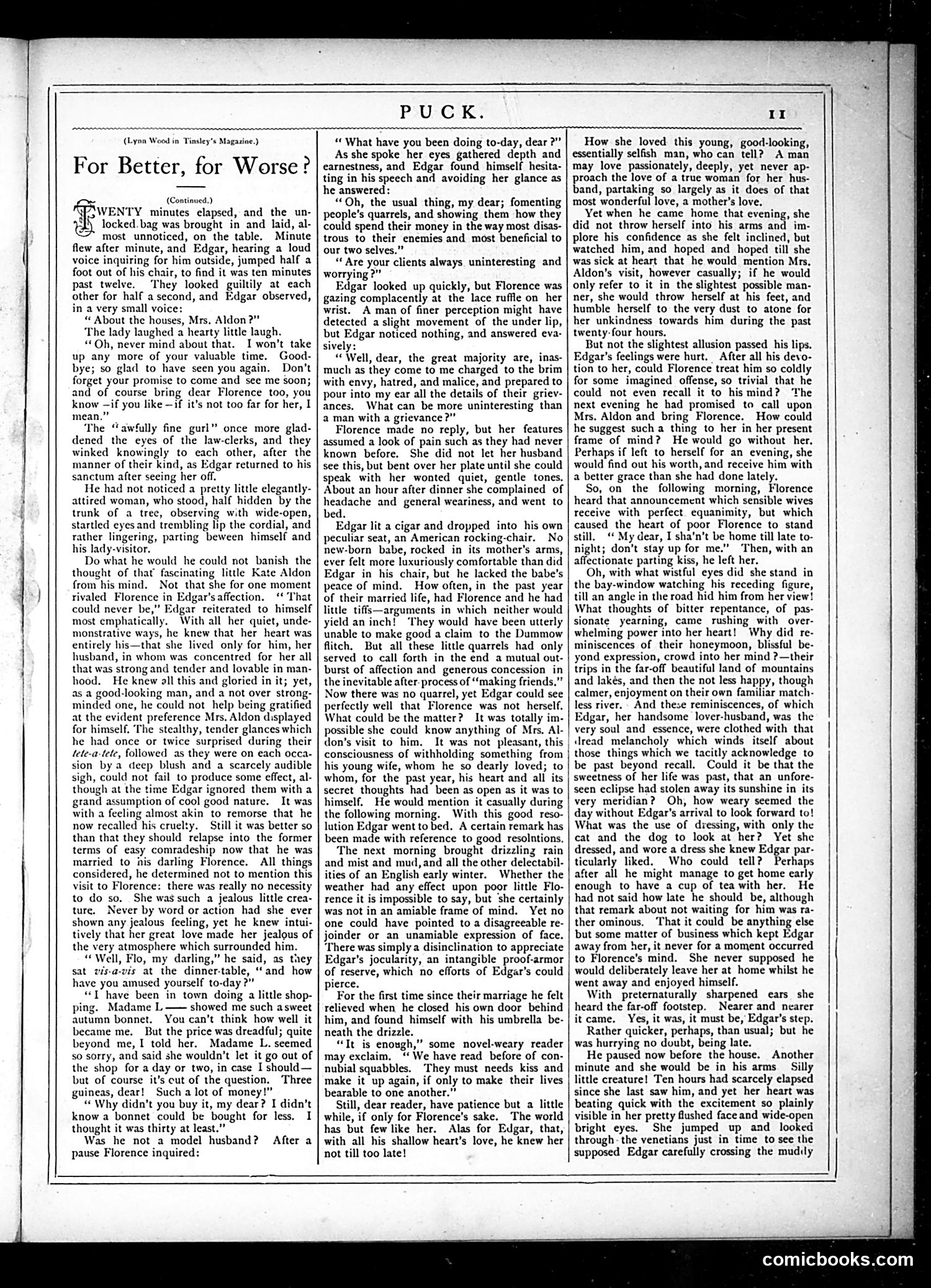
This page contains a **serialized short story** titled "For Better, for Worse?" rather than a political cartoon. The narrative, continued from a previous issue, depicts a domestic drama between a married couple—Edgar and Florence—whose relationship is strained by Edgar's emotional distance and absorption in his work. The story explores **Victorian-era marriage anxieties**: Florence feels neglected despite Edgar's financial provision; Edgar remains emotionally guarded, suspicious that Florence only married him for money. The text emphasizes their mutual misunderstandings and the era's gender dynamics regarding women's roles and romantic expectations. This appears to be **serialized fiction entertainment** rather than satirical commentary, offering contemporary readers insight into early 20th-century attitudes toward marriage, class, and spousal relationships.
📄 Transcribed text from this page (OCR, searchable)
Machine-transcribed from the original scan — historical spelling and the odd misread are preserved.
PUCK. II (Lynn Wood in Tinsley’s Magazine.) For Better, for Worse? (Continved.) 3S WENTY minutes elapsed, and the un- rey locked.bag was brought in and laid, al- <* most unnoticed, on the table. Minute flew after minute, and Edgar, hearing a loud voice inquiring for him outside, jumped half a foot out of his chair, to find it was ten minutes past twelve. They looked guiltily at each other for half a second, and Edgar observed, in a very small voice: “ About the houses, Mrs, Aldon?” ‘The lady laughed a hearty little laugh. “Oh, never mind about that. I won't take up any more of your valuable time. Good- bye; so glad to have seen you again. Don't forget your promise to come and see me soon; and of course bring dear Florence too, you know —if you like —if it's not too far for her, I mean, The ‘awfully fine gurl” once more glad- dened the eyes of the law-clerks, and they winked knowingly to each other, after the manner of their kind, as Edgar returned to his sanctum after seeing her off. He had not noticed a pretty little elegantly- attired woman, who stood, half hidden by the trunk of a tree, observing with wide-open, startled eyes and trembling lip the cordial, and rather lingering, parting beween himself and his lady-visitor. Do what he would he could not banish the thought of that’ fascinating little Kate Aldon from his mind. Not that she for one moment rivaled Florence in Edgar’saffection. ‘ That could never be, gar reiterated to himself most emphatically. With all her quiet, unde- monstrative ways, he knew that her heart was entirely his—that she lived only for him, her husband, in whom was concentred for her all that was strong and tender and lovable in man- hood. He knew all this and gloried in it; yet, as a good-looking man, and a not over strong- minded one, he could not help being gratified at the evident preference Mrs. Aldon displayed for himself. ‘The stealthy, tender glances which he had once or twice surprised during their tete-a-tete, followed as they were on each occa- sion by a deep blush and a scarcely audible sigh, could not fail to produce some effect, al- though at the time Edgar ignored them with a grand assumption of cool good nature. It was with a feeling almost akin to remorse that he now recalled his cruelty. Still it was better so than that they should relapse into the former terms of easy comradeship now that he was married to nis darling Florence. All things considered, he determined not to mention this visit to Florence: there was really no necessity to do so, She was such a jealous little crea- ture. Never by word or action had she ever shown any jealous feeling, yet he knew intui- tively that her great love made her jealous of the very atmosphere which surrounded him. “Well, Flo, my darling,” he said, as they sat vis-a-vis at the dinner-table, ‘and how have you amused yourself to-day ?” “T have been in town doing a little shop- ping. Madame L— showed me such asweet autumn bonnet. You can’t think how well it became me. But the price was dreadful; quite beyond me, I told her. Madame L. seemed so sorry, and said she wouldn’t let it go out of the shop for a day or two, in case I should— but of course it’s cut of the question. Three guineas, dear! Such a lot of money!” “Why didn’t you buy it, my dear? I didn’t know a bonnet could be bought for less. I thought it was thirty at least.” Was he not a model husband? After a pause Florence inquired: “What have you been doing to-day, dear ?” As she spoke her eyes gathered depth and earnestness, and Edgar found himself hesita- ting in his speech and avoiding her glance as he answered: “Oh, the usual thing, my dear; fomenting people's quarrels, and showing them how they could spend their money in the way most disas- trous to their enemies and most beneficial to our two selves.” “ Are your clients always. uninteresting and worrying ?” Edgar looked up quickly, but Florence was gazing complacently at the lace ruffle on her wrist. A man of finer perception might have detected a slight movement of the under lip, but Edgar noticed nothing, and answered eva- sively: “Well, dear, the great majority are, inas- much as they come to me charged to the brim with envy, hatred, and malice, and prepared to pour into my ear all the details of their griev- ances. What can be more uninteresting than a man with a grievance?” Florence made no reply, but her features assumed a look of pain such as they had never known before. She did not let her husband see this, but bent over her plate until she could speak with her wonted quiet, gentle tones, About an hour after dinner she complained of headache and general weariness, and went to bed. Edgar lit a cigar and dropped into his own peculiar seat, an American rocking-chair. No new-born babe, rocked in its mother’s arms, ever felt more luxuriously comfortable than did Edgar in his chair, but he lacked the babe’s peace of mind. How often, in the past year of their married life, had Florence and he had little tiffs—arguments in which neither would yield an inch! ‘They would have been utterly unable to make good a claim to the Dummow flitch. But all these little quarrels had only served to call forth in the end a mutual out- burst of affection and generous concession in the inevitable after- process of ‘making friends,”” Now there was no quarrel, yet Edgar could see perfectly well that Florence was not herself. What could be the matter? It was totally im- possible she could know anything of Mrs, Al- don’s visit to him, It was not pleasant, this consciousness of withholding something from | his young wife, whom he so dearly loved; to whom, for the past year, his heart and all its secret thoughts had been as open as it was to himself, He would mention it casually during the following morning. With this good reso- lution Edgar went to bed. A certain remark has been made with reference to good resolntions. The next morning brought drizzling rain and mist and mud, and all the other delectabil- ities of an English early winter. Whether the weather had any effect upon poor little Flo- rence it is impossible to say, but ‘she certainly was not in an amiable frame of mind. Yet no one could have pointed to a disagreeable re- joinder or an unamiable expression of face. ‘There was simply a disinclination to appreciate Edgar’s jocularity, an intangible proof-armor of reserve, which no efforts of Edgar's could pierce. For the first time since their marriage he felt relieved when he closed his own door behind him, and found himself with his umbrella be- neath the drizzle. “Tt is enough,” some novel-weary reader may exclaim. ‘ We have read before of con- nubial squabbles. They must needs kiss and make it up again, if only to make their lives bearable to one another.” Still, dear reader, have patience but a little while, if only for Florence's sake. The world has but few like her. Alas for Edgar, that, with all his shallow heart’s love, he knew her not till too late! How she loved this young, good-looking, essentially selfish man, who can tell? A man may love passionately, deeply, yet never ap- proach the love of a true woman for her hus- band, partaking so largely as it does of that most wonderful love, a mother’s love. Yet when he came home that evening, she did not throw herself into his arms and im- plore his confidence as she felt inclined, but watched him, and hoped and hoped till she was sick at heart that he would mention Mrs, Aldon’s visit, however casually; if he would only refer to it in the slightest possible man- ner, she would throw herself at his feet, and humble herself to the very dust to atone for her unkindness towards him during the past twenty-four hours. But not the slightest allusion passed his lips. Edgar’s feelings were hurt. After all his devo- tion to her, could Florence treat him so coldly for some imagined offense, so trivial that he could not even recall it to his mind? ‘The next evening he had promised to call upon Mrs. Aldon and bring Florence. How could he suggest such a thing to her in her present frame of mind? He would go without her. Perhaps if left to herself for an evening, she would find out his worth, and receive him with a better grace than she had done lately. , on the following morning, Florence heard that announcement which sensible wives receive with perfect equanimity, but which caused the heart of poor Florence to stand still,“ My dear, I sha'n’t be home till late to- night; don’t stay up for me.” Then, with an affectionate parting kiss, he left her. Oh, with what wistful eyes did she stand in the bay-window watching his receding figure, till an angle in the road hid him from her view! What thoughts of bitter repentance, of pas- sionate yearning, came rushing with over- whelming power into her heart! Why did re- miniscences of their honeymoon, blissful be- yond expression, crowd into her mind ?—their trips in the far-off beautiful land of mountains and lakés, and then the not less happy, though calmer, enjoyment on their own familiar match- less river. And these reminiscences, of which Edgar, her handsome lover-husband, was the very soul and essence, were clothed with that dread melancholy which winds itself about those things which we tacitly acknowledge to be past beyond recall. Could it be that the sweetness of her life was past, that an unfore- seen eclipse had stolen away its sunshine in its very meridian? Oh, how weary seemed the day without Edgar’s arrival to look forward to! What was the use of dressing, with only the cat and the dog to look at her? Yet she dressed, and wore a dress she knew Edgar par- ticularly liked. Who could tell? Perhaps after all he might manage to get home carly enough to have a cup of tea with her. He had not said how late he should be, although that remark about not waiting for was ra- ther ominous, That it could be anything else but some matter of business which kept Edgar away from her, it never for a moment occurred to Florence's mind. She never supposed he would deliberately leave her at home whilst he went away and enjoyed himself. With preternaturally sharpened ears she heard the far-off footstep. Nearer and nearer it came. Yes, it was, it must be, Edgar’s step. Rather quicker, perhaps, than usual; but he was hurrying no doubt, being late. He paused now before the house. Another minute and she would be in his arms Silly little creature! Ten hours had scarcely elapsed since she last saw him, and yet her heart was beating quick with the excitement so plainly visible in her pretty flushed face and wide-open bright eyes. She jumped up and looked through: the venetians just in time to see the supposed Edgar carefully crossing the mudily comicbooks.com