
Puck, 1878-08-14 · page 4 of 16
Puck — August 14, 1878 — page 4: what you’re looking at
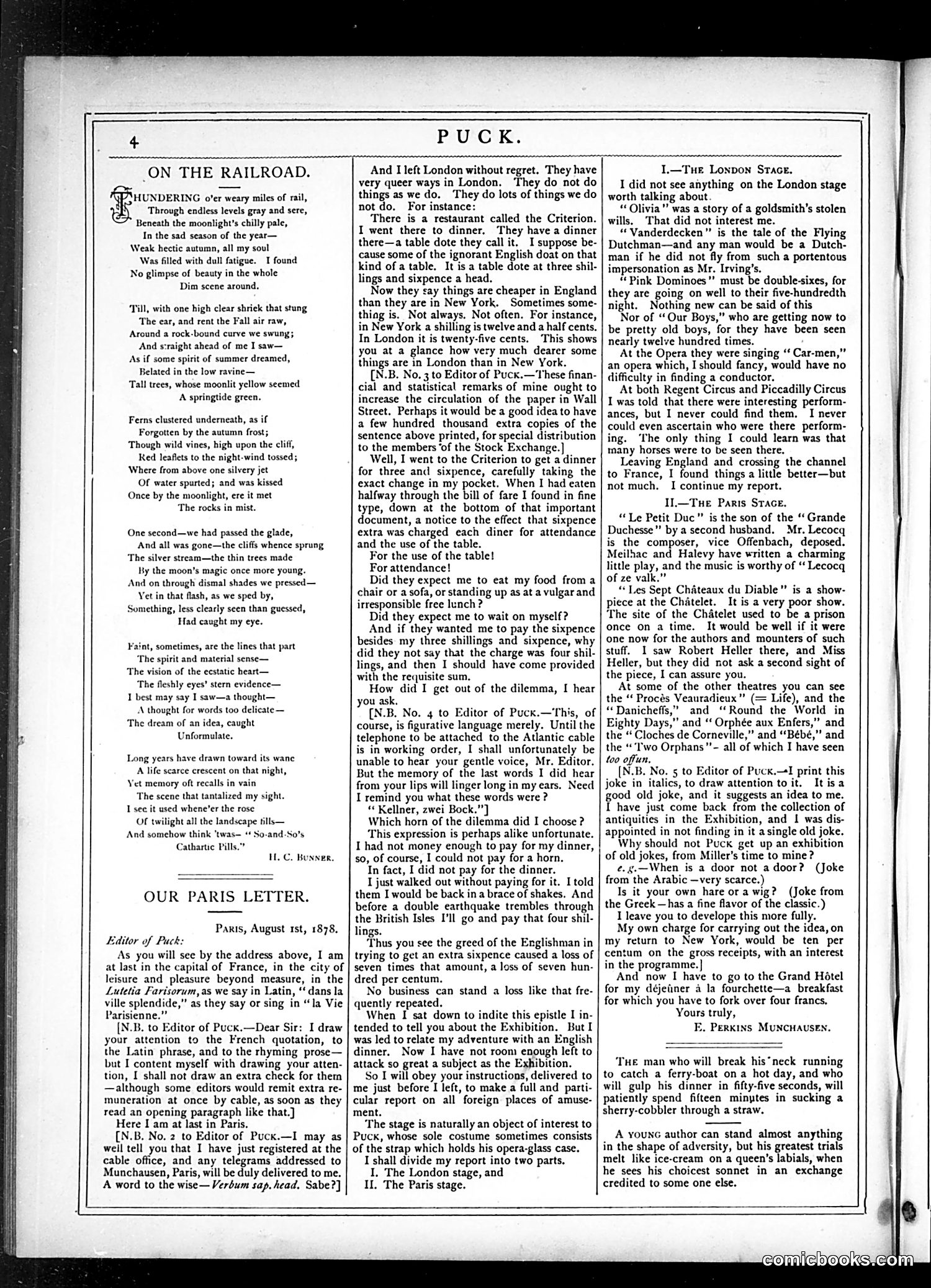
What you’re looking at
This page contains three separate sections rather than a unified cartoon: 1. **"On the Railroad"** - A poem by H.C. Bunner describing tedious train travel, with no apparent satirical target. 2. **"The London Stage"** and **"The Paris Stage"** - Theater reviews discussing London and Paris productions, including opera and comedies. These are straightforward critical commentary on European theatrical offerings. 3. **"Our Paris Letter"** - A correspondent's account of Parisian life, including complaints about English tourists and restaurant pricing disparities between London and Paris. **No clear political satire is evident.** This appears to be a miscellaneous editorial/entertainment page mixing travel writing, theater criticism, and social observation rather than political cartooning. The humor is mild and observational rather than pointed satire.
📄 Transcribed text from this page (OCR, searchable)
Machine-transcribed from the original scan — historical spelling and the odd misread are preserved.
4 PUCK. _ON THE RAILROAD. HUNDERING oter weary miles of rail, Through endless levels gray and sere, Beneath the moonlight’s chilly pale, In the sad season of the year— Weak hectic autumn, all my soul ‘Was filled with dull fatigue. I found No glimpse of beauty in the whole Dim scene around. ‘Till, with one high clear shriek that stung ‘The ear, and rent the Fall air raw, Around a rock-bound curve we swung; ‘And s:raight ahead of me I saw— As if some spirit of summer dreamed, Belated in the low ravine— Tall trees, whose moonlit yellow seemed A springtide green. Ferns clustered underneath, as if Forgotten by the autumn frost; Though wild vines, high upon the cliff, Red leaffets to the night-wind tossed; ‘Where from above one silvery jet Of water spurted; and was kissed Once by the moonlight, ere it met The rocks in mist. One second—we had passed the glade, And all was gone—the cliffs whence sprung The silver stream—the thin trees made By the moon’s magic once more young. And on through dismal shades we pressed— Yet in that flash, as we sped by, Something, less clearly seen than guessed, Had caught my eye. Faint, sometimes, are the lines that part ‘The spirit and material sense— The vision of the ecstatic heart— ‘The fleshly eyes’ stern evidence— 1 best may say I saw—a thought— \ thought for words too delicate— ‘The dream of an idea, caught Unformulate. Long years have drawn toward its wane A life scarce crescent on that night, Yet memory oft recalls in vain The scene that tantalized my sight. 1 sec it used whene’er the rose OL twilight all the landscape fills— And somehow think ‘twas— “ So-and-So’s Cathartic Pills.” IL. C. Buxwer. OUR PARIS LETTER. Paris, August 1st, 1878. Editor of Pack: As you will see by the address above, I am at last in the capital of France, in the city of leisure and pleasure beyond measure, in the Lutelia Farisorum,as we say in Latin, “ dans la ville splendide,” as they say or sing in “la Vie Parisienne.” [N.B. to Editor of Puck.—Dear Sir: I draw your attention to the French quotation, to the Latin phrase, and to the rhyming prose— but I content myself with drawing your atten- tion, I shall not draw an extra check for them —although some editors would remit extra re- muneration at once by cable, as soon as they read an opening paragraph like that.] Here I am at last in Paris. [N.B. No. 2 to Editor of Puck.—I may as weil tell you that I have just registered at the cable office, and any telegrams addressed to Munchausen, Paris, will be duly delivered to me. A word to the wise—Verbum sap, head, Sabe?] And I left London without regret. They have very queer ways in London. They do not do things as we do. They do lots of things we do not do. For instance: There is a restaurant called the Criterion. I went there to dinner, They have a dinner there—a table dote they call it. I suppose be- cause some of the ignorant English doat on that kind of a table. It is a table dote at three shil- lings and sixpence a head. Now they say things are cheaper in England than they are in New York. Sometimes some- thing is. Not always. Not often. For instance, in New York a shilling is twelve and a half cents. In London it is twenty-five cents. ‘This shows you at a glance how very much dearer some things are in London than in New York. [N.B. No. 3 to Editor of Puck.—These finan- cial and statistical remarks of mine ought to increase the circulation of the paper in Wall Street. Perhaps it would be a good idea to have a few hundred thousand extra copies of the sentence above printed, for special distribution to the members ‘of the Stock Exchange.] Well, I went to the Criterion to get a dinner for three and sixpence, carefully taking the exact change in my pocket. When I had eaten halfway through the bill of fare I found in fine type, down at the bottom of that important deciment, a notice to the effect that sixpence extra was charged each diner for attendance and the use of the table. For the use of the table! For attendance! Did they expect me to eat my food from a chair or a sofa, or standing up as at a vulgar and irresponsible free lunch ? Did they expect me to wait on myself? And if they wanted me to pay the sixpence besides my three shillings and sixpence, why did they not say that the charge was four shil- lings, and then I should have come provided with the requisite sum. How did I get out of the dilemma, I hear you ask, {N.B, No. 4 to Editor of Puck.—This, of course, is figurative language merely. Until the telephone to be attached to the Atlantic cable is in working order, I shall unfortunately be unable to hear your gentle voice, Mr. Editor. But the memory of the last words I did hear from your lips will linger long in my ears. Need I remind you what these words were ? * Kellner, zwei Bock.”] Which horn of the dilemma did I choose ? This expression is perhaps alike unfortunate. I had not money enough to pay for my dinner, so, of course, I could not pay for a horn. In fact, I did not pay for the dinner. I just walked out without paying for it. I told them I would be back ina brace of shakes. And before a double earthquake trembles through the British Isles I'll go and pay that four shil- lings. Thus you see the greed of the Englishman in trying to get an extra sixpence caused a loss of seven times that amount, a loss of seven hun- dred per centum. No business can stand a loss like that fre- quently repeated. When I sat down to indite this epistle I in- tended to tell you about the Exhibition. But I was led to relate my adventure with an English dinner. Now I have not room enough left to attack so great a subject as the Exhibition. So I will obey your instructions, delivered to me just before I left, to make a full and parti- cular report on all foreign places of amuse- ment. ‘The stage is naturally an object of interest to Puck, whose sole costume sometimes consists of the strap which holds his opera-glass case. I shall divide my report into two parts. I. The London stage, and II. The Paris stage. 1.—Tue Lonpon Stace. I did not see anything on the London stage worth talking about “ Olivia" was a story of a goldsmith’s stolen wills. That did not interest me. “Vanderdecken” is the tale of the Flying Dutchman—and any man would be a Dutch- man if he did not fly from such a portentous impersonation as Mr. Irving’s, “Pink Dominoes” must be double-sixes, for they are going on well to their five-hundredth night. Nothing new can be said of this Nor of “Our Boys,” who are getting now to be pretty old boys, for they have been seen nearly twelve hundred times. ‘At the Opera they were singing “ Car-men,” an opera which, I should fancy, would have no difficulty in finding a conductor. At both Regent Circus and Piccadilly Circus I was told that there were interesting perform- ances, but I never could find them. I never could even ascertain who were there perform- ing. ‘The only thing I could learn was that many horses were to be seen there. Leaving England and crossing the channel to France, I found things a little better—but not much. I continue my report. II.—Tue Paris Stace. “Le Petit Duc” is the son of the “Grande Duchesse” by a second husband. Mr. Lecocq is the composer, vice Offenbach, deposed. Meilhac and Halevy have written a charming little play, and the music is worthy of “Lecocq of ze valk.” “Les Sept Chateaux du Diable" is a show- piece at the Chatelet. It is a very poor show. The site of the Chatelet used to be a prison once on a time. It would be well if it were one now for the authors and mounters of such stuff. I saw Robert Heller there, and Miss Heller, but they did not ask a second sight of the piece, I can assure you. At some of the other theatres you can see the “ Procés Veauradieux” (= Life), and the “Danicheffs,” and ‘Round the World in Eighty Days,” and Orphée aux Enfers,” and the “Cloches de Corneville,” and “Bébé,” and the “‘I'wo Orphans"'- all of which I have seen too offun. [N.B. No. 5 to Editor of Puck.—!I print this joke in italics, to draw attention to it. Itisa good old joke, and it suggests an idea to me. I have just come back from the collection of antiquities in the Exhibition, and 1 was dis- appointed in not finding in it a single old joke. Why should not Puck get up an exhibition of old jokes, from Miller's time to mine? a When is a door not a door? (Joke from the Arabic —very scarce.) Is it your own hare ora wig? (Joke from the Greek —has a fine flavor of the classic.) I leave you to develope this more fully. My own charge for carrying out the idea, on my return to New York, would be ten per centum on the gross receipts, with an interest in the programme.] And now I have to go to the Grand Hotel for my déeiiner a la fourchette—a breakfast for which you have to fork over four francs, Yours truly, FE. Perkins MuNcHAUSEN. ‘THe man who will break his’neck running to catch a ferry-boat ona hot day, and who will gulp his dinner in fifty-five seconds, will patiently spend fifteen minytes in sucking a sherry-cobbler through a straw. A younc author can stand almost anything in the shape of adversity, but his greatest trials melt like ice-cream on a queen's labials, when he sees his choicest sonnet in an exchange credited to some one else.