
Puck, 1878-08-14 · page 12 of 16
Puck — August 14, 1878 — page 12: what you’re looking at
What you’re looking at
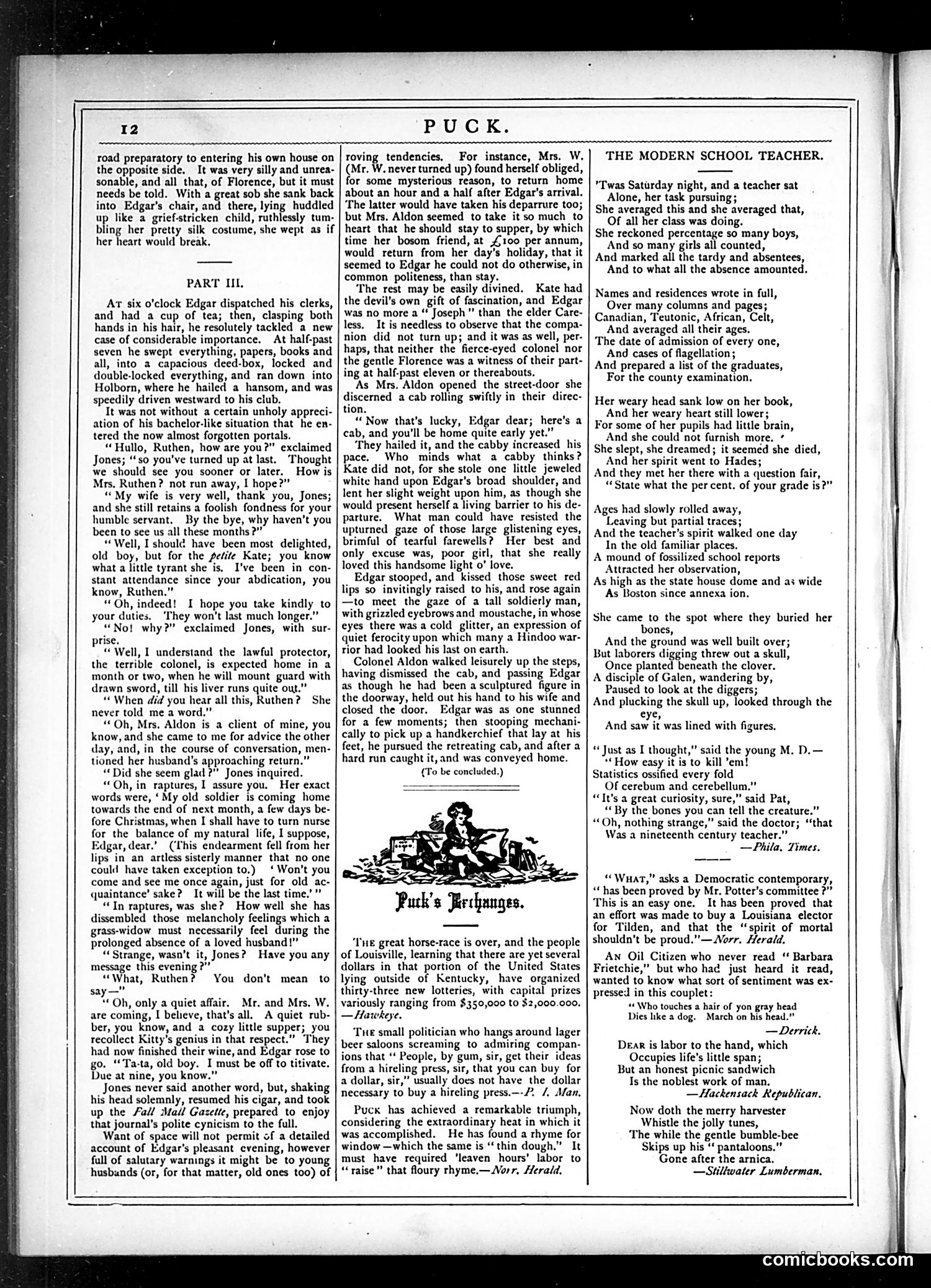
This page contains serialized fiction and social commentary rather than political cartoons. The main content is "Part III" of a story about Edgar and various romantic entanglements, along with "The Modern School Teacher" poem on the right. The bottom section, "Puck's Briefings," contains brief satirical news items and jokes about contemporary topics: a Kentucky horse-race with lotteries, a politician buying ideas from a "hireling press," and various other social observations. The illustration shows what appears to be figures in period dress, though details are unclear from this reproduction. The content satirizes 1890s social institutions—education, journalism, gambling—through witty commentary rather than visual caricature. Without knowing the publication date, specific historical context remains difficult to pin down precisely.
📄 Transcribed text from this page (OCR, searchable)
Machine-transcribed from the original scan — historical spelling and the odd misread are preserved.
12 PUCK. road preparatory to entering his own house on the opposite side, It was very silly and unrea- sonable, and all that, of Florence, but it must needs be told. With a great sob she sank back into Edgar's chair, and there, lying huddled te like a grief-stricken child, ruthlessly tum- bling her pretty silk costume, she wept as if her heart would break. PART IL, Ar six o'clock Edgar dispatched his clerks, and had a cup of tea; then, clasping both hands in his hair, he resolutely tackled a new case of considerable importance. At half-past seven he swept everything, papers, books and all, into a capacious deed-box, locked and double-locked everything, and ran down into Holborn, where he hailed a hansom, and was speedily driven westward to his club, It was not without a certain unholy appreci- ation of his bachelor-like situation that he en- tered the now almost forgotten portals. “Hullo, Ruthen, how are you?” exclaimed Jones; ‘so you've turned up at last, Thought we should see you sooner or later. How is Mrs. Ruthen? not run away, I hope?” “My wife is very well, thank you, Jones; and she still retains a foolish fondness for your humble servant, By the bye, why haven't you been to see us all these months ?” “Well, I should have been most delighted, old boy, but for the petite Kate; you know what a little tyrant she is, I’ve been in con- stant attendance since your abdication, you know, Ruthen,” “Oh, indeed! I hope you take kindly to your duties. ‘They won't last much longer.” “No! why?” exclaimed Jones, with sur- prise. “Well, I understand the lawful protector, the terrible colonel, is expected home in a month or two, when he will mount guard with drawn sword, till his liver runs quite out.” “When did you hear all this, Ruthen? She never told me a word.” “Oh, Mrs. Aldon is a client of mine, you know, and she came to me for advice the other day, and, in the course of conversation, men- tioned her husbands approaching return.” “Did she seem glad ?” Jones inquired. “Oh, in raptures, I assure you. Her exact words were, ‘ My old soldier is coming home towards the end of next month, a few days be- fore Christmas, when I shall have to turn nurse for the balance of my natural life, I suppose, Edgar, dear.’ (‘This endearment fell from her lips in an artless sisterly manner that no one could have taken exception to.) ‘ Won’t you come and see me once again, just for old ‘ac- quaintance’ sake? It will be the last time.’ ” “Tn raptures, was she? How well she has dissembled those melancholy feelings which a grass-widow must necessarily feel during the prolonged absence of a loved husband!” “ Strange, wasn’t it, Jones? Have you any message this evening ?”” “What, Ruthen? say—" “Oh, only a quiet affair. Mr. and Mrs. W. are coming, I believe, that’s all. A quiet rub- ber, you know, and a cozy little supper; you recollect Kitty’s genius in that respect.” They had now finished their wine, and Edgar rose to go. “Ta-ta, old boy. I must be off to titivate. Due at nine, you know.” Jones never said another word, but, shaking his head solemnly, resumed his cigar, and took up the Fai Madl Gazette, prepared to enjoy that journal’s polite cynicism to the full. Want of space will not permit of a detailed account of Edgar's pleasant evening, however full of salutary warnings it might be to young husbands (or, for that matter, old ones too) of You don’t mean to roving tendencies, For instance, Mrs. W. (Mr. W. never turned up) found herself obliged, for some mysterious reason, to return home about an hour and a half after Edgar’s arrival. ‘The latter would have taken his deparrure too; but Mrs. Aldon seemed to take it so much to heart that he should stay to supper, by which time her bosom friend, at £100 per annum, would return from her day's holiday, that it seemed to Edgar he could not do otherwise, in common politeness, than stay. ‘The rest may be easily divined. Kate had the devil’s own gift of fascination, and Edgar was no more a “ Joseph" than the elder Care- less. It is needless to observe that the compa- nion did not turn up; and it was as well, per- haps, that neither the fierce-eyed colonel nor the gentle Florence was a witness of their part- ing at half-past eleven or thereabouts. As Mrs. Aldon opened the street-door she discerned a cab rolling swiftly in their direc- tion. “Now that’s lucky, Edgar dear; here's a cab, and you'll be home quite early yet.” ‘They hailed it, and the cabby increased his pace. Who minds what a cabby thinks? Kate did not, for she stole one little jeweled white hand upon Edgar’s broad shoulder, and lent her slight weight upon him, as though she would present herself a living barrier to his de- parture. What man could have resisted the upturned gaze of those large glistening eyes, brimful of tearful farewells? Her best and only excuse was, poor girl, that she really loved this handsome light 0’ love. Edgar stooped, and kissed those sweet red lips so invitingly raised to his, and rose again —to meet the gaze of a tall soldierly man, with grizzled eyebrows and moustache, in whose eyes there was a cold glitter, an expression of quiet ferocity upon which many a Hindoo war- tior had looked his last on earth. Colonel Aldon walked leisurely up the steps, having dismissed the cab, and passing Edgar as though he had been a sculptured figure in the doorway, held out his hand to his wife and closed the door. Edgar was as one stunned for a few moments; then stooping mechani- cally to pick up a handkerchief that lay at his feet, he pursued the retreating cab, and after a hard run caught it,and was conveyed home. {To be concluded.) ‘Ine great horse-race is over, and the people of Louisville, learning that there are yet several dollars in that portion of the United States lying outside of Kentucky, have organized thirty-three new lotteries, with capital prizes variously ranging from $350,000 to $2,000.00. —Hawkeye. ‘Tue small politician who hangs around lager beer saloons screaming to admiring compan- ions that “ People, by gum, sir, get their ideas from a hireling press, sir, that you can buy for a dollar, sir,” usually does not have the dollar necessary to buy a hireling press.—-P. /. Man, Puck has achieved a remarkable triumph, considering the extraordinary heat in which it was accomplished. He has found a rhyme for window —which the same is “thin dough.” It must have required ‘leaven hours’ labor to “raise” that floury rhyme,—Worr, Herald, THE MODERN SCHOOL TEACHER. 'Twas Saturday night, and a teacher sat Alone, her task pursuing; She averaged this and she averaged that, Of all her class was doing. She reckoned percentage so many boys, And so many girls all counted, And marked all the tardy and absentees, And to what all the absence amounted. Names and residences wrote in full, Over many columns and pages; Canadian, Teutonic, African, Celt, And averaged all their ages. The date of admission of every one, And cases of flagellation; And prepared a list of the graduates, For the county examination, Her weary head sank low on her book, And her weary heart still lower; For some of her pupils had little brain, And she could not furnish more. * She slept, she dreamed; it seemed she died, And her spirit went to Hades; And they met her there with a question fair, “State what the per cent. of your grade is?” Ages had slowly rolled away, Leaving but partial traces; And the teacher’s spirit walked one day In the old familiar places. A mound of fossilized school reports Attracted her observation, ‘As high as the state house dome and as wide As Boston since annexa ion, She came to the spot where they buried her bones, And the ground was well built over; But laborers digging threw out a skull, Once planted beneath the clover. A disciple of Galen, wandering by, Paused to look at the diggers; And plucking the skull up, looked through the eye, And saw it was lined with figures. “ Just as I thought,” said the young M. D.— «How easy it is to kill ’em! Statistics ossified every fold Of cerebum and cerebellum.” “It's a great curiosity, sure,” said Pat, “By the bones you can tell the creature.” “Oh, nothing strange,” said the doctor; ‘that Was a nineteenth century teacher.” —Phila, Times. “ Wuat,” asks a Democratic contemporary, “has been proved by Mr. Potter's committee ?” This is an easy one. It has been proved that an effort was made to buy a Louisiana elector for Tilden, and that the “spirit of mortal shouldn't be proud.”—orr. Herald, Aw Oil Citizen who never read “ Barbara Frietchie,” but who had just heard it read, wanted to know what sort of sentiment was ex- pressed in this couplet: “Who touches a hair of yon gray head Dies ike a dog. March on his head.” —Derrick. Dear is labor to the hand, which Occupies life's little span; But an honest picnic sandwich Is the noblest work of man, —Hackensack Republican, Now doth the merry harvester Whistle the jolly tunes, ‘The while the gentle bumble-bee Skips up his ‘ pantaloons.”” Gone after the arnica. —Stiltwater Lumberman, comicbooks.com