
Puck, 1878-08-14 · page 7 of 16
Puck — August 14, 1878 — page 7: what you’re looking at
What you’re looking at
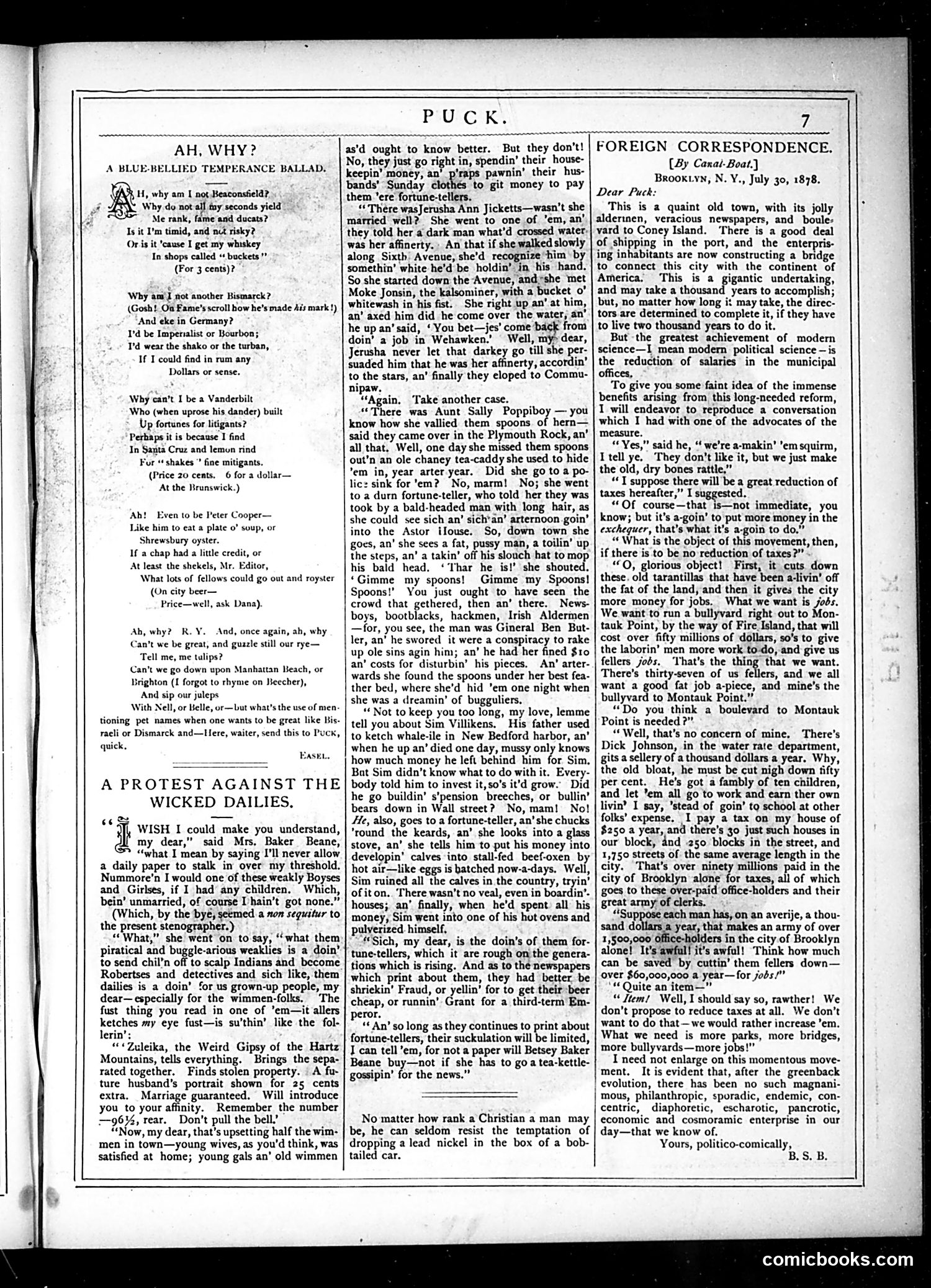
This page contains three distinct pieces of satirical content: 1. **"Ah, Why?" - A Blue-Bellied Temperance Ballad**: A poem mocking temperance advocates, using dialect and humorous scenarios about working-class people trying to improve their finances through abstinence—suggesting the movement's unrealistic expectations. 2. **"A Protest Against the Wicked Dailies"**: A letter from "Mrs. Baker Beane" criticizing newspapers for publishing sensationalist stories about fortune-tellers, con artists, and swindlers. She argues these accounts encourage fraud rather than preventing it, and calls for newspapers to stop covering such schemes entirely. 3. **"Foreign Correspondence"**: A letter from Brooklyn (July 30, 1878) describing infrastructure improvements, municipal salary reform, and urban development—likely praising civic progress and modernization efforts. The page satirizes both temperance movements and press sensationalism while celebrating urban development.
📄 Transcribed text from this page (OCR, searchable)
Machine-transcribed from the original scan — historical spelling and the odd misread are preserved.
PUCK. AH, WHY? A BLUE-BELLIED TEMPERANCE BALLAD, H, why am [ not Beaconsfield? Why do not alf fay seconds yield Me rank, fame’and ducats? Is it I'm timid, and net risky? Oris it ‘cause I get my whiskey In shops called “« buckets ”” (For 3 cents)? ‘Why ani’ not another Bismarck? (Gosh! Oa Fame’s scroll how he’s made Ais mark!) ‘And eke in Germany? I'd be Imperialist or Bourbon; T’d wear the shako or the turban, If T could find in rum any Dollars or sense. Why can’t I be a Vanderbilt Who (when uprose his dander) built Up fortunes for litigants? Perbaps it is because I find In Sata Cruz and lemon rind For “shakes ” fine mitigants, (Price 20 cents. 6 for a dollar— At the Brunswick.) Ah! Even to be Peter Cooper— Like him to eat a plate 0° soup, or Shrewsbury oyster. If a chap had a little credit, or At least the shekels, Mr. Editor, What lots of fellows could go out and royster (On city beer— Price—well, ask Dana). Ab, why? R.Y. And, once again, ab, why Can't we be great, and guzzle still our rye— Tell me, me tulips? Can't we go down upon Manhattan Beach, or Brighton (I forgot to rhyme on Heecher), And sip our juleps With Nell, or Belle, or—Lut what's the use of men- tioning pet names when one wants to be great like Bis- racli or Dismarck and—Here, waiter, send this to Puck, quick, Ease. A PROTEST AGAINST THE WICKED DAILIES. oe bi my dear,” said Mrs. Baker Beane, ‘what I mean by saying I'll never allow a daily paper to stalk in over my threshold. Nummore'n I would one of these weakly Boyses and Girlses, if I had any children. Which, bein’ unmarried, of course Dhain’t got none.” (Which, by the byé, seemed a non sequitur to the present stenographer.) “What,” she went on to say, what them piratical and buggle-arious weaklies is a doin’ to send chil’n off to scalp Indians and become Robertses and detectives and sich like, them dailies is a doin’ for us grown-up people, my dear— especially for the wimmen-folks. The fust thing you read in one of ’em—it allers Ketch my eye fust—is su’thin’ like the fol- lerin’: “‘Zuleika, the Weird Gipsy of the Hartz Mountains, tells everything. Brings the sepa- rated together. Finds stolen property. | A fu- ture husband’s portrait shown for 25 cents extra, Marriage guaranteed. Will introduce you to your affinity. Remember the number 96%, rear. Don't pull the bell’ “Now, my dear, that’s upsetting half the wim- men in town—young wives, as you'd think, was satisfied at home; young gals an’ old wimmen WISH I could make you understand, as'd ought to know better. But they don’t! No, they just go right in, spendin’ their house- keepin’ money, an’ p'raps pawnin’ their hus- bands’ Sunday clothés to git money to pay them ere’ fortune-tellers. “There wasJerusha Ann Jicketts—wasn’t she married well? She went to one of ’em, an’ they told her a dark man what'd crossed water: was her affinerty.: An that if she walked slowly along Sixth: Avenue, she'd recognize “him by somethin’ white he’d be holdin’ in his hand. So she started down the Avenue, andshe met Moke Jonsin, the kalsominer, with a bucket o° whitewash in his fist. She right up an’ at him, an’ axed him did he come over the water, an’ he up an’said, ‘ You bet—jes’ come from doin’ a job in Wehawken.’ Well, my> dear, Jerusha never let that darkey go till she per- suaded him that he was her affinerty, accordin’ to the stars, an’ finally they eloped to Commu- nipaw. “Again, ‘Take another case. “There was Aunt Sally Poppiboy — you know how she vallied them spoons of hern— said they came over in the Plymouth Rock, an’ all that, Well, one day she missed them spoons out’n an ole chaney tea-caddy she used to hide ’em in, year arter year. Did she go to a po- lice sink for’em? No, marm! No; she went to a durn fortune-teller, who told her they was took by a bald-headed man with long hair, as she could see sich an’ sich’an’ arternoon goin’ into the Astor ifouse. So, down town she goes, an’ she sees a fat, pussy man, a toilin’ up the steps, an’ a takin’ off his slouch hat to mop his bald head. ‘Thar he is!’ she shouted. “Gimme my spoons! Gimme my Spoons! Spoons!’ You just ought to have seen the crowd that gethered, then an’ there. News- boys, bootblacks, hackmen, Irish Aldermen —for, you see, the man was Gineral Ben But- ler, an’ he swored it were a conspiracy to rake up ole sins agin him; an’ he had her fined $10 an’ costs for disturbin’ his pieces. An’ arter- wards she found the spoons under her best fea- ther bed, where she'd hid 'em one night when she was a dreamin’ of bugguliers, “Not to keep you too long, my love, lemme tell you about Sim Villikens, His father used to ketch whale-ile in New Bedford harbor, an’ when he up an’ died one day, mussy only knows how much money he left behind him for Sim. Bat Sim didn’t know what to do with it. Every- body told him to invest it, so’s it'd grow. Did he go buildin’ s'pension breeches, or bullin’ bears down in Wall street? No, mam! No! He, also, goes to a fortune-teller, an’ she chucks ‘round the keards, an’ she looks into a glass stove, an’ she tells him to put his money into developin’ calves into stall-fed beef-oxen by hot air—like eggs is batched now-a-days, Well, Sim ruined all the calves in the country, tryin’ ofiton.. ‘There wasn’t no veal, even in boardin’- houses; an’ finally, when he'd spent. all his money, Sim went into one of his hot ovens and pulverized. himself, ‘€Sich, my dear, is the doin’s of them for- tune-tellers, which it are rough on'the genera- tions which is rising. And as to the newspapers which print about them, they had better be shriekin’ Fraud, or yellin’ for to get their beer cheap, or runnin’ Grant for a third-term Em- eror. ‘An’ so long as they continues to print about fortune-tellers, their suckulation will be limited, I can tell’em, for not a paper will Betsey Baker Beane buy—not if she has to goa tea-kettle- gossipin’ for the news.” No matter how rank a Christian a man may be, he can seldom resist the temptation of dropping a lead nickel in the box of a bob- tailed car. ponder y 7 FOREIGN CORRESPONDENCE. (By Canal-Boat.} Brooxtyn, N. Y., July 30, 1878. Dear Puck: This is a quaint old town, with its jolly alderinen, veracious newspapers, and boule: vard to Coney Island. There is a good deal of shipping in the port, and the enterpris- ing inhabitants are now constructing a bridge to connect this city with the continent of America, This is a gigantic undertaking, and may take a thousand. years to accomplish; but, no matter how long it may take, the direc- tors are determined to complete it, if they have to live two thousand years to do it. But the greatest achievement of modern science—I mean modern political science —is the reduction of salaries in the municipal offices, To give you some faint idea of the immense benefits arising from this long-needed reform, I will endeavor to reproduce a conversation which I had with one of the advocates of the measure. “Yes,” said he, ‘ we're a-makin’ em squirm, I tell ye. They don’t like it, but we just make the old, dry bones rattle,” “I suppose there will be a great reduction of taxes hereafter,” I suggested. “Of course—that is—not immediate, you know; but it’s a-goin’ to put more money in the exchequer, that’s what it’s a-goin to do,” “What is the object of this movement, then, if there is to be no reduction of taxes?” ‘€O, glorious object! First, it cuts down these. old tarantillas that have been a-livin’ off the fat of the land, and then it gives the city more money for jobs. What we want is jobs. We want to run a bullyvard right out to Mon- tauk Point, by the way of Fire Island, that will cost over fifty millions of dollars, so’s to give the laborin’ men more work to-do, and give us fellers jobs. ‘That's the thing that we want. There's thirty-seven of us fellers, and we all want a good fat job a-piece, and mine's the bullyvard to Montauk Point.” “Do you think a boulevard to Montauk Point is needed ?” “Well, that’s no concern of mine. There’s Dick Johnson, in the water rate department, gits a sellery of a thousand dollars a year. Why, the old bloat, he must be cut nigh down fifty percent. He's got a fambly of ten children, and let ’em all go to work and earn ther own livin’ I say, ’stead of goin’ to school at other folks’ expense. I pay a tax on my house of $250 a year, and there’s 30 just such houses in our block, and 250 blocks in the street, and 1,750 streets of the same average length in the city. That's over ninety millions paid in the city of Brooklyn alone for taxes, all of which goes to these over-paid office-holders and their great army of clerks. _ Sumpoeeeaeh man has, on an averije, a thou- sand dol a year, that makes an army of over 1,500,000 Office-holders in the city of Brooklyn alone! It's ‘awful! it’s awful! Think how much can be saved by cuttin’ them fellers down— over $60,000,000 a year—for jobs/” ‘“ Quite an item—" “Item! Well, I should say so, rawther! We don’t propose to reduce taxes at all. We don’t want to do that—we would rather increase ’em. What we need is more parks, more bridges, more bullyvards—more jobs!"” I need not enlarge on this momentous move- ment. It is evident that, after the greenback | evolution, there has been no such magnani- mous, philanthropic, sporadic, endemic, con- centric, diaphoretic, escharotic, pancrotic, economic and cosmoramic enterprise in our day—that we know of. Yours, politico-comically, comicbooks.com