
Puck, 1878-08-14 · page 6 of 16
Puck — August 14, 1878 — page 6: what you’re looking at
What you’re looking at
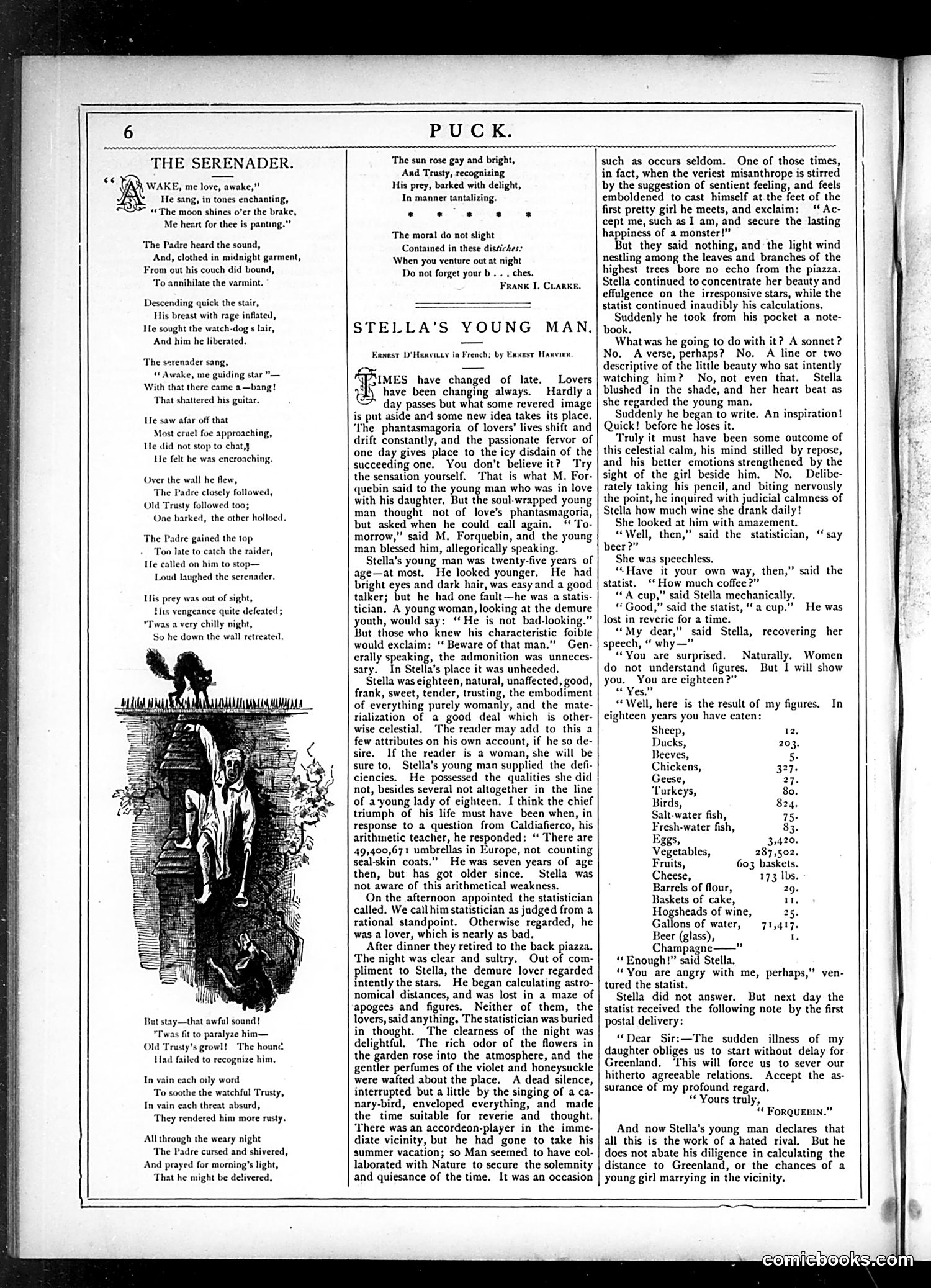
This page contains literary content rather than political satire. It features "The Serenader," a poem about romantic courtship, and "Stella's Young Man," a prose story by Ernest d'Hervilly translated from French. The narrative concerns a statistician lover who calculates astronomical data and distances rather than expressing genuine emotion. The story satirizes excessive rationalism and emotional coldness in romance—the statistician's obsession with numbers and calculations makes him an inadequate suitor despite possessing Stella's other ideal qualities. The accompanying illustration shows figures in what appears to be a garden or courtyard scene, supporting the romantic narrative. This reflects late-19th-century satirical humor mocking overly intellectual, emotionally-detached men and the tension between rational analysis and human feeling.
📄 Transcribed text from this page (OCR, searchable)
Machine-transcribed from the original scan — historical spelling and the odd misread are preserved.
PUCK. THE SERENADER. eS WAKE, me love, awake,” He sang, in tones enchanting, «The moon shines o'er the brake, Me heat for thee is panting.”” ‘The Padre heard the sound, And, clothed in midnight garment, From out his couch did bound, ‘To annihilate the varmint. Descending quick the stair, His breast with rage inflated, He sought the watch-dog s lair, And him he liberated. ‘The serenader sang, « Awake, me guiding star "— With that there came a—bang! ‘That shattered his guitar. He saw afar off that Most cruel foe approaching, Me did not stop to chat,y He felt he was encroaching. Over the wall he flew, ‘The Padre closely followed, Old Trusty followed too; One barked, the other holloed. ‘The Padre gained the top ‘Too late to catch the raider, Ie called on him to stop— Loud laughed the serenader. Ilis prey was out of sight, tis vengeance quite defeated ; 'Twas a very chilly night, So he down the wall retreated. But stay—that awful sound! "Twas fit to paralyze him— Old Trusty’s growl! The hound Had failed to recognize him, In vain each otly word To soothe the watchful Trusty, In vain each threat absurd, They rendered him more rusty. Allthrough the weary night The Padre cursed and shivered, And prayed for morning’s light, ‘That he might be detivered, ‘The sun rose gay and bright, And Trusty, recognizing Mis prey, barked with delight, In manner tantalizing. es Lehi ‘The moral do not slight Contained in these distiches: ‘When you venture out at Do not forget your b. . . ches. Frank I. CLARKE. STELLA’S YOUNG MAN. Eawest D'Hexvitty in French; by Exwest Hanvien, PMIMES have changed of late. Lovers SB, have been changing always. Hardly a — day passes but what some revered image is put aside and some new idea takes its place. ‘rhe phantasmagoria of lovers’ lives shift and drift constantly, and the passionate fervor of one day gives place to the icy disdain of the succeeding one. You don’t believe it? Try the sensation yourself. ‘That is what M. For- quebin said to the young man who was in love with his daughter. But the soul-wrapped young man thought not of love’s phantasmagoria, but asked when he could call again. “ ‘To- morrow,” said M. Forquebin, and the young man blessed him, allegorically speaking. Stella’s young man was twenty-five years of age—at most. He looked younger. He had bright eyes and dark hair, was easy and a good talker; but he had one fault—he was a statis- tician. A young woman, looking at the demure youth, would say: “He is not bad-looking.” But those who knew his characteristic foible would exclaim: ‘ Beware of that man.” Gen- erally speaking, the admonition was unneces- sary. In Stella’s place it was unheeded. Stella was eighteen, natural, unaffected, good, frank, sweet, tender, trusting, the embodiment of everything purely womanly, and the mate- rialization of a good deal which is other- wise celestial. ‘The reader may add to this a few attributes on his own account, if he so de- sire. If the reader is a woman, she will be sure to. Stella’s young man supplied the defi- ciencies. He possessed the qualities she did not, besides several not altogether in the line of a-young lady of eighteen. I think the chief triumph of his life must have been when, in response to a question from Caldiafierco, his arithmetic teacher, he responded: ‘ There are 49,400,671 umbrellas in Europe, not counting seal-skin coats.” He was seven years of age then, but has got older since, Stella was not aware of this arithmetical weakness. On the afternoon appointed the statistician called. We callhim statistician as jadged from a rational standpoint. Otherwise regarded, he was a lover, which is nearly as bad. After dinner they retired to the back piazza, The night was clear and sultry. Out of com- pliment to Stella, the demure lover regarded intently the stars. He began calculating astro- nomical distances, and was lost in a maze of apogees and figures. Neither of them, the lovers, said anything. The statistician was buried in thought. “The clearness of the night was delightful. ‘The rich odor of the flowers in the arden rose into the atmosphere, and the gentler perfumes of the violet and honeysuckle were wafted about the place. A dead silence, interrupted but a little by the singing of a ca- nary-bird, enveloped everything, and made the time suitable for reverie and thought. ‘There was an accordeon-player in the imme- diate vicinity, but he had gone to take his summer vacation; so Man seemed to have col- laborated with Nature to secure the solemnity and quiesance of the time. It was an occasion such as occurs seldom. One of those times, in fact, when the veriest_misanthrope is stirred by the suggestion of sentient feeling, and feels emboldened to cast himself at the feet of the first pretty girl he meets, and exclaim: ‘* Ac- cept me, such as I am, and secure the lasting happiness of a monster!” But they said nothing, and the light wind nestling among the leaves and branches of the highest trees bore no echo from the piazza. Stella continued to concentrate her beauty and effulgence on the irresponsive stars, while the statist continued inaudibly his calculations. Suddenly he took from his pocket a note- book. What was he going to do with it? A sonnet? No. A verse, perhaps? No. A line or two descriptive of the little beauty who sat intently watching him? No, not even that. Stella blushed in the shade, and her heart beat as she regarded the young man. Suddenly he began to write. An inspiration! Quick! before he loses it. Truly it must have been some outcome of this celestial calm, his mind stilled by repose, and his better emotions strengthened by the sight of the girl beside him. No. Delibe- rately taking his pencil, and biting nervously the point, he inquired with judicial calmness of Stella how much wine she drank daily! She looked at him with amazement. “Well, then,” said the statistician, ‘say beer?” She was speechless. “Have it your own way, then,” said the statist. ‘How much coffee?” “A cup,” said Stella mechanically. “ Good,” said the statist, a cup.” He was lost in reverie for a time. “My dear,” said Stella, recovering her speech, “ why—” “You are surprised. Naturally. Women do not understand figures. But I will show you. You are cighteen?” Yes “Well, here is the result of my figures. In eighteen years you have eaten: Sheep, Ducks, Beeves, Chickens, Geese, ‘Turkeys, Birds, Salt-water fish, Fresh-water fish, Eggs, Vegetables, Fruits, 603 baskets. Cheese, 173 Ibs. Barrels of flour, 29. Baskets of cake, ie Hogsheads of wine, 25. Gallons of water, | 71,417. Beer (glass), 1 Champagne—” “Enough!” said Stella. “You are angry with me, perhaps,” ven- tured the statist. Stella did not answer. But next day the statist received the following note by the first postal delivery: “Dear Sir:—The sudden illness of my daughter obliges us to start without delay for Greenland. ‘This will force us to sever our hitherto agreeable relations. Accept the as- surance of my profound regard. “ Yours truly, “ FORQUEBIN.”” And now Stella's young man declares that all this is the work of a hated rival. But he does not abate his diligence in calculating the distance to Greenland, or the chances of a young girl marrying in the vicinity.