
A complete issue · 16 pages · 1878
Puck — August 7, 1878
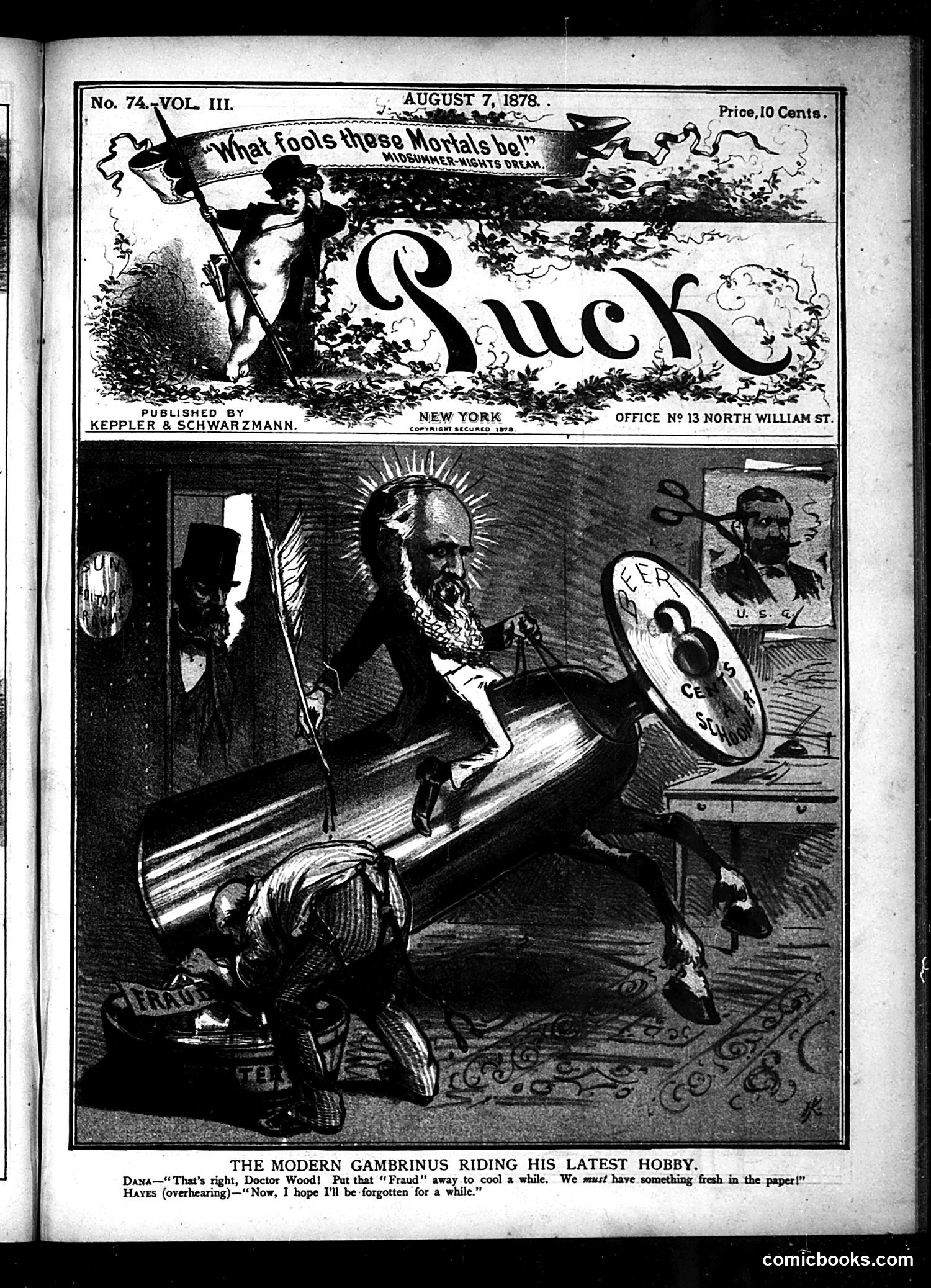
This cartoon satirizes what appears to be a contemporary scandal involving fraudulent claims or deceptive practices. The main figure, labeled "Doctor Wood," is depicted as a modern Gambrinus (a legendary beer-king) astride a large barrel or container marked with text suggesting fraud or deception. The caption indicates that Dana (likely editor Charles Dana of the New York Sun) wants to expose "fraud" in the newspaper while Hayes (likely President Rutherford B. Hayes, visible in the background portrait) hopes to suppress the story. The satire critiques the tension between press freedom and political suppression—suggesting influential figures wish to keep scandals quiet while journalists seek to publicize them. The grotesque, exaggerated caricature style was typical of Puck's political mockery.
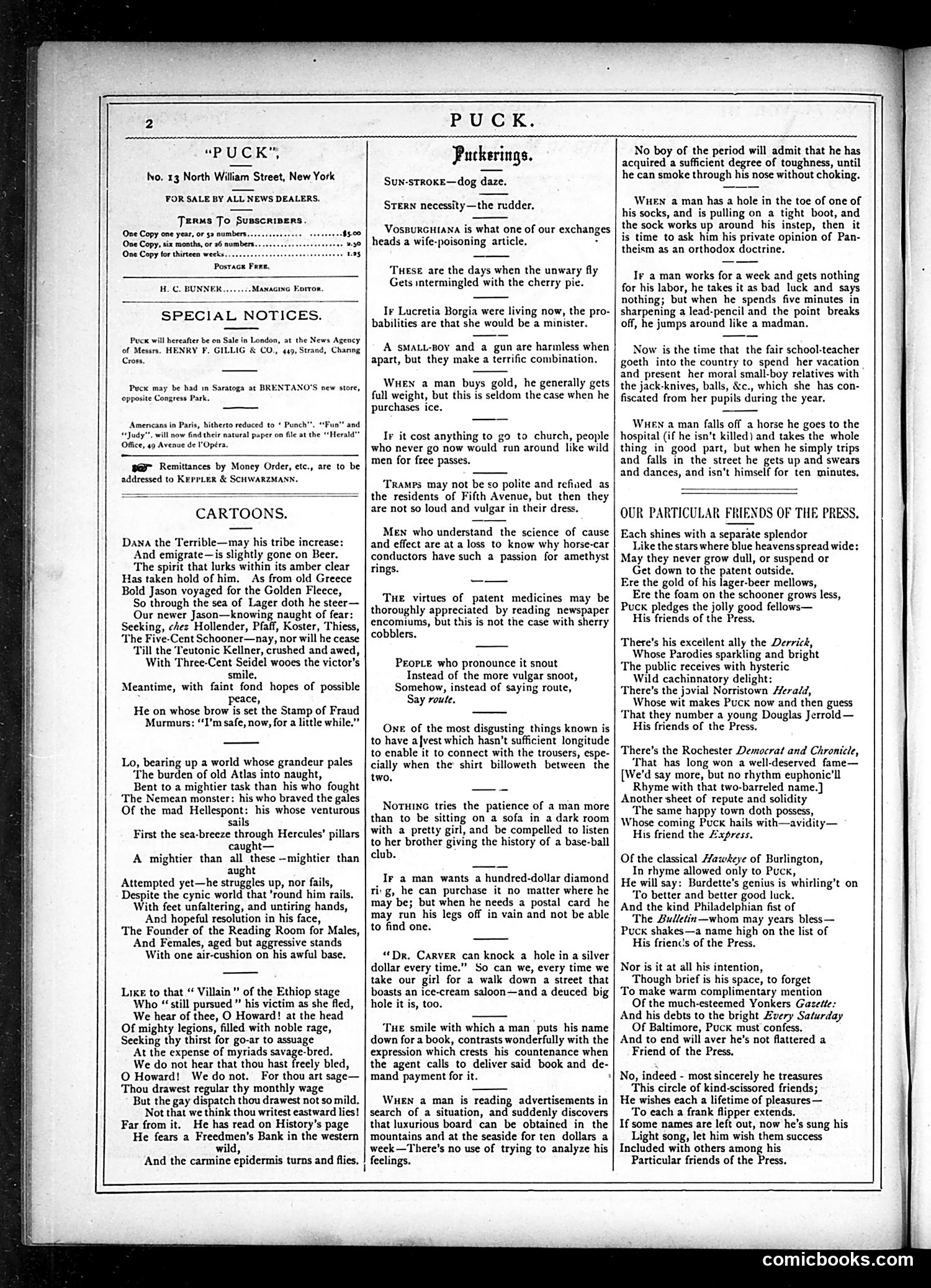
This page contains **no political cartoons**—it's primarily text-based content from Puck magazine's satirical section. The **"Puckerings"** column offers brief humorous observations on everyday social situations: small boys with guns, church attendance, horse accidents, and patent medicines. These are gentle, non-partisan jokes about human nature and social customs. The **"Cartoons"** section presents longer satirical verses about various figures—some identifiable (Dana the Terrible, Hollender), others unclear without additional context. References to Tutonic Kellner and the Reading Room for Males suggest local New York figures. The **"Our Particular Friends of the Press"** section appears to mock rival publications and journalists, a common Puck practice. Overall, this page reflects Puck's general humor style: social satire rather than pointed political commentary.
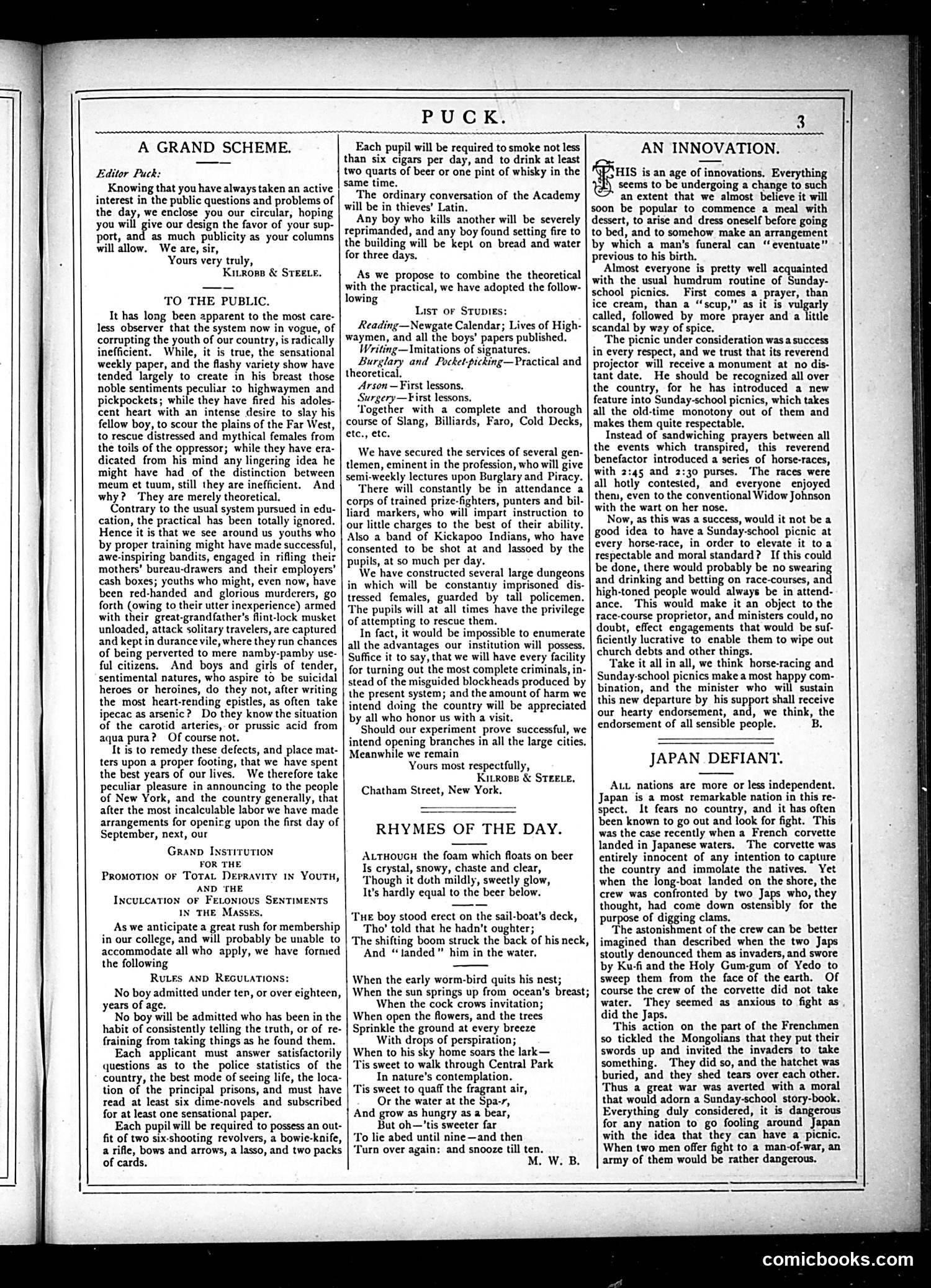
This page contains satirical commentary and announcements rather than traditional political cartoons. The main content includes: **"A Grand Scheme"** - A letter to the editor criticizing how newspapers sensationalize crime, particularly cases involving youth. The writer argues that extensive coverage of murders and scandals corrupts young people by glorifying criminals. **"An Innovation"** - Describes a new Sunday school practice combining religious instruction with picnics and secular activities. The satire appears gentle, mocking how institutions try to make morality entertaining. **"Japan Defiant"** - Commentary on Japanese independence and a recent incident where a French corvette landed in Japanese waters. The piece critiques how nations respond to foreign intrusion and uses the event to satirize Japanese national pride and Western imperialism. The "Rhymes of the Day" are humorous verse observations on daily life.
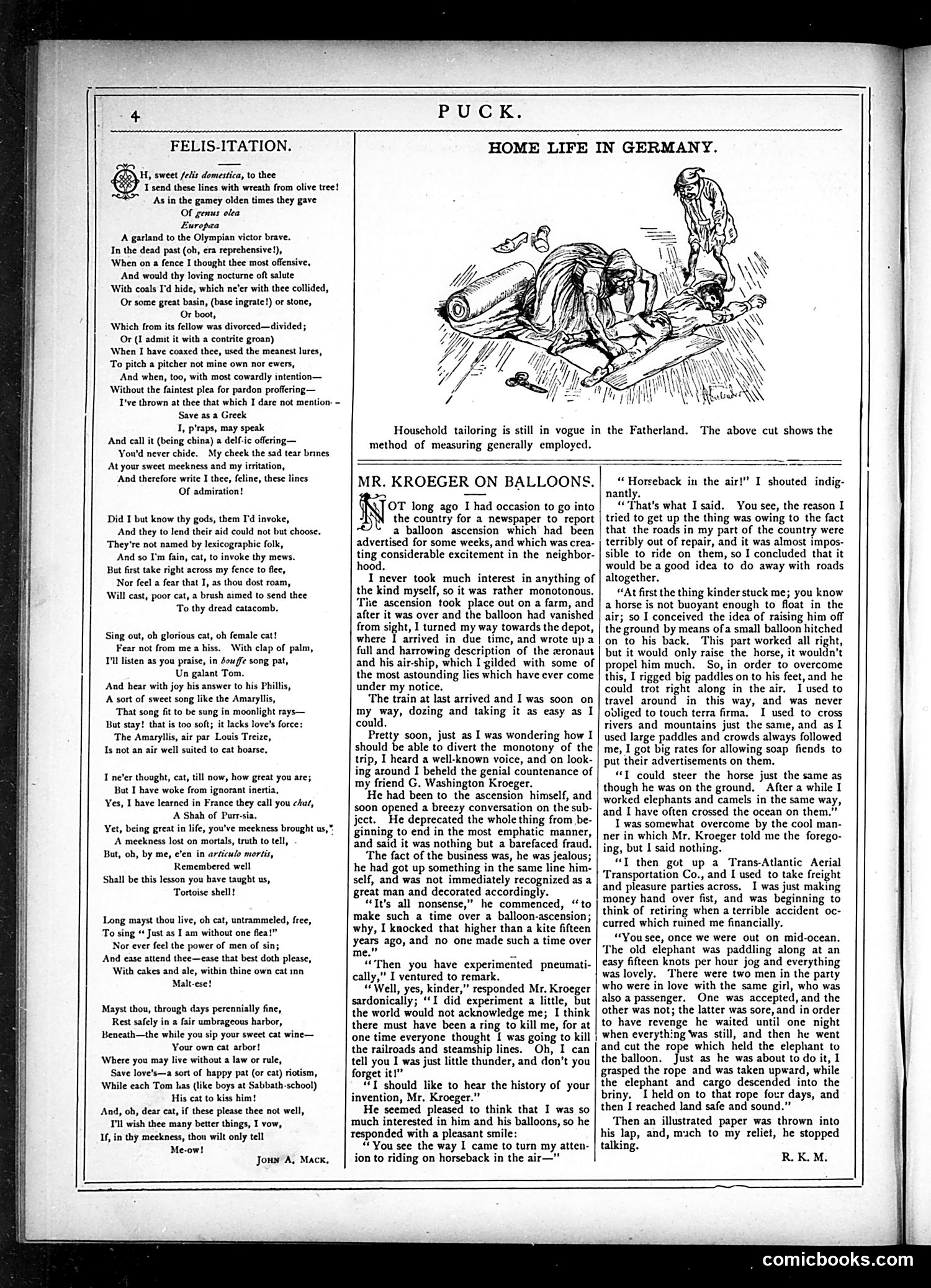
This page contains three separate pieces: 1. **"Felis-Itation"** (left column): A poem mocking someone's flowery classical allusions and pretentious writing style, comparing unfavorably to Greek references. 2. **"Home Life in Germany"** (top right): A brief illustrated article about German household tailoring methods, showing workers measuring garments. This is straightforward reportage, not satire. 3. **"Mr. Kroeger on Balloons"** (main article): A humorous anecdote about a man named Kroeger who attended a balloon ascension and later claimed to have invented hot-air balloons. The joke satirizes his dubious credibility and boastfulness—he makes increasingly absurd claims about his "invention," which everyone recognizes as fraudulent braggadocio. The page mixes light verse, practical information, and comedic storytelling typical of Puck's varied content.
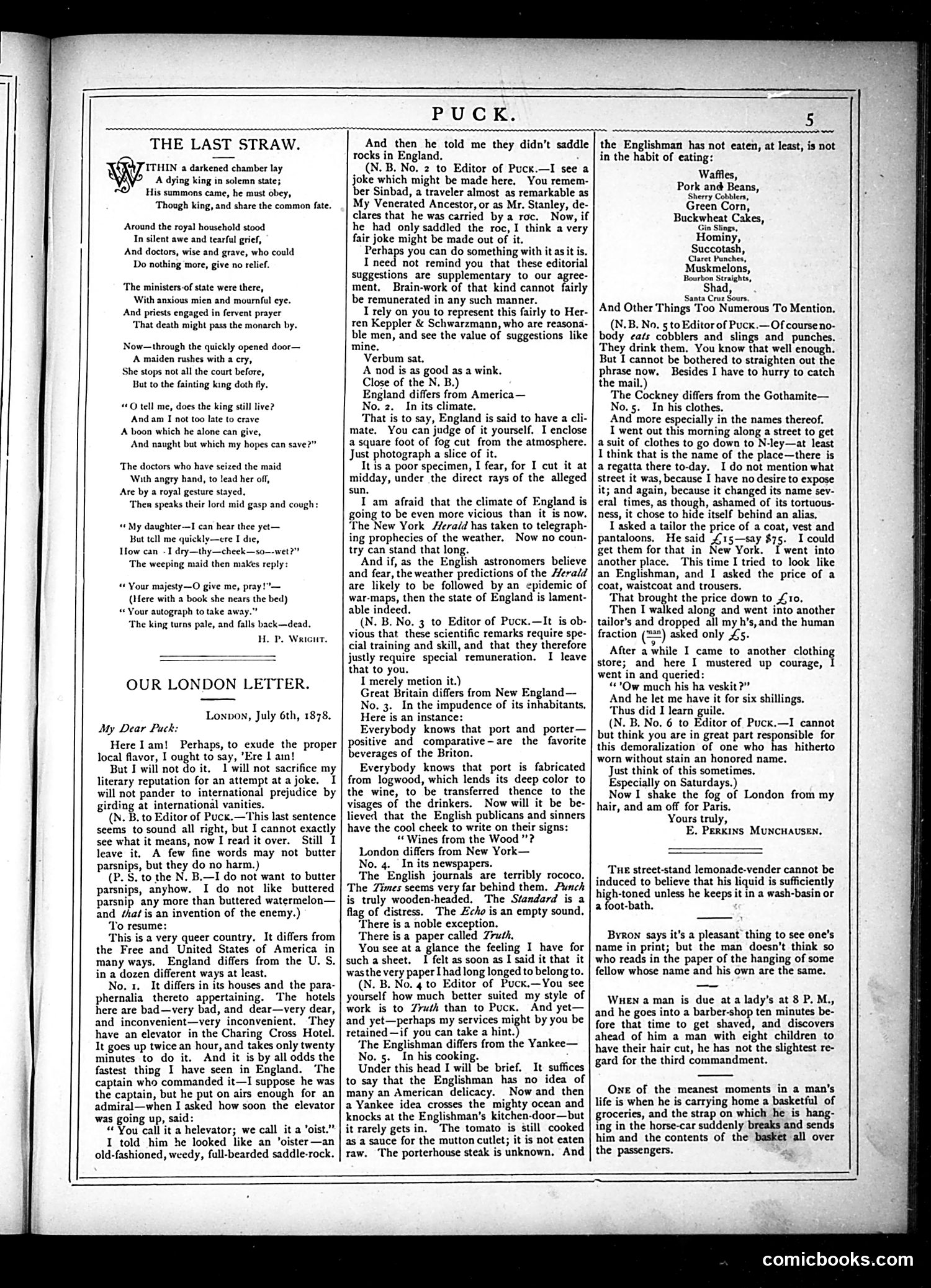
This poem depicts a domestic dispute, likely satirizing Victorian marriage dynamics. The narrative describes a husband returning home to find his wife has committed an unforgivable offense—apparently related to household management or social propriety (the exact transgression remains unclear from the text alone). The "last straw" metaphor suggests accumulated frustrations in their relationship have reached a breaking point. The wife's apparent indifference to his anger ("She stood with folded hands") contrasts with his rage. The broader page contains letters to the editor comparing English and American customs—food, newspapers, manners—typical Puck satirical commentary on transatlantic differences and pretensions. **Without seeing the actual cartoon illustration clearly, specific political figures or detailed social commentary cannot be definitively identified.**
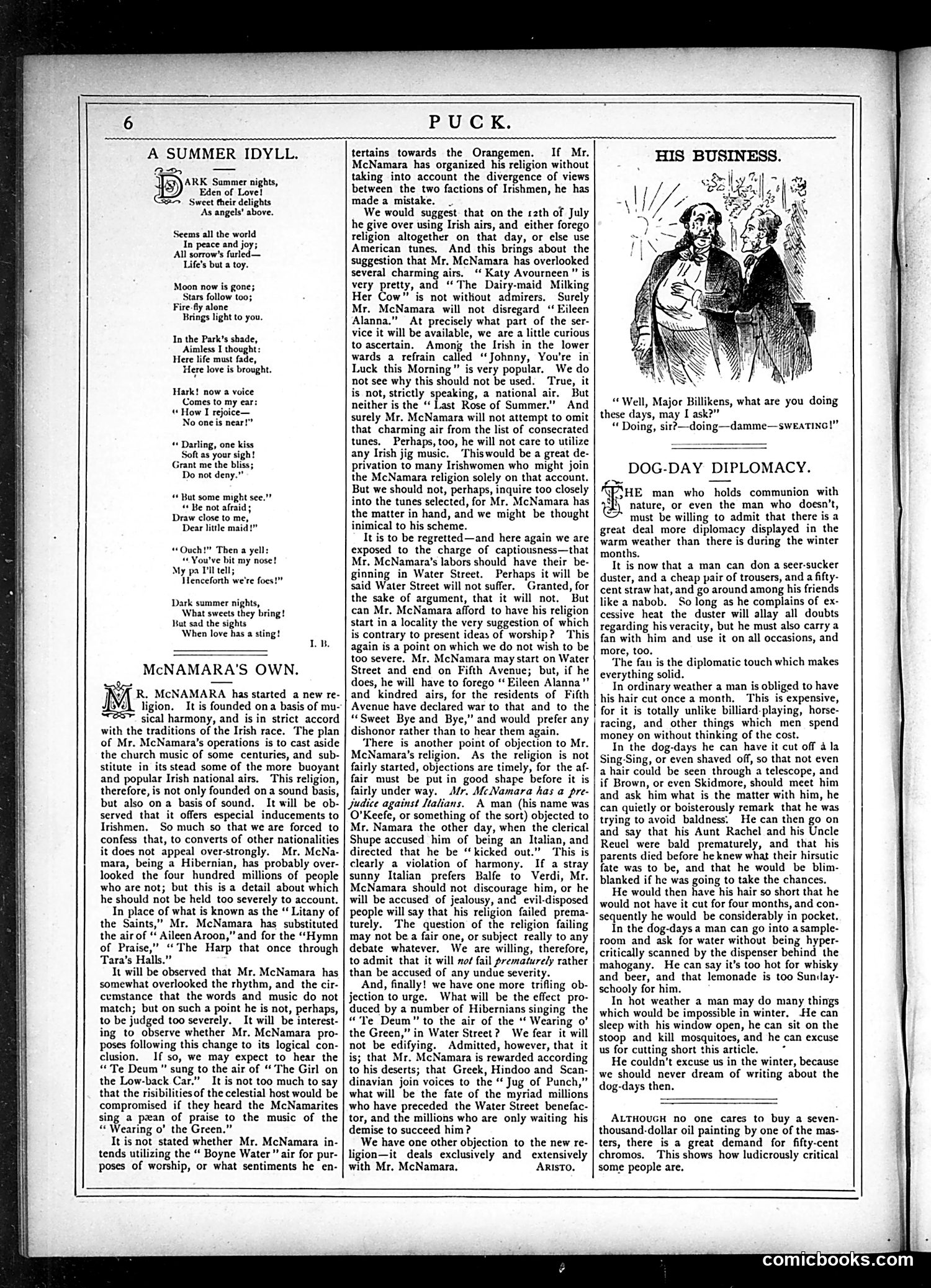
The page contains three distinct pieces: **"A Summer Idyll"** — Poetry celebrating rural romance and nature. **"McNamara's Own"** — A lengthy article critiquing Mr. McNamara's plan to start a new Irish religious organization. The text objects to his use of Irish nationalist songs and airs for religious purposes, arguing this conflates religion with nationalism inappropriately. It suggests McNamara should abandon certain Irish airs if he wants broad support. **"His Business"** — A cartoon showing two men in conversation. One asks the other (identified as "Major Billikens") what he's doing. The response includes "SWEATING," suggesting the cartoon satirizes someone engaged in strenuous or dishonest activity, though the specific reference remains unclear without additional context. The page addresses Irish-American religious and cultural identity issues of its era.
This page contains two distinct pieces: a poem titled "At the Sea-Shore" (left) and an essay titled "How Far Mr. Muggins Got Toward Polo" (right). The essay by Ephraim Muggins is a humorous first-person account of a gentleman attempting to learn polo—a sport associated with high society and the wealthy. Muggins describes his comical struggles acquiring clubs, misunderstanding the sport's rules, and managing an uncooperative horse. The satire targets the pretensions of social climbers attempting to participate in elite recreational activities without proper training or natural aptitude. The piece mocks both Muggins's incompetence and the exclusivity of upper-class sporting culture, suggesting that polo remains inaccessible to outsiders despite their determined efforts.
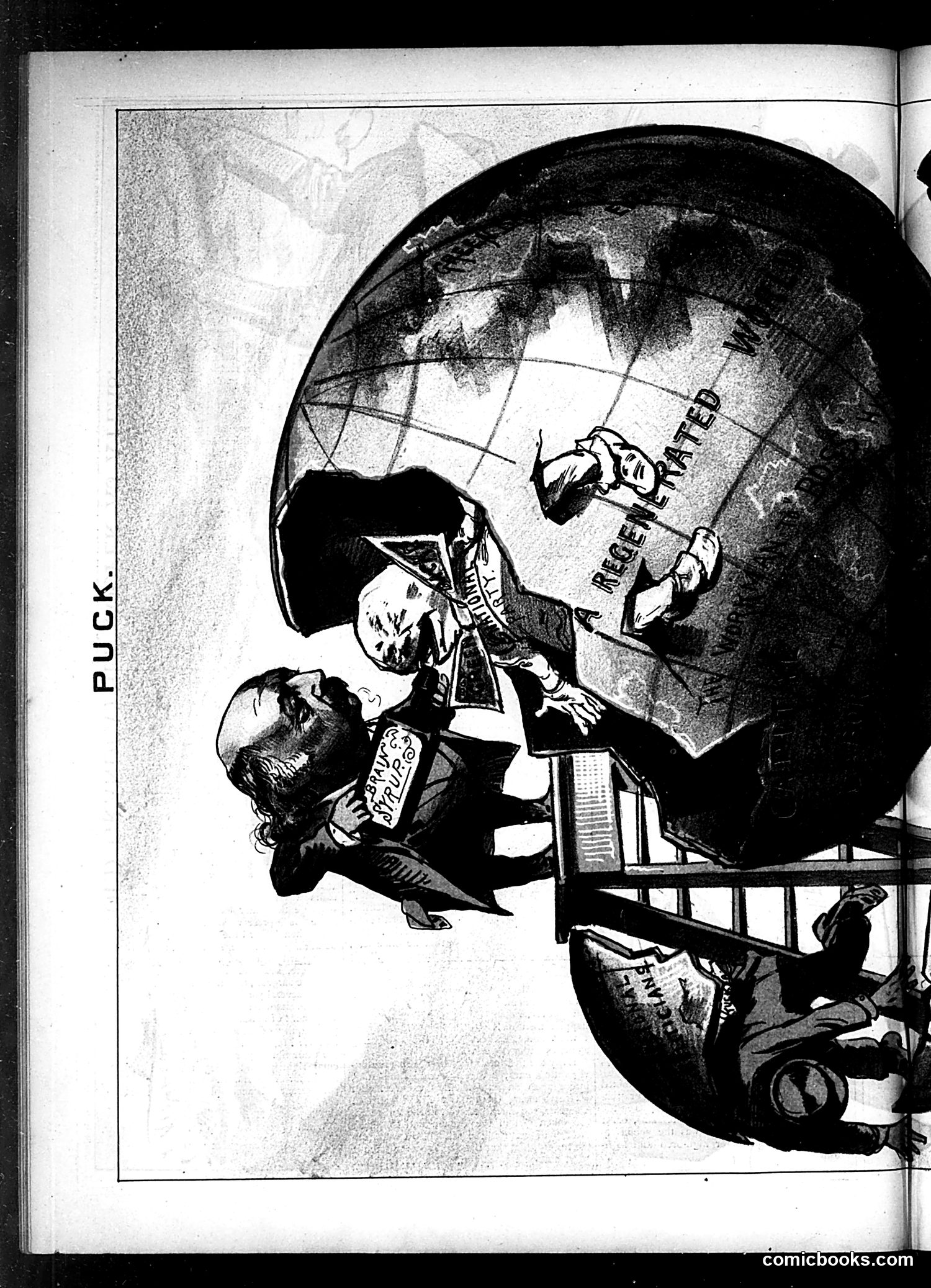
This page contains a political cartoon labeled "PUCK" on the left margin. The image shows a large globe with a figure appearing to push or manipulate it. The figure appears to be a caricatured politician or businessman in formal dress, depicted with exaggerated features typical of Puck's satirical style. The text visible on the globe reads "MELTED PUFF" (or similar—OCR clarity is uncertain), and there appear to be additional labels or captions that are difficult to read clearly in this reproduction. Without being able to definitively identify the specific historical figure or date this cartoon references, I cannot accurately explain the political point or social satire intended. The general theme appears to involve commentary on someone's influence or manipulation of global affairs or public opinion, but more specific context would require clearer text or additional information about the publication date.
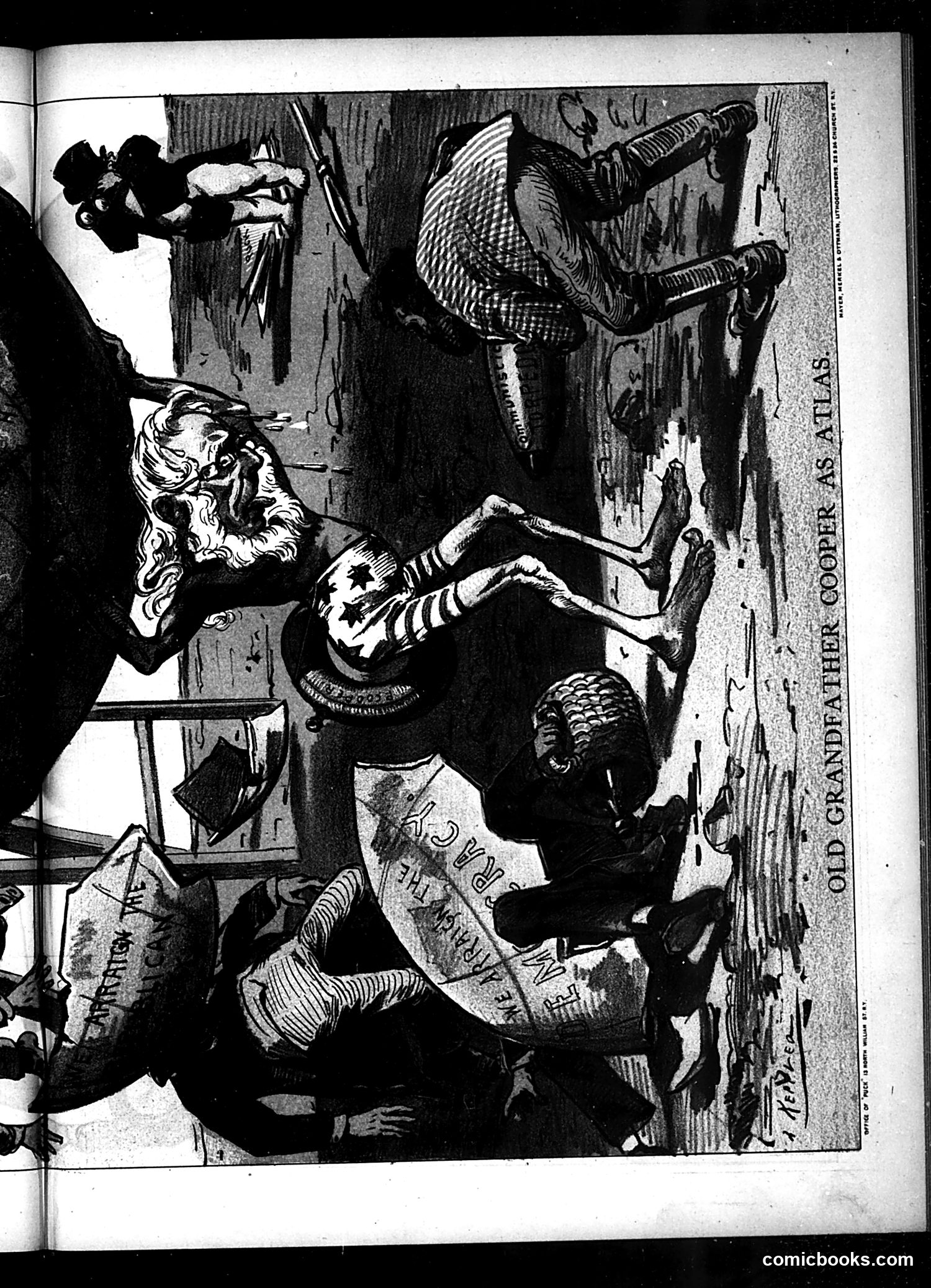
This appears to be a satirical illustration from Puck magazine titled "Odd Grandfather Cooper's Atlas" (visible on the right margin). The image depicts what seems to be a caricatured older man with exaggerated features lying down or reclining, with other figures around him in what appears to be an indoor setting with period furnishings and decorative elements. Without clearer visibility of all text and identifying details, I cannot definitively identify the specific historical figures or the precise political event being satirized. The style and composition suggest social or political commentary typical of Puck's approach, but asserting specific identities or references would require clearer textual evidence than the OCR provides. The cartoonist's intent likely involved commentary on a contemporary public figure or situation recognizable to Puck's 19th-century readers.
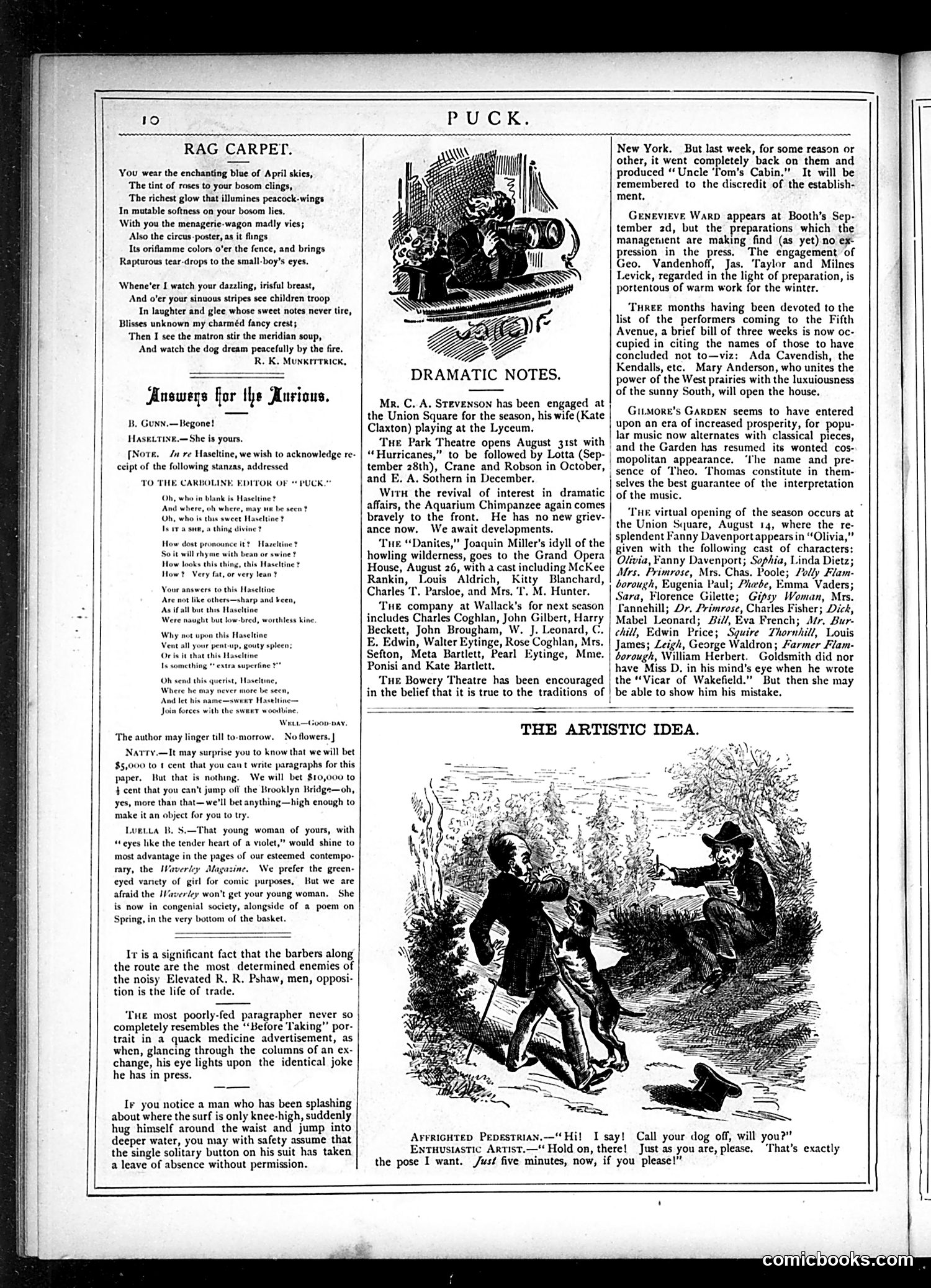
**"The Artistic Idea"** cartoon depicts two figures in a rural landscape: an "Affrighted Pedestrian" asking a man to call off his dog, and an "Enthusiastic Artist" who refuses, saying he needs the exact pose for "just five minutes now, if you please!" The satire mocks overly dedicated artists who prioritize their work above others' safety and comfort. The joke is that the artist is so committed to capturing the "perfect pose"—even with the pedestrian in genuine danger from the dog—that he ignores the person's legitimate distress. The page also contains dramatic notes about theatrical productions and literary commentary, including discussion of upcoming shows and performers at various New York theaters.
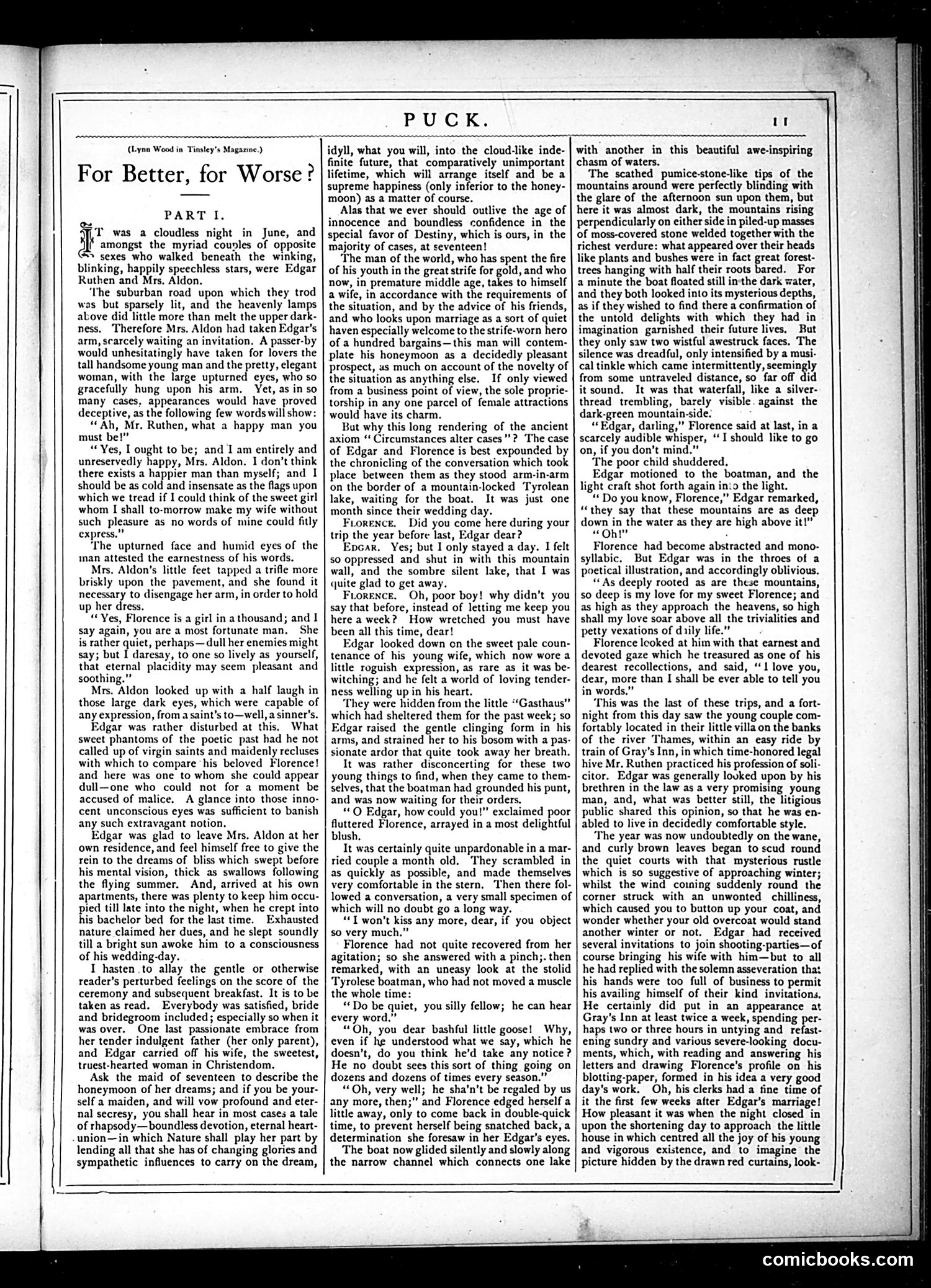
This page contains the opening of a serialized short story rather than a political cartoon. The narrative follows Edgar and Florence, a newly married couple on their honeymoon at a mountain lake. The story appears to be a romantic melodrama examining marriage and domestic life. The text presents contrasting perspectives: Edgar questions whether marriage will bring happiness, while Florence is devotedly romantic. The setup suggests the story will explore whether their union proves beneficial or problematic—hence the title's question. This represents Puck's literary content rather than satirical cartooning. The magazine mixed humor, social commentary, and fiction to appeal to middle-class readers interested in domestic and romantic themes of the era.
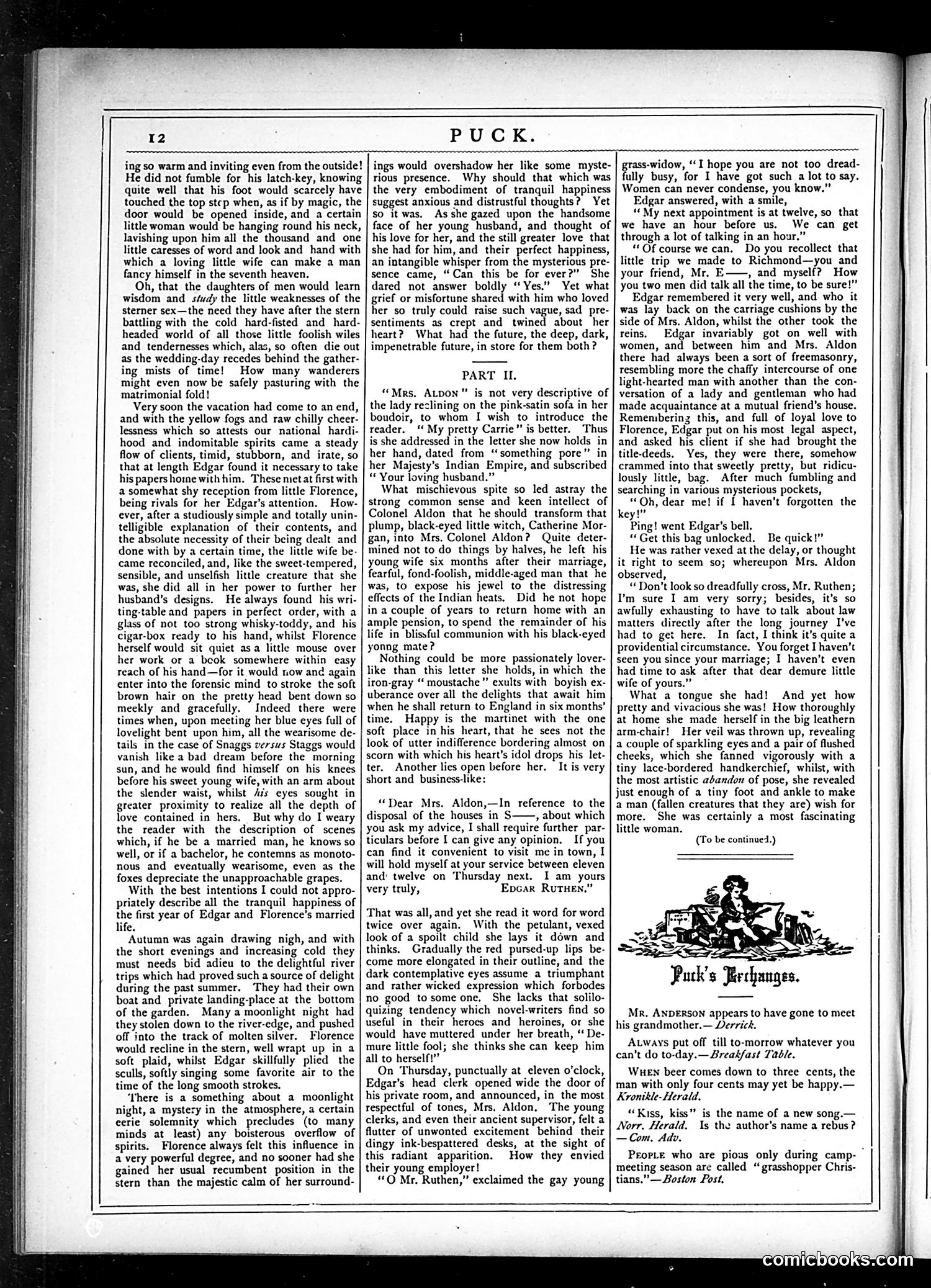
This page contains the continuation of a serialized short story titled "PART II" rather than political satire or social commentary. The narrative focuses on personal domestic drama involving characters named Mrs. Aldon, Edgar Rutherford, and Colonel Aldon, discussing marriage troubles, an unhappy wife's infidelity concerns, and household management issues in what appears to be a period setting. At the bottom of the page is "Puck'sPertinences," a small humor section with brief jokes about contemporary topics (a politician meeting his grandmother, beer prices dropping to three cents, and a pun about an author's name). These are light satirical quips rather than substantive political commentary. This page is primarily fiction and light humor rather than the political cartoons Puck magazine is known for.
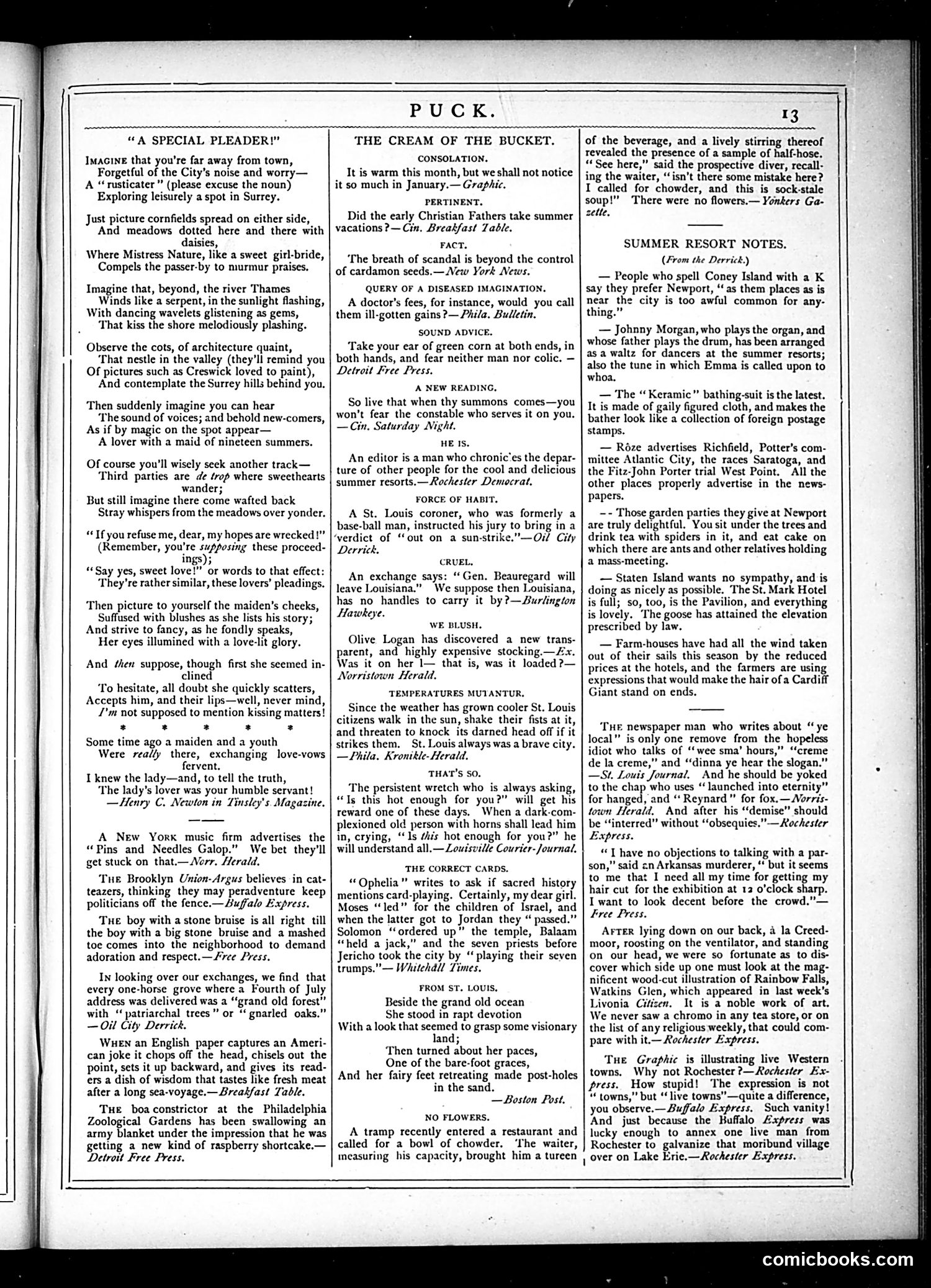
This page is primarily **text content** rather than political cartoons—it's a collection of satirical prose pieces, jokes, and social commentary typical of Puck's format. The pieces mock various targets: pretentious urban life ("A Special Pleader"), medical quackery ("Query of a Diseased Imagination"), editorial hypocrisy, and social absurdities. One item satirizes a St. Louis coroner's "sun-strike" verdict, suggesting legal incompetence. Another mocks Gen. Beauregard leaving Louisiana, implying cowardice. "Summer Resort Notes" pokes fun at Newport society and its affected pretensions—fashionable bathing costumes, snobbish attitudes toward advertising, and the self-important behavior of wealthy vacationers. The satire is **gentle social criticism** aimed at contemporary urban and upper-class American life, rather than hard political commentary.
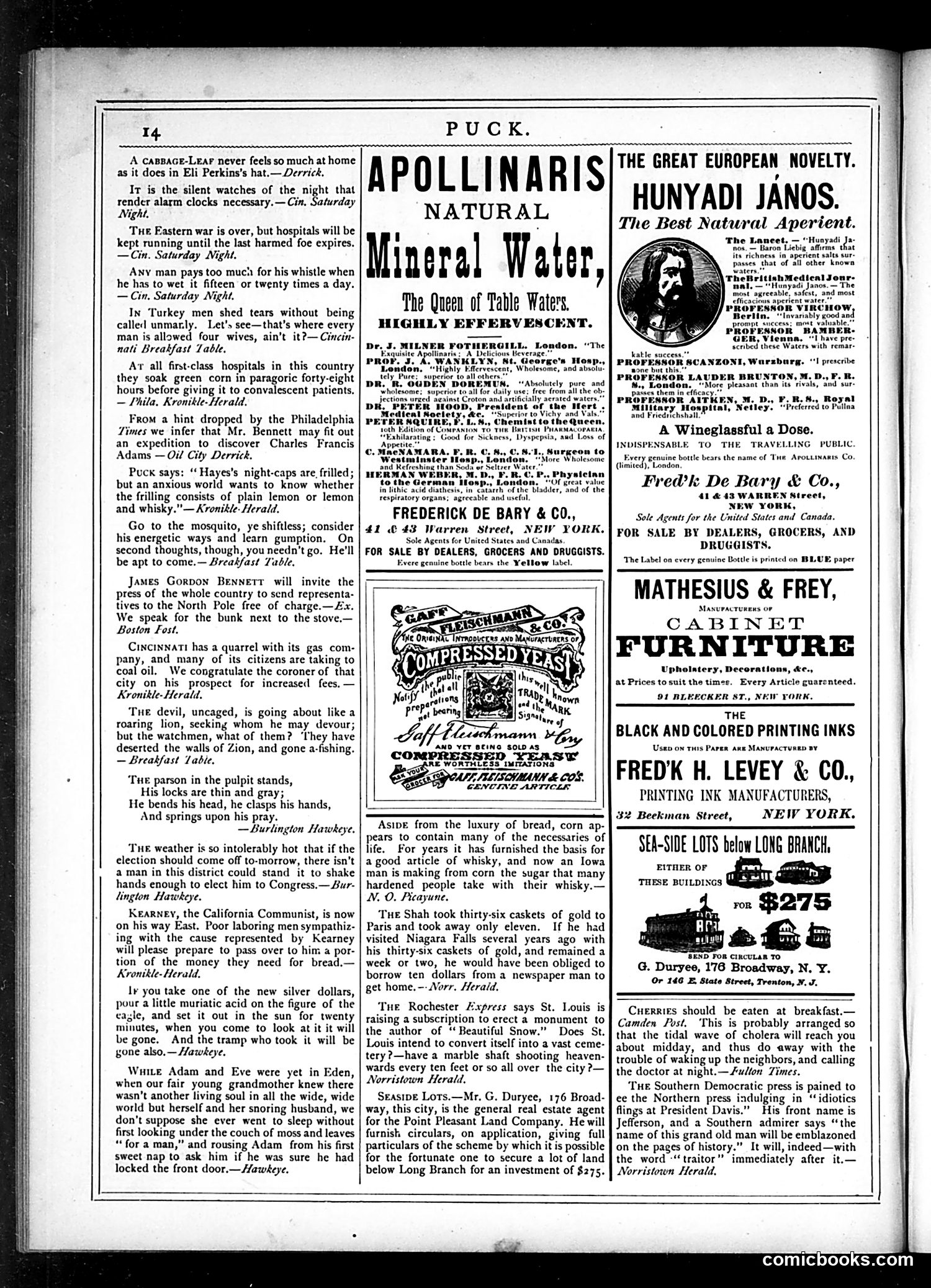
This is primarily an **advertising page** from Puck magazine, not a political cartoon. The page features multiple commercial advertisements for products including: - **Apollinaris Natural Mineral Water** (prominently featured with testimonials from doctors and celebrities) - **Mathesius & Frey Cabinet Furniture** - **Fredk H. Levey & Co. Printing Inks** - **Fleischmann's Compressed Yeast** - Real estate offerings for seaside lots The left column contains brief satirical news items typical of Puck's commentary—jokes about Turkish marriage customs, hospital conditions, and political figures—but these are short quips rather than developed cartoons. The page's primary purpose is commercial rather than satirical commentary.
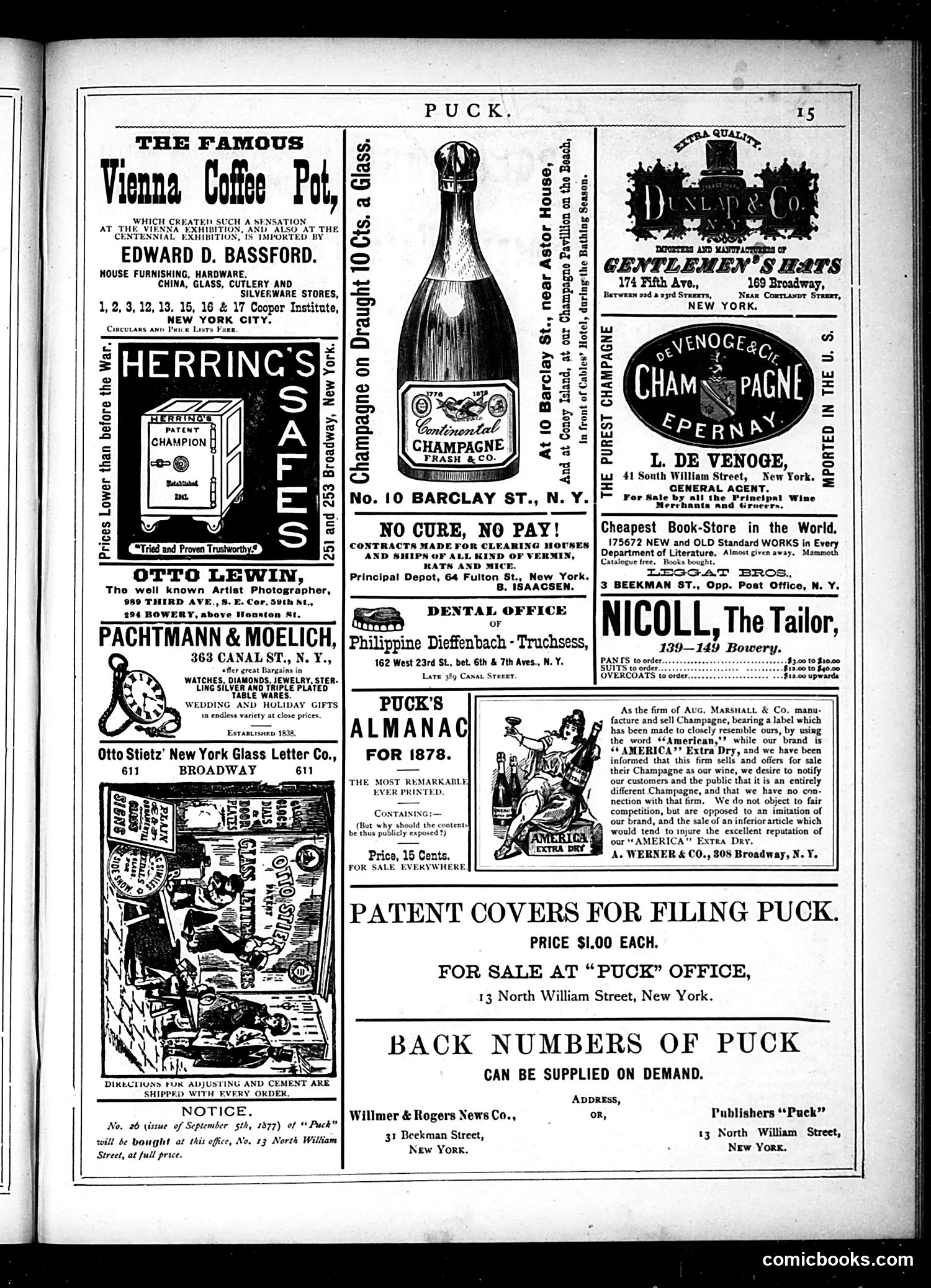
This page is primarily **advertising and back matter** for Puck magazine (1878), not political satire. The visible content includes: - Multiple commercial advertisements for products like Vienna Coffee Pots, champagne, hats, dental work, and photography services - A notice about Puck's Almanac for 1878 - Information about patent covers and back-issue subscriptions The only cartoon visible is a small illustration labeled "AMERICA'S EXTRA DRY" showing figures in a celebratory pose, advertising A. Werner & Co.'s champagne—a commercial joke rather than political satire. The page demonstrates how 19th-century magazines blended editorial content with advertising revenue. Without seeing the magazine's main satirical pages, we cannot identify specific political targets or social commentary from this back section.
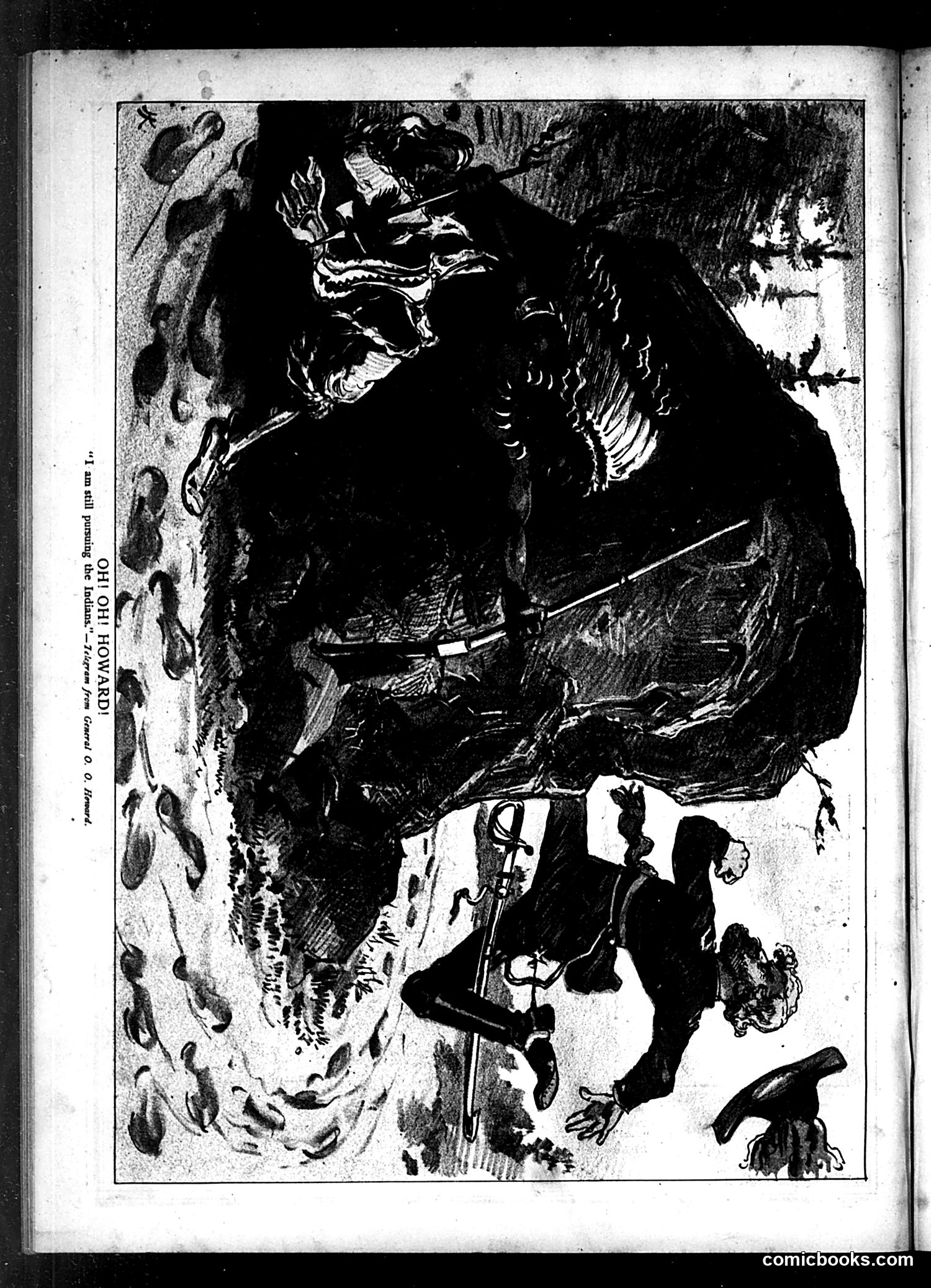
I can see this is a Puck magazine page with a dramatic illustration, but the OCR text provided is largely illegible or missing, making it difficult to identify the specific figures, historical context, or satirical point with certainty. The image shows what appears to be a large menacing figure looming over smaller human figures below. The style and composition suggest political or social satire typical of Puck's editorial cartoons. However, without clear text or visible captions identifying the figures or historical moment referenced, I cannot reliably explain which political events, personalities, or social issues this cartoon addresses. To provide accurate analysis for modern readers, I would need legible identifying text, visible dates, or clearer figure labels from the original page.