
Puck, 1878-08-07 · page 6 of 16
Puck — August 7, 1878 — page 6: what you’re looking at
What you’re looking at
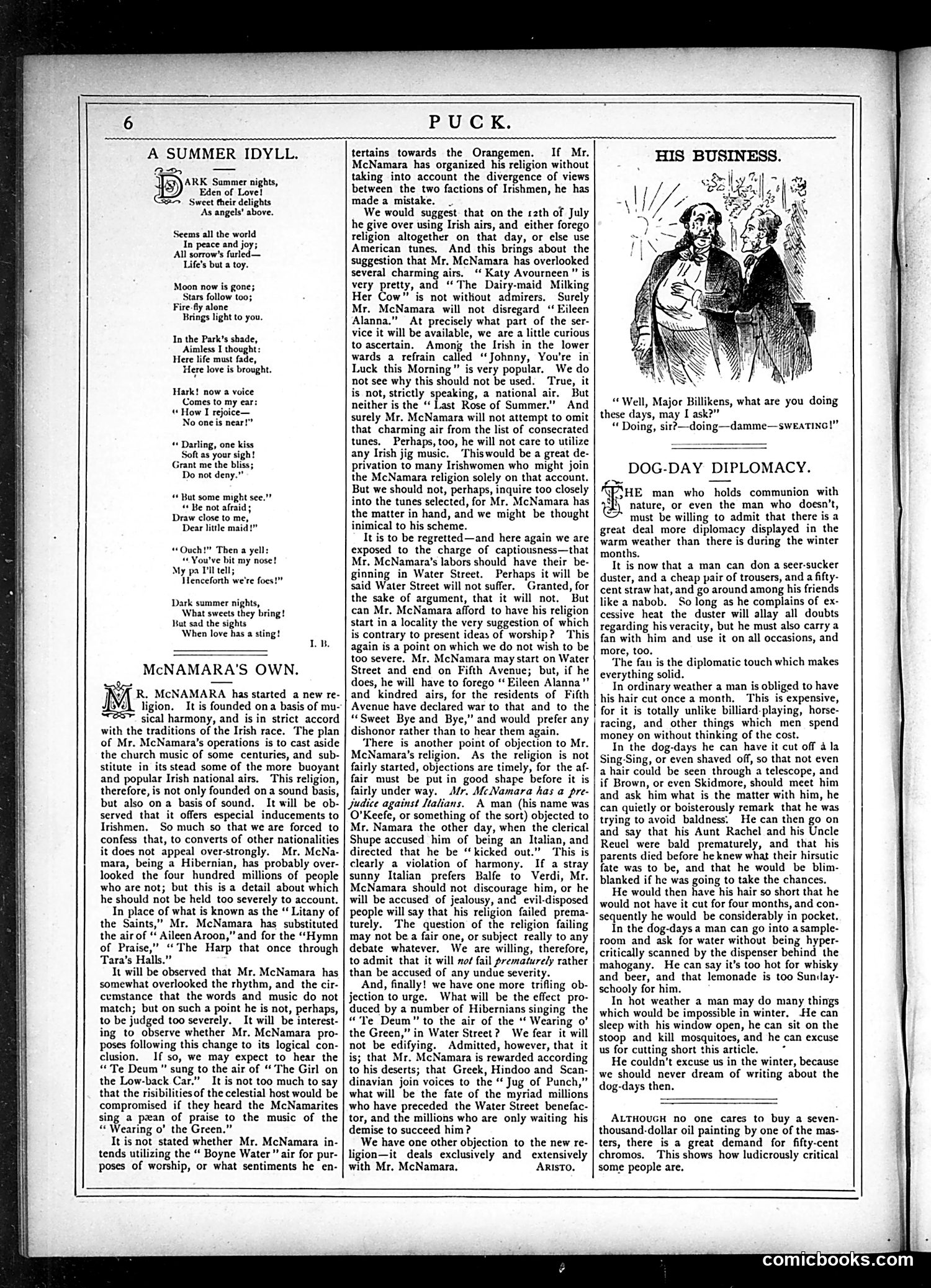
The page contains three distinct pieces: **"A Summer Idyll"** — Poetry celebrating rural romance and nature. **"McNamara's Own"** — A lengthy article critiquing Mr. McNamara's plan to start a new Irish religious organization. The text objects to his use of Irish nationalist songs and airs for religious purposes, arguing this conflates religion with nationalism inappropriately. It suggests McNamara should abandon certain Irish airs if he wants broad support. **"His Business"** — A cartoon showing two men in conversation. One asks the other (identified as "Major Billikens") what he's doing. The response includes "SWEATING," suggesting the cartoon satirizes someone engaged in strenuous or dishonest activity, though the specific reference remains unclear without additional context. The page addresses Irish-American religious and cultural identity issues of its era.
📄 Transcribed text from this page (OCR, searchable)
Machine-transcribed from the original scan — historical spelling and the odd misread are preserved.
| | | | | es —— PUCK. A SUMMER IDYLL. ARK Summer nights, Eden of Love! GEA Sweet their delights As angels’ above. Seems all the world In peace and joy; All sorrow’s furled Life's but a toy. Moon now is gone; Stars follow too Fire-fy alone Brings light to you. In the Park’s shade, Aimless I thought: Here life must fade, Here love is brought. Hark! now a voice ‘Comes to my ear: « How I rejoice— No oneis near!” « Darling, one kiss + But some might see."” + Be not afraid; Draw close to me, Dear little maid!” “Ouch!” Then a yell: “You've bit my nose! My pa I'll tell Henceforth we're foes!” Dark summer nights, ‘What sweets they bring! Wut sad the sights When love has a sting! McNAMARA'S OWN. M R. McNAMARA has started a new re- ion. It is founded ona basis of mu- sical harmony, and is in strict accord with the traditions of the Irish race. The plan of Mr. McNamara’s operations is to cast aside the church music of some centuries, and sub- stitute in its stead some of the more buoyant and popular Irish national airs. ‘This religion, therefore, is not only founded ona sound basis, but also ona basis of sound. It will be ob- served that it offers especial inducements to Irishmen. So much so that we are forced to confess that, to converts of other nationalities it does not appeal over-strongly. Mr. McNa- mara, being a Hibernian, has probably over- looked the four hundred millions of people who are not; but this is a detail about which he should not be held too severely to account. In place of what is known as the “ Litany of the Saints,” Mr. McNamara has substituted the air of “ Aileen Aroon,” and for the “Hymn of Praise,” ‘The Harp that once through Tara’s Halls.” It will be observed that Mr, McNamara has somewhat overlooked the rhythm, and the cir- cumstance that the words and music do not match; but on such a point he is not, perhaps, to be judged too severely. It will be interest- ing to observe whether Mr. McNamara pro- poses following this change to its logical con- clusion. If so, we may expect to hear the “Te Deum ” sung to the air of “ The Girl on the Low-back Car.” It is not too much to say that the risibilities of the celestial host would be compromised if they heard the McNamarites sing a pxan of praise to the music of the “ Wearing o' the Green.” It is not stated whether Mr. McNamara in- tends utilizing the “ Boyne Water” air for pur- poses of worship, or what sentiments he en- tertains towards the Orangemen. If Mr. McNamara has organized his religion without taking into account the divergence of views between the two factions of Irishmen, he has made a mistake. _ We would suggest that on the r2th of July he give over using Irish airs, and either forego religion altogether on that day, or else use American tunes, And this brings about the suggestion that Mr. McNamara has overlooked several charming airs. “Katy Avourneen ” is very pretty, and “The Dairy-maid Milking Her Cow” is not without admirers. Surely Mr. McNamara will not disregard ‘Eileen Alanna.” At precisely what part of the ser- vice it will be available, we are a little curious to ascertain. Among the Irish in the lower wards a refrain called “Johnny, You're in Luck this Morning” is very popular. We do not see why this should not be used. True, it is not, strictly speaking, a national air. But neither is the ‘ Last Rose of Summer.” And surely Mr. McNamara will not attempt to omit that charming air from the list of consecrated tunes, Perhaps, too, he will not care to utilize any Irish jig music. ‘Thiswould be a great de- privation to many Irishwomen who might join the McNamara religion solely on that account. But we should not, perhaps, inquire too closely into the tunes selected, for Mr. McNamara has the matter in hand, and we might be thought inimical to his scheme. It is to be regretted—and here again we are exposed to the charge of captiousness—that Mr. McNamara’s labors should have their be- ginning in Water Street. Perhaps it will be said Water Street will not suffer. Granted, for the sake of argument, that it will not. But can Mr. McNamara afford to have his religion start in a locality the very suggestion of which is contrary to present ideas of worship? ‘This again is a point on which we do not wish to be too severe. Mr. McNamara may start on Water Street and end on Fifth Avenue; but, if he does, he will have to forego ‘Eileen Alanna’’ and kindred airs, for the residents of Fifth Avenue have declared war to that and to the “Sweet Bye and Bye,” and would prefer any dishonor rather than to hear them again. ‘There is another point of objection to Mr. McNamara’s religion, As the rel fairly started, objections are timely, for the af- fair must be put in good shape before it is fairly under way. Mr. McNamara has a pre- judice against Halians. A man (his name was O'Keefe, or something of the sort) objected to Mr. Namara the other day, when the clerical Shupe accused him of being an Italian, and directed that he be ‘kicked out.” This is clearly a violation of harmony. If a stray sunny Italian prefers Balfe to Verdi, Mr. McNamara should not discourage him, or he will be accused of jealousy, and evil-disposed people will say that his religion failed prema- turely. The question of the religion failing may not be a fair one, or subject really to any debate whatever, We are willing, therefore, to admit that it will nof fail prematurely rather than be accused of any undue severity. And, finally! we have one more trifling ob- jection to urge. What will be the effect pro- duced by a number of Hibernians singing the “Te Deum” to the air of the ‘‘ Wearing 0° the Green,” in Water Street? We fear it will not be edifying. Admitted, however, that it is; that Mr. McNamara is rewarded according to his deserts; that Greek, Hindoo and Scan- dinavian join voices to the “ Jug of Punch,” what will be the fate of the myriad millions who have preceded the Water Street benefac- tor, and the millions who are only waiting his demise to succeed him? We have one other objection to the new re- ligion—it deals exclusively and extensively with Mr, McNamara, ARISTO. HIS BUSINESS. “Well, Major Billikens, what are you doing these days, may I ask?” “ Doing, sir-—doing—damme—sweatino!” DOG-DAY DIPLOMACY. — = ‘pur man who holds communion with ey nature, or even the man who doesn’t, must be willing to admit that there is a great deal more diplomacy displayed in the warm weather than there is during the winter months. It is now that a man can don a seer-sucker duster, and a cheap pair of trousers, and a fifty- cent straw hat, and go around among his friends like a nabob. So long as he complains of ex- cessive heat the duster will allay all doubts regarding his veracity, but he must also carry a fan with him and use it on all occasions, and more, too. ‘The fan is the diplomatic touch which makes everything solid. In ordinary weather a man is obliged to have his hair cut once a month, This is expensive, for it is totally unlike billiard-playing, horse- racing, and other things which men spend money on without thinking of the cost. In the dog-days he can have it cut off 4 la Sing-Sing, or even shaved off, so that not even a hair could be seen through a telescope, and if Brown, or even Skidmore, should meet him and ask him what is the matter with him, he can quietly or boisterously remark that he was trying to avoid baldness. He can then go on and say that his Aunt Rachel and his Uncle Reuel were bald prematurely, and that his parents died before he knew what their hirsutic fate was to be, and that he would be blim- blanked if he was going to take the chances. He would then have his hair so short that he would not have it cut for four months, and con- sequently he would be considerably in pocket, In the dog-days a man can go into asample- room and ask for water without being hyper- critically scanned by the dispenser behind the mahogany. He can say it’s too hot for whisky and beer, and that lemonade is too Sunilay- schooly for him. In hot weather a man may do many things which would be impossible in winter, -He can sleep with his window open, he can sit on the stoop and kill mosquitoes, and he can excuse us for cutting short this article. J He couldn't excuse us in the winter, because we should never dream of writing about the dog-days then. ALTHOUGH no one cares to buy a seven- thousand-dollar oil painting by one of the mas- ters, there is a great demand for fifty-cent chromos. This shows how ludicrously critical some people are. comicbooks.com