
Puck, 1878-08-07 · page 5 of 16
Puck — August 7, 1878 — page 5: what you’re looking at
What you’re looking at
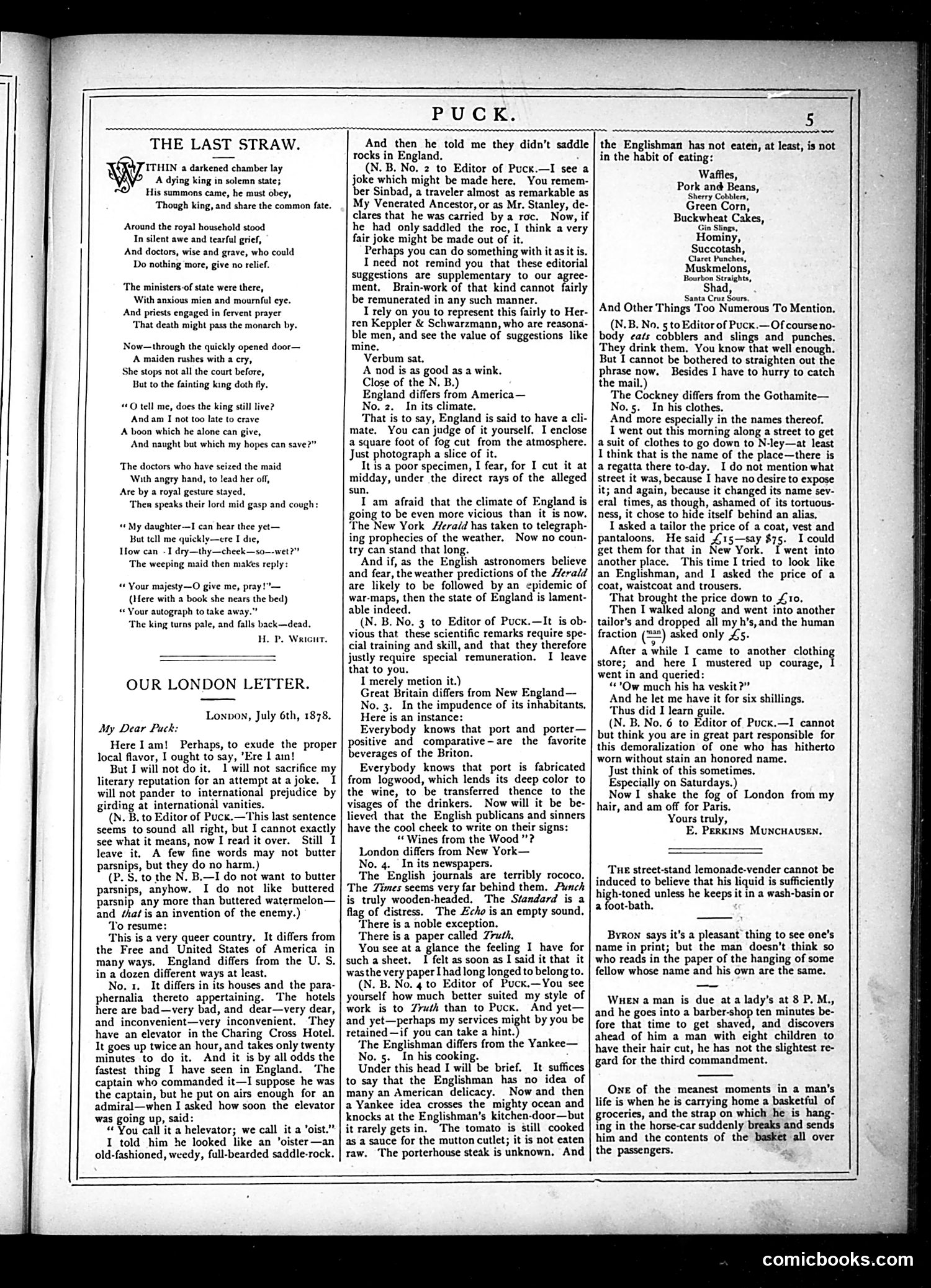
This poem depicts a domestic dispute, likely satirizing Victorian marriage dynamics. The narrative describes a husband returning home to find his wife has committed an unforgivable offense—apparently related to household management or social propriety (the exact transgression remains unclear from the text alone). The "last straw" metaphor suggests accumulated frustrations in their relationship have reached a breaking point. The wife's apparent indifference to his anger ("She stood with folded hands") contrasts with his rage. The broader page contains letters to the editor comparing English and American customs—food, newspapers, manners—typical Puck satirical commentary on transatlantic differences and pretensions. **Without seeing the actual cartoon illustration clearly, specific political figures or detailed social commentary cannot be definitively identified.**
📄 Transcribed text from this page (OCR, searchable)
Machine-transcribed from the original scan — historical spelling and the odd misread are preserved.
PUCK. 5 THE LAST STRAW. SAT ITHIN a darkened chamber lay A dying king in solemn state; His summons came, he must obey, ‘Though king, and share the common fate. Around the royal household stood In silent awe and tearful grief, And doctors, wise and grave, who could Do nothing more, give no relief. The ministers-of state were there, With anxious mien and mournful eye. And priests engaged in fervent prayer ‘That death might pass the monarch by. Now—through the quickly opened door— ‘A maiden rushes with a cry, She stops not all the court before, But to the fainting king doth fy. “O tell me, does the king still live? And am I not too late to crave A boon which he alone can give, And naught but which my hopes can save?” The doctors who have seized the maid With angry hand, to lead her off, Are by a royal gesture stayed, ‘Then speaks their lord mid gasp and cough: «« My daughter—I can hear thee yet— But tell me quickly—ere I die, How can -I dry—thy—cheek—so—-wet?” ‘The weeping maid then makes reply: “ Your majesty—O give me, pray!"— (Iere with a book she nears the bed) « Your autograph to take away.” ‘The king turns pale, and falls back—dead. H. P. Waicut. OUR LONDON LETTER. Lonpon, July 6th, 1878, My Dear Puck: Here Iam! Perhaps, to exude the proper local flavor, I ought to say, 'Ere 1 ain! But I will not do it. 1 will not sacrifice my literary reputation for an attempt at a joke. I will not pander to international prejudice by girding at international vanities. (N. B. to Editor of Puck.—This last sentence seems to sound all right, but I cannot exactly see what it means, now I read it over. Still I leave it. A few fine words may not butter parsnips, but they do no harm.) (P. S. to the N. B.—I do not want to butter parsnips, anyhow. I do not like buttered parsnip any more than buttered watermelon— and ‘hat is an invention of the enemy.) ‘To resume: This is a very queer country. It differs from the Free and United States of America in many ways. England differs from the U. S. in a dozen different ways at least. No. 1. It differs in its houses and the para- phernalia thereto appertaining. The hotels here are bad—very bad, and dear—very dear, and inconvenient—very inconvenient. They have an elevator in the Charing Cross Hotel. It goes up twice an hour, and takes only twenty minutes to do it. And it is by all odds the fastest thing I have seen in England. The captain who commanded it—I suppose he was the captain, but he put on airs enough for an admiral—when I asked how soon the elevator was going up, said: “ You call it a helevator; we call it a ‘oist.” I told him he looked like an 'oister—an old-fashioned, weedy, full-bearded saddle-rock. And then he told me they didn’t saddle rocks in England. _(N. B, No. 2 to Editor of Puck.—I see a joke which might be made here. You remem- ber Sinbad, a traveler almost as remarkable as My Venerated Ancestor, or as Mr. Stanley, de- clares that he was carried by a roc. Now, if he had only saddled the roc, I think a very fair joke might be made out of it. Perhaps you can do something with it as it is. Ineed not remind you that these editorial Suggestions are supplementary to our agree- ment. Brain-work of that kind cannot fairly be remunerated in any such manner. T rely on you to represent this fairly to Her- ren Keppler & Schwarzmann, who are reasona- ble men, and see the value of suggestions like mine. Verbum sat. A nod is as good as a wink. Close of the N. B.) England differs from America— No. 2, In its climate. ‘That is to say, England is said to have a cli- mate, You can judge of it yourself. I enclose a square foot of fog cut from the atmosphere. Just photograph a slice of it. It is a poor specimen, I fear, for I cut it at midday, under the direct rays of the alleged sun, I am afraid that the climate of England is going to be even more vicious than it is now. ‘The New York /era/d has taken to telegraph- ing prophecies of the weather. Now no coun- try can stand that long. And if, as the English astronomers believe and fear, the weather predictions of the Herald are likely to be followed by an epidemic of war-maps, then the state of England is lament- able indeed. (N. B. No. 3 to Editor of Puck.—It is ob- vious that these scientific remarks require spe- cial training and skill, and that they therefore justly require special remuneration. I leave that to you. I merely metion it.) Great Britain differs from New England— No, 3. In the impudence of its inhabitants, Here is an instance: Everybody knows that port and porter— positive and comparative-are the favorite beverages of the Briton. Everybody knows that port is fabricated from logwood, which lends its deep color to the wine, to be transferred thence to the visages of the drinkers. Now will it be be- lieved that the English publicans and sinners have the cool cheek to write on their signs: Wines from the Wood ”? London differs from New York— No. 4. In its newspapers. The English journals are terribly rococo. The Zimes seems very far behind them. Punch is truly wooden-headed. The Standard is a flag of distress. The Echo is an empty sound. ‘There is a noble exception. There is a paper called Zruth, You see at a glance the feeling I have for such a sheet. I felt as soon as I said it that it was the very paper I had long longed to belong to. (N. B. No. 4 to Editor of Puck.—You see yourself how much better suited my style of work is to Zruth than to Puck. And yet— and yet—perhaps my services might by you be retained —if you can take a hint. ‘The Englishman differs from the Yankee— No. 5. In his cooking. Under this head I will be brief. It suffices to say that the Englishman has no idea of many an American delicacy. Now and then a Yankee idea crosses the mighty ocean and knocks at the Englishman’s kitchen-door—but it rarely gets in. The tomato is still cooked as a sauce for the mutton cutlet; it is not eaten raw. ‘The porterhouse steak is unknown, And the Englishman has not eaten, at least, is not in the habit of eating: Waffles, Pork an@ Beans, Sherry Cobblers, Green Corn, Buckwheat Cakes, Gin Slings, Hominy, Succotash, Claret Punches, Muskmelons, Bourbon Straights, Shad, santa Cruz Sours, si And Other Things Too Numerous To Mention. (N.B. No, 5 to Editor of Puck.— Of course no- body eats cobblers and slings and punches. They drink them. You know that well enough. But I cannot be bothered to straighten out the phrase now. Besides I have to hurry to catch the mail.) The Cockney differs from the Gothamite— No.5. In his clothes. And more especially in the names thereof. I went out this morning along a street to get a suit of clothes to go down to N-ley—at least I think that is the name of the place—there is a regatta there to-day. I do not mention what street it was, because I have no desire to expose it; and again, because it changed its name sev- eral times, as though, ashamed of its tortuous- ness, it chose to hide itself behind an alias, I asked a tailor the price of a coat, vest and pantaloons. He said £15—say $75. I could get them for that in New York. I went into another place. This time I tried to look like an Englishman, and I asked the price of a coat, waistcoat and trousers. That brought the price down to £10, Then I walked along and went into another tailor’s and dropped ail my h’s, and the human fraction (222) asked only £5. After awhile I came to another clothing store; and here I mustered up courage, I went in and queried: “«'Ow much his ha veskit?” And he let me have it for six shillings. Thus did I learn guile. (N. B. No. 6 to Editor of Puck.—I cannot but think you are in great part responsible for this demoralization of one who has hitherto worn without stain an honored name. Just think of this sometimes. Especially on Saturdays.) Now I shake the fog of London from my hair, and am off for Paris. Yours truly, E. Perkins MUNCHAUSEN, Tue street-stand lemonade-vender cannot be induced to believe that his liquid is sufficiently high-toned unless he keeps it in a wash-basin or a foot-bath, Byron says it’s a pleasant thing to see one’s name in print; but the man doesn’t think so who reads in the paper of the hanging of some fellow whose name and his own are the same. Wuen a man is due ata lady’s at 8 P. M., and he goes into a barber-shop ten minutes be- fore that time to get shaved, and discovers ahead of him a man with eight children to have their hair cut, he has not the slightest re- gard for the third commandment. One of the meanest moments in a man’s life is when he is carrying home a basketful of groceries, and the strap on which he is hang- ing in the horse-car suddenly breaks and sends him and the contents of the basket all over the passengers. 2 comicbooks.com