
Puck, 1878-08-07 · page 4 of 16
Puck — August 7, 1878 — page 4: what you’re looking at
What you’re looking at
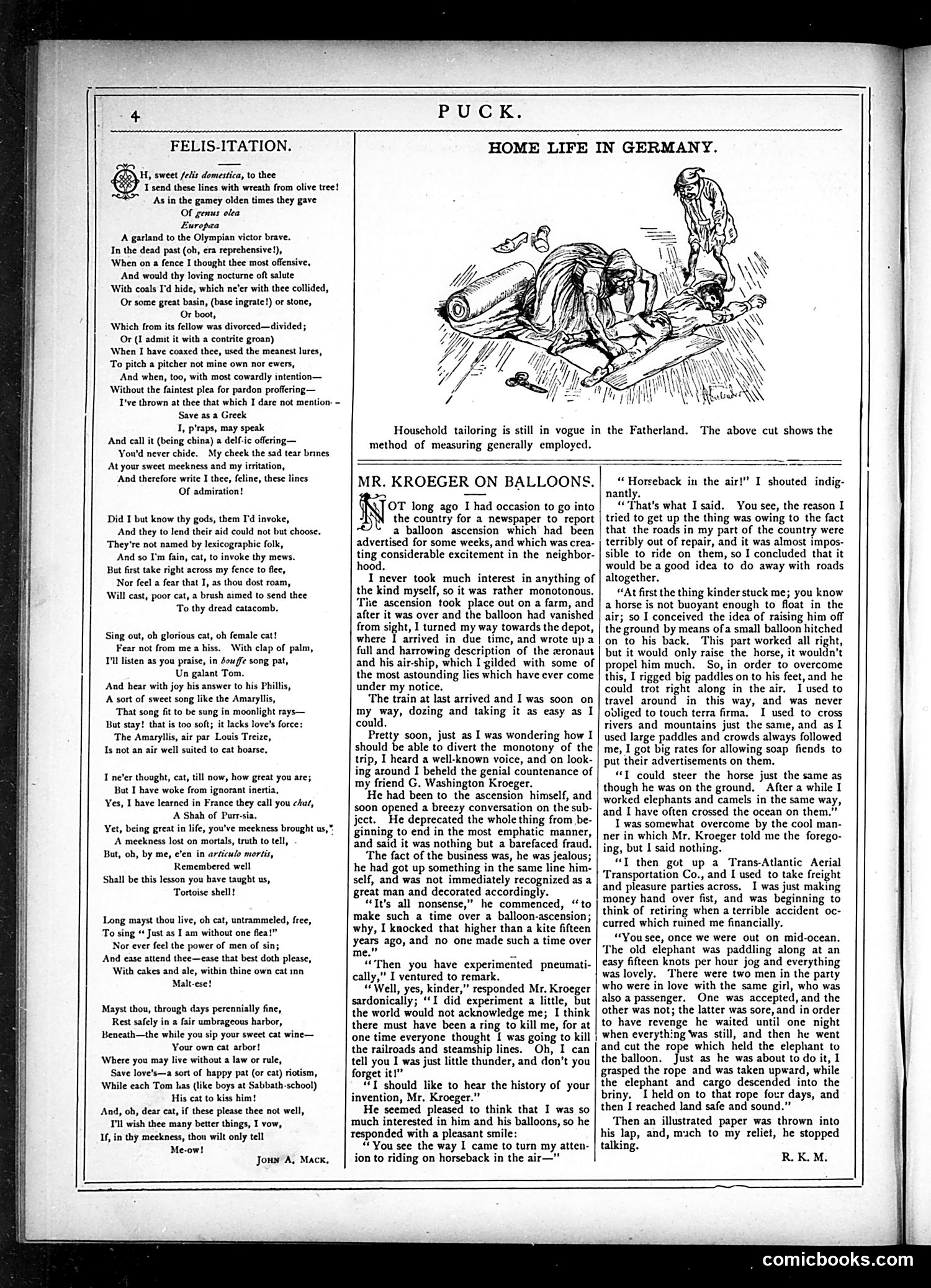
This page contains three separate pieces: 1. **"Felis-Itation"** (left column): A poem mocking someone's flowery classical allusions and pretentious writing style, comparing unfavorably to Greek references. 2. **"Home Life in Germany"** (top right): A brief illustrated article about German household tailoring methods, showing workers measuring garments. This is straightforward reportage, not satire. 3. **"Mr. Kroeger on Balloons"** (main article): A humorous anecdote about a man named Kroeger who attended a balloon ascension and later claimed to have invented hot-air balloons. The joke satirizes his dubious credibility and boastfulness—he makes increasingly absurd claims about his "invention," which everyone recognizes as fraudulent braggadocio. The page mixes light verse, practical information, and comedic storytelling typical of Puck's varied content.
📄 Transcribed text from this page (OCR, searchable)
Machine-transcribed from the original scan — historical spelling and the odd misread are preserved.
PUCK. FELIS-ITATION. , Sweet felis domestica, to thee I send these lines with wreath from olive tree! As in the gamey olden times they gave Of genus olea Europea ‘A garland to the Olympian victor brave. In the dead past (oh, era reprehensive!), ‘When on a fence I thought thee most offensive, And would thy loving nocturne off salute With coals I'd hide, which ne'er with thee collided, Or some great basin, (base ingrate!) or stone, Or boot, Which from its fellow was divorced—divided ; Or (I admit it with a contrite groan) ‘When I have coaxed thee, used the meanest lures, To pitch a pitcher not mine own nor ewers, And when, too, with most cowardly intention— Without the faintest plea for pardon proffering— I've thrown at thee that which I dare not mention: - Save as a Greek I, p'raps, may speak And call it (being china) a delf-ic offering— You'd never chide. My cheek the sad tear brines At your sweet meekness and my irritation, And therefore write I thee, feline, these lines Of admiration! Did I but know thy gods, them I'd invoke, And they to lend their aid could not but choose. They're not named by lexicographic folk, ‘And so I'm fain, cat, to invoke thy mews. But first take right across my fence to flee, Nor feel a fear that I, as thou dost roam, Will cast, poor cat, a brush aimed to send thee To thy dread catacomb. Sing out, oh glorious cat, oh female cat! Fear not from me a hiss. With clap of palm, T'll listen as you praise, in bouffe song pat, Un galant Tom. And hear with joy his answer to his Phillis, A sort of sweet song like the Amaryllis, That song fit to be sung in moonlight rays— But stay! that is too soft; it lacks love's force: The Amaryllis, air par Louis Treize, Is not an air well suited to cat hoarse, I ne'er thought, cat, till now, how great you are; Bat I have woke from ignorant inertia, Yes, I have learned in France they call you chut, A Shah of Purr-sia, Yet, being great in life, you've meekness brought us,* A meekness lost on mortals, truth to tell, But, ob, by me, e’en in articulo mortis, Remembered well Shall be this lesson you have taught us, Tortoise shell! Long mayst thou live, oh cat, untrammeled, free, To sing * Just as I am without one flea!” Nor ever feel the power of men of sin; ‘And ease attend thee—ease that best doth please, With cakes and ale, within thine own cat inn Malt-ese! Mayst thou, through days perennially fine, Rest safely in a fair umbrageous harbor, Beneath—the while you sip your sweet cat wine— Your own cat arbor! Where you may live without a law or rule, Save love’s—a sort of happy pat (or cat) riotism, While each Tom has (like boys at Sabbath-school) His cat to kiss him! And, ob, dear cat, if these please thee not well, Till wish thee many better things, I vow, If, in thy meekness, thon wilt only tell Me-ow! Joun A, Mack. HOME LIFE IN GERMANY. Houschold tailoring is still in vogue in the Fatherland. The above cut shows the method of measuring generally employed. MR. KROEGER ON BALLOONS. OT long ago I had occasion to go into the country for a newspaper to report a balloon ascension which had been advertised for some weeks, and which was crea- ting considerable excitement in the neighbor- hood. I never took much interest in anything of the kind myself, so it was rather monotonous. ‘The ascension took place out on a farm, and after it was over and the balloon had vanished from sight, I turned my way towards the depot, where I arrived in due time, and wrote up a full and harrowing description of the xronaut and his air-ship, which I gilded with some of the most astounding lies which have ever come under my notice. ‘The train at last arrived and I was soon on my way, dozing and taking it as easy as I could. Pretty soon, just as I was wondering how I should be able to divert the monotony of the trip, I heard a well-known voice, and on look- ing around I beheld the genial countenance of my friend G. Washington Kroeger. He had been to the ascension himself, and soon opened a breezy conversation on the sub- ject. He deprecated the whole thing from be- ginning to end in the most emphatic manner, and said it was nothing but a barefaced fraud. ‘The fact of the business was, he was jealous; he had got up something in the same line him- self, and was not immediately recognized as a great man and decorated accordingly. “It's all nonsense,” he commenced, “to make such a time over a balloon-ascension; why, I knocked that higher than a kite fifteen years ago, and no one made such a time over me.” = “Then you have experimented pneumati- cally,” I ventured to remark. “Well, yes, kinder,” responded Mr. Kroeger sardonically; ‘(I did experiment a little, but the world would not acknowledge me; I think there must have been a ring to kill me, for at one time everyone thought { was going to kill the railroads and steamship lines. Oh, I can tell you I was just little thunder, and don’t you forget it!” “T should like to hear the history of your invention, Mr. Kroeger.” He seemed pleased to think that I was so much interested in him and his balloons, so he responded with a pleasant smile: “You see the way I came to turn my atten- ion to riding on horseback in the air—” “ Horseback in the air!’ I shouted indig- nantly, “That's what I said. You see, the reason I tried to get up the thing was owing to the fact that the roads in my part of the country were | terribly out of repair, and it was almost impos- sible to ride on them, so I concluded that it would be a good idea to do away with roads altogether. “At first the thing kinder stuck me; you know a horse is not buoyant enough to float in the air; so I conceived the idea of raising him off the ground by means ofa small balloon hitched on to his back. This part worked all right, but it would only raise the horse, it wouldn't propel him much. So, in order to overcome this, I rigged big paddles on to his feet, and he could trot right along in the air. I used to travel around in this way, and was never obliged to touch terra firma. I used to cross rivers and mountains just the same, and as I used large paddles and crowds always followed me, I got big rates for allowing soap fiends to put their advertisements on them, “1 could steer the horse just the same as though he was on the ground. After a while I worked elephants and camels in the same way, and I have often crossed the ocean on them.” I was somewhat overcome by the cool man- ner in which Mr. Kroeger told me the forego- ing, but 1 said nothing. “I then got up a Trans-Atlantic Acrial ‘Transportation Co., and I used to take freight and pleasure parties across. I was just making money hand over fist, and was beginning to think of retiring when a terrible accident oc- curred which ruined me financially. “You see, once we were out on mid-ocean. ‘The old elephant was paddling along at an easy fifteen knots per hour jog and everything was lovely, ‘There were two men in the party who were in love with the same girl, who was also a passenger. One was accepted, and the other was not; the latter was sore, and in order to have revenge he waited until one night when everything Was still, and then he went and cut the rope which held the elephant to the balloon, Just as he was about to do it, I grasped the rope and was taken upward, while the elephant and cargo descended into the briny. I held on to that rope four days, and then I reached land safe and sound.” Then an illustrated paper was thrown into his lap, and, much to my reliet, he stopped talking. S . K.M. comicbooks.com