
Puck, 1878-08-07 · page 11 of 16
Puck — August 7, 1878 — page 11: what you’re looking at
What you’re looking at
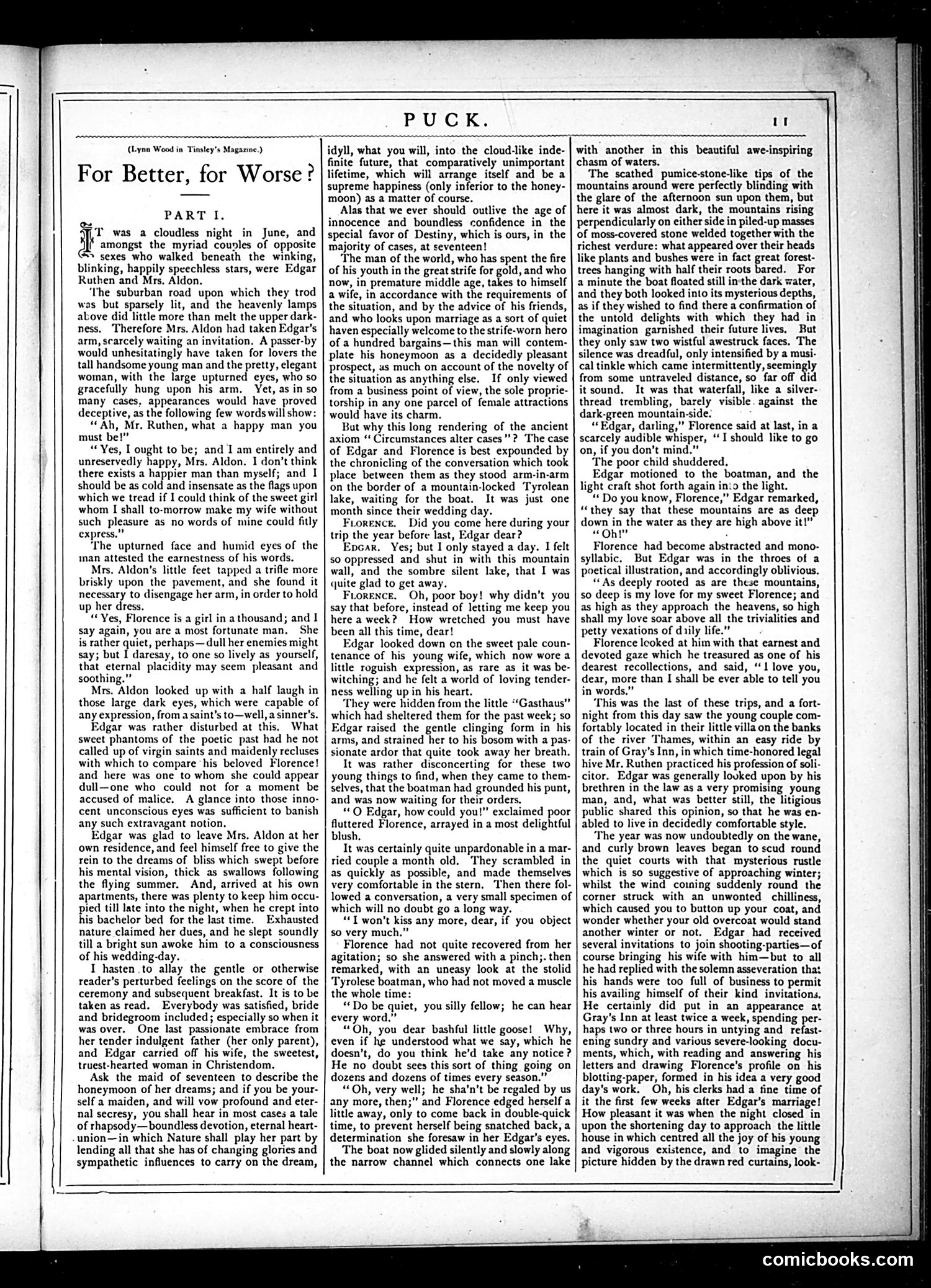
This page contains the opening of a serialized short story rather than a political cartoon. The narrative follows Edgar and Florence, a newly married couple on their honeymoon at a mountain lake. The story appears to be a romantic melodrama examining marriage and domestic life. The text presents contrasting perspectives: Edgar questions whether marriage will bring happiness, while Florence is devotedly romantic. The setup suggests the story will explore whether their union proves beneficial or problematic—hence the title's question. This represents Puck's literary content rather than satirical cartooning. The magazine mixed humor, social commentary, and fiction to appeal to middle-class readers interested in domestic and romantic themes of the era.
📄 Transcribed text from this page (OCR, searchable)
Machine-transcribed from the original scan — historical spelling and the odd misread are preserved.
PUCK. (Lynn Wood in Tinsley’s Magazine.) For Better, for Worse? PART I, T was a cloudless night in June, and amongst the myriad couples of opposite > sexes who walked beneath the winking, blinking, happily speechless stars, were Edgar Ruthen and Mrs, Aldon, ‘The suburban road upon which they trod was but sparsely lit, and the heavenly lamps above did little more than melt the upper dark- ness. Therefore Mrs. Aldon had taken Edgar’s arm, scarcely waiting an invitation. A passer-by would unhesitatingly have taken for lovers the tall handsome young man and the pretty, elegant woman, with the large upturned eyes, who so gracefully hung upon his arm, Yet, as in so many cases, appearances would have proved deceptive, as the following few words will show: “Ah, Mr. Ruthen, what a happy man you must be!”” “Yes, I ought to be; and I am entirely and unreservedly happy, Mrs. Aldon, I don’t think there exists a happier man than myself; and I should be as cold and insensate as the flags upon which we tread if I could think of the sweet girl whom I shall to-morrow make my wife without such pleasure as no words of mine could fitly express.” The upturned face and humid eyes of the man attested the earnestness of his words. Mrs. Aldon’s little feet tapped a trifle more briskly upon the pavement, and she found it necessary to disengage her arm, in order to hold up her dress. “Yes, Florence is a girl in a thousand; and I say again, you are a most fortunate man, She is rather quiet, perhaps—dull her enemies might say; but I daresay, to one so lively as yourself, that eternal placidity may seem pleasant and soothing.” Mrs. Aldon looked up with a half laugh in those large dark eyes, which were capable of any expression, from a saint's to—well, a sinner’s. Edgar was rather disturbed at this. What sweet phantoms of the poetic past had he not called up of virgin saints and maidenly recluses with which to compare ‘his beloved Florence! and here was one to whom she could appear dull—one who could not for a moment be accused of malice. A glance into those inno- cent unconscious eyes was sufficient to banish any such extravagant notion, Edgar was glad to leave Mrs, Aldon at her own residence, and feel himself free to give the rein to the dreams of bliss which swept before his mental vision, thick as swallows following the flying summer. And, arrived at his own apartments, there was plenty to keep him occu- pied till late into the night, when he crept into his bachelor bed for the last time. Exhausted nature claimed her dues, and he slept soundly till. a bright sun awoke him to a consciousness of his wedding-day. I hasten to allay the gentle or otherwise reader’s perturbed feelings on the score of the ceremony and subsequent breakfast. It is to be taken as read. Everybody was satisfied, bride and bridegroom included ; especially so when it was over. One last passionate embrace from her tender indulgent father (her only parent), and Edgar carried off his wife, the sweetest, truest-hearted woman in Christendom. Ask the maid of seventeen to describe the honeymoon of her dreams; and if you be your- self a maiden, and will vow profound and eter- nal secresy, you shall hear in most cases a tale of rhapsody— boundless devotion, eternal heart- -union—in which Nature shall play her part by lending all that she has of changing glories and sympathetic influences to carry on the dream, idyll, what you will, into the cloud-like inde- finite future, that comparatively unimportant lifetime, which will arrange itself and be a supreme happiness (only inferior to the honey- moon) as a matter of course. Alas that we ever should outlive the age of innocence and boundless confidence in the special favor of Destiny, which is ours, in the majority of cases, at seventeen! The man of the world, who has spent the fire of his youth in the great strife for gold, and who now, in premature middle age, takes to himself a wife, in accordance with the requirements of the situation, and by the advice of his friends, and who looks upon marriage as a sort of quiet haven especially welcome to the strife-worn hero of a hundred bargains—this man will contem- plate his honeymoon as a decidedly pleasant prospect, us much on account of the novelty of the situation as anything else. If only viewed from a business point of view, the sole proprie- torship in any one parcel of female attractions would have its charm. But why this long rendering of the ancient axiom ‘‘ Circumstances alter cases"? The case of Edgar and Florence is best expounded by the chronicling of the conversation which took place between them as they stood arm-in-arm on the border of a mountain-locked Tyrolean lake, waiting for the boat. It was just one month since their wedding day. Fiorence. Did you come here during your trip the year before last, Edgar dear? Epcar. Yes; but I only stayed a day. I felt so oppressed and shut in with this mountain wall, and the sombre silent lake, that I was quite glad to get away, FLorence. Oh, poor boy! why didn’t you say that before, instead of letting me keep you here a week? How wretched you must have been all this time, dear! Edgar looked down cn the sweet pale coun- tenance of his young wife, which now wore a little roguish expression, as rare as it was be- witching; and he felt a world of loving tender- ness welling up in his heart. ‘They were hidden from the little ““Gasthaus” which had sheltered them for the past week; so Edgar raised the gentle clinging form in his arms, and strained her to his bosom with a pas- sionate ardor that quite took away her breath. It was rather disconcerting for these two young things to find, when they came to them- selves, that the boatman had grounded his punt, and was now waiting for their orders. “O Edgar, how could you!" exclaimed poor fluttered Florence, arrayed in a most delightful blush, It was certainly quite unpardonable in a mar- ried couple a month old. They scrambled in as quickly as possible, and made themselves very comfortable in the stern, Then there fol- lowed a conversation, a very small specimen of which will no doubt go a long way. “LT won't kiss any more, dear, if you object so very much.” Florence had not quite recovered from her agitation; so she answered with a pinch;. then remarked, with an uneasy look at the stolid Tyrolese boatman, who had not moved a muscle the whole time: “Do be quiet, you silly fellow; he can hear every word.” “Oh, you dear bashful little goose! Why, even if he understood what we say, which he doesn’t, do you think he'd take any notice? He no doubt sees this sort of thing going on dozens and dozens of times every season.” “Oh, very well; he sha’n’t be regaled by us any more, then;” and Florence edged herself a little away, only to come back in double-quick time, to prevent herself being snatched back, a determination she foresaw in her Edgar's eyes. The boat now glided silently and slowly along the narrow channel which connects one lake with another in this beautiful awe-inspiring chasm of waters. The scathed pumice-stone-like tips of the mountains around were perfectly blinding with the glare of the afternoon sun upon them, but here it was almost dark, the mountains rising perpendicularly on either side in piled-up masses of moss-covered stone welded together with the richest verdure: what appeared over their heads like plants and bushes were in fact great forest- trees hanging with half their roots bared. For a minute the boat floated still inthe dark water, and they both looked into its mysterious depths, as if they wished to find there a confirmation of the untold delights with which they had in imagination garnished their future lives, But they only saw two wistful awestruck faces, The silence was dreadful, only intensified by a musi- cal tinkle which came intermittently, seemingly from some untraveled distance, so far off did it sound. It was that waterfall, like a silver- thread trembling, barely visible. against the dark-green mountain-side. “Edgar, darling,” Florence said at last, in a scarcely audible whisper, “1 should like to go on, if you don’t mind.” The poor child shuddered, Edgar motioned to the boatman, and the light craft shot forth again into the light. “Do you know, Florence,” Edgar remarked, “they say that these mountains are as deep down in the water as they are high above it!” “Oh!” . Florence had become abstracted and mono- syllabic, But Edgar was in the throes of a poetical illustration, and accordingly oblivious. “As deeply rooted as are these mountains, so deep is my love for my sweet Florence; and as high as they approach the heavens, so high shall my love soar above all the trivialities and petty vexations of daily life.” Florence looked at him with that earnest and devoted gaze which he treasured as one of his dearest recollections, and said, ‘1 love you, dear, more than I shall be ever able to tell you in words.” ‘This was the last of these trips, and a fort- night from this day saw the young couple com- fortably located in their little villa on the banks of the river Thames, within an easy ride by train of Gray's Inn, in which time-honored legal hive Mr, Ruthen practiced his profession of soli- citor. Edgar was generally louked upon by his brethren in the law as a very promising young man, and, what was better still, the litigious public shared this opinion, so that he was en- abled to live in decidedly comfortable style. ‘The year was now undoubtedly on the wane, and curly brown leaves began to scud round the quiet courts with that mysterious rustle which is so suggestive of Spprosching; winter; whilst the wind coming suddenly round the corner struck with an unwonted chilliness, which caused you to button up your coat, and wonder whether your old overcoat would stand another winter or not. Edgar had received several invitations to shooting-parties—of course bringing his wife with him—but to all he had replied with the solemn asseveration that his hands were too full of business to permit his availing himself of their kind invitations, He certainly did put in an appearance at Gray's Inn at least twice a week, spending per- haps two or three hours in untying and _refast- ening sundry and various severe-looking docu- ments, which, with reading and answering his letters and drawing Florence's profile on his blotting-paper, formed in his idea a very good day’s work. Oh, his clerks had a fine time of it the first few weeks after Edgar’s marriage! How pleasant it was when the night closed in upon the shortening day to approach the little house in which centred all the joy of his young and vigorous existence, and to imagine the picture hidden by the drawn red curtains, look- comicbooks.com