
A complete issue · 16 pages · 1878
Puck — July 24, 1878
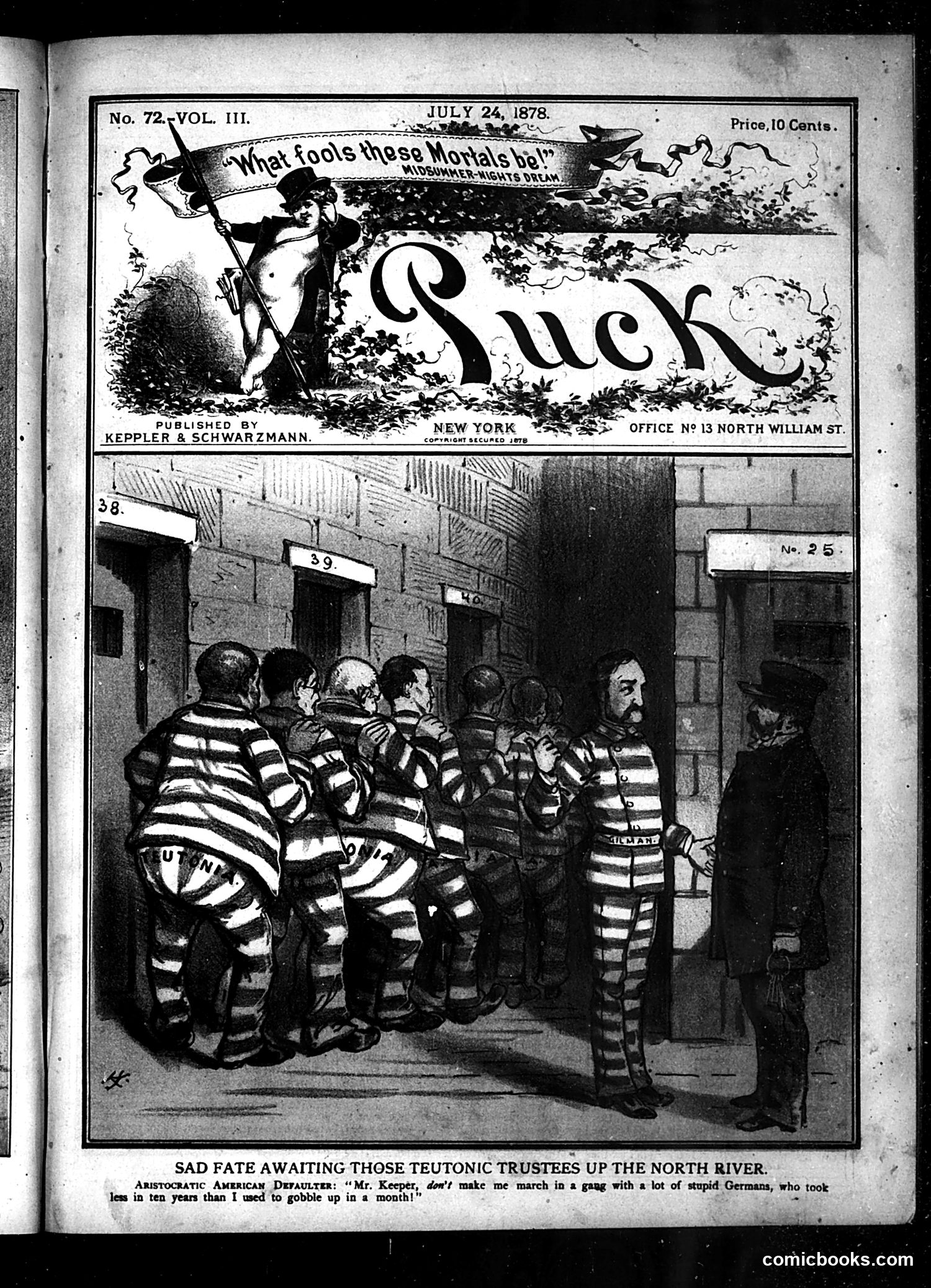
This cartoon satirizes the "Teutonic Trustees" — apparently wealthy German-American businessmen involved in financial fraud or mismanagement. The title "Sad Fate Awaiting Those Teutonic Trustees Up the North River" suggests they're destined for Sing Sing Prison (located on the Hudson River north of New York City). The image shows men in striped prison uniforms being escorted by a guard. The caption includes a quote from "Mr. Keeper" mocking an "Aristocratic American Defaulter" who complains about being forced into a gang with "stupid Germans" — suggesting irony that wealthy German-Americans are being imprisoned alongside other criminals. The satire targets corrupt financial elites and German-American business fraud, a recurring theme in 1870s Puck magazine's social commentary.
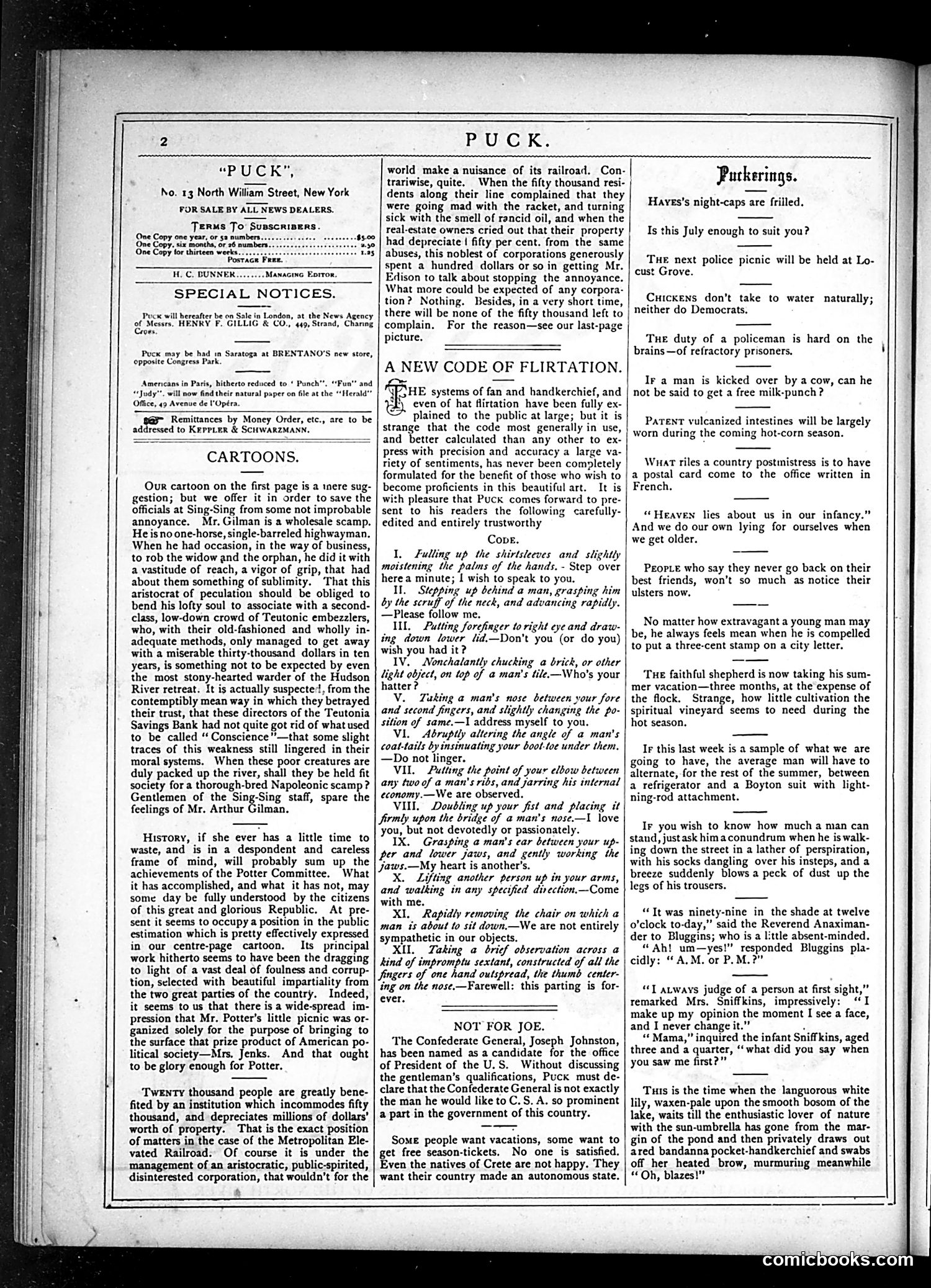
This page contains editorial content and humor sections rather than political cartoons. The main pieces include: **"A New Code of Flirtation"** — A satirical list of eleven "rules" for appropriate flirting behavior, mocking Victorian-era courtship conventions through exaggerated etiquette (e.g., "stepping up behind a man, grasping his coat-tail"). **"Puckerings"** — A brief humor section with short jokes about contemporary topics: police picnics, Democrats, policemen, cows, and patent medicines. **"Not for Joe"** — Commentary suggesting Confederate General Joseph Johnston as a presidential candidate would be absurd, referencing post-Civil War political sensitivities about Southern candidates. The satire targets social pretension, bureaucratic inefficiency, and political absurdities of the era. No major political figures are caricatured on this particular page.
This page contains three satirical pieces: 1. **"A Change"** mocks British politics regarding King John of Abyssinia and the Menelek succession issue. The satire suggests the English press, which initially doubted Menelek's legitimacy, now supports him for the throne—a flip-flop presented as opportunistic. 2. **"Fishing for Monkeys"** ridicules an alleged English traveler's claim of capturing monkeys using unconventional methods in Africa. The piece satirizes tall tales and exaggerated expedition reports common in Victorian travel narratives. 3. **"Ambidexterity"** is a lengthy letter mocking a scientist who plagiarized another novelist's work, then offered transparently absurd justifications—calling the victim a "dolt" and claiming independent invention of identical ideas. It's satire on academic dishonesty and shameless denial. All three target Victorian-era pretension and hypocrisy.
This page consists primarily of **literary content rather than political cartoons**. It contains: 1. **"Sweet Mary Anne"** — a poem by R.K. Munkerrick with romantic/sentimental verse about a woman 2. **"What a Manager May Do"** — a prose article describing theatrical management challenges, including discussion of managing actors, producing plays (mentioning Shakespeare), and running a theater on Broadway 3. **"A Mash in Madrid"** — a numbered poem or story with Spanish setting references There are **no clear political cartoons or caricatures visible** on this page. The content is entertainment-focused rather than satirical commentary on current events or politics. This appears to be a typical Puck issue balancing humor with literary contributions.
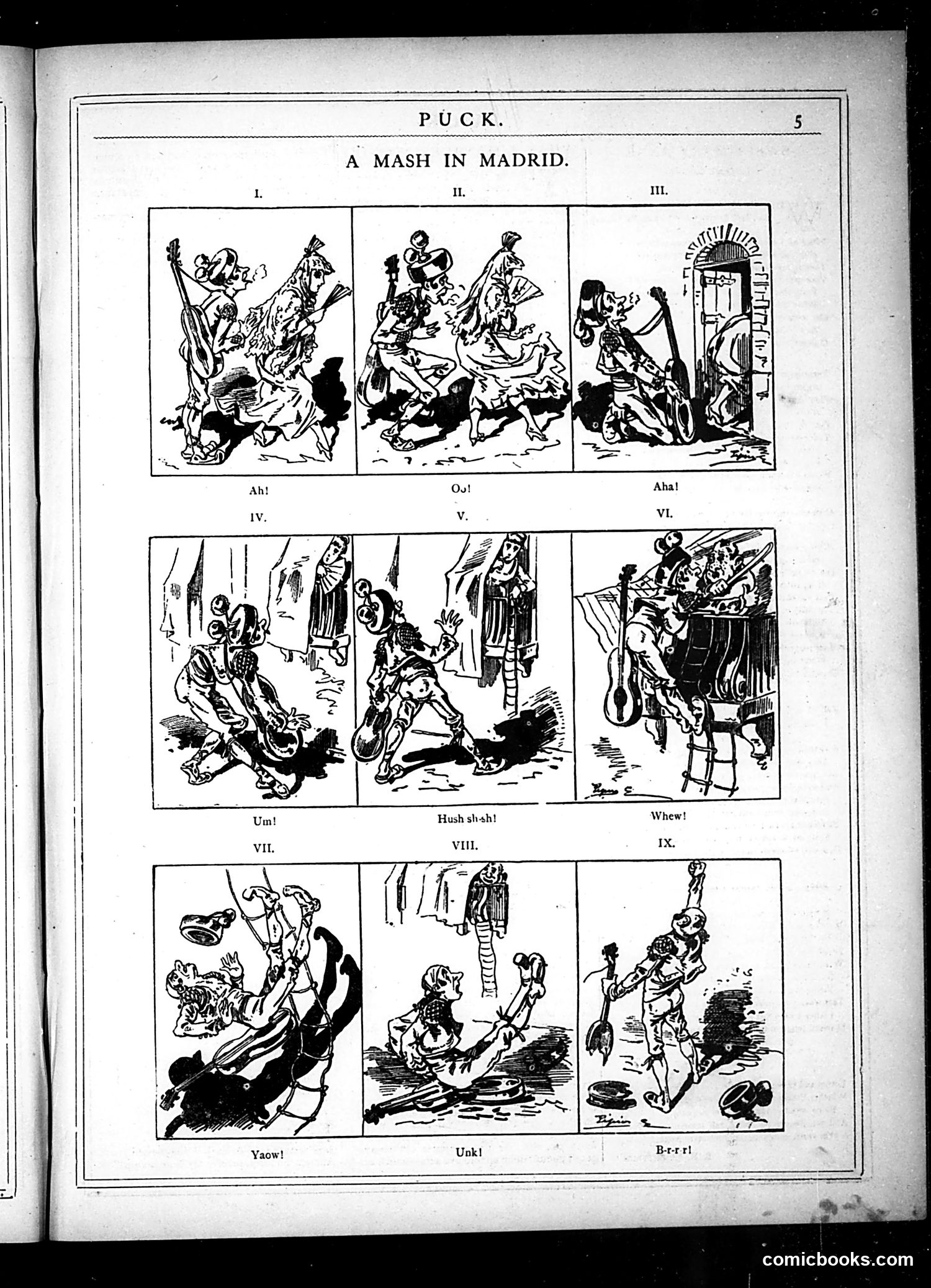
This nine-panel comic strip depicts chaotic scenes labeled "A Mash in Madrid," likely satirizing Spanish social or political disorder. The sequential panels show increasingly absurd situations with figures in period dress engaged in tumultuous, slapstick scenarios—fighting, falling, and general mayhem. The exclamations ("Ah!", "Ou!", "Aha!", "Um!", "Hush sh-sh!", "Whew!", "Yaow!", "Unk!", "Brr!") emphasize comedic physical violence and confusion. Without additional historical context, the specific political target remains unclear, though "Madrid" suggests commentary on Spanish affairs during the late 19th or early 20th century when Puck was active. The style employs exaggeration typical of period satire, but the precise event or figures being mocked requires additional historical knowledge.
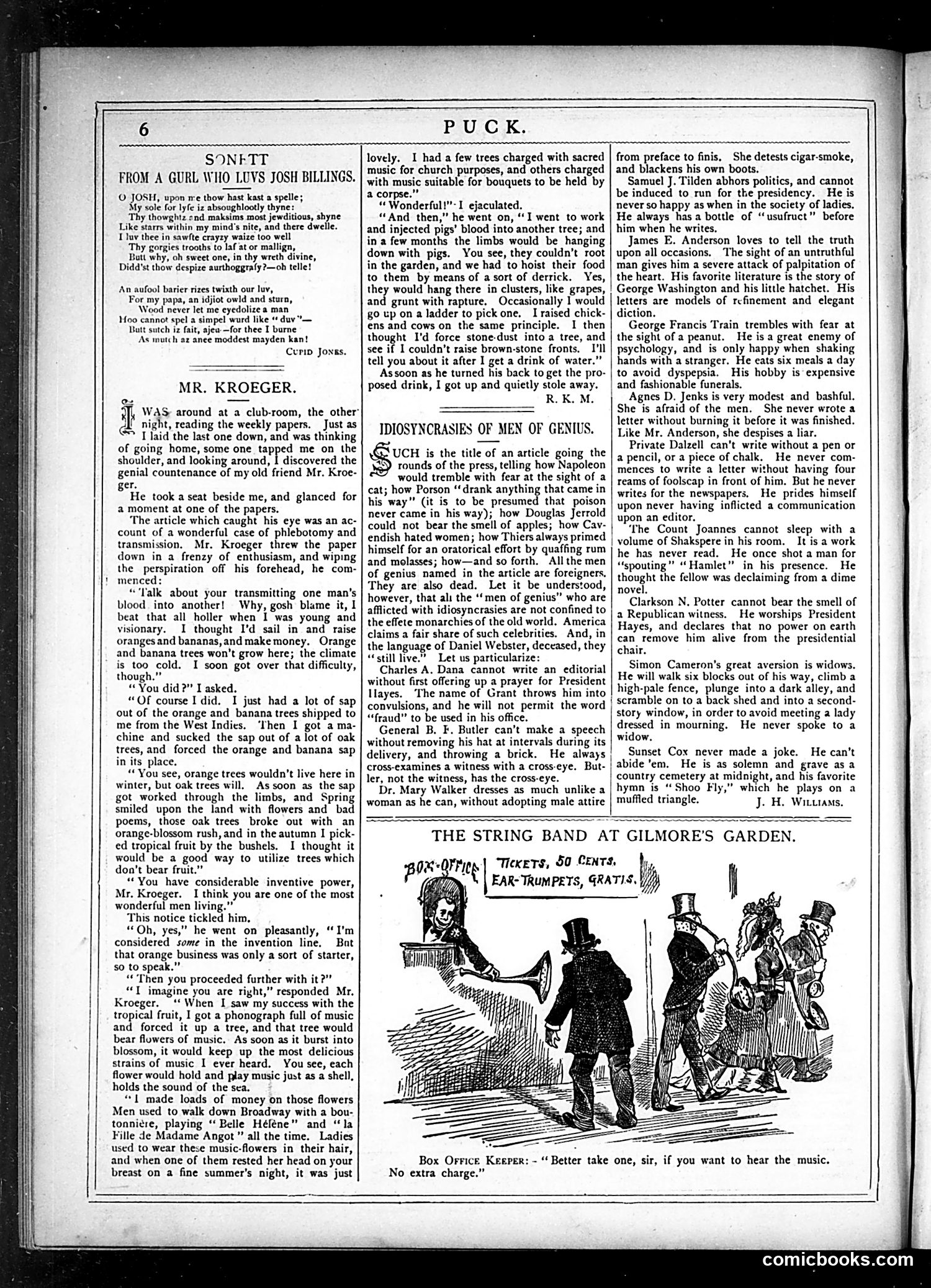
This page contains three distinct sections: **"Sonnet from a Gurl Who Luv's Josh Billings"** and **"Mr. Kroeger"** are literary pieces with no political content—they appear to be humorous fiction columns typical of Puck's entertainment coverage. **"Idiosyncrasies of Men of Genius"** is a satirical commentary mocking famous men's peculiar habits. It references figures like Napoleon, Douglas Jerrold, and Daniel Webster, pointing out their odd behaviors and contradictions—how supposedly great men often have petty or absurd personal quirks. The satire suggests that "genius" doesn't exempt people from being ridiculous. **"The String Band at Gilmore's Garden"** is a cartoon showing a street musician offering music for "50 Cents, Ear-Trumpets Gratis"—a joke about forcing unwilling audiences to listen to bad street music while profiting from their discomfort.
This page contains two literary pieces rather than political cartoons: 1. **"Pastoral"** — A poem by Hem. Loch satirizing romantic notions of rural summer life. It mocks the disconnect between idealized country living and actual discomforts (heat, insects, noise). 2. **"My Summer Rest"** — A humorous essay about an author finishing a novel. It satirizes the writer's pretensions about finding peaceful places to work and his encounters with intrusive, gossipy people at a doctor's office who demand details about his book. Both pieces use social satire typical of Puck's style—mocking middle-class pretensions and human foibles rather than targeting specific political figures. The humor relies on relatable frustrations with polite society's nosiness and the gap between expectations and reality.
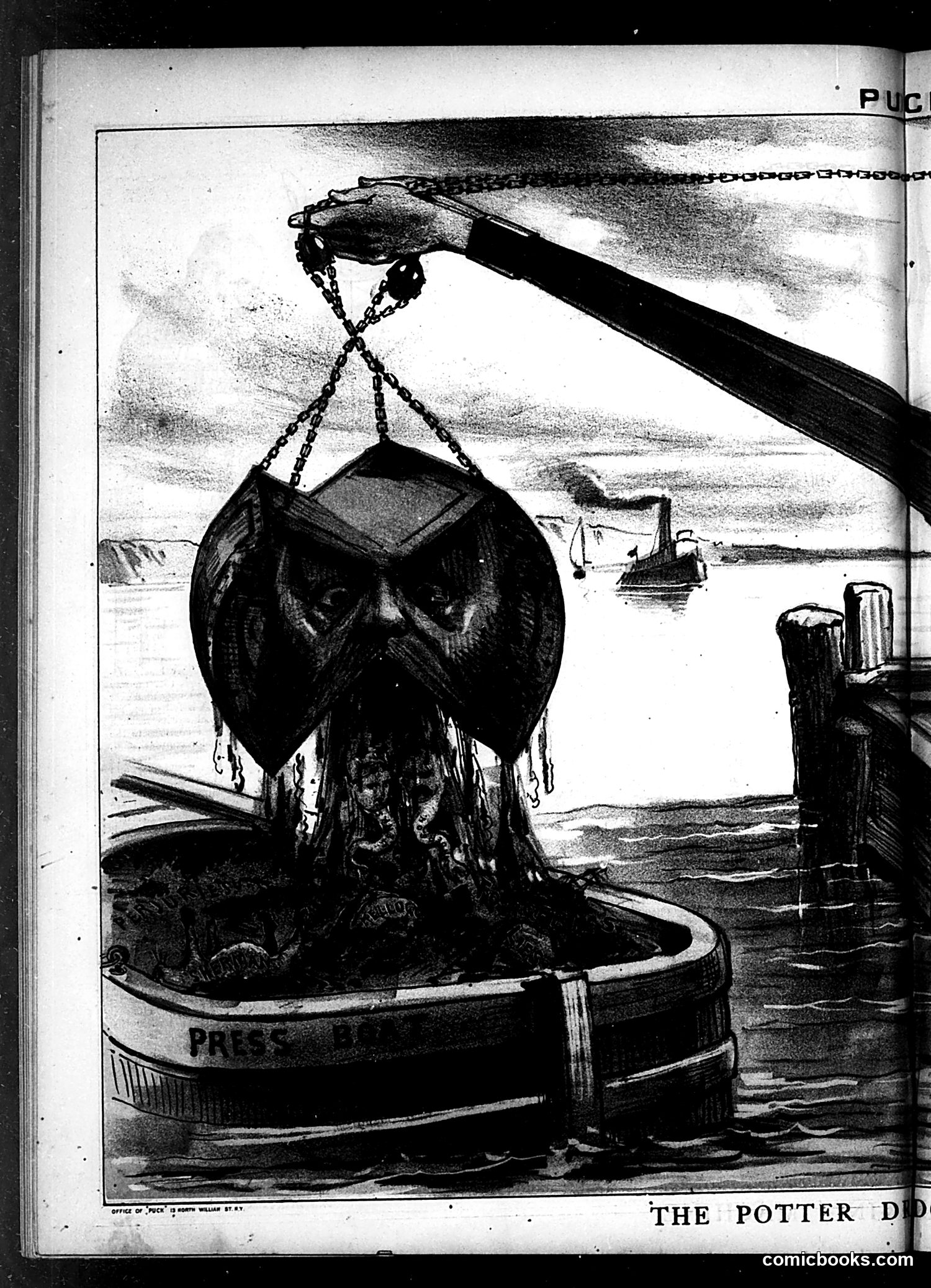
This Puck cartoon depicts a large spherical object being hoisted by crane over water at what appears to be a dock or port. The sphere has a menacing face with prominent features rendered in dark shading, suspended by chains over a basin or vat. The title begins "The Potter D..." (likely "The Potter's Dilemma" or similar), suggesting a reference to pottery or craftsmanship. The cartoon likely uses the sphere and water imagery as metaphor—possibly depicting a political figure or concept being "dunked" or tested. Without the complete caption and full title visible, the specific political target remains unclear, though the ominous mood and industrial setting suggest commentary on a controversial policy or leader facing public pressure or consequences.
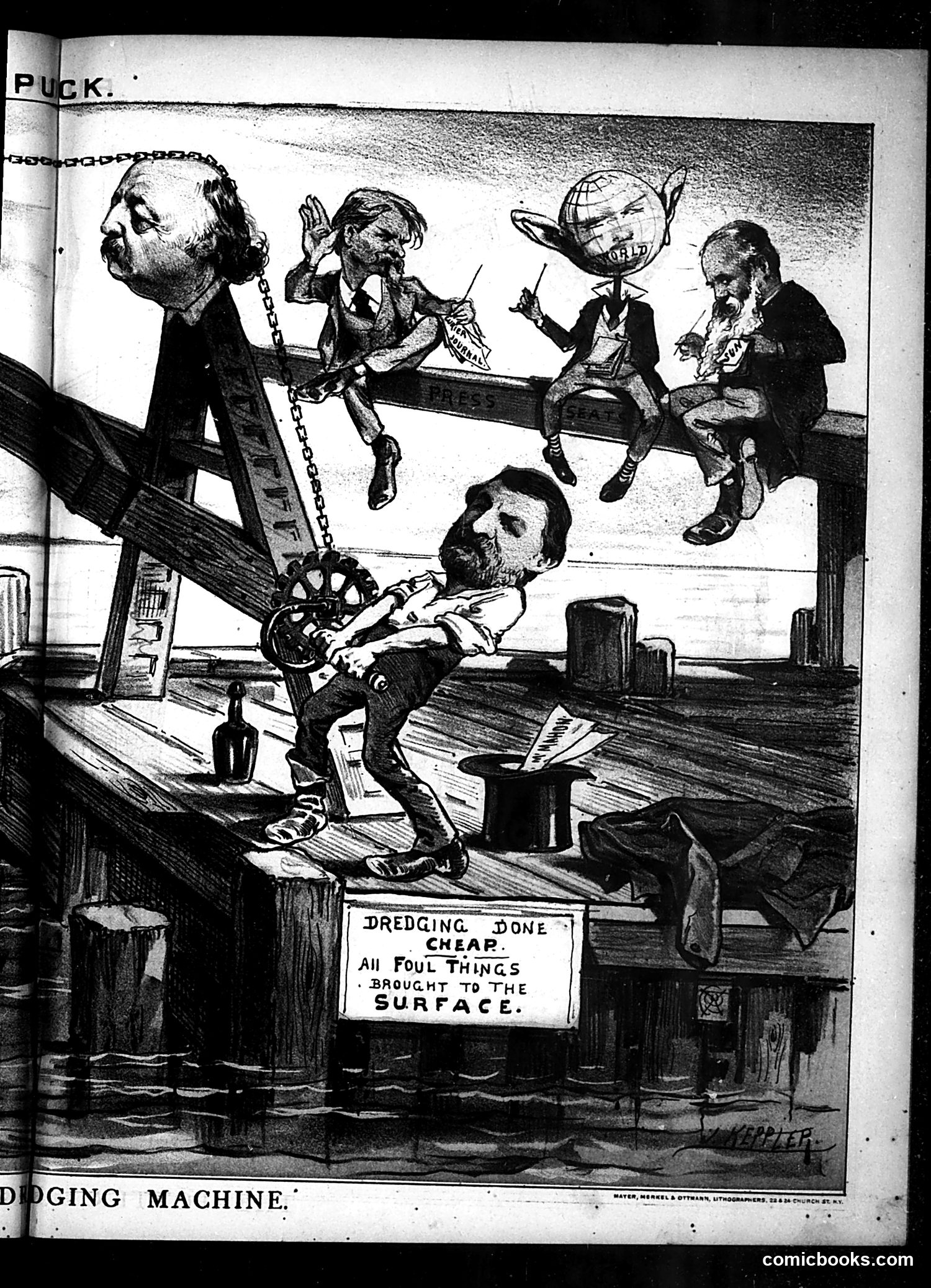
This Puck cartoon depicts a satirical "dredging machine" that brings "foul things" to the surface. The contraption features caricatured political figures operating a mechanical system, with one figure at the bottom operating a large dredge mechanism. The caption reads: "Dredging Done Cheap / All Foul Things Brought to the Surface." This appears to be commentary on political investigations or exposés—likely depicting politicians or journalists mechanically "dredging up" scandals and corruption. The caricatured figures suggest specific contemporary political targets, though without additional context, their identities remain unclear. The satire suggests that while such dredging may reveal wrongdoing, the process itself is portrayed as mechanical and somewhat crude. The image criticizes either the investigative process or those conducting it.
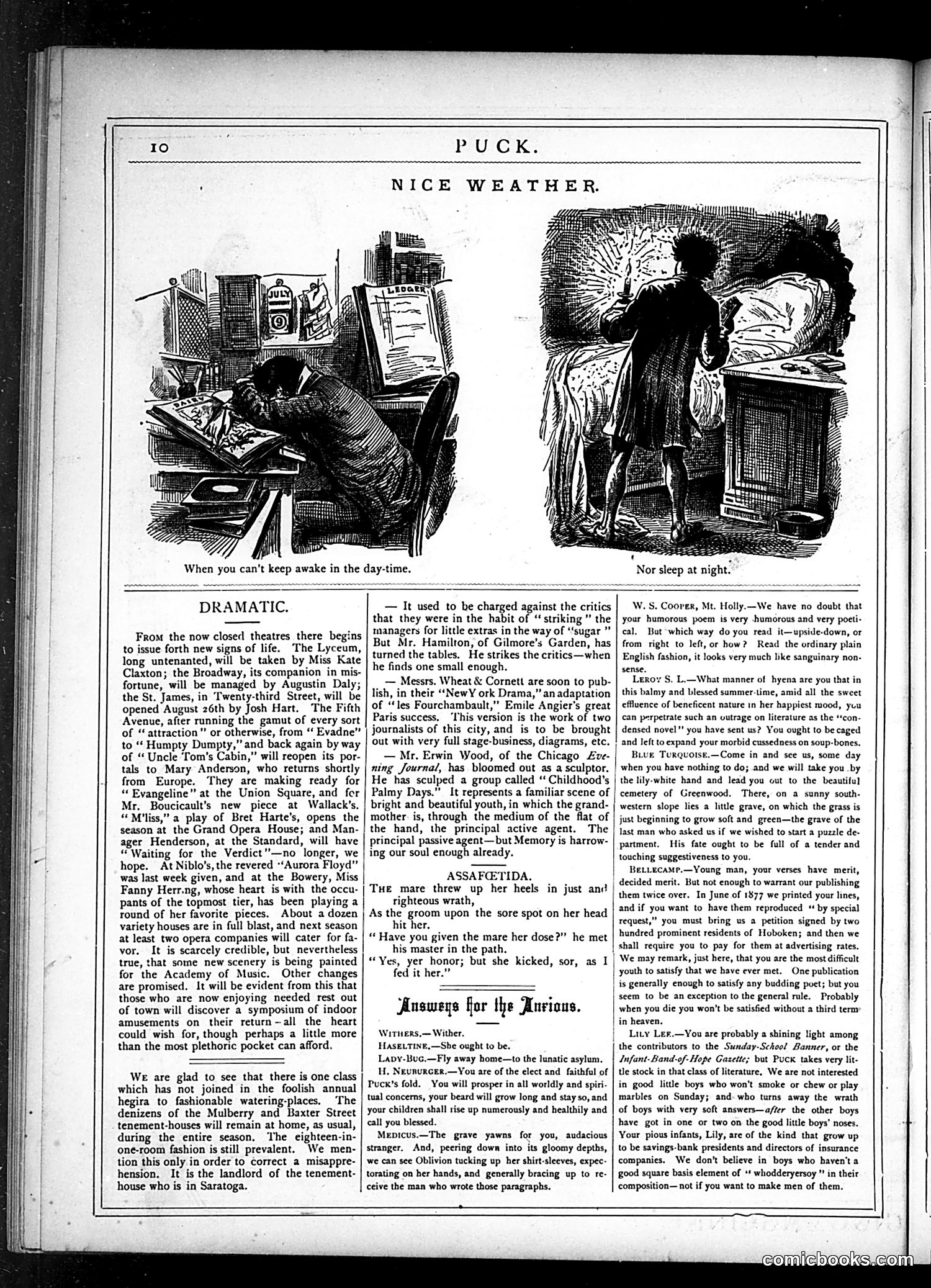
This page contains two satirical illustrations under the heading "Nice Weather," contrasting indoor and outdoor activities during pleasant conditions. The left cartoon shows a man hunched at a desk, captioned "When you can't keep awake in the day-time," satirizing office workers forced indoors during good weather. The right cartoon depicts a figure at a window at night, captioned "Nor sleep at night," suggesting insomnia or restlessness when weather keeps one awake. The satire targets the irony of weather's effects on human productivity and sleep—people struggle to work when it's nice outside, yet can't rest when pleasant conditions persist. This reflects broader turn-of-the-century complaints about modern urban life's disconnect from natural rhythms, a common Puck theme.
This page contains no political cartoon, but rather a short story titled "Nils Jensen" (Part III), continuing a narrative about Norwegian characters. The text depicts a romantic drama between Nils and a young woman named Dorthe, with Gustav as a rival suitor pressuring Nils to leave the area. The story reflects late 19th-century themes about peasant life, immigration, and personal honor. References to "your country" and Norwegian customs suggest this may satirize immigrant communities or Scandinavian stereotypes popular in American magazines of that era. However, **no specific political figures or events are identifiable** in this literary excerpt. The page is primarily text-based fiction rather than satirical cartooning, which was Puck's typical format.
This page contains the conclusion of a serialized story about romantic conflict between Gustav and Dorthe (a Scandinavian couple). The narrative focuses on Gustav's jealousy over Dorthe's flirtation with a man named Nils, culminating in Gustav's decision to leave and never return. Below the story is a short comic section titled "Puck's Exchanges: African Dixie" — a humorous poem playing on dialect humor, where "I dun it" is conjugated through various forms as wordplay. The page is primarily **literary content rather than political satire**. It represents Puck's broader editorial approach of mixing serialized domestic fiction with light comedic verse, rather than focusing exclusively on political cartoons. The Scandinavian setting and names suggest appeal to immigrant readership.
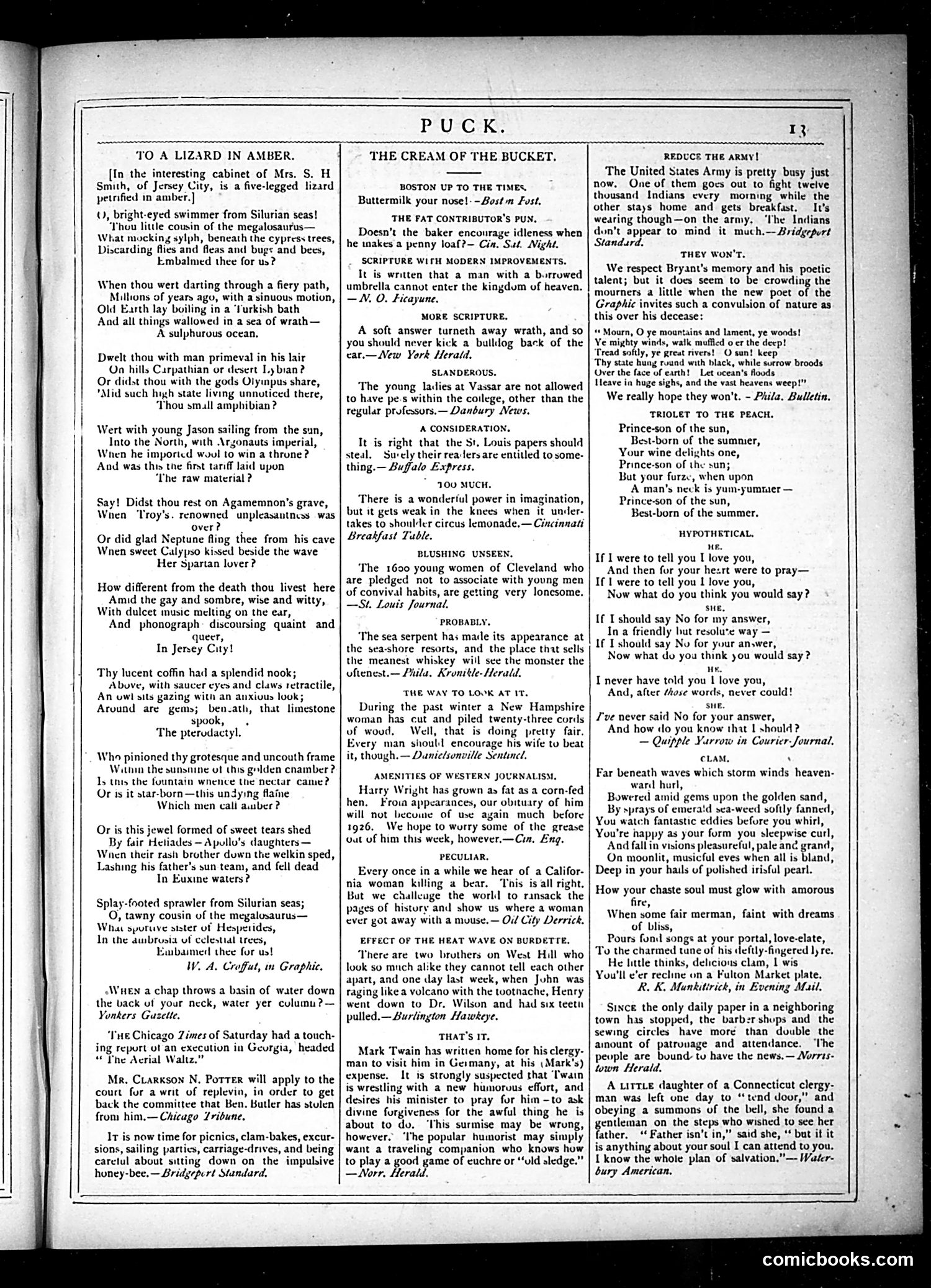
This page contains primarily **short humorous items and satirical quips** rather than illustrated cartoons. The content includes: - Poetry and brief comedic pieces mocking various social groups: Silurian cousins, Turkish baths, bureaucrats, clergy, journalists, and Western settlers - Jokes about contemporary issues: baker idleness, heaven's entrance requirements, circus lemonade, Cleveland women avoiding "congenial habits," a New Hampshire woman cutting wood, and California bear hunting - References to Mark Twain's travel writings and clergy members' prayer requests - Social satire targeting excess newspaper patronage and picnic etiquette The overall tone is **lighthearted mockery of American society, manners, and current events**—typical of Puck's satirical approach. Without visible illustrations on this particular page, the humor relies entirely on text-based wit rather than political cartooning.
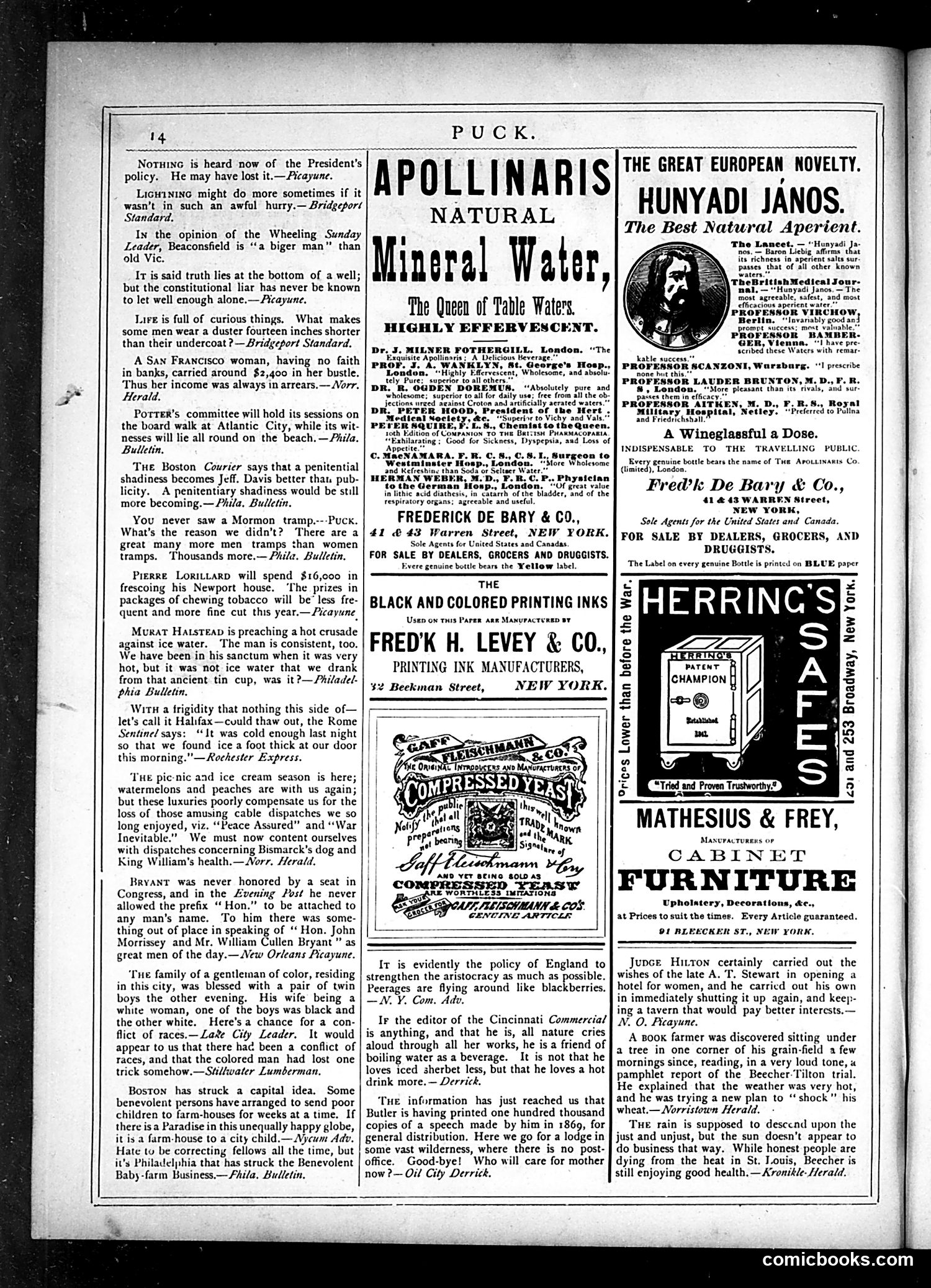
This Puck page is primarily **advertising and editorial content** rather than political cartoons. The advertisements dominate—for Apollinaris mineral water, Hunyadi János aperient (a laxative), printing inks, compressed yeast, cabinet furniture, and other products. The editorial snippets are brief social commentary typical of Puck's satirical style: - Political gossip about unnamed Washington figures - Jokes about local scandals (a man preaching against ice water while secretly using it) - Anecdotes about aristocrats and social pretension - Commentary on journalism and public figures The cartoons are small and illustrative rather than central to the page. Without clearer identification of specific individuals or dated events in the visible text, the precise targets of satire remain unclear to a modern reader—these appear to be references to contemporary (late 19th-century) political and social figures whose names aren't explicitly stated.
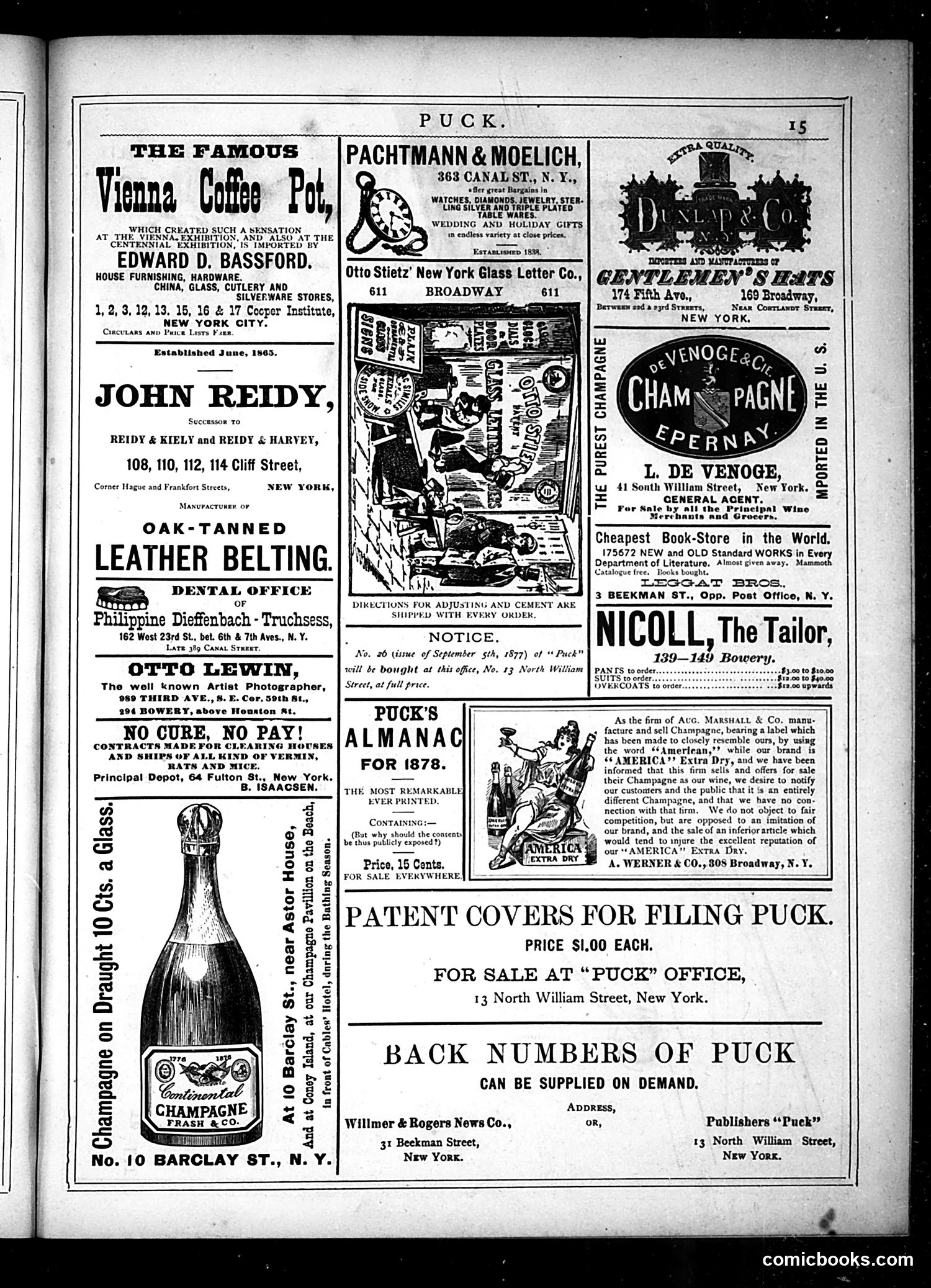
This is primarily an **advertising page** from Puck magazine (page 15), not a satirical cartoon section. The page contains various commercial advertisements for 1870s New York businesses, including: - A "Vienna Coffee Pot" by Edward D. Bassford - John Reidy's leather belting manufacturer - Pachtmann & Moelich jewelers - Otto Stietz's glass letter company - Champagne and wine merchants - A tailor named Nicoll - Various other vendors The only substantive editorial content is **Puck's Almanac for 1878** advertisement, promoting the publication's annual issue. The page reflects Puck's business model: mixing satirical content with paid advertisements to support the magazine's operations. No political satire or social commentary is visible on this particular page.
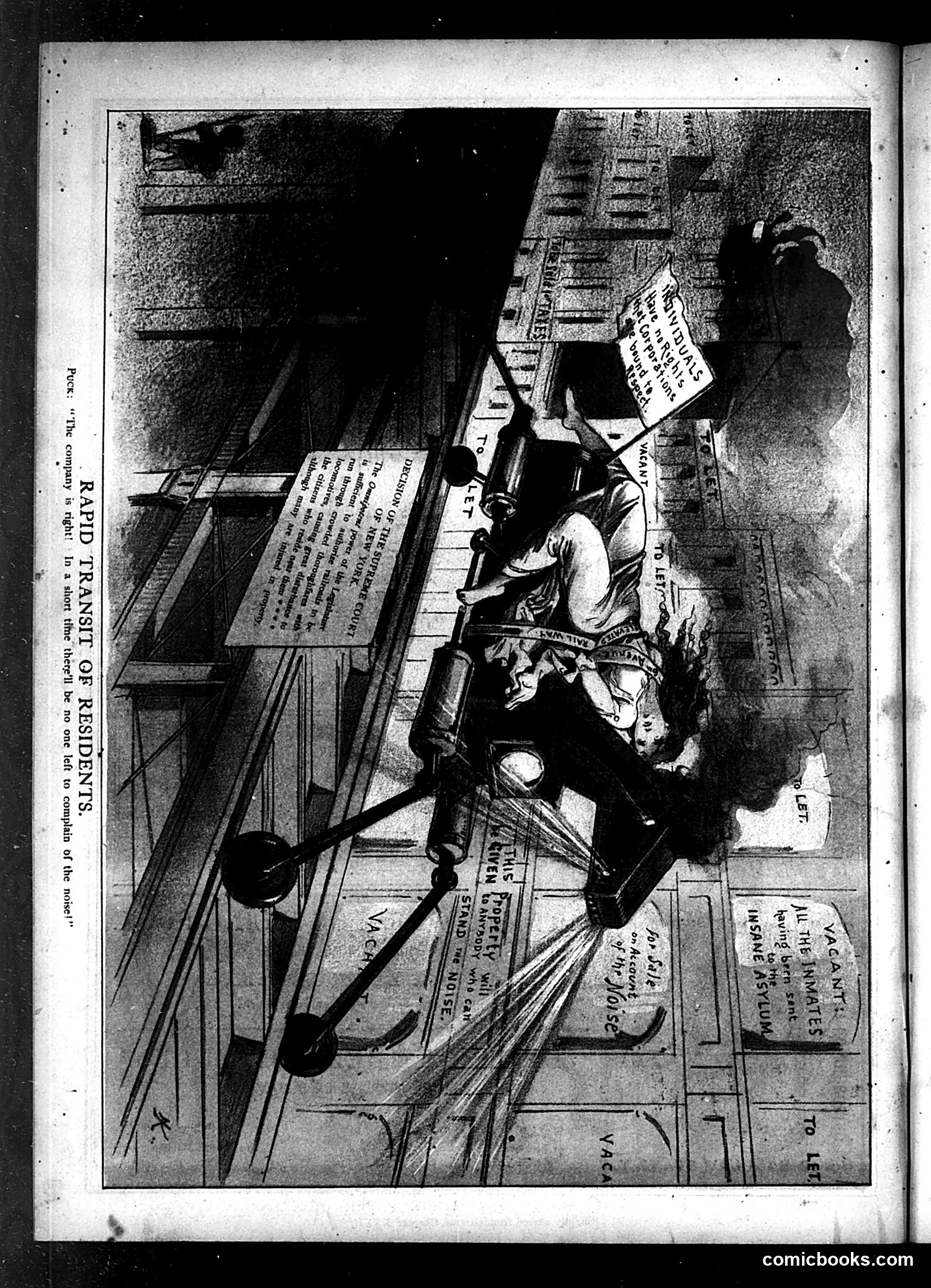
This Puck cartoon satirizes rapid residential turnover in urban housing. The image shows what appears to be a landlord or property agent literally moving tenants out via an elevated chute or slide system—suggesting evictions or forced relocations happen with industrial speed and efficiency. The visible text references "rapid transit of residents" and mentions "heads" being removed, likely commenting on how quickly tenants are displaced from their homes. This critiques both landlord practices and urban development that prioritized profit over tenant stability. The mechanical, dehumanizing imagery—treating people like objects on a conveyor system—emphasizes Puck's sardonic point: that modern cities treat working-class residents as disposable, moving them out as quickly as goods in a factory. The satire targets exploitative housing practices common in early 20th-century American cities.