
Puck, 1878-07-24 · page 11 of 16
Puck — July 24, 1878 — page 11: what you’re looking at
What you’re looking at
This page contains no political cartoon, but rather a short story titled "Nils Jensen" (Part III), continuing a narrative about Norwegian characters. The text depicts a romantic drama between Nils and a young woman named Dorthe, with Gustav as a rival suitor pressuring Nils to leave the area. The story reflects late 19th-century themes about peasant life, immigration, and personal honor. References to "your country" and Norwegian customs suggest this may satirize immigrant communities or Scandinavian stereotypes popular in American magazines of that era. However, **no specific political figures or events are identifiable** in this literary excerpt. The page is primarily text-based fiction rather than satirical cartooning, which was Puck's typical format.
📄 Transcribed text from this page (OCR, searchable)
Machine-transcribed from the original scan — historical spelling and the odd misread are preserved.
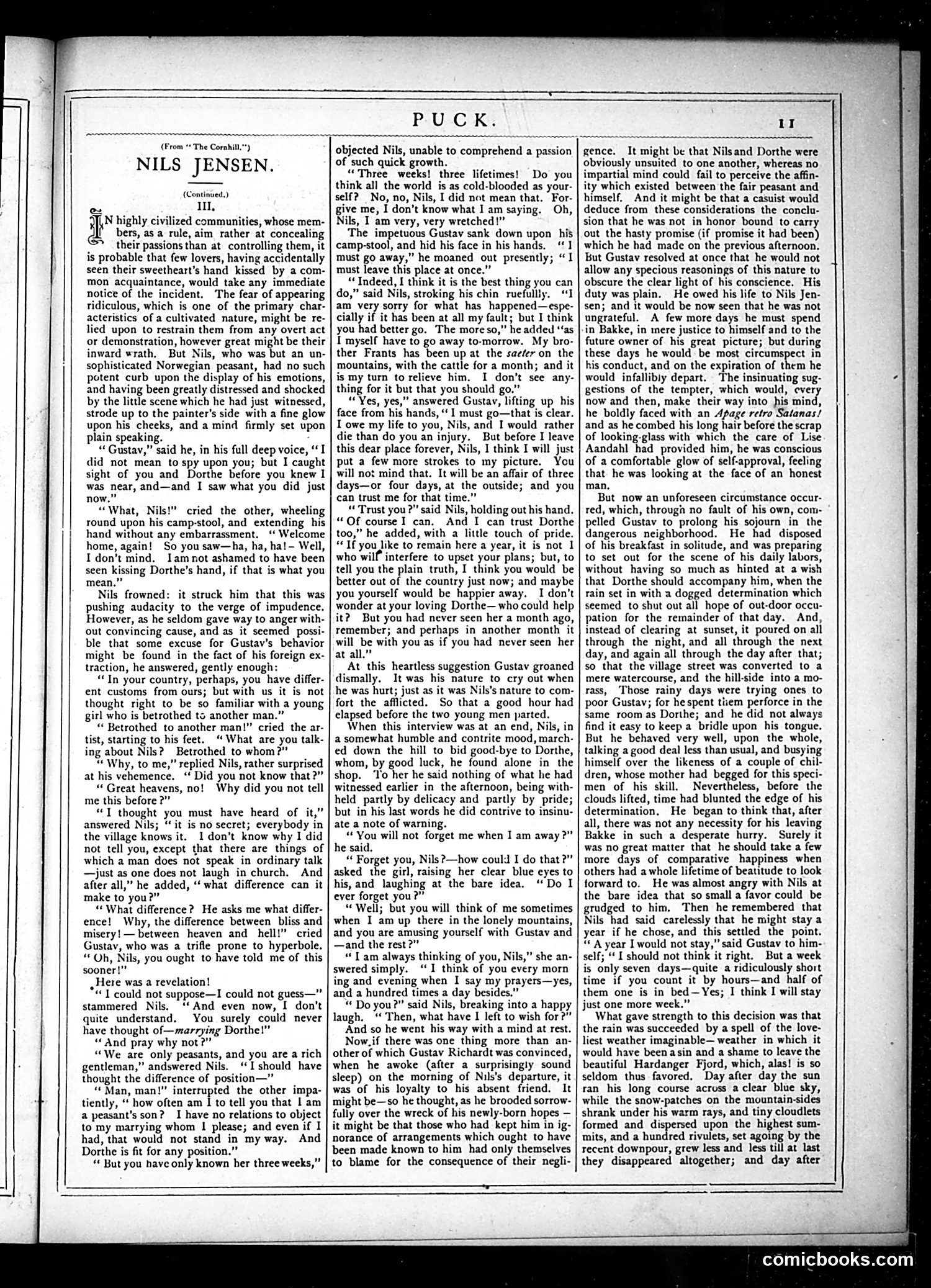
(Continied,) ML, a highly civilized communities, whose mem- bers, as a rule, aim rather at concealing their passions than at controlling them, it is probable that few lovers, having accidentally seen their sweetheart’s hand kissed by a com- mon acquaintance, would take any immediate notice of the incident, The fear of appearing ridiculous, which is one of the primary char- acteristics of a cultivated nature, might be re- lied upon to restrain them from any overt act or demonstration, however great might be their inward wrath, But Nils, who was but an un- sophisticated Norwegian peasant, had no such potent curb upon the display of his emotions, and having been greatly distressed and shocked by the little scene which he had just witnessed, strode up to the painter's side with a fine glow upon his cheeks, and a mind firmly set upon plain speaking. “ Gustav,” said he, in his full deep voice, “I did not mean to spy upon you; but I caught sight of you and Dorthe before you knew I was near, and—and I saw what you did just now.” “What, !" cried the other, wheeling round upon his camp-stool, and extending his hand without any embarrassment. ‘“ Welcome home, again! So you saw—ha, ha, ha!- Well, I don't mind. Iam not ashamed to have been seen kissing Dorthe’s hand, if that is what you mean.” Nils frowned: it struck him that this was pushing audacity to the verge of impudence. However, as he seldom gave way to anger with- out convincing cause, and as it seemed possi- ble that some excuse for Gustav’s behavior might be found in the fact of his foreign ex- traction, he answered, gently enough: “In your country, perhaps, you have differ- ent customs from ours; but with us it is not thought right to be so familiar with a young girl who is betrothed ts another man." “ Betrothed to another man!” cried the ar- tist, starting to his feet. ‘What are you talk- ing about Nils? Betrothed to whom?” “Why, to me,” replied Nils, rather surprised at his vehemence. ‘ Did you not know that?” “Great heavens, no! Why did you not tell me this before ?”” “T thought you must have heard of it,” answered Nils; “ it is no secret; everybody in the village knows it. I don’t know why I did not tell you, except that there are things of which a man does not speak in ordinary talk —just as one does not laugh in church. And after all,” he added, ‘what difference can it make to you?” ‘What difference? He asks me what differ- ence! Why, the difference between bliss and misery! — between heaven and hell!” cried Gustav, who was a trifle prone to hyperbole. “Oh, Nils, you ought to have told me of this sooner!"" Here was a revelation! “I could not suppose—I could not guess—"”” stammered Nils. ‘¢ And even now, I don’t quite understand. You surely could never have thought of—marrying Dorthe!” “And pray why not?” “We are only peasants, and you are a rich gentleman,” andswered Nils. ‘I should have thought the difference of position—” “« Man, man!” interrupted the other impa- tiently, “ how often am I to tell you that | am a peasant’s son? I have no relations to object to my marrying whom I please; and even if I had, that would not stand in my way. And Dorthe is fit for any position.” “ But you have only known her three weeks,” PUCK. objected Nils, unable to comprehend a passion of such quick growth. “Three weeks! three lifetimes! Do you think all the world is as cold-blooded as your- self? No, no, Nils, I did not mean that. For- give me, I don’t know what I am saying. Oh, Nils, I am very, very wretched!” The impetuous Gustav sank down upon his camp-stool, and hid his face in his hands. ‘1 must go away,” he moaned out presently; “I must leave this place at once.” “Indeed, I think it is the best thing you can do,” said Nils, stroking his chin ruefully. “I am very sorry for what has happened—espe- cially if it has been at all my fault; but I think you had better go. The more so,” he added “‘as I myself have to go away to-morrow. My bro- ther Frants has been up at the sae/er on the mountains, with the cattle for a month; and it is my turn to relieve him. I don’t see any- thing for it but that you should go.” “Yes, yes,” answered Gustay, lifting up his face from his hands, ‘1 must go—that is clear. I owe my life to you, Nils, and I would rather die than do you an injury. But before I leave this dear place forever, Nils, I think I will just put a few more strokes to my picture. You will not mind that. It will be an affair of three days—or four days, at the outside; and you can trust me for that time.” “Trust you?” said Nils, holding out his hand. “Of course I can. And I can trust Dorthe too,” he added, with a little touch of pride. “If you like to remain here a year, it is not 1 who wilf interfere to upset your plans; but, to tell you the plain truth, I think you would be better out of the country just now; and maybe you yourself would be happier away. I don’t wonder at your loving Dorthe— who could help it? But you had never seen her a month ago, remember; and perhaps in another month it will be with you as if you had never seen her at all.” At this heartless suggestion Gustav groaned dismally. It was his nature to cry out when he was hurt; just as it was Nils's nature to com- fort the afflicted. So that a good hour had elapsed before the two young men parted. When this interview was at an end, Nils, in a somewhat humble and contrite mood, march- ed down the hill to bid good-bye to Dorthe, whom, by good luck, he found alone in the shop. ‘To her he said nothing of what he had witnessed earlier in the afternoon, being with- held partly by delicacy and partly by pride; but in his last words he did contrive to insinu- ate a note of warning. “You will not forget me when I am away ?” he said. “Forget you, Nils?—how could I do that?” asked the girl, raising her clear blue eyes to his, and laughing at the bare idea. “Do I ever forget you?” “Well; but you will think of me sometimes when I am up there in the lonely mountains, and you are amusing yourself with Gustav and —and the rest?” “Tam always thinking of you, Nils,” she an- swered simply. ‘1 think of you every morn ing and evening when I say my prayers—yes, and a hundred times a day besides.” “ Do you?” said Nils, breaking into a happy laugh. ‘“ Then, what have I left to wish for?” And so he went his way with a mind at rest. Now.if there was one thing more than an- other of which Gustav Richardt was convinced, when he awoke (after a surprisingly sound sleep) on the morning of Nils's departure, it was of his loyalty to his absent friend. It might be—so he thought, as he brooded sorrow- fully over the wreck of his newly-born hopes — it might be that those who had kept him in ig- norance of arrangements which ought to have been made known to him had only themselves to blame for the consequence of their negli- gence. It might be that Nilsand Dorthe were obviously unsuited to one another, whereas no impartial mind could fail to perceive the affin- ity which existed between the fair peasant and himself, And it might be that a casuist would deduce from these considerations the conclu- sion that he was not in honor bound to carry out the hasty promise (if promise it had been) which he had made on the previous afternoon, But Gustav resolved at once that he would not allow any specious reasonings of this nature tu obscure the clear light of his conscience. His duty was plain. He owed his life to Nils Jen- sen; and it would be now seen that he was not ungrateful. A few more days he must spend in Bakke, in mere justice to himself and to the future owner of his great picture; but during these days he would be most circumspect in his conduct, and on the expiration of them he would infallibly depart. ‘The insinuating sug- gestions of the tempter, which would, ever} now and then, make their way into his iBiad. he boldly faced with an Apage retro Satanas! and as he combed his long hair before the scrap of looking-glass with which the care of Lise Aandahl had provided him, he was conscious of a comfortable glow of self-approval, feeling that he was looking at the face of an honest man, But now an unforeseen circumstance occur- red, which, through no fault of his own, com- pelled Gustav to prolong his sojourn in the dangerous neighborhood. He had disposed of his breakfast in solitude, and was preparing to set out for the scene of his daily labors, without having so much as hinted at a wish that Dorthe should accompany him, when the rain set in with a dogged determination which seemed to shut out all hope of out-door occu- pation for the remainder of that day. And, instead of clearing at sunset, it poured on all through the night, and all through the next day, and again all through the day after that; so that the village street was converted to a mere watercourse, and the hill-side into a mo- rass, Those rainy days were trying ones to poor Gustav; for he spent tiem perforce in the same room as Dorthe; and he did not always find it easy to keep a bridle upon his tongue. But he behaved very well, upon the whole, talking a good deal less than usual, and busying himself over the likeness of a couple of chil- dren, whose mother had begged for this speci- men of his skill. Nevertheless, before the clouds lifted, time had blunted the edge of his determination, He began to think that, after all, there was not any necessity for his leaving Bakke in such a desperate hurry. Surely it was no great matter that he should take a few more days of comparative happiness when others had a whole lifetime of beatitude to look forward to. He was almost angry with Nils at the bare idea that so small a favor could be grudged to him. Then he remembered that Nils had said carelessly that he might stay a year if he chose, and this settled the point. “ A year I would not stay,"’said Gustav to him- self; “I should not think it right. But a week is only seven days—quite a ridiculously short time if you count it by hours—and half of them one is in bed—Yes; I think I will stay just one more week.” What gave strength to this decision was that the rain was succeeded by a spell of the love- liest weather imaginable— weather in which it would have been asin and a shame to leave the beautiful Hardanger Fjord, which, alas! is so seldom thus favored. Day after day the sun ran his long course across a clear blue sky, while the snow-patches on the mountain-sides shrank under his warm rays, and tiny cloudlets formed and dispersed upon the highest sum- mits, and a hundred rivulets, set agoing by the recent downpour, grew less and less till at last they disappeared altogether; and day after —w. PE TM comicbo: oks.com