
Puck, 1878-07-24 · page 10 of 16
Puck — July 24, 1878 — page 10: what you’re looking at
What you’re looking at
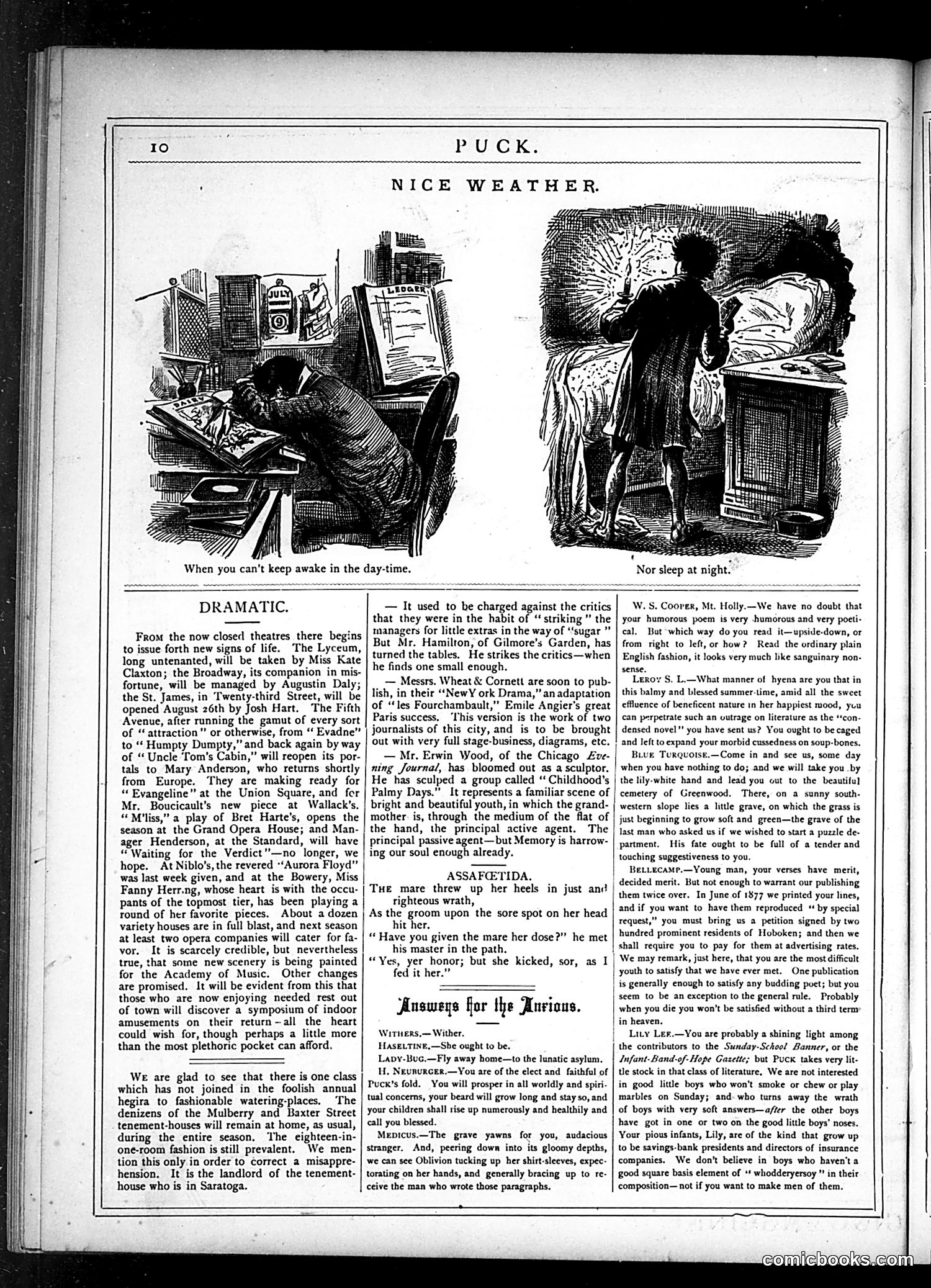
This page contains two satirical illustrations under the heading "Nice Weather," contrasting indoor and outdoor activities during pleasant conditions. The left cartoon shows a man hunched at a desk, captioned "When you can't keep awake in the day-time," satirizing office workers forced indoors during good weather. The right cartoon depicts a figure at a window at night, captioned "Nor sleep at night," suggesting insomnia or restlessness when weather keeps one awake. The satire targets the irony of weather's effects on human productivity and sleep—people struggle to work when it's nice outside, yet can't rest when pleasant conditions persist. This reflects broader turn-of-the-century complaints about modern urban life's disconnect from natural rhythms, a common Puck theme.
📄 Transcribed text from this page (OCR, searchable)
Machine-transcribed from the original scan — historical spelling and the odd misread are preserved.
PUCK. When you can’t keep awake in the day-time. NICE WEATHER. Nor sleep at night. DRAMATIC. From the now closed theatres there begins to issue forth new signs of life. The Lyceum, long untenanted, will be taken by Miss Kate Claxton; the Broadway, its companion in mis- fortune, will be managed by Augustin Daly; the St. James, in Twenty-third Street, will be opened August 26th by Josh Hart. The Fifth Avenue, after running the gamut of every sort of “attraction” or otherwise, from ‘ Evadne” to “ Humpty Dumpty,” and back again by way of “ Uncle Tom's Cabin,” will reopen its por- tals to Mary Anderson, who returns shortly from Europe. They are making ready for “ Evangeline” at the Union Square, and fer Mr. Boucicault’s new piece at Wallack's. “M'liss,” a play of Bret Harte’s, opens the season at the Grand Opera House; and Man- ager Henderson, at the Standard, will have “Waiting for the Verdict—no longer, we hope. At Niblo’s, the revered “‘Aurora Floyd” was last week given, and at the Bowery, Miss Fanny Herr.ng, whose heart is with the occu- pants of the topmost tier, has been playing a round of her favorite pieces. About a dozen variety houses are in full blast, and next season at least two opera companies will cater for fa- vor. It is scarcely credible, but nevertheless true, that some new scenery is being painted for the Academy of Music. Other changes are promised. It will be evident from this that those who are now enjoying needed rest out of town will discover a symposium of indoor amusements on their return -all the heart could wish for, though perhaps a little more than the most plethoric pocket can afford. We are glad to see that there is one class which has not joined in the foolish annual hegira to fashionable watering-places. ‘The denizens of the Mulberry and Baxter Street tenement-houses will remain at home, as usual, during the entire season, ‘The eighteen-in- one-room fashion is still prevalent. We men- tion this only in order to Correct a misappre- hension. It is the landlord of the tenement- house who is in Saratoga. — It used to be charged against the critics that they were in the habit of “ striking " the managers for little extras in the way of ‘sugar ” But Mr. Hamilton, of Gilmore’s Garden, has turned the tables. He strikes the critics—when he finds one small enough. — Messrs. Wheat & Cornett are soon to pub- lish, in their ““NewY ork Drama,” an adaptation of ‘les Fourchambault,” Emile Angier's great Paris success, ‘his version is the work of two journalists of this city, and is to be brought out with very full stage-business, diagrams, etc. — Mr. Erwin Wood, of the Chicago £ve- ning Journal, has bloomed out as a sculptor. He has sculped a group called “Childhood's | Palmy Days.” It represents a familiar scene of bright and beautiful youth, in which the grand- mother. is, through the medium of the flat of the hand, the principal active agent. The principal passive agent—but Memory is harrow- ing our soul enough already. ASSAFCETIDA, Tue mare threw up her heels in righteous wrath, As the groom upon the sore spot on her head hit her. “ Have you given the mare her dose?” he met his master in the path. | just and | “Yes, yer honor; but she kicked, sor, as 1 | fed it her.”” | Answeys for the Anrious. Witners,— Wither. | HasELTINE.—She ought to be. Lapy-Buc.—Fly away home—to the lunatic asylum. H, NeuRURGER.—You are of the elect and faithful of Puck’s fold. You will prosper in all worldly and spiri- tual concerns, your beard will grow long and stay so, and your children shall rise up numerously and healthily and call you blessed. Mepicus.—The grave yawns for you, audacious stranger. And, peering down into its gloomy depths, we can see Oblivion tucking up her shirt-sleeves, expec- torating on her hands, and generally bracing up to re- ceive the man who wrote those paragraphs. W. S. Coorer, Mt, Holly.—We have no doubt that your humorous poem is very humorous and very poeti- cal. But which way do you read it—upside-down, or from right to left, or how? Read the ordinary plain English fashion, it looks very much like sanguinary non- sense. Leroy S, L.—What manner of hyena are you that in this balmy and blessed summer-time, amid all the sweet effluence of beneficent nature in her happiest mood, you can perpetrate such an outrage on literature as the “‘con- densed novel” you have sent us? You ought to be caged and left to expand your morbid cussedness on soup-bones. Bue Turquotst.—Come in and sce us, some day when you have nothing to do; and we will take you by the lily-white hand and lead you out to the beautiful cemetery of Greenwood. There, on a sunny south- western slope lies a litle grave, on which the grass is just beginning to grow soft and green—the grave of the last man who asked us if we wished to start a puzzle de- partment. His fate ought to be full of a tender and touching suggestiveness to you. BewLecame.—Young man, your verses have merit, decided merit. But not enough to warrant our publishing them twice over. In June of 1877 we printed your lines, and if you want to have them reproduced “ by special request,” you must bring us a petition signed by two hundred prominent residents of Hoboken; and then we shall require you to pay for them at advertising rates. | We may remark, just here, that you are the most difficult youth to satisfy that we have ever met. One publication | is generally enough to satisfy any budding poet; but you seem to be an exception to the general rule. Probably when you die you won't be satisfied without a third term in heaven. Lity Le.—You are probably a shining light among the contributors to the Sunday-School Banner, ot the Infant-Band-of-Hope Gazette; but Puck takes very lit- Ue stock in that class of literature, We are not interested in good little boys who won't smoke or chew or play marbles on Sunday; and- who turns away the wrath of boys with very soft answers—a/ter the other boys have got in one or two on the good little boys’ noses. Your pious infants, Lily, are of the kind that grow up to be savings-bank presidents and directors of insurance companies. We don’t believe in boys who haven't a good square basis element of * whodderyersoy "in their composition—not if you want to make men of them. COMIEHOOKSFCOM